
If you are planning a large garage, one of the first questions you will ask is: how many square feet is a 4 car garage?
The answer depends on layout, vehicle size, and extra space needs, but in general:
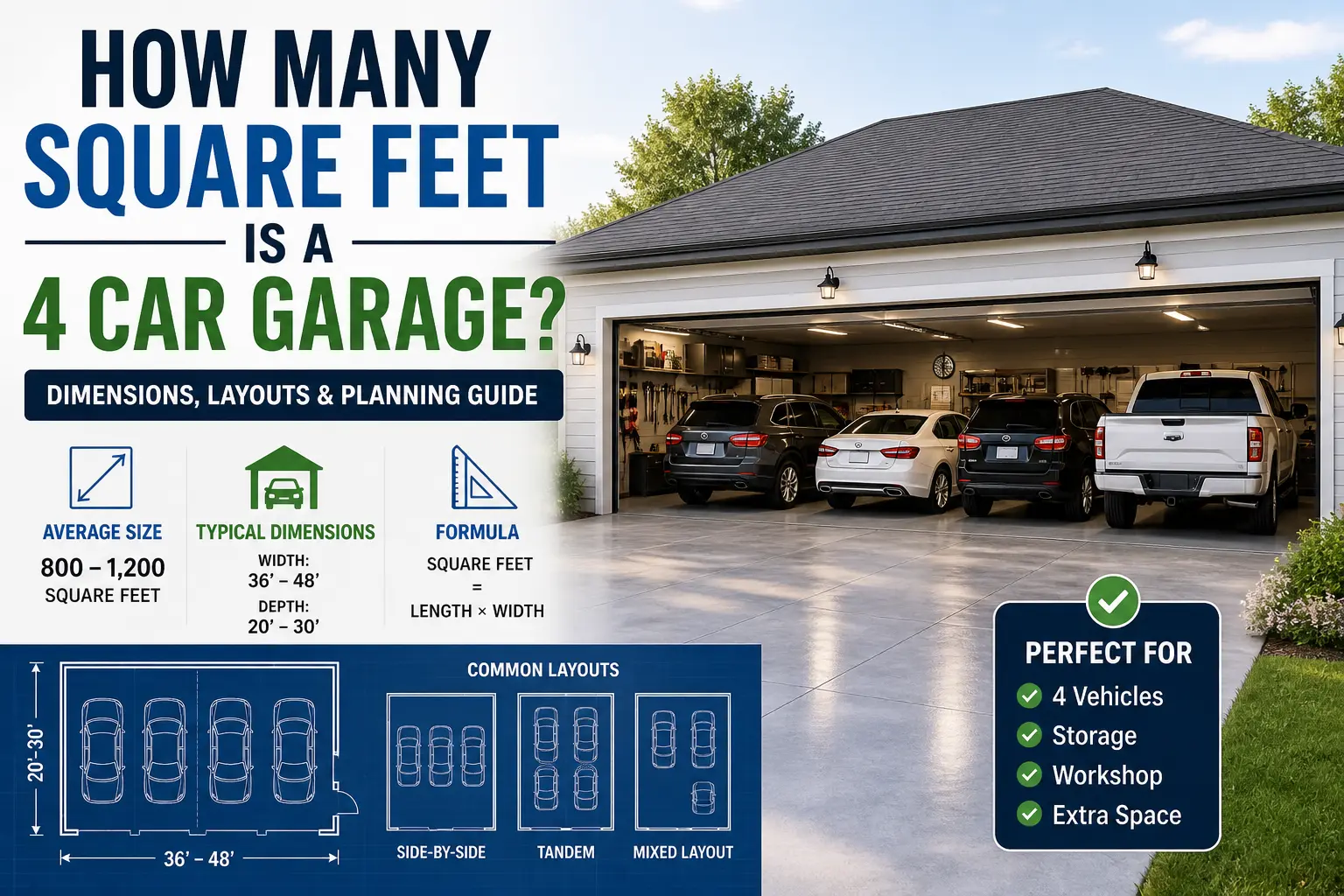
A standard 4 car garage typically ranges between 800 and 1,200 square feet.
However, this is only a starting point. The actual size can vary significantly based on how you plan to use the space. Some garages are built just for parking, while others include storage, workshops, or even living areas.
In this complete guide, you will learn:
- Standard dimensions of a 4 car garage
- Different layout options
- How to calculate square footage
- Space requirements per vehicle
- Expert planning tips
This will help you design a garage that fits your needs perfectly.
Discover More articles How Many Cubic Feet Are in a Square Foot?
Quick Answer: Average Size of a 4 Car Garage
A typical 4 car garage usually falls within this range:
- Width: 36 to 48 feet
- Depth: 20 to 30 feet
- Total Area: 800 to 1,200 square feet
For example:
- 40 ft × 24 ft = 960 square feet
- 48 ft × 25 ft = 1,200 square feet
These sizes allow enough room for four standard vehicles with moderate spacing.
Standard Dimensions of a 4 Car Garage
Typical Width
Width is the most important factor in a 4 car garage, especially for side-by-side parking.
- Minimum width: 36 feet
- Comfortable width: 40 to 48 feet
Each car typically needs about 8 to 10 feet of width, plus extra space for opening doors.
Typical Depth
Depth determines how much space you have from front to back.
- Minimum depth: 20 feet
- Ideal depth: 22 to 26 feet
- Extra-large depth: 30 feet
Deeper garages allow room for storage, workbenches, or larger vehicles.
Ceiling Height
Height is often overlooked but very important.
- Standard height: 8 to 10 feet
- For larger vehicles or lifts: 12 to 14 feet
Higher ceilings provide better ventilation and storage options.
Square Footage Breakdown
Minimum Size
A basic 4 car garage with tight spacing:
- 36 ft × 20 ft = 720 square feet
This is functional but not very comfortable.
Average Size
Most homeowners prefer a balanced design:
- 40 ft × 24 ft = 960 square feet
This provides enough room for parking and limited storage.
Large or Luxury Size
For extra comfort and functionality:
- 48 ft × 30 ft = 1,440 square feet
This size allows for:
- Workspaces
- Storage cabinets
- Larger vehicles
Layout Options for a 4 Car Garage
Side-by-Side Layout
All four cars are parked next to each other.
Advantages:
- Easy access to each vehicle
- No need to move cars
- Best for daily use
Disadvantages:
- Requires more width
Tandem Layout
Cars are parked in two rows, one behind the other.
Advantages:
- Requires less width
- Fits on narrow lots
Disadvantages:
- Cars may block each other
Mixed Layout
A combination of side-by-side and tandem.
Advantages:
- Flexible design
- Balanced space usage
Disadvantages:
- More complex planning
How to Calculate Square Feet for a Garage
Calculating square footage is simple:
Square Feet = Length × Width
Example:
- Length = 24 feet
- Width = 40 feet
24 × 40 = 960 square feet
This method works for any garage size.
Space Requirements Per Vehicle
Each car requires a certain amount of space for comfort and usability.
Typical space per vehicle:
- Width: 8 to 10 feet
- Length: 18 to 20 feet
So for four cars:
- Minimum area per car: about 160–200 square feet
Total minimum:
- 4 × 200 = 800 square feet
This aligns with standard garage sizes.
Additional Space Considerations
Storage
Many homeowners use garages for more than parking.
You may need space for:
- Tools
- Shelves
- Seasonal items
Adding 100 to 300 extra square feet can make a big difference.
Workshop Area
If you plan to work in your garage:
- Add 150 to 400 square feet
- Include proper lighting and ventilation
Door Clearance
Garage doors need space to open fully.
Also consider:
- Walking space around vehicles
- Space for opening car doors
Comparison Table: Garage Sizes
| Garage Type | Typical Size (sq ft) | Cars |
|---|---|---|
| 1 Car | 200–300 | 1 |
| 2 Car | 400–600 | 2 |
| 3 Car | 600–900 | 3 |
| 4 Car | 800–1,200+ | 4 |
This table helps you compare options based on your needs.
Common Mistakes When Planning Garage Size
Underestimating Space
Many people build too small and regret it later.
Ignoring Storage Needs
A garage is often used for more than parking.
Not Considering Vehicle Size
Large vehicles like SUVs need more space.
Poor Layout Planning
A bad layout can make even a large garage feel cramped.
Forgetting Future Needs
Always plan for future vehicles or storage.
Expert Tips for Designing a 4 Car Garage
- Choose at least 40 feet width for comfort
- Add extra depth for flexibility
- Plan storage from the beginning
- Consider ceiling height for future upgrades
- Use durable flooring materials
- Ensure proper lighting and ventilation
Conclusion
So, how many square feet is a 4 car garage?
Most standard designs fall between 800 and 1,200 square feet, but the ideal size depends on your needs, layout, and available space.
If you want comfort, storage, and flexibility, consider going larger than the minimum. A well-designed garage is not just a parking area; it is a valuable extension of your home.
By understanding dimensions, layouts, and practical requirements, you can plan a 4 car garage that is functional, spacious, and future-proof.
FAQs
The average size ranges between 800 and 1,200 square feet.
The minimum is around 720 to 800 square feet, but it will feel tight.
Typically between 36 and 48 feet, depending on spacing
Yes, using a tandem layout, but it may reduce convenience.
Each car needs about 160 to 200 square feet for comfortable use.