

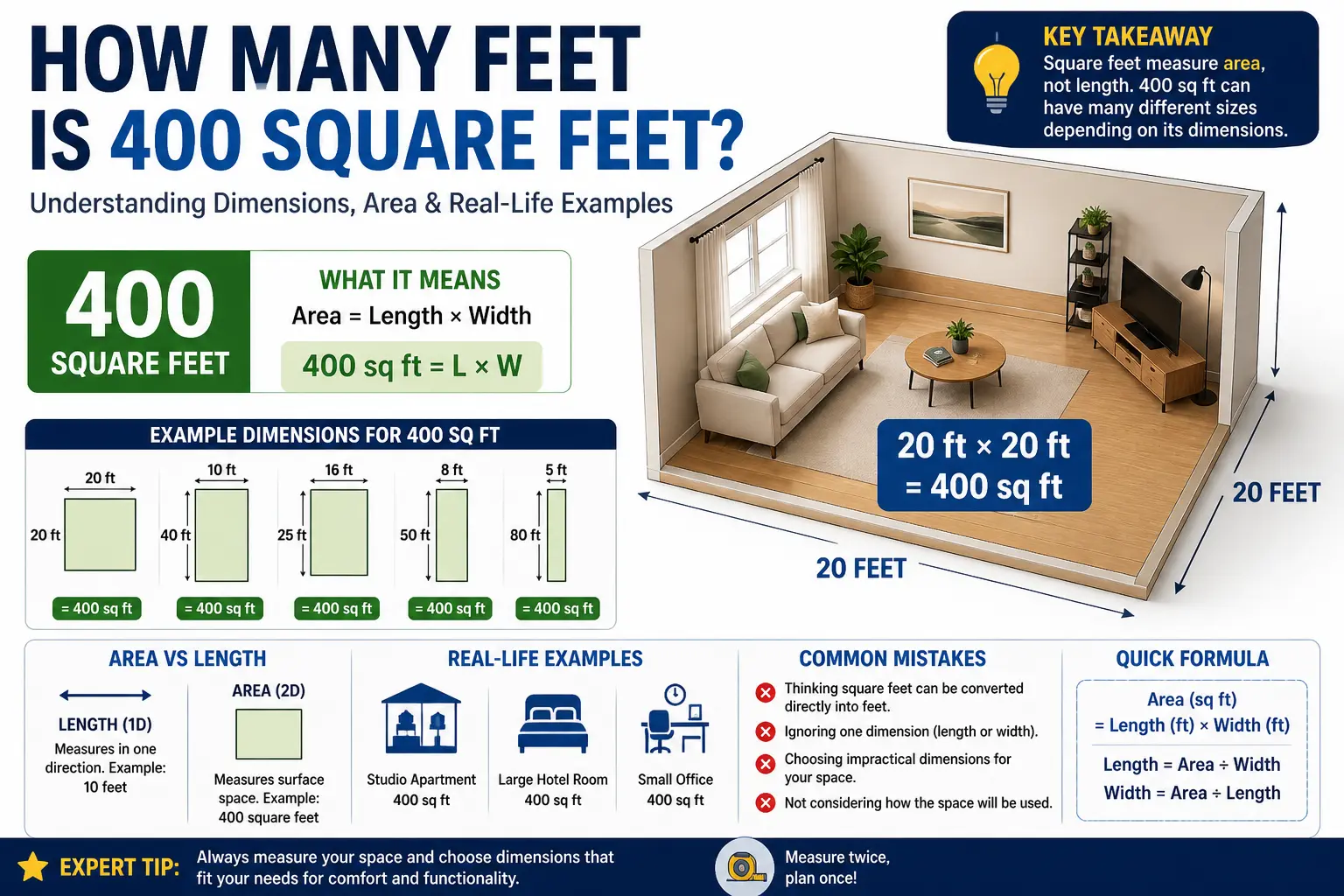
If you are trying to understand how many feet is 400 square feet, you are asking a very common but slightly misunderstood question. Many people assume that square feet can be converted into feet directly, but this is not correct. Square feet measure area, while feet measure length. These are two different types of measurements, and because of that, there is no single number that answers this question. Instead, 400 square feet represents a total area that can take many different shapes depending on the length and width of the space.
To make this simple, think of 400 square feet as a flat surface. That surface could be shaped in many ways. For example, it could be a square room that is 20 feet by 20 feet, or it could be a long narrow space that is 10 feet by 40 feet. Both of these layouts equal 400 square feet, but the lengths are completely different. This is why the question does not have one fixed answer and must always be understood using dimensions.
Understanding this concept is important for many real-life situations. Whether you are planning a room, renting an apartment, designing an office, or working on a construction project, knowing how to break down square feet into actual dimensions will help you make better decisions. In this guide, you will learn how to calculate, visualize, and use 400 square feet effectively.
Discover more articles
How Many Square Feet Is a 4 Car Garage?
How Many Cubic Feet Are in a Square Foot?
Quick Answer and Explanation
The most direct explanation is that 400 square feet is not equal to a single length in feet. Instead, it is the result of multiplying two dimensions together. These dimensions are length and width. Some common examples of 400 square feet include 20 feet by 20 feet, 16 feet by 25 feet, and 10 feet by 40 feet. Each of these combinations produces the same total area, but the shape and layout of the space are different.
So, instead of asking how many feet 400 square feet is, the better way to think about it is to ask what combinations of length and width make up 400 square feet. Once you understand this, the concept becomes much clearer and easier to apply in real situations.
Understanding the Difference Between Feet and Square Feet
What Is a Foot
A foot is a unit used to measure length. It measures distance in a straight line. For example, if you measure the height of a door or the length of a table, you are using feet. This is a one-dimensional measurement because it only considers one direction.
What Is a Square Foot
A square foot is a unit used to measure area. It represents a surface that is one foot long and one foot wide. This makes it a two-dimensional measurement because it includes both length and width. When you measure a room or a floor, you are calculating square feet.
Why They Cannot Be Directly Converted
The reason you cannot convert square feet into feet directly is because they measure different dimensions. Feet measure only one direction, while square feet measure two directions at the same time. To convert square feet into feet, you must know at least one side of the space. Without that information, the calculation cannot be completed.
Why 400 Square Feet Cannot Be Converted Into Feet
To understand why there is no direct conversion, imagine you are given only the total area of a space. If you do not know the length or width, there are endless possibilities for how that space could be shaped. For example, if one side is 20 feet, the other side must also be 20 feet to make 400 square feet. But if one side is 10 feet, the other side must be 40 feet.
This shows that the answer changes depending on the dimensions. That is why the question does not have a single numerical answer. Instead, it depends on how the space is arranged.
Conversion Table and Dimension Options
| Shape Type | Dimensions (ft) | Description |
|---|---|---|
| Square | 20 × 20 | Balanced space |
| Wide | 25 × 16 | Slightly rectangular |
| Narrow | 10 × 40 | Long layout |
| Extended | 8 × 50 | Very narrow |
This table helps you visualize different possibilities.
How to Calculate Dimensions of 400 Square Feet
Formula Explained
The formula for calculating area is simple. Area equals length multiplied by width. This means that if you know the area and one dimension, you can find the other dimension by dividing the area by the known side.
Step-by-Step Method
First, decide one side of the space. For example, choose a width of 20 feet. Then divide the total area by that number. So 400 divided by 20 equals 20. This means the length is also 20 feet. Now you have a complete set of dimensions. You can repeat this process with different numbers to create different layouts.
Common Dimension Combinations for 400 Square Feet
There are many possible combinations of length and width that equal 400 square feet. Some of the most common include 20 by 20 feet, which creates a perfect square layout. Another common option is 16 by 25 feet, which creates a slightly rectangular space that is often used for living rooms or offices. A long and narrow option is 10 by 40 feet, which works well for hallways or studio apartments. You can also have extreme layouts like 5 by 80 feet, but these are less practical for most uses.
Each of these combinations has its own advantages and disadvantages. Square layouts are balanced and easy to design, while rectangular layouts can be more flexible depending on the use of the space.
Common Dimension Examples
Here are some possible combinations for 400 square feet:
| Length (ft) | Width (ft) | Area (sq ft) |
|---|---|---|
| 20 | 20 | 400 |
| 10 | 40 | 400 |
| 16 | 25 | 400 |
| 8 | 50 | 400 |
| 5 | 80 | 400 |
Each layout gives the same area but different shapes.
Layout Types and Their Impact on Space
The shape of a 400 square foot area has a big impact on how it feels and functions. A square layout provides equal proportions, making it easier to arrange furniture and move around. A rectangular layout can create a sense of direction and flow, which is useful for certain types of rooms. Narrow layouts can feel cramped and are usually less comfortable unless they are used for specific purposes like corridors.
Choosing the right layout depends on how you plan to use the space. For example, a square layout is ideal for a bedroom or living room, while a rectangular layout may work better for an office or studio apartment.
Real-Life Examples of 400 Square Feet
A 400 square foot apartment is typically considered a small studio. It usually includes a combined living and sleeping area, a small kitchen, and a bathroom. While compact, it can still be comfortable with proper design and furniture placement.
In terms of rooms, 400 square feet is quite large. A room of this size can easily fit a bed, sofa, table, and storage units without feeling crowded. It provides enough space for both living and working.
In office settings, 400 square feet can accommodate multiple desks and chairs. It is suitable for small teams or shared workspaces.
Visualizing 400 Square Feet in Everyday Life
To better understand this size, imagine a standard one-car garage. That is roughly the same size as 400 square feet. You can also think of it as a large hotel room or a compact apartment. Visualizing space in this way helps you understand how much room you actually have.
If you were to walk inside a 20 by 20 foot room, you would notice that it feels open and balanced. This is one of the most practical ways to imagine 400 square feet.
Comparison Table of Different Layouts
A square layout of 20 by 20 feet offers balance and flexibility. A rectangular layout of 16 by 25 feet provides a slightly elongated shape that works well for furniture arrangement. A narrow layout of 10 by 40 feet creates a long space that may be useful for specific designs. Each layout gives the same total area but feels completely different in real life.
Common Mistakes People Make
One of the biggest mistakes is thinking that square feet can be converted directly into feet. This misunderstanding leads to confusion and incorrect planning. Another mistake is ignoring the shape of the space. Even if two spaces have the same area, they can feel very different depending on their layout. Some people also forget to consider how the space will be used, which can result in impractical designs.
Expert Tips for Planning 400 Square Feet
When working with 400 square feet, always start by deciding how the space will be used. Choose dimensions that match your needs rather than focusing only on the total area. Use square or near-square layouts for better balance. Avoid extremely narrow designs unless necessary. Plan furniture placement in advance to make the most of the space. Good planning can make even a small area feel comfortable and functional.
- Always think in terms of length and width
- Use simple multiplication and division
- Sketch layouts to visualize space
- Choose dimensions based on usage
- Avoid extremely narrow layouts unless necessary
Conclusion
Understanding how many feet is 400 square feet requires a shift in thinking. Instead of looking for a single number, you need to think in terms of dimensions. Square feet measure area, not length, so they cannot be directly converted into feet. By using the formula of length multiplied by width, you can create multiple combinations that equal 400 square feet. Common examples include 20 by 20 feet, 16 by 25 feet, and 10 by 40 feet. Once you understand this concept, it becomes much easier to visualize space, plan layouts, and make informed decisions for your home or project.
FAQs
There is no exact single answer because it depends on the dimensions. It could be 20 by 20 feet or any other combination that equals 400.
It is similar to a small studio apartment or a large room.
No, you need at least one dimension to calculate the other.
Yes, it is enough for one person if the space is designed well.
A square layout such as 20 by 20 feet is usually the most practical.