

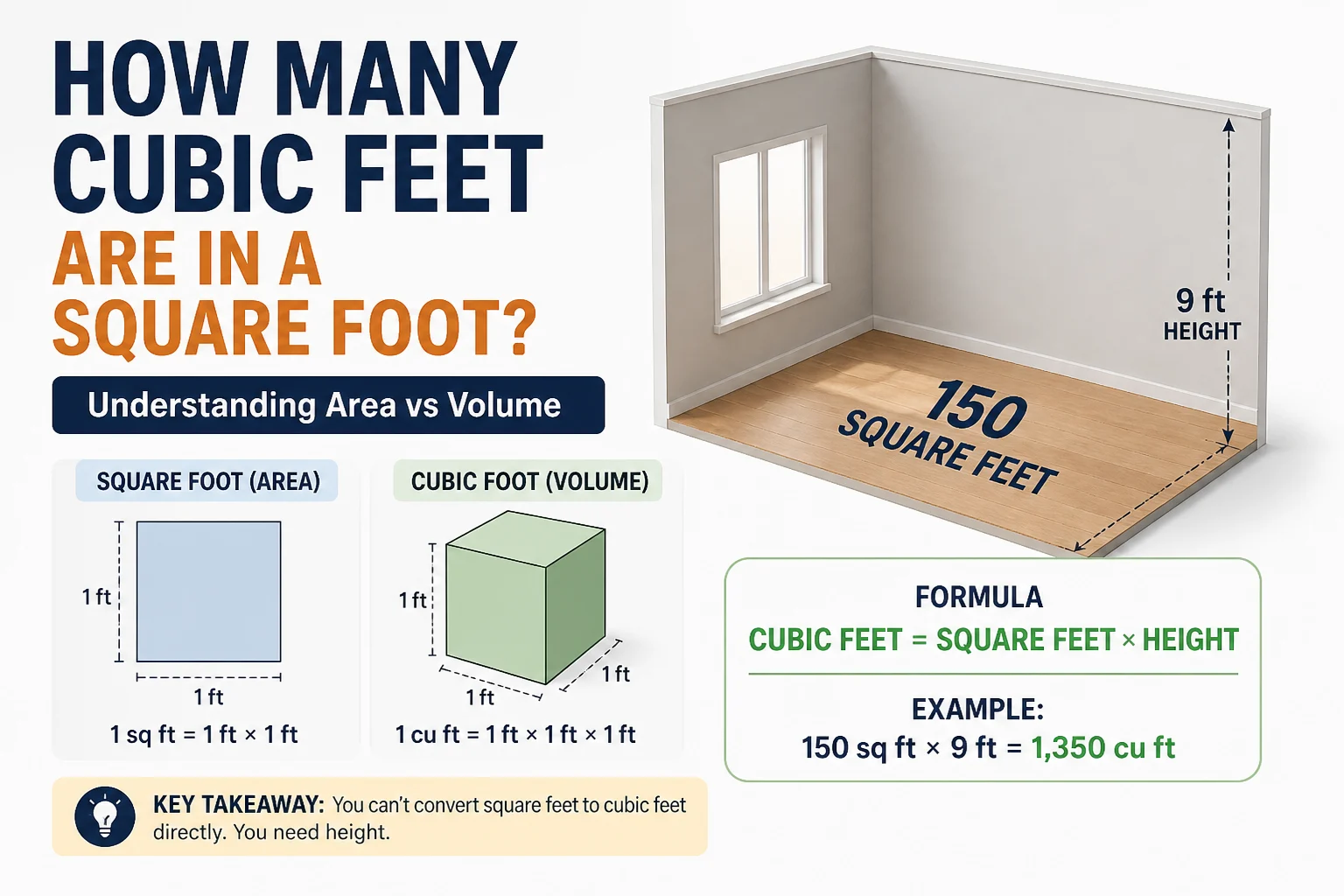
If you are wondering how many cubic feet are in a square foot, the answer is not a fixed number. This is because square feet and cubic feet measure completely different things, even though they sound similar.
Square feet measure area, while cubic feet measure volume. Because of this fundamental difference, you cannot directly convert one into the other unless you include a third dimension, which is height.
This confusion is very common, especially among homeowners, students, and people working on construction or renovation projects. Many assume there is a direct conversion, but that assumption leads to incorrect calculations.
In this detailed guide, you will clearly understand:
- The difference between square feet and cubic feet
- Why height is necessary for conversion
- The correct formula to use
- Real-life applications
- Common mistakes to avoid
By the end of this article, you will be able to confidently calculate volume from area in any situation.
Understanding the Core Concept
What Is a Square Foot?
A square foot is a unit used to measure area, which refers to a flat, two-dimensional surface. It only considers length and width.
One square foot equals:
- 1 foot in length
- 1 foot in width
So, mathematically:
Square Foot = Length × Width
This means it represents the size of a flat surface without any depth.
Square feet are widely used in everyday situations, especially when dealing with surfaces. Some common uses include:
- Measuring the size of a room or house
- Calculating flooring materials such as tiles, wood, or carpet
- Estimating wall area for painting or wallpaper
- Determining land size in real estate
For example, if a room is 10 feet long and 10 feet wide, its area is:
10 × 10 = 100 square feet
This tells you how much surface area the room covers, but it does not tell you anything about the height or space inside the room.
What Is a Cubic Foot?
A cubic foot is a unit used to measure volume, which represents three-dimensional space. It includes length, width, and height.
One cubic foot equals:
- 1 foot in length
- 1 foot in width
- 1 foot in height
So, mathematically:
Cubic Foot = Length × Width × Height
This measurement tells you how much space something can contain.
Cubic feet are commonly used in situations where capacity or storage is important. Some examples include:
- Measuring the size of a room in terms of air volume
- Determining storage capacity of boxes or containers
- Calculating refrigerator or freezer space
- Estimating material quantities like concrete or soil
For instance, a box that is 1 foot long, 1 foot wide, and 1 foot high has a volume of 1 cubic foot.
Unlike square feet, cubic feet include depth, which makes them essential for real-world applications involving space and capacity.
Key Difference Between Area and Volume
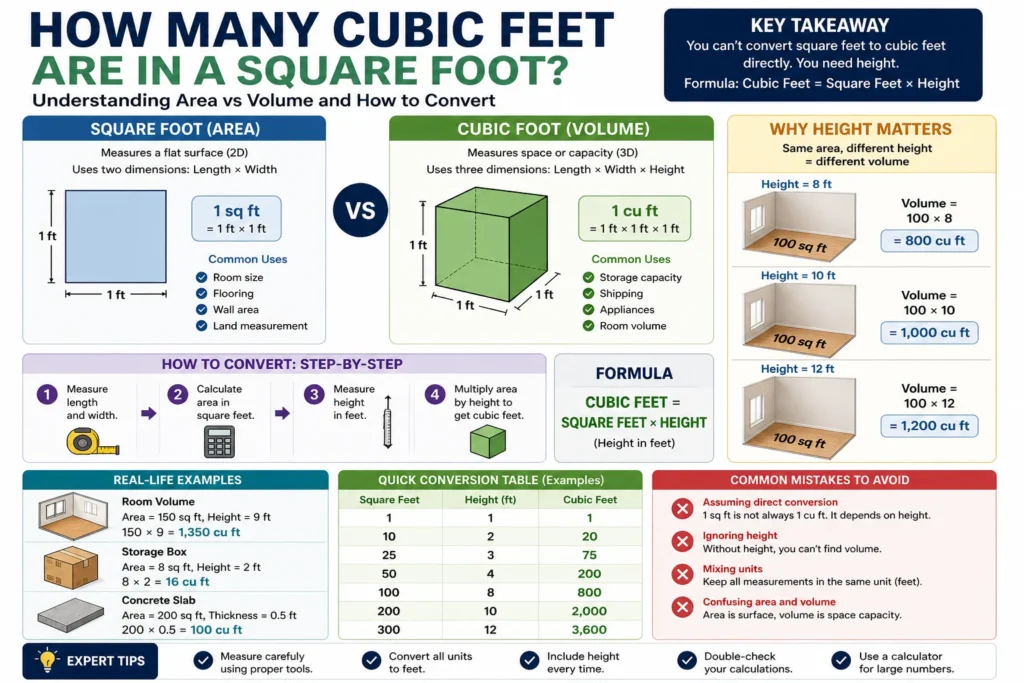
The difference between square feet and cubic feet is one of the most important concepts to understand.
| Measurement Type | Unit | Dimensions Included | Practical Meaning |
|---|---|---|---|
| Area | Square feet | Length and Width | Surface coverage |
| Volume | Cubic feet | Length, Width, Height | Space capacity |
Area is two-dimensional, while volume is three-dimensional. This is why they cannot be directly converted without additional information.
Can You Convert Square Feet to Cubic Feet Directly?
The simple answer is no. You cannot convert square feet into cubic feet without knowing the height.
Why Conversion Needs Height
To calculate volume, you must include height. Without it, the calculation is incomplete because volume requires three dimensions.
Consider this example:
- A floor area of 100 square feet
Now, if the height is:
- 8 feet, the volume becomes 800 cubic feet
- 10 feet, the volume becomes 1,000 cubic feet
The same area produces different volumes depending on the height. This clearly shows that height is essential.
The Missing Dimension Explained
Square feet only describe a flat surface. Cubic feet require depth, which comes from height.
This is why the question how many cubic feet are in a square foot cannot have a single answer. The result always depends on the height of the space.
Without height, you only know how much area something covers, not how much space it contains.
Formula to Convert Square Feet to Cubic Feet
Basic Formula
The correct formula is:
Cubic Feet = Square Feet × Height (in feet)
This formula is simple but powerful. It allows you to convert area into volume as long as you know the height.
Step-by-Step Explanation
To calculate cubic feet accurately, follow these steps:
- Measure the length and width of the space
- Multiply them to get square feet
- Measure the height of the space
- Multiply the square feet by the height
This process ensures that all three dimensions are included.
For example:
- Length = 12 feet
- Width = 10 feet
- Height = 8 feet
Step 1: Area = 12 × 10 = 120 square feet
Step 2: Volume = 120 × 8 = 960 cubic feet
This gives you the total volume of the space.
Real-Life Examples of Conversion
Room Volume
Imagine you are calculating the volume of a room for ventilation or air conditioning.
- Area = 150 square feet
- Height = 9 feet
Volume = 150 × 9 = 1,350 cubic feet
This helps determine how much air the room can hold and what size of cooling or heating system is needed.
Storage Box
Now consider a storage box.
- Base area = 8 square feet
- Height = 2 feet
Volume = 8 × 2 = 16 cubic feet
This tells you how much space is available inside the box for storing items.
Construction Use
In construction, volume calculations are essential for materials like concrete.
- Area = 200 square feet
- Thickness = 0.5 feet
Volume = 200 × 0.5 = 100 cubic feet
This helps estimate how much material is required, saving time and cost.
Quick Conversion Table
| Square Feet | Height (ft) | Cubic Feet |
|---|---|---|
| 1 | 1 | 1 |
| 10 | 2 | 20 |
| 50 | 3 | 150 |
| 100 | 8 | 800 |
| 200 | 10 | 2,000 |
This table clearly shows that cubic feet increase as height increases, even if the square feet remain the same.
Common Mistakes
Assuming Direct Conversion
Many people believe that one square foot equals one cubic foot. This is only true when the height is exactly one foot. In all other cases, this assumption leads to incorrect results.
Ignoring Height
Skipping height is the most common mistake. Without height, it is impossible to calculate volume correctly.
Mixing Units
Another frequent error is mixing units such as feet and inches. For example, using height in inches while area is in feet can produce wrong results unless converted properly.
Confusing Area and Volume
People often use square feet and cubic feet interchangeably, which is incorrect. Area measures surface, while volume measures capacity. Understanding this distinction is essential.
Practical Uses
Understanding how to convert square feet to cubic feet is useful in many real-life situations.
Square Feet Uses
Square feet are commonly used for surface-related calculations, including:
- Buying or selling property
- Measuring floor space
- Installing tiles, carpet, or wood flooring
- Painting walls or ceilings
These tasks only require two dimensions.
Cubic Feet Uses
Cubic feet are used when depth or capacity matters. Examples include:
- Storage and packaging calculations
- Determining refrigerator or freezer size
- Estimating air volume in a room
- Calculating material quantities in construction
These tasks require all three dimensions.
Real-Life Scenario
Suppose you want to install an air conditioning unit.
- Room area = 200 square feet
- Height = 8 feet
Volume = 200 × 8 = 1,600 cubic feet
This volume helps determine the correct AC capacity, ensuring efficient cooling.
Expert Tips
Measure Accurately
Always use proper tools such as measuring tapes and ensure accuracy in your measurements. Small errors can lead to large differences in volume.
Use Consistent Units
Convert all measurements into the same unit before calculating. If height is in inches, convert it into feet.
Always Include Height
Never attempt to calculate cubic feet without height. It is a necessary component.
Double-Check Calculations
Before finalizing your results, verify your calculations to avoid mistakes.
Use Digital Tools
For larger calculations, using a calculator or digital tool can improve accuracy and save time.
Conclusion
The question how many cubic feet are in a square foot does not have a fixed answer because these units measure different dimensions.
Square feet measure area, which is two-dimensional, while cubic feet measure volume, which is three-dimensional. To convert between them, height must always be included.
The most important formula to remember is:
Cubic Feet = Square Feet × Height
Once you understand this concept, you can easily calculate volume for rooms, storage spaces, and construction projects. This knowledge is practical, widely applicable, and essential for accurate measurements in everyday life.
FAQs
How many cubic feet are in one square foot?
It depends on height. If the height is 1 foot, then it equals 1 cubic foot.
Add image
Can square feet be converted to cubic feet directly?
No, height is required to calculate volume.
What is the formula for cubic feet?
Cubic Feet = Square Feet × Height
Why is height important in conversion?
Because cubic feet measure volume, which requires three dimensions.
Where are cubic feet used in daily life?
They are used in storage, shipping, appliances, and construction.