
f you are asking how many feet are in 10 acres, the most accurate answer is that 10 acres equals 435,600 square feet.
However, acres measure area, while feet measure length. This means you cannot convert 10 acres into one single number of linear feet unless you know the shape of the land.
For example, a 10-acre property could be square, long and narrow, wide and short, or irregularly shaped. Each shape can have the same total area but a different length, width, and perimeter.
That is why it is important to understand the difference between square feet and linear feet before planning a fence, buying land, building a home, or estimating landscaping costs.
This guide explains how many square feet are in 10 acres, possible 10-acre lot dimensions, fencing estimates, real-world comparisons, and simple ways to measure land accurately.
Quick Answer: How Many Feet Are in 10 Acres?
The quick answer is:
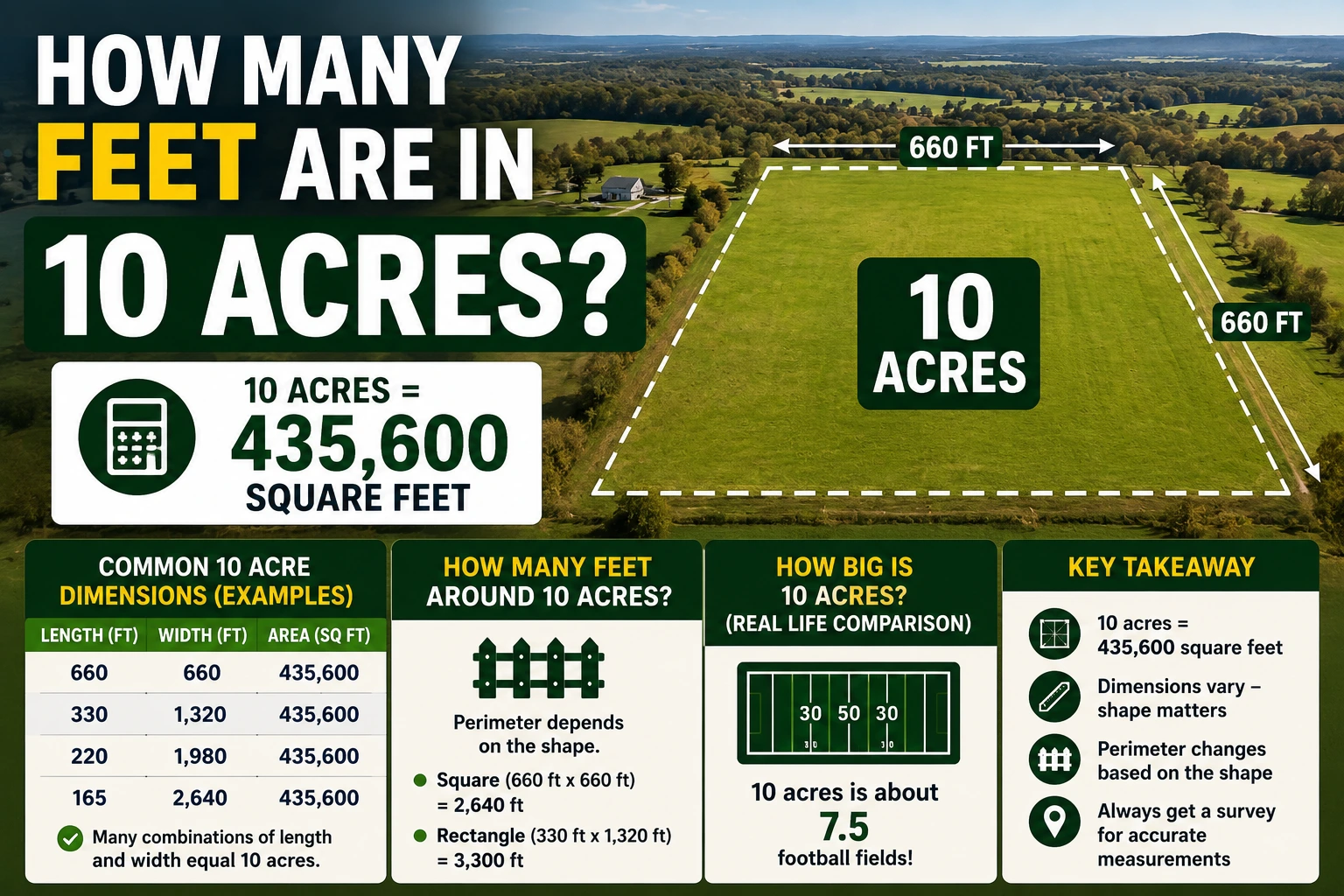
10 acres = 435,600 square feet
Here is the calculation:
1 acre = 43,560 square feet
10 acres × 43,560 square feet = 435,600 square feet
So, a 10-acre property covers 435,600 square feet of land area.
But remember, this is square footage, not linear footage.
If you want to know how many feet around 10 acres, you need the property’s length and width. A square 10-acre property has a different perimeter than a long, narrow 10-acre property.
How Many Square Feet Are in 10 Acres?
When people search for how many feet are in 10 acres, they usually mean square feet.
The Acre-to-Square-Foot Formula
Use this formula:
Acres × 43,560 = Square Feet
Since one acre always contains 43,560 square feet, converting acreage is straightforward.
Calculating 10 Acres in Square Feet
To calculate 10 acres:
10 × 43,560 = 435,600 square feet
That means:
| Acres | Square Feet |
|---|---|
| 1 acre | 43,560 sq ft |
| 2 acres | 87,120 sq ft |
| 5 acres | 217,800 sq ft |
| 10 acres | 435,600 sq ft |
| 20 acres | 871,200 sq ft |
A 10-acre lot is a large piece of land for most residential uses. It can provide room for a home, driveway, garden, workshop, barn, storage area, animals, trees, and open space.
Why You Cannot Convert 10 Acres Directly Into Feet
Acres are units of area. Feet are units of length.
Think of it this way:
- A foot measures one straight line.
- A square foot measures a flat area.
- An acre measures a large land area.
Because 10 acres can have many different shapes, there is no single answer for its length or perimeter.
For example, both of these properties equal 10 acres:
- A square property that is about 660 feet by 660 feet
- A rectangular property that is 330 feet by 1,320 feet
Both cover the same area, but they have different boundaries.
This matters when you need to estimate:
- Fence materials
- Driveway length
- Property line distance
- Irrigation pipe length
- Landscaping costs
- Security lighting
- Walking distance around the land
What Are the Dimensions of 10 Acres in Feet?
The dimensions of a 10-acre property depend on its shape.
A Perfect Square 10-Acre Lot
A square is often the easiest shape to understand.
To find the length of each side, calculate the square root of the total area:
√435,600 = about 660 feet
So, a square 10-acre lot is approximately:
660 feet × 660 feet
This equals:
660 × 660 = 435,600 square feet
A square 10-acre property has four equal sides.
Common Rectangular 10-Acre Lot Dimensions
A 10-acre property can also be rectangular.
Here are several examples:
| Length | Width | Total Area |
| 660 feet | 660 feet | 435,600 sq ft |
| 330 feet | 1,320 feet | 435,600 sq ft |
| 440 feet | 990 feet | 435,600 sq ft |
| 220 feet | 1,980 feet | 435,600 sq ft |
| 165 feet | 2,640 feet | 435,600 sq ft |
All of these examples equal 10 acres.
The shape may depend on road access, zoning rules, nearby properties, natural features, or the original land survey.
Long and Narrow 10-Acre Property Examples
Some rural lots are long and narrow. This layout may provide road frontage while extending far back from the road.
For example:
165 feet wide × 2,640 feet long = 435,600 square feet
This is still 10 acres, but it may require much more fencing than a square lot.
Long, narrow land can be useful for:
- Roadside businesses
- Agricultural rows
- Horse paddocks
- Long driveways
- Utility access
- Hunting land
- Timber lots
However, it may be less convenient for large buildings or wide open fields.
10 Acre Lot Dimensions Chart
| Property Shape | Example Dimensions | Area |
| Square | 660 ft × 660 ft | 10 acres |
| Rectangle | 330 ft × 1,320 ft | 10 acres |
| Rectangle | 440 ft × 990 ft | 10 acres |
| Narrow rectangle | 220 ft × 1,980 ft | 10 acres |
| Very narrow rectangle | 165 ft × 2,640 ft | 10 acres |
This chart shows why acreage alone does not tell you the full story. Always check the land survey or property map before planning a project.
How Many Feet Around 10 Acres?
The number of feet around 10 acres is called the perimeter.
The perimeter depends on the property’s shape.
Perimeter of a Square 10-Acre Property
A square 10-acre property is about 660 feet on each side.
To find the perimeter:
660 + 660 + 660 + 660 = 2,640 feet
So, a square 10-acre property has a perimeter of about:
2,640 linear feet
This is useful if you are planning fencing around all four sides.
Perimeter of a Rectangular 10-Acre Property
A 330-foot by 1,320-foot rectangular lot also equals 10 acres.
To find the perimeter:
330 + 1,320 + 330 + 1,320 = 3,300 feet
So, this 10-acre property needs about:
3,300 linear feet of fencing
Even though both lots are 10 acres, the rectangular lot needs 660 more feet of fencing than the square lot.
Why Perimeter Changes by Lot Shape
A square shape has the shortest perimeter for a given area. Long and narrow shapes have longer boundaries.
This can affect your budget for:
- Fence posts
- Wire or panels
- Gates
- Labor
- Security systems
- Landscaping
- Property maintenance
Before buying land, it is smart to compare both acreage and perimeter.
How Much Fencing Do You Need for 10 Acres?
If your 10-acre property is square, you need about 2,640 linear feet of fencing.
However, most properties are not perfect squares. You may need more fencing depending on the land shape.
Here is a simple estimate:
| Lot Shape | Approximate Fence Needed |
| Square 10 acres | 2,640 feet |
| 330 ft × 1,320 ft | 3,300 feet |
| 440 ft × 990 ft | 2,860 feet |
| 220 ft × 1,980 ft | 4,400 feet |
| 165 ft × 2,640 ft | 5,610 feet |
These estimates do not include gates, corners, hills, curves, or irregular property lines.
For accurate fencing estimates, use a recent survey. Do not rely only on online maps or old property descriptions.
How Big Is 10 Acres in Real Life?
Ten acres is a substantial amount of land. It is much larger than a standard residential lot.
Sports Field Comparisons
A standard American football field, including end zones, covers about 1.32 acres.
That means 10 acres is roughly equal to:
7.5 football fields including end zones
If you compare only the main 100-yard playing field, the number may be slightly different.
Football Field Comparison
A football field is about 360 feet long including end zones and 160 feet wide.
That is around 57,600 square feet.
Since 10 acres equals 435,600 square feet:
435,600 ÷ 57,600 = about 7.56
So, 10 acres is about seven and a half full football fields.
City Block and Everyday Comparisons
The size of a city block varies widely. Still, 10 acres may be similar to several city blocks in a suburban area.
It can also be compared to:
- About 435,600 square feet
- Roughly 7.5 football fields
- Around 4 hectares
- About 0.0156 square miles
- A square area around 660 feet on each side
These comparisons can help you picture the scale before visiting the property.
Practical Uses for a 10-Acre Property
A 10-acre property offers many possibilities, depending on local zoning and land conditions.
Common uses include:
- Building a home with privacy
- Keeping horses or small livestock
- Starting a hobby farm
- Growing vegetables or fruit trees
- Creating a large garden
- Building a barn or workshop
- Installing solar panels
- Storing equipment
- Creating walking trails
- Planting trees
- Building a guest house where permitted
- Keeping recreational space
Before making plans, check local zoning rules, easements, setbacks, flood zones, utility access, and building restrictions.
How to Measure 10 Acres Accurately
Knowing the estimated size is helpful, but exact boundaries matter for legal and financial decisions.
Use a Land Survey
A professional land survey is the most reliable option. A surveyor can identify property corners, boundary lines, easements, and encroachments.
This is especially important before:
- Building a fence
- Buying land
- Constructing a house
- Installing a driveway
- Digging a pond
- Selling property
- Resolving a boundary dispute
Use Property Maps and GIS Tools
County property maps and GIS tools can give a general view of lot lines and acreage. These are useful for research but may not be precise enough for construction or fencing.
Use GPS Apps Carefully
GPS apps can help you estimate distance while walking a property. However, phone GPS can be inaccurate, especially near trees, hills, buildings, or poor signal areas.
Use GPS as a planning tool, not as a legal boundary source.
Common Mistakes When Converting Acres to Feet
Avoid these mistakes when working with land measurements.
Treating Acres as Linear Feet
Ten acres does not equal one fixed number of feet. Acres measure area, not length.
Forgetting the Difference Between Square Feet and Feet
Ten acres equals 435,600 square feet, not 435,600 linear feet.
Assuming All 10-Acre Lots Are 660 Feet by 660 Feet
That is only true for a perfectly square lot. Most real properties are irregular or rectangular.
Estimating Fence Length From Acreage Alone
You need the perimeter, not only the acreage, to estimate fencing.
Ignoring Easements and Setbacks
Part of your land may have utility easements, road rights-of-way, wetlands, or building restrictions.
Expert Tips Before Buying, Fencing, or Building on 10 Acres
Use these practical tips to make better land decisions.
- Ask for a current land survey before closing a purchase.
- Review the exact property dimensions, not only the acreage.
- Check zoning rules before planning a home, farm, or business.
- Measure the perimeter before requesting fence quotes.
- Confirm access to water, electricity, roads, and drainage.
- Check whether the land is flat, sloped, wooded, or flood-prone.
- Ask about easements and shared driveways.
- Plan for gate locations before installing fencing.
- Consider future uses before planting trees or building structures.
- Keep copies of maps, surveys, and property documents.
Frequently Asked Questions About 10 Acres
How many square feet are in 10 acres?
Ten acres equals 435,600 square feet. One acre contains 43,560 square feet, so you multiply 43,560 by 10.
How many feet around is 10 acres?
It depends on the property shape. A square 10-acre lot is about 660 feet on each side and has a perimeter of about 2,640 feet. A long, narrow 10-acre lot can have a much larger perimeter.
What are the dimensions of a 10-acre square?
A square 10-acre property is approximately 660 feet by 660 feet. This creates an area of about 435,600 square feet.
Is 10 acres enough land for a house and farm?
For many people, yes. Ten acres can provide space for a house, garden, barn, animals, storage, and open land. However, local zoning, soil quality, water access, and regulations will affect what you can do.
How many football fields is 10 acres?
Ten acres is about 7.5 American football fields when including the end zones. A standard full football field covers roughly 1.32 acres.
Conclusion: How Many Feet Are in 10 Acres?
So, how many feet are in 10 acres? The correct area conversion is 435,600 square feet.
However, there is no single linear-foot answer because 10 acres can have many shapes. A square 10-acre property is about 660 feet by 660 feet, while a rectangular or narrow property can have very different dimensions and perimeter measurements.
If you are planning a fence, driveway, home, farm, or landscaping project, always review the actual property survey. Knowing the acreage is helpful, but understanding the lot shape, boundaries, and usable land will help you make better decisions.
Discover more