

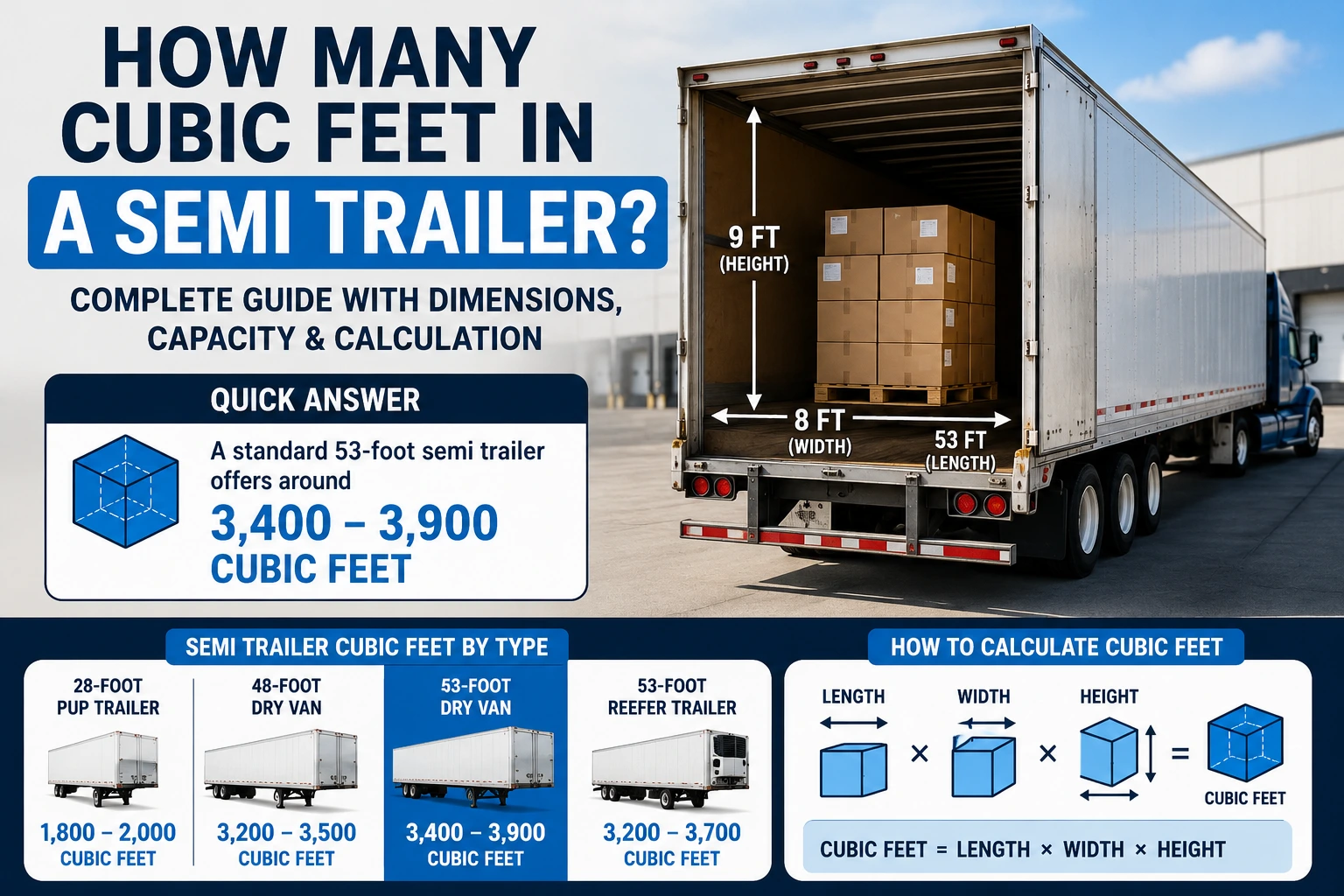
If you are asking how many cubic feet in a semi trailer, the answer depends on the trailer type, interior dimensions, and whether the trailer is a standard dry van, refrigerated unit, flatbed, or smaller pup trailer.
A standard 53-foot dry van semi trailer usually holds around 3,400 to 3,900 cubic feet of cargo space. Many common 53-foot trailers offer close to 3,800 cubic feet when measured from the inside.
However, cubic feet alone does not tell the full story. A trailer may have enough physical space for your shipment but still reach its legal weight limit before it is full. That is why freight planners look at both volume and payload weight.
This guide explains semi trailer cubic-foot capacity, common trailer sizes, how to calculate volume, pallet limits, loading examples, and practical tips for choosing the right trailer.
Quick Answer: How Many Cubic Feet in a Semi Trailer?
Most standard semi trailers hold between 2,900 and 3,900 cubic feet.
A typical 53-foot dry van trailer usually has around:
- Interior length: 52 to 53 feet
- Interior width: about 8 feet
- Interior height: 8.5 to 9 feet
- Total volume: about 3,400 to 3,900 cubic feet
A common estimate for a 53-foot trailer is:
53 feet × 8 feet × 9 feet = 3,816 cubic feet
So, if you need a quick answer, you can estimate that a standard full-size semi trailer holds about 3,800 cubic feet.
Still, always confirm the exact interior dimensions with the carrier or trailer manufacturer before booking freight.
How Many Cubic Feet in a 53-Foot Semi Trailer?
A 53-foot trailer is one of the most common trailers used in full truckload shipping across the United States and Canada. It is widely used for retail goods, furniture, packaged food, electronics, consumer products, and many other types of freight.
Typical 53-Foot Dry Van Interior Dimensions
The outside length may be 53 feet, but the usable interior space is often slightly smaller. Trailer walls, doors, insulation, flooring, and equipment take up some room.
Typical interior dimensions include:
| Measurement | Typical Range |
|---|---|
| Interior length | 52 to 53 feet |
| Interior width | 8 feet to 8.2 feet |
| Interior height | 8.5 to 9 feet |
| Door height | 8 to 9 feet |
| Door width | 7.5 to 8 feet |
| Total cubic capacity | 3,400 to 3,900 cubic feet |
The exact dimensions can vary by trailer brand and model.
53-Foot Trailer Cubic Foot Calculation
To calculate the cubic feet in a semi trailer, multiply:
Length × Width × Height
For example:
53 feet × 8 feet × 9 feet = 3,816 cubic feet
That means a 53-foot dry van can often carry close to 3,800 cubic feet of boxed freight, furniture, or palletized products.
Some trailers have a slightly lower interior roof, so their total capacity may be closer to 3,500 cubic feet. Others may have more interior height and reach nearly 4,000 cubic feet.
Semi Trailer Cubic Feet by Trailer Type
Not all semi trailers have the same amount of cargo space. Here is a simple comparison of common trailer types.
28-Foot Pup Trailer
A pup trailer is shorter than a standard semi trailer. These are often used in less-than-truckload freight networks.
Typical capacity:
- Length: 28 feet
- Width: about 8 feet
- Height: about 8.5 feet
- Cubic capacity: around 1,800 to 2,000 cubic feet
Pup trailers are useful for smaller shipments or multi-stop deliveries.
48-Foot Dry Van Trailer
A 48-foot trailer is still common in some freight operations.
Typical capacity:
- Length: 48 feet
- Width: about 8 feet
- Height: about 8.5 to 9 feet
- Cubic capacity: around 3,200 to 3,500 cubic feet
This option works well when a 53-foot trailer is not needed or cannot access a tight delivery location.
53-Foot Dry Van Trailer
A 53-foot dry van is the most common option for general freight.
Typical capacity:
- Length: 53 feet
- Width: about 8 feet
- Height: about 9 feet
- Cubic capacity: around 3,400 to 3,900 cubic feet
It is ideal for dry, boxed, palletized, or protected freight.
Refrigerated Semi Trailer
A refrigerated trailer, often called a reefer, has insulation and cooling equipment. This reduces usable interior space.
Typical capacity:
- Cubic capacity: around 3,200 to 3,700 cubic feet
- Lower usable height than some dry vans
- Less interior width due to insulation
- Designed for temperature-controlled cargo
Reefer trailers are used for food, flowers, pharmaceuticals, dairy products, frozen goods, and other temperature-sensitive shipments.
Flatbed Semi Trailer
A flatbed trailer does not have enclosed walls or a roof. Because of this, cubic feet are not usually used to measure its capacity.
Flatbeds are measured by:
- Deck length
- Deck width
- Weight capacity
- Cargo height restrictions
- Securement needs
Flatbeds are best for machinery, steel, lumber, construction materials, and oversized cargo.
Semi Trailer Capacity Chart
| Trailer Type | Typical Length | Approximate Cubic Feet | Typical Pallet Capacity |
| 28-foot pup trailer | 28 feet | 1,800–2,000 cu ft | 14 pallets |
| 48-foot dry van | 48 feet | 3,200–3,500 cu ft | 24 pallets |
| 53-foot dry van | 53 feet | 3,400–3,900 cu ft | 26 pallets |
| 53-foot reefer | 53 feet | 3,200–3,700 cu ft | 24–26 pallets |
| Flatbed trailer | 48–53 feet | Not usually measured in cubic feet | 24–26 pallets, depending on load |
This chart gives a practical estimate. Actual capacity can change based on pallet size, cargo shape, stacking rules, trailer design, and weight limits.
How to Calculate Cubic Feet in a Semi Trailer
You can calculate trailer volume yourself if you know the interior dimensions.
Step 1: Measure Interior Length
Measure the usable length from the front wall to the rear doors.
Do not assume the interior is exactly the same as the trailer’s outside length.
Step 2: Measure Interior Width
Measure the usable width between the inside walls.
A trailer may be about 8.5 feet wide on the outside but closer to 8 feet wide inside.
Step 3: Measure Interior Height
Measure from the floor to the lowest point of the roof.
For refrigerated trailers, account for insulation and cooling equipment.
Step 4: Multiply the Measurements
Use this formula:
Cubic Feet = Length × Width × Height
For example:
- Length: 52.5 feet
- Width: 8 feet
- Height: 8.5 feet
52.5 × 8 × 8.5 = 3,570 cubic feet
This means the trailer has roughly 3,570 cubic feet of usable space.
Cubic Feet vs Weight Capacity: Why Both Matter
A semi trailer can fill up by volume or by weight.
This is important because some goods are light but take up a lot of space. Other goods are heavy but compact.
For example:
| Cargo Type | Likely Limit Reached First |
| Pillows | Cubic space |
| Furniture | Cubic space |
| Plastic products | Cubic space |
| Paper rolls | Weight |
| Steel parts | Weight |
| Bottled drinks | Weight |
| Tile and stone | Weight |
A standard 53-foot dry van may carry around 43,000 to 45,000 pounds of cargo, depending on the truck, fuel level, axle setup, road regulations, and other factors.
You should never plan a shipment using cubic feet alone. Always check:
- Total shipment weight
- Number of pallets
- Pallet dimensions
- Stackability
- Product fragility
- Loading equipment
- Delivery location restrictions
How Many Pallets Fit in a Semi Trailer?
Pallet capacity is one of the most useful ways to plan freight.
Standard Pallet Capacity in a 53-Foot Trailer
A standard 53-foot dry van can usually fit:
- 26 standard 48-inch by 40-inch pallets
- Two pallets side by side across the trailer
- Thirteen rows from front to back
This assumes the pallets are loaded in a standard layout and do not need extra spacing.
Some shipments may fit fewer pallets because of:
- Oversized pallet dimensions
- Fragile products
- Non-stackable freight
- Temperature-control requirements
- Product overhang
- Special loading rules
Pallet Height and Cubic Volume
Pallet height matters because a trailer may have enough floor space but not enough vertical room.
For example, a pallet that is 48 inches by 40 inches and 60 inches tall uses about 66.7 cubic feet.
Formula:
4 feet × 3.33 feet × 5 feet = about 66.7 cubic feet
If you have 26 pallets of this size, they would use around 1,734 cubic feet. However, the empty space above them may not be usable unless the pallets can safely be double stacked.
Real-World Examples of Semi Trailer Loads
Furniture and Moving Loads
Furniture often fills a trailer before reaching the weight limit. Sofas, mattresses, chairs, cabinets, and boxed household goods are bulky but not always heavy.
A moving company may use most of the 3,800 cubic feet in a 53-foot trailer while staying far below the maximum payload.
Retail and E-Commerce Shipments
Retail products are commonly packed in cartons and loaded on pallets. A shipment of clothing, toys, household goods, or lightweight electronics may be limited by volume.
Freight planners often use cubic feet, pallet count, and carton dimensions to decide whether a shipment needs LTL service or a full truckload.
Food and Refrigerated Freight
Refrigerated loads need careful planning because airflow matters. You cannot always pack a reefer trailer as tightly as a dry van.
Frozen food, dairy products, produce, and pharmaceuticals may require spacing around the load for proper temperature control.
Heavy Equipment and Building Materials
Steel, concrete products, tile, machinery parts, and building materials may reach the legal weight limit long before the trailer is full.
In these cases, the trailer may look partly empty but still cannot legally carry more cargo.
Factors That Change Semi Trailer Cubic Foot Capacity
Several factors can reduce the usable cargo space inside a trailer.
- Interior insulation
- Refrigeration equipment
- Wheel wells
- Interior posts and rails
- Cargo bars
- Load locks
- Pallet overhang
- Packaging shape
- Non-stackable products
- Required airflow
- Door opening size
- Cargo securement needs
For this reason, the advertised cubic capacity may be higher than the practical space available for your specific load.
Common Mistakes When Estimating Trailer Space
Avoid these common errors when planning freight.
Using Exterior Trailer Dimensions
The outside of a trailer is larger than the inside. Always use interior measurements for cubic-foot calculations.
Ignoring Weight Limits
A trailer can have thousands of cubic feet available but still be too heavy to load legally.
Forgetting Pallet Height
A shipment may fit on the floor but be too tall to fit through the trailer door or under the roof.
Assuming Every Pallet Can Be Double Stacked
Double stacking can save space, but only if the product is strong, stable, and approved for stacking.
Not Allowing for Airflow or Securement
Refrigerated freight, fragile goods, and uneven loads may need open space, straps, load bars, or dunnage.
Expert Tips for Better Freight Load Planning
Use these tips to avoid surprises before booking a trailer.
- Get the exact interior trailer dimensions from the carrier.
- Measure every pallet, including stretch wrap and overhang.
- Calculate both total cubic feet and total weight.
- Ask whether your pallets can be double stacked.
- Consider door clearance, not just interior height.
- Leave room for load bars, straps, and safety equipment.
- Use a loading diagram for large or mixed shipments.
- Confirm whether the freight needs a dry van, reefer, flatbed, or specialized trailer.
- Ask about axle weight distribution for heavy freight.
- Do not rely only on a general online trailer calculator.
Frequently Asked Questions About Semi Trailer Cubic Feet
How many cubic feet are in a 53-foot semi trailer?
A typical 53-foot dry van semi trailer holds around 3,400 to 3,900 cubic feet. Many standard trailers provide close to 3,800 cubic feet of usable cargo space.
How many pallets can fit in a semi trailer?
A standard 53-foot dry van can usually fit 26 standard 48-inch by 40-inch pallets. The exact number may be lower for oversized, fragile, non-stackable, or temperature-controlled freight.
What is the maximum weight of a semi trailer?
Many 53-foot dry vans can carry roughly 43,000 to 45,000 pounds of cargo. However, the actual legal payload depends on truck weight, axle limits, fuel, road regulations, and the carrier’s equipment.
Is a 53-foot trailer always the same size inside?
No. Interior dimensions can vary by manufacturer, trailer type, insulation thickness, roof height, and equipment. Always ask the carrier for exact usable interior measurements.
How do I calculate the volume of my shipment?
Multiply the length, width, and height of each item or pallet in feet. Then add the results together. For example, a pallet measuring 4 feet by 3.33 feet by 5 feet uses about 66.7 cubic feet.
Conclusion: How Many Cubic Feet in a Semi Trailer?
So, how many cubic feet in a semi trailer? A standard 53-foot dry van usually provides around 3,400 to 3,900 cubic feet, with about 3,800 cubic feet being a practical average.
However, trailer space is only one part of freight planning. You also need to consider weight limits, pallet count, cargo height, stackability, loading rules, and the type of trailer required.
Before booking a shipment, measure your freight carefully and confirm the interior dimensions with the carrier. This helps you choose the right trailer, avoid unexpected costs, and use your shipping space more efficiently.
Discover more