
If you are planning to build a fence, one of the first questions you will ask is, “how many fence posts do I need for 100 feet?” This is an important step because the number of fence posts affects your material costs, fence strength, and overall project layout.
The answer depends mainly on the spacing between posts and the type of fence you are installing. Most residential fences place posts between 6 and 8 feet apart. In many cases, a 100-foot fence needs around 13 to 17 fence posts.
However, there is more to the calculation than simple division. Fence material, terrain, weather conditions, and gate placement all affect the final number of posts you need.
In this complete guide, you will learn how to calculate fence posts for 100 feet, understand standard spacing rules, avoid common mistakes, and build a stronger, longer-lasting fence.
Understanding Fence Post Spacing
Fence post spacing is the distance between each fence post along the fence line.
Correct spacing is extremely important because it affects:
- Fence stability
- Fence appearance
- Material costs
- Long-term durability
Improper spacing can cause sagging panels, leaning posts, and structural weakness.
Why Fence Post Spacing Matters
Fence posts support the entire structure. If posts are too far apart:
- Fence panels may bend
- Wind pressure increases
- The fence becomes unstable
If posts are too close together:
- Material costs rise unnecessarily
- Installation takes longer
- You may use more concrete and labor than needed
Proper spacing creates a balance between strength and efficiency.
Standard Fence Post Distance
Most fences use these common spacing guidelines:
| Fence Type | Standard Post Spacing |
|---|---|
| Wood fence | 6–8 feet |
| Vinyl fence | 6–8 feet |
| Chain link fence | 8–10 feet |
| Farm fence | 8–12 feet |
| Privacy fence | 6–8 feet |
For most residential fencing projects, 8-foot spacing is the most common standard.
How Many Fence Posts Do I Need for 100 Feet?
The number of fence posts needed depends on spacing.
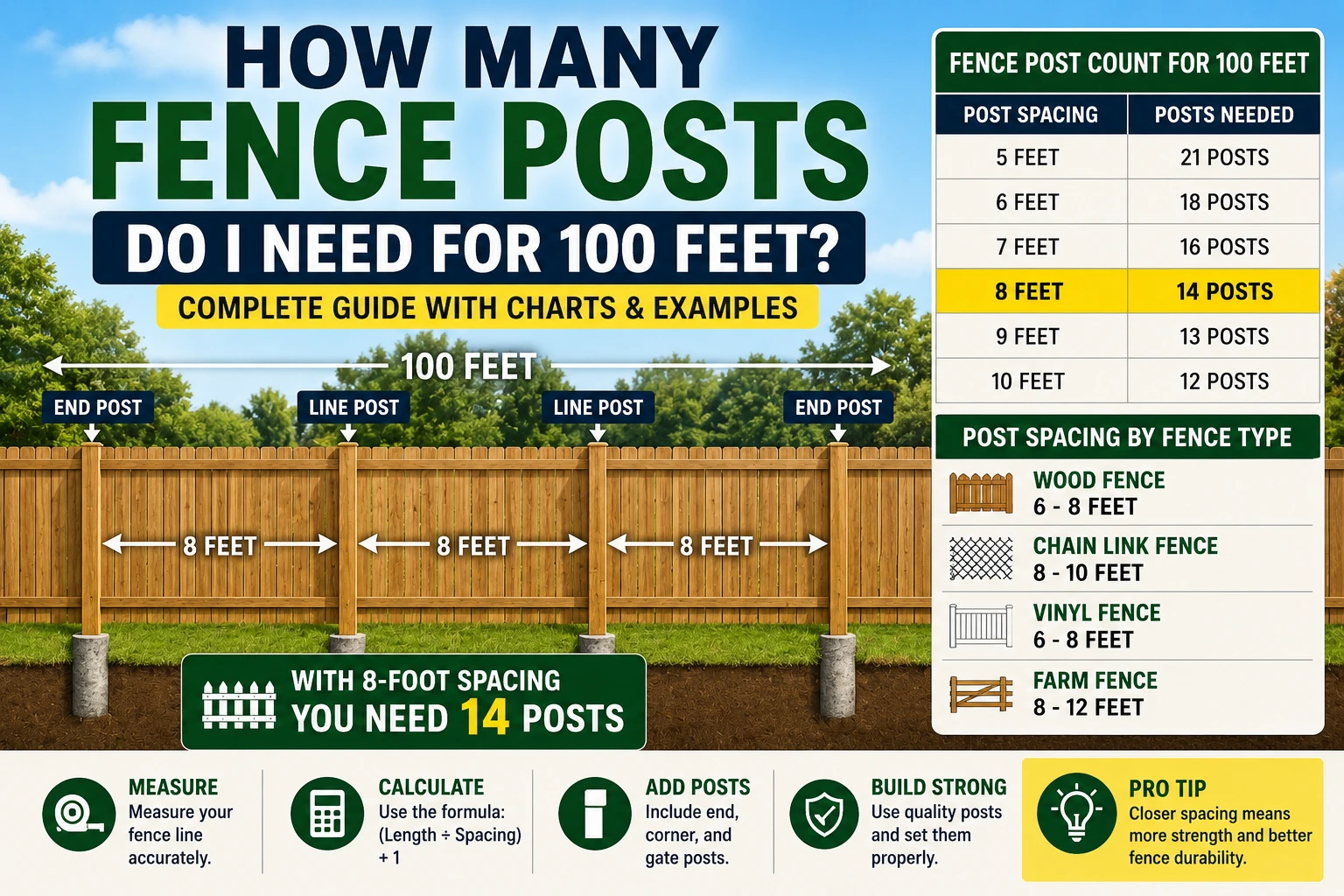
Here is the quick answer for a 100-foot fence:
| Post Spacing | Fence Posts Needed |
|---|---|
| 6 feet | 18 posts |
| 7 feet | 16 posts |
| 8 feet | 14 posts |
| 10 feet | 12 posts |
These numbers include end posts.
Quick Answer for Common Fence Types
For a standard residential wood or vinyl fence with 8-foot spacing, you typically need:
100÷8+1≈14 posts
This calculation includes:
- Starting post
- Ending post
- Intermediate line posts
Fence Post Calculation Formula
Use this simple formula to estimate fence posts:
Posts Needed=Post SpacingFence Length+1
This formula works for most straight fence runs.
For example:
- Fence length = 100 feet
- Spacing = 8 feet
Calculation:
8100+1=13.5 ≈14 posts
Always round up to ensure proper support.
Fence Post Spacing Chart for 100 Feet
Here is a detailed chart showing common fence spacing options.
| Fence Length | Post Spacing | Posts Required |
|---|---|---|
| 100 feet | 5 ft | 21 posts |
| 100 feet | 6 ft | 18 posts |
| 100 feet | 7 ft | 16 posts |
| 100 feet | 8 ft | 14 posts |
| 100 feet | 9 ft | 13 posts |
| 100 feet | 10 ft | 12 posts |
This chart can save time during planning and budgeting.
Factors That Affect Fence Post Count
Several factors can change how many posts you actually need.
Fence Material
Different materials require different support levels.
Wood Fences:
- Heavier
- Usually need closer spacing
- Common spacing: 6–8 feet
Vinyl Fences:
- Lightweight but flexible
- Typically use 6–8 foot spacing
Chain Link Fences:
- Lighter structure
- Can use wider spacing
- Common spacing: 8–10 feet
Farm Fences:
- Often use wider gaps
- Sometimes spaced up to 12 feet
Terrain and Ground Conditions
Uneven ground may require:
- Extra support posts
- Shorter spacing
- Additional corner reinforcement
Rocky soil may also affect post placement.
Wind and Weather Exposure
High winds create more pressure on fences.
Privacy fences in windy areas usually require:
- Closer post spacing
- Deeper post holes
- Stronger concrete support
Ignoring weather conditions can shorten fence lifespan.
How to Calculate Fence Posts Step by Step
Calculating fence posts is simple when done correctly.
Measuring the Fence Line
First, measure the total fence length carefully.
For example:
- Backyard fence = 100 feet
Always double-check measurements before purchasing materials.
Dividing by Post Spacing
Next, choose your desired spacing.
Example using 8-foot spacing:
100÷8=12.5
Round up to 13 spaces.
Adding End and Corner Posts
Finally, add one extra post for the fence end.
Result:
- 13 spaces
- 14 total posts
If your fence includes corners or gates, additional posts are required.
Fence Post Spacing by Fence Type
Different fences require different spacing rules.
Wood Fence
Wood fences are heavier and need strong support.
Recommended spacing:
- 6–8 feet
For a 100-foot wood fence:
- Usually 14–17 posts
Privacy fences especially benefit from tighter spacing.
Chain Link Fence
Chain link fences are lighter and more flexible.
Recommended spacing:
- 8–10 feet
For 100 feet:
- Usually 12–14 posts
This reduces material costs while maintaining strength.
Vinyl Fence
Vinyl fencing needs balanced spacing because panels can flex.
Recommended spacing:
- 6–8 feet
Too much distance may cause sagging panels.
Farm Fence
Farm fencing often uses:
- 8–12 foot spacing
Wire fences can span longer distances because they weigh less.
Common Fence Post Mistakes to Avoid
Many DIY fence builders make avoidable mistakes.
Incorrect Measurements
A small measurement mistake can lead to:
- Uneven fence sections
- Wasted materials
- Poor appearance
Always measure twice before installation.
Ignoring Gate Posts
Gates need additional reinforcement.
Gate posts should:
- Be stronger
- Be deeper in the ground
- Use extra concrete
Spacing Posts Too Far Apart
Large gaps weaken the fence.
This may cause:
- Sagging panels
- Leaning posts
- Wind damage
Forgetting Corner Posts
Corners experience extra tension and stress.
Corner posts should always be reinforced properly.
Expert Tips for Strong Fence Installation
Professional fence installers follow several best practices.
Use Quality Fence Posts
Pressure-treated wood and galvanized steel last longer.
Cheap materials may rot or weaken quickly.
Dig Proper Post Holes
Most fence posts should be buried:
- About one-third of total post length
For example:
- A 6-foot fence often needs 8-foot posts
Use Concrete Correctly
Concrete improves post stability.
However:
- Too much water weakens concrete
- Proper curing time matters
Check Local Building Codes
Some areas regulate:
- Fence height
- Post depth
- Property setbacks
Always check local rules before starting.
Cost Considerations for Fence Posts
Fence posts are a major part of fencing costs.
Average post costs:
- Wood posts: $15–$40 each
- Vinyl posts: $20–$50 each
- Metal posts: $25–$60 each
Concrete, tools, and labor add additional expenses.
Example estimate for 14 wood posts:
- Posts: $280–$560
- Concrete: $100–$200
- Hardware: $50–$150
Planning accurately helps prevent overspending.
Frequently Asked Questions
How many fence posts do I need for 100 feet with 8-foot spacing?
You usually need about 14 fence posts for a 100-foot fence using 8-foot spacing.
What is the standard spacing for fence posts?
Most residential fences use 6 to 8 feet between posts.
Do corner posts count in fence calculations?
Yes. Corner posts and gate posts should always be included separately.
Can fence posts be spaced 10 feet apart?
Yes, but mainly for lighter fences like chain link or farm fencing.
How deep should fence posts be buried?
Fence posts are usually buried one-third of their total length for stability.
Conclusion
If you have been asking, “how many fence posts do I need for 100 feet,” the answer depends mainly on your post spacing and fence type. Most standard residential fences need between 12 and 18 posts for a 100-foot fence line.
For many wood and vinyl fences, 8-foot spacing is the most common choice, requiring approximately 14 posts.
Remember this simple formula:
Posts Needed=Post SpacingFence Length+1
Careful planning, proper spacing, and quality materials will help you build a fence that is strong, durable, and visually appealing for years to come.
Discover more