
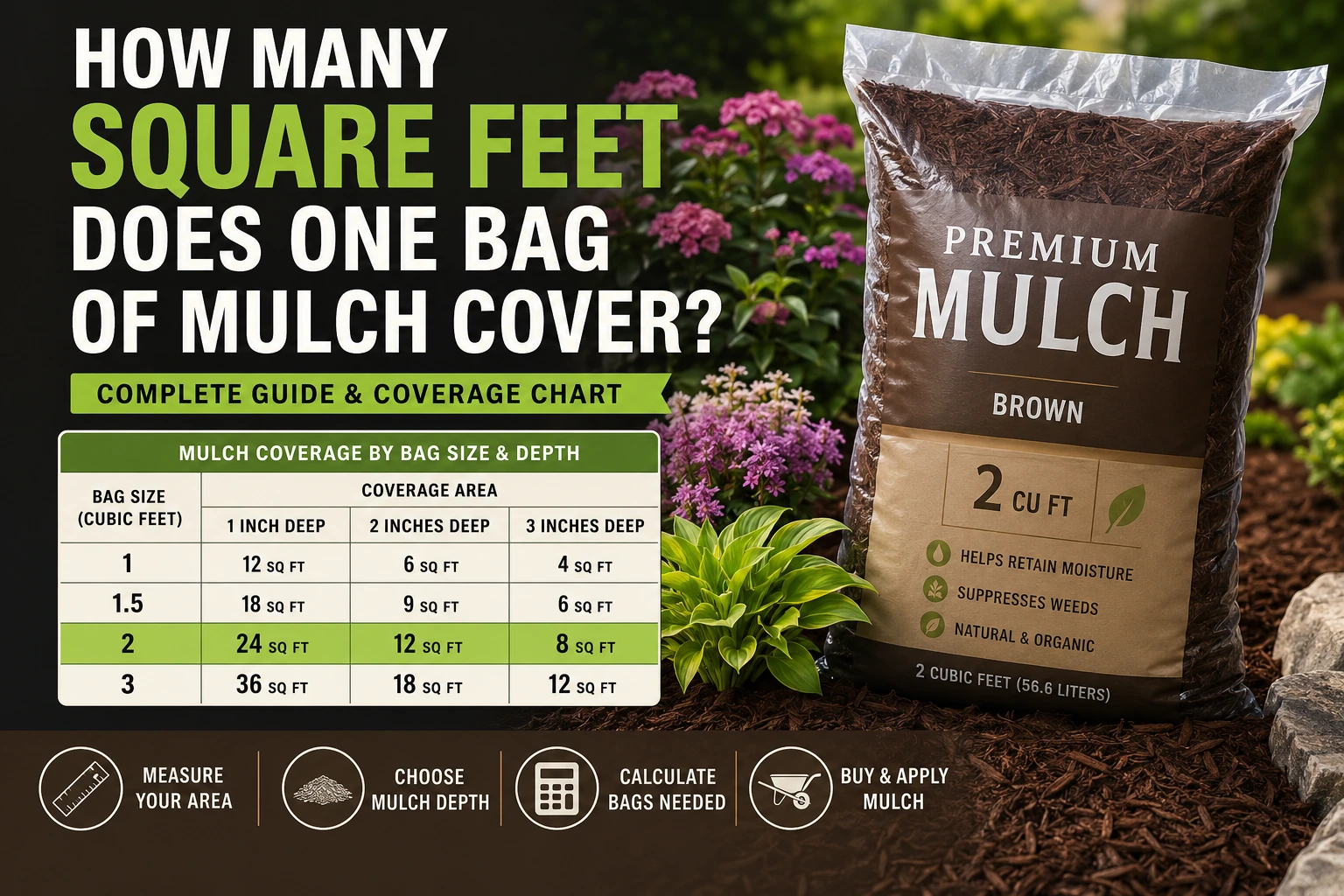
Mulch is one of the easiest ways to improve the look and health of your garden. It helps soil retain moisture, reduces weeds, regulates temperature, and gives landscaping a clean finished appearance. But before starting any project, many homeowners ask the same question: how many square feet does one bag of mulch cover?
The answer depends on three main factors:
- The size of the mulch bag
- The depth of the mulch layer
- The total area you want to cover
In most cases, a standard 2 cubic foot bag of mulch covers:
- About 24 square feet at 1 inch deep
- Around 12 square feet at 2 inches deep
- Roughly 8 square feet at 3 inches deep
However, different landscaping projects require different mulch depths. In this complete guide, you’ll learn exactly how mulch coverage works, how to calculate your needs, and how to avoid buying too much or too little.
Why Mulch Coverage Matters
Understanding mulch coverage helps you:
- Save money on landscaping materials
- Prevent waste
- Buy the correct number of bags
- Create healthier garden beds
- Avoid uneven mulch application
Many people underestimate how much mulch they need. Others spread it too thinly, which reduces its benefits. Proper calculations ensure your landscaping looks professional and functions properly.
Understanding Mulch Bag Sizes
Before calculating coverage, you need to know how mulch is sold.
Standard Mulch Bag Sizes
Most bagged mulch comes in these sizes:
| Mulch Bag Size | Common Use |
|---|---|
| 1 cubic foot | Small gardens and touch-ups |
| 1.5 cubic feet | Medium flower beds |
| 2 cubic feet | Most common residential size |
| 3 cubic feet | Larger landscaping projects |
The larger the bag, the more square footage it covers.
Cubic Feet Explained
Mulch bags are measured in cubic feet because mulch has volume, not just surface area.
A cubic foot measures:
1 cubic foot=12 in×12 in×12 in
Coverage changes depending on how thickly the mulch is spread.
How Many Square Feet Does One Bag of Mulch Cover at Different Depths?
Depth is the biggest factor affecting mulch coverage.
A thin layer covers more ground, while a thicker layer provides better weed control and moisture retention.
1 Cubic Foot Bag Coverage
Here’s how much area a 1 cubic foot bag covers:
| Mulch Depth | Coverage Area |
|---|---|
| 1 inch | 12 square feet |
| 2 inches | 6 square feet |
| 3 inches | 4 square feet |
This size works best for small flower beds or container gardens.
2 Cubic Foot Bag Coverage
A 2 cubic foot bag is the most popular option.
| Mulch Depth | Coverage Area |
|---|---|
| 1 inch | 24 square feet |
| 2 inches | 12 square feet |
| 3 inches | 8 square feet |
Most landscaping experts recommend 2–3 inches for garden beds.
3 Cubic Foot Bag Coverage
Large bags are useful for bigger projects.
| Mulch Depth | Coverage Area |
|---|---|
| 1 inch | 36 square feet |
| 2 inches | 18 square feet |
| 3 inches | 12 square feet |
These bags reduce the number of trips needed for large yards.
Mulch Coverage Chart
Use this quick mulch coverage chart for fast estimates.
| Bag Size | 1 Inch Deep | 2 Inches Deep | 3 Inches Deep |
|---|---|---|---|
| 1 cubic foot | 12 sq ft | 6 sq ft | 4 sq ft |
| 1.5 cubic feet | 18 sq ft | 9 sq ft | 6 sq ft |
| 2 cubic feet | 24 sq ft | 12 sq ft | 8 sq ft |
| 3 cubic feet | 36 sq ft | 18 sq ft | 12 sq ft |
This table makes it easier to estimate how many bags you’ll need for any landscaping project.
Recommended Mulch Depth for Landscaping
Different areas need different mulch depths.
Flower Beds
Recommended depth:
- 2 to 3 inches
This helps block weeds while allowing water to reach plant roots.
Vegetable Gardens
Recommended depth:
- 1 to 2 inches
Too much mulch can trap excessive moisture around vegetables.
Trees and Shrubs
Recommended depth:
- 3 to 4 inches
Keep mulch a few inches away from trunks to prevent rot.
Playgrounds and Pathways
Recommended depth:
- 4 inches or more
Extra depth provides cushioning and durability.
How to Calculate Mulch Coverage
Calculating mulch needs is simple when broken into steps.
Measure Your Area
First, measure the length and width of your garden bed.
Use this formula:
Area=Length×Width
Example:
- Length = 10 feet
- Width = 5 feet
Total area:
10×5=50 square feet
Choose Mulch Depth
Most homeowners choose:
- 2 inches for general landscaping
- 3 inches for better weed control
Use the Formula
You can estimate mulch bags with this basic formula:
Mulch Bags Needed=Coverage Per BagArea
Example:
If your area is 50 square feet and a 2 cubic foot bag covers 12 square feet at 2 inches deep:
1250≈4.2
You would need 5 bags.
Real World Mulch Coverage Examples
Practical examples make calculations easier.
Small Garden Bed
Garden size:
- 4 ft × 6 ft
Area:
4×6=24 square feet
At 2 inches deep:
- One 2 cubic foot bag is enough
Front Yard Landscaping
Landscape area:
- 20 ft × 15 ft
Area:
20×15=300 square feet
At 3 inches deep:
- Each 2 cubic foot bag covers 8 square feet
- About 38 bags are needed
Around Trees
Circular mulch areas are common around trees.
For circles, use:
A=πr2
r
A=πr2≈28.27
C=2πr≈18.85r = 3.00
If the mulch ring radius is 3 feet:
A=π(3)2≈28.3 square feet
At 2 inches deep:
- About 3 bags of 2 cubic foot mulch are needed
Common Mulch Buying Mistakes
Many landscaping problems happen because of simple mistakes.
Buying Too Little Mulch
Underestimating square footage is very common.
Always buy slightly extra mulch because:
- Mulch settles over time
- Uneven terrain uses more material
- Touch-ups may be needed later
Applying Mulch Too Deeply
Too much mulch can:
- Suffocate plant roots
- Cause fungal growth
- Hold too much moisture
- Attract pests
Avoid mulch layers thicker than 4 inches.
Ignoring Mulch Type
Different mulch materials settle differently.
For example:
- Wood chips stay fluffier
- Shredded bark compresses more
- Rubber mulch behaves differently than organic mulch
Coverage estimates may vary slightly depending on mulch texture.
Expert Tips for Mulching Success
Professional landscapers follow a few important rules.
Mulch at the Right Time
The best seasons are:
- Spring
- Early summer
- Fall
Fresh mulch helps protect soil during temperature changes.
Leave Space Around Plant Stems
Never pile mulch directly against:
- Tree trunks
- Plant stems
- Shrubs
This prevents rot and disease.
Refresh Mulch Annually
Organic mulch breaks down naturally over time.
Most gardens need:
- 1 inch of fresh mulch yearly
Water Before Applying Mulch
Moist soil holds nutrients better.
Watering first also improves mulch performance.
Mulch Coverage Comparison: Bags vs Bulk Mulch
For larger projects, homeowners often compare bagged mulch with bulk mulch.
| Feature | Bagged Mulch | Bulk Mulch |
|---|---|---|
| Best for | Small projects | Large projects |
| Convenience | Easy to carry | Requires delivery |
| Cost | Higher per cubic foot | Lower overall cost |
| Cleanup | Minimal | More cleanup |
| Coverage Accuracy | Easy to calculate | Less precise |
If your project exceeds 500 square feet, bulk mulch is often more economical.
FAQs
How many square feet does one bag of mulch cover at 2 inches deep?
A standard 2 cubic foot bag covers about 12 square feet at 2 inches deep.
How many bags of mulch do I need for 100 square feet?
At 2 inches deep, you would need approximately 9 bags of 2 cubic foot mulch.
Is 2 inches of mulch enough?
Yes. Two inches works well for most flower beds and landscaping projects.
What happens if mulch is too thick?
Excessively thick mulch can block airflow, trap moisture, and damage plants.
How often should mulch be replaced?
Most organic mulch should be refreshed once per year.
Conclusion
If you’ve been wondering how many square feet does one bag of mulch cover, the answer depends mainly on bag size and mulch depth.
Here’s a quick recap:
- A 2 cubic foot bag covers about 24 square feet at 1 inch deep
- It covers around 12 square feet at 2 inches deep
- It covers roughly 8 square feet at 3 inches deep
Understanding mulch coverage helps you save money, avoid waste, and create healthier landscaping. By measuring your area correctly and choosing the right mulch depth, you can complete your project with confidence.
Whether you’re refreshing flower beds, landscaping around trees, or improving curb appeal, proper mulch calculations make the job easier and more effective.
Discover more