
If you’ve ever wondered how many feet is a yard stick, the answer is surprisingly simple. A standard yardstick measures exactly 3 feet long. Because one yard equals three feet, a yardstick provides a convenient tool for measuring short distances in homes, classrooms, workshops, and construction projects.
Understanding this basic conversion can make measuring tasks much easier. Whether you’re working on a DIY project, helping a child with homework, planning a room layout, or learning the imperial measurement system, knowing how yards and feet relate is essential.
In this guide, you’ll learn exactly how many feet are in a yardstick, why the conversion works, practical examples, measurement charts, and expert tips for accurate measuring.
What Is a Yard Stick?
A yardstick is a measuring tool commonly used to measure lengths and distances.
It is typically:
- 36 inches long
- 3 feet long
- 1 yard long
Most yardsticks are made from:
- Wood
- Plastic
- Metal
- Composite materials
They often feature measurement markings in:
- Inches
- Feet
- Centimeters
- Millimeters
Definition of a Yard Stick
A yardstick is a rigid measuring device specifically designed to measure one yard in length.
The word “yardstick” comes from the fact that it represents the exact length of one yard.
Common Uses of Yardsticks
People use yardsticks for:
- Classroom learning
- Sewing projects
- Interior decorating
- Construction work
- Woodworking
- Home improvement projects
- Craft making
Because of its fixed length, a yardstick provides consistent and reliable measurements.
How Many Feet Is a Yard Stick?
The simple answer is:
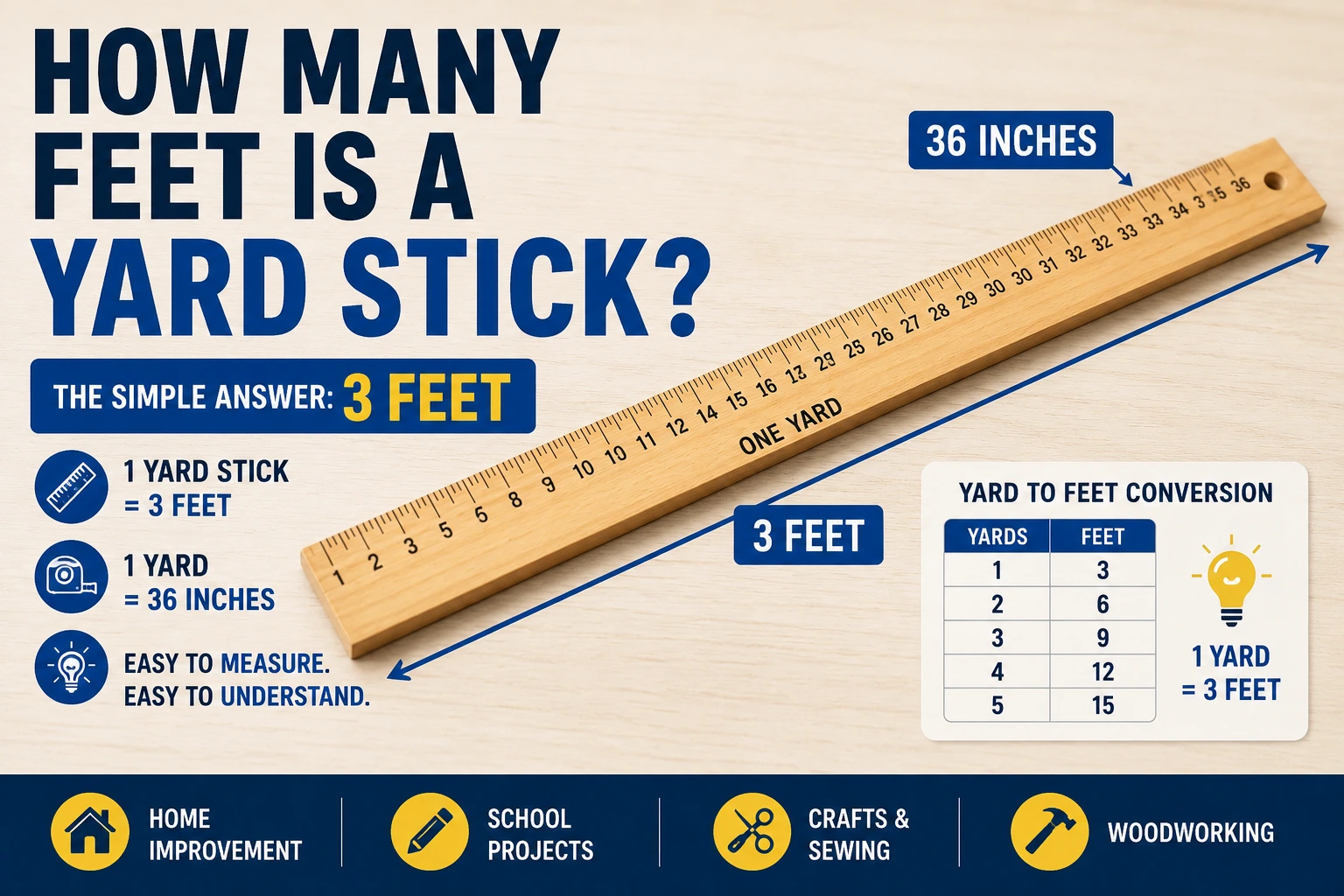
One Yard Stick = 3 Feet
This relationship never changes.
Conversion formula:
1 Yard = 3 Feet
Since a standard yardstick measures one yard:
1 Yard Stick = 3 Feet
Quick Conversion Table
| Measurement | Equivalent |
|---|---|
| 1 Yard | 3 Feet |
| 1 Yard Stick | 3 Feet |
| 1 Yard | 36 Inches |
| 3 Feet | 36 Inches |
| 36 Inches | 1 Yard |
Therefore, whenever someone asks how many feet is a yard stick, the answer is always 3 feet.
Understanding Yards, Feet, and Inches
To fully understand yardsticks, it’s helpful to know how these units relate to one another.
Inches
An inch is one of the smallest common units in the imperial measurement system.
Feet
A foot contains:
12 inches
Yards
A yard contains:
- 3 feet
- 36 inches
The relationship can be shown like this:
| Unit | Equivalent |
|---|---|
| 1 Foot | 12 Inches |
| 1 Yard | 3 Feet |
| 1 Yard | 36 Inches |
| 3 Feet | 36 Inches |
These conversions form the foundation of many everyday measurements.
Yard to Feet Conversion Chart
This chart helps convert yards into feet quickly.
| Yards | Feet |
|---|---|
| 1 | 3 |
| 2 | 6 |
| 3 | 9 |
| 4 | 12 |
| 5 | 15 |
| 10 | 30 |
| 15 | 45 |
| 20 | 60 |
| 25 | 75 |
| 50 | 150 |
Formula
To convert yards into feet:
Feet = Yards × 3
Example:
5 yards × 3 = 15 feet
Why a Yard Stick Equals Three Feet
The yard has been part of measurement systems for centuries.
Historically, a yard was standardized to create consistent measurements across industries.
Today, the official relationship remains:
- 1 yard = 3 feet
- 1 foot = 12 inches
Therefore:
3 × 12 = 36 inches
This means every standard yardstick measures:
36 inches
or
3 feet
or
1 yard
These measurements all describe the same length.
Practical Examples of Yard Stick Measurements
Understanding how many feet is a yard stick becomes easier when applied to real-world situations.
Home Improvement Projects
Suppose you’re installing shelving.
Shelf length:
3 feet
A single yardstick can measure the entire shelf length without needing additional tools.
School Activities
Teachers often use yardsticks for:
- Demonstrating measurement concepts
- Teaching conversions
- Measuring classroom objects
Students quickly learn that:
1 yardstick = 3 feet
Crafting and Sewing
Many fabric measurements use yards.
For example:
3 yards of fabric
equals:
9 feet of fabric
Knowing the conversion helps avoid mistakes during cutting and sewing.
How to Measure Using a Yard Stick
Using a yardstick is simple and accurate.
Step 1: Position the Yard Stick
Place one end at the starting point of the object.
Ensure it lies flat against the surface.
Step 2: Read the Markings
Identify:
- Inches
- Half inches
- Quarter inches
Read the measurement at the object’s endpoint.
Step 3: Extend if Necessary
If the object exceeds 3 feet:
Move the yardstick forward and continue measuring.
Add the measurements together.
Measurement Tips
For better accuracy:
- Keep the yardstick straight
- Avoid gaps between measurements
- Use good lighting
- Measure twice
- Record measurements immediately
These habits reduce errors.
Yard Stick vs Ruler vs Tape Measure
Each measuring tool serves a different purpose.
| Tool | Typical Length | Best Use |
|---|---|---|
| Ruler | 12 inches | Small objects |
| Yard Stick | 36 inches | Medium distances |
| Tape Measure | 12–35+ feet | Large projects |
Yard Stick Advantages
- Rigid and straight
- Easy to read
- Durable
- Great for education
Tape Measure Advantages
- Flexible
- Longer reach
- Portable
Choosing the right tool depends on the project.
Common Measurement Conversions
Here are useful conversions related to yardsticks.
| Measurement | Equivalent |
|---|---|
| 1 Yard | 3 Feet |
| 1 Yard | 36 Inches |
| 2 Yards | 6 Feet |
| 3 Yards | 9 Feet |
| 5 Yards | 15 Feet |
| 10 Yards | 30 Feet |
Feet to Yards Formula
Yards = Feet ÷ 3
Example:
12 feet ÷ 3 = 4 yards
Benefits and Limitations of Using a Yard Stick
Every measuring tool has strengths and weaknesses.
Benefits
Easy to Use
The markings are clear and straightforward.
Reliable
Rigid construction improves accuracy.
Affordable
Most yardsticks are inexpensive.
Educational
Excellent for teaching measurements and conversions.
Limitations
Limited Length
Only measures up to 3 feet at one time.
Less Portable
Compared to retractable tape measures.
Not Ideal for Large Projects
Long-distance measurements require repeated positioning.
Common Mistakes When Measuring
Many measurement errors occur because of simple oversights.
Starting at the Wrong Mark
Always begin at the zero mark.
Measuring at an Angle
Keep the yardstick straight.
Forgetting Unit Conversions
Confusing inches, feet, and yards can cause errors.
Not Double-Checking
Professional builders often measure twice before cutting materials.
Expert Tips for Accurate Measurements
Professionals use several best practices.
Verify Calibration
Replace damaged or warped yardsticks.
Use the Right Tool
Large projects may require a tape measure instead.
Keep Measurements Consistent
Always use the same unit throughout a project.
Write Measurements Down
Avoid relying on memory.
Check Twice Before Cutting
This prevents costly mistakes.
Everyday Items About One Yard Long
Visualizing a yardstick becomes easier when comparing it to common objects.
Examples include:
- A baseball bat
- A guitar neck
- A kitchen countertop section
- A large computer desk shelf
- Three standard rulers placed end to end
Each is approximately 3 feet long.
Frequently Asked Questions
1. How many feet is a standard yard stick?
A standard yardstick is exactly 3 feet long.
2. How many inches are in a yardstick?
A yardstick contains 36 inches.
3. Is a yard stick the same as a ruler?
No. A ruler is usually 12 inches long, while a yardstick measures 36 inches.
4. How do I convert yards to feet?
Multiply the number of yards by 3.
Formula:
Feet = Yards × 3
5. Why is a yardstick useful?
A yardstick provides a quick and accurate way to measure distances up to 3 feet without using a tape measure.
Conclusion
If you’re asking how many feet is a yard stick, the answer is simple: a standard yardstick measures exactly 3 feet long. Because one yard equals three feet and thirty-six inches, the yardstick serves as a convenient reference tool for education, home projects, crafting, woodworking, and everyday measurements.
Understanding how many feet is a yard stick also makes it easier to convert between yards, feet, and inches. Whether you’re measuring furniture, learning basic math, planning a DIY project, or teaching measurement concepts, knowing that a yardstick equals 3 feet provides a useful foundation for accurate and confident measuring.
Discover more