
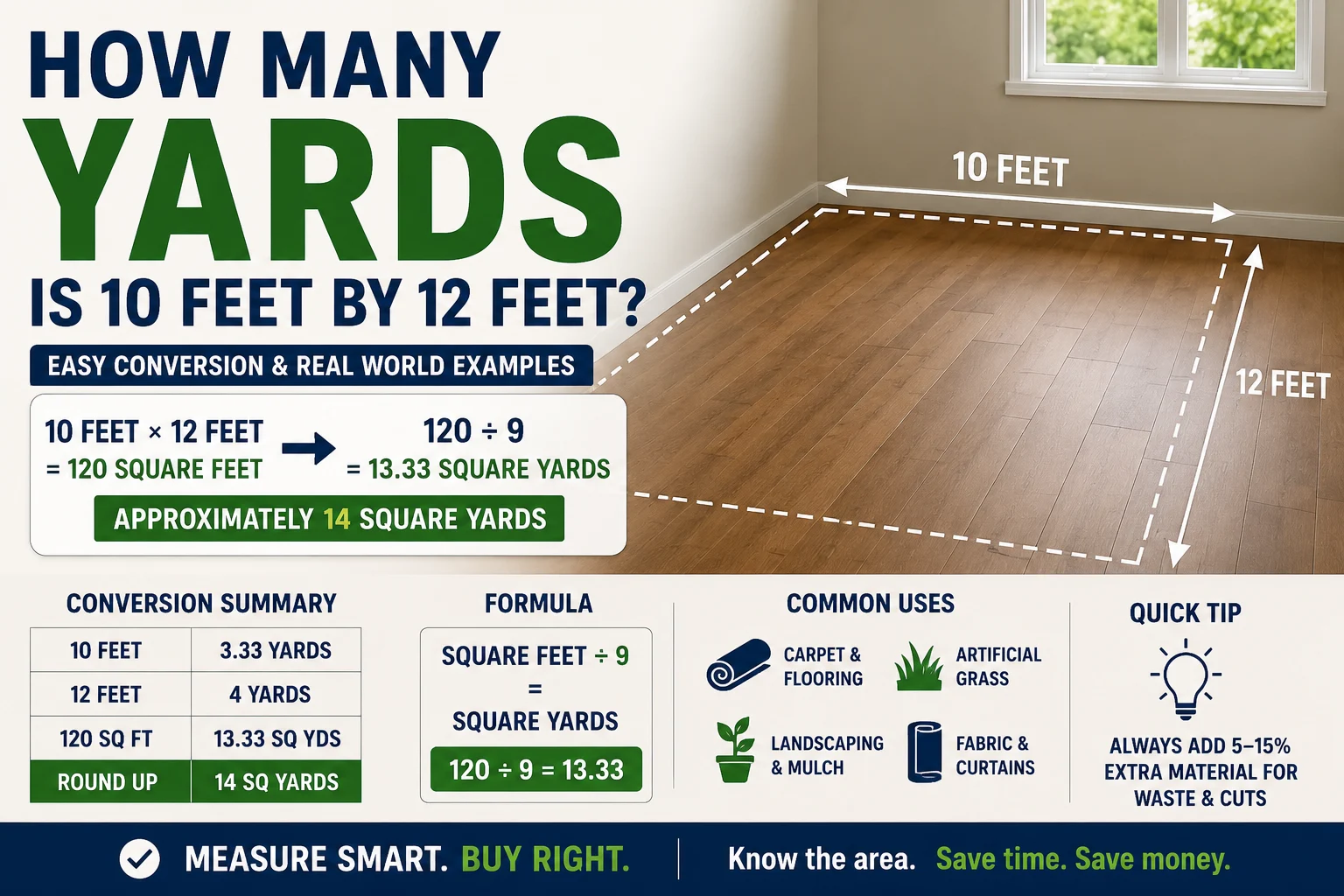
If you are trying to work out how many yards is 10 feet by 12 feet, the answer depends on whether you mean square yards or linear yards. This is important because flooring, carpet, landscaping, and fabric projects often use different measurement methods.
A 10-foot by 12-foot space has an area of:
120 square feet
To convert square feet into square yards, divide by 9:
120 ÷ 9 = 13.33 square yards
So, a 10 by 12 foot area equals approximately:
13.33 square yards
For most projects, you should round up. That means you may need about 14 square yards of material before adding extra waste for cuts, seams, and mistakes.
This guide explains the math in simple terms, shows how linear yards differ from square yards, and helps you estimate materials for real projects.
Quick Answer: 10 Feet by 12 Feet in Yards
A 10-foot by 12-foot area is:
| Measurement | Result |
|---|---|
| Area in square feet | 120 sq ft |
| Area in square yards | 13.33 sq yd |
| Rounded square yards | 14 sq yd |
| 10 feet in yards | 3.33 yd |
| 12 feet in yards | 4 yd |
The most useful answer for flooring, carpet, turf, and similar materials is:
10 feet by 12 feet = 13.33 square yards.
However, if someone asks for the dimensions in yards, the room is:
3.33 yards by 4 yards.
The Difference Between Linear Yards and Square Yards
Before buying materials, understand these two terms.
Linear Yard
A linear yard measures length only.
One linear yard equals:
3 feet
For example:
- 3 feet = 1 linear yard
- 6 feet = 2 linear yards
- 12 feet = 4 linear yards
Square Yard
A square yard measures area.
One square yard equals:
3 feet by 3 feet
That means:
1 square yard = 9 square feet
For a room, lawn, floor, or patio, square yards are usually more useful than linear yards.
How Many Yards Is 10 Feet by 12 Feet in Square Yards?
To find the square-yard measurement, first calculate the area in square feet.
Step 1: Find the Area in Square Feet
Use this formula:
Length × Width = Square Feet
For a 10 by 12 foot room:
10 × 12 = 120 square feet
The area is:
120 square feet
Step 2: Convert Square Feet to Square Yards
There are 9 square feet in 1 square yard.
Use this formula:
Square Feet ÷ 9 = Square Yards
Now calculate:
120 ÷ 9 = 13.33
Therefore:
10 feet by 12 feet = 13.33 square yards
For ordering purposes, round up to 14 square yards.
How Many Linear Yards Is 10 Feet by 12 Feet?
A room has two measurements, so it does not become one single linear-yard number. Instead, convert each side separately.
| Dimension | Feet | Yards |
|---|---|---|
| Length | 10 feet | 3.33 yards |
| Width | 12 feet | 4 yards |
So, the dimensions are:
3.33 yards by 4 yards
This is useful when measuring fabric, rolls of carpet, or materials sold by the linear yard.
Why Width Matters for Carpet and Fabric
Carpet and fabric are often sold by linear yard, but they come in fixed widths.
For example, a carpet roll may be 12 feet wide. If your room is 10 feet by 12 feet, a 12-foot-wide roll can cover the room with one 10-foot-long cut.
You would need:
- 10 linear feet of carpet
- Or 3.33 linear yards
- Plus extra for trimming and fitting
That is why you should never rely only on square-yard calculations when buying carpet or fabric.
10 by 12 Feet Conversion Chart
Use this chart for quick reference.
| Calculation | Formula | Result |
|---|---|---|
| Area in square feet | 10 × 12 | 120 sq ft |
| Square yards | 120 ÷ 9 | 13.33 sq yd |
| Rounded square yards | Round up | 14 sq yd |
| Length in yards | 10 ÷ 3 | 3.33 yd |
| Width in yards | 12 ÷ 3 | 4 yd |
| Room perimeter | 10 + 10 + 12 + 12 | 44 ft |
| Perimeter in yards | 44 ÷ 3 | 14.67 yd |
The perimeter is useful for baseboards, trim, edging, or caulking. The area is useful for flooring, carpet, turf, and landscaping.
Common Uses for a 10×12 Area
A 10 by 12 foot space is common in homes and gardens. Knowing that it equals 120 square feet or 13.33 square yards makes planning easier.
Carpet and Flooring
For flooring, start with the room area:
120 square feet
Most flooring projects need extra material for cuts and waste.
| Material | Recommended Extra | Total to Buy |
|---|---|---|
| Carpet | 5%–10% | 126–132 sq ft |
| Laminate | 10% | 132 sq ft |
| Vinyl plank | 10% | 132 sq ft |
| Tile | 10%–15% | 132–138 sq ft |
| Hardwood | 10% | 132 sq ft |
For carpet sold by square yard, 120 square feet equals 13.33 square yards. With waste, plan for around 15 square yards.
Artificial Grass
If you are covering a 10 by 12 foot patio or lawn area with artificial grass, you need:
- 120 square feet of turf
- Around 13.33 square yards
- Extra material for trimming around edges
Artificial grass usually comes in rolls with fixed widths. Check the roll width before ordering.
Landscaping Materials
Mulch, gravel, and soil calculations require area and depth.
For example, a 10 by 12 foot garden bed has:
120 square feet of surface area
If you add 3 inches of mulch, you need:
120 × 0.25 = 30 cubic feet
This is a volume calculation, not a square-yard calculation. Still, knowing the area is the first step.
Fabric and Curtains
Fabric is commonly sold by linear yard. A 10 by 12 foot area does not automatically tell you how many yards of fabric you need because fabric width varies.
Always check:
- Fabric width
- Pattern direction
- Seam allowance
- Hem allowance
- Extra fabric for matching patterns
How to Calculate Yards for Flooring or Carpet
Follow these steps before buying materials.
Step 1: Measure the Room
Measure wall to wall at the widest points.
For a rectangular room:
- Length = 10 feet
- Width = 12 feet
Multiply them:
10 × 12 = 120 square feet
Step 2: Convert to Square Yards
Divide by 9:
120 ÷ 9 = 13.33 square yards
Step 3: Add a Waste Allowance
Do not order the exact minimum amount.
Add extra material for:
- Corners
- Doorways
- Cuts
- Pattern matching
- Installation mistakes
- Future repairs
For a simple 10 by 12 room, ordering 14 to 15 square yards is usually safer for carpet.
Step 4: Check Product Width
A roll’s width may change the amount you need.
For example, a 12-foot-wide carpet roll works well for a 10 by 12 room. But a narrower roll may create seams and require more material.
Real-World Examples of a 10×12 Foot Space
Example 1: Bedroom Carpet
A bedroom measures 10 feet by 12 feet.
- Area: 120 square feet
- Square yards: 13.33
- Carpet waste allowance: 10%
Calculation:
120 × 1.10 = 132 square feet
Convert to square yards:
132 ÷ 9 = 14.67 square yards
Order approximately:
15 square yards of carpet
Example 2: Vinyl Plank Flooring
A small office is 10 by 12 feet.
- Base area: 120 square feet
- Add 10% waste: 12 square feet
- Total needed: 132 square feet
If each box covers 20 square feet:
132 ÷ 20 = 6.6 boxes
Round up:
7 boxes
Example 3: Garden Mulch
A flower bed is 10 feet by 12 feet and needs 3 inches of mulch.
- Area: 120 square feet
- Depth: 3 inches = 0.25 feet
- Volume: 120 × 0.25 = 30 cubic feet
You would need about:
30 cubic feet of mulch
Square Feet vs Square Yards vs Linear Yards
These measurements are often confused.
| Unit | What It Measures | Best Used For |
|---|---|---|
| Linear feet | Length | Trim, baseboards, edging |
| Linear yards | Length | Fabric and carpet rolls |
| Square feet | Area | Flooring, rooms, paint planning |
| Square yards | Area | Carpet, turf, landscaping |
| Cubic feet | Volume | Soil, mulch, gravel, concrete |
A 10 by 12 foot room is:
- 120 square feet
- 13.33 square yards
- 44 linear feet around the perimeter
- 14.67 linear yards around the perimeter
Each answer is correct for a different purpose.
Common Mistakes When Converting 10 Feet by 12 Feet to Yards
Dividing Each Side by 3 and Multiplying Incorrectly
Some people convert 10 feet to 3.33 yards and 12 feet to 4 yards, then assume the answer is simply 7.33 yards.
That is incorrect because area requires multiplication.
Correct calculation:
3.33 × 4 = 13.33 square yards
Forgetting That 1 Square Yard Equals 9 Square Feet
A square yard is not equal to 3 square feet.
It is:
3 feet × 3 feet = 9 square feet
Skipping the Waste Allowance
Exact measurements rarely account for cuts, seams, and mistakes.
Always add extra material.
Using Area for Perimeter Projects
Baseboards, trim, and edging use linear feet, not square yards.
For a 10 by 12 room, the perimeter is:
44 linear feet
Expert Tips for Accurate Material Estimates
- Measure each wall twice before ordering.
- Sketch the room and note doors, closets, and alcoves.
- Use the widest room measurements for carpet.
- Add 5% to 15% extra material based on the project.
- Check the product’s packaging coverage before buying.
- Ask installers about seam placement for carpet and vinyl.
- Save leftover flooring or tile for future repairs.
- Keep all units consistent during calculations.
FAQs
1. How many square yards is 10 feet by 12 feet?
A 10-foot by 12-foot area is 120 square feet, which equals 13.33 square yards.
2. Should I round 13.33 square yards up to 14 yards?
Yes. For most projects, round up to at least 14 square yards. Add more for waste, cuts, and seams.
3. How many yards of carpet do I need for a 10×12 room?
A 10×12 room needs 13.33 square yards of carpet before waste. In most cases, plan for about 14 to 15 square yards.
4. What are the dimensions of 10 feet by 12 feet in yards?
The dimensions are approximately 3.33 yards by 4 yards.
5. How many linear feet are around a 10 by 12 room?
The perimeter is 44 linear feet. This is useful for baseboards, trim, caulk, or edging.
Conclusion
So, how many yards is 10 feet by 12 feet? The area is 120 square feet, which equals approximately 13.33 square yards. For most flooring, carpet, turf, or similar projects, round up to 14 square yards before adding a waste allowance.
Remember that square yards measure area, while linear yards measure length. A 10 by 12 foot space is also about 3.33 yards by 4 yards in dimensions. By using the right conversion and adding extra material for cuts and fitting, you can estimate your project more accurately and avoid running short.
Discover more