
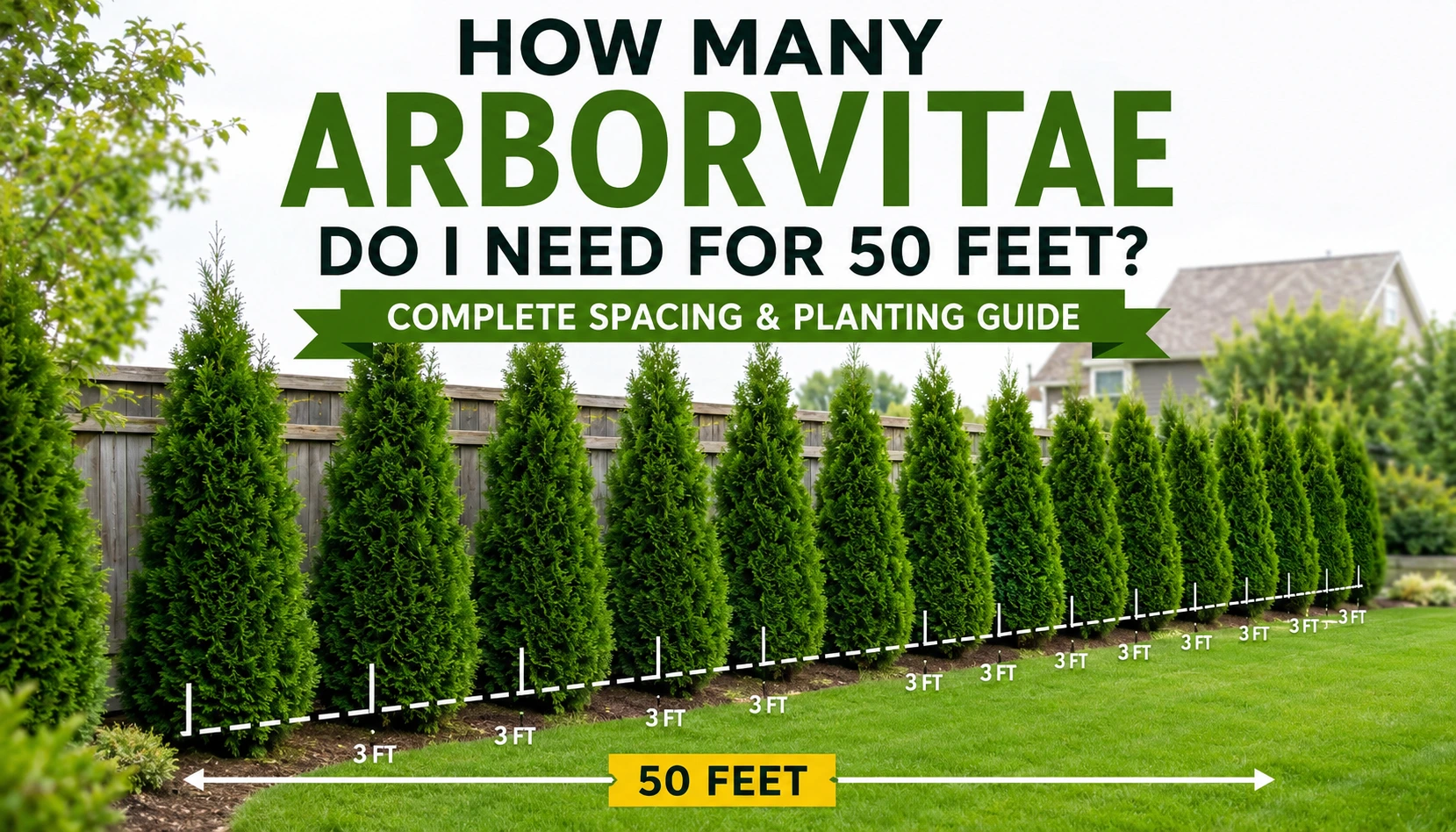
If you’re planning a privacy hedge, one of the first questions you’ll likely ask is: how many arborvitae do I need for 50 feet?
The answer depends largely on the variety of arborvitae you choose and the spacing between each tree. In most cases, homeowners need between 10 and 25 arborvitae trees to cover a 50-foot stretch.
Arborvitae are among the most popular evergreen privacy trees because they grow quickly, stay green year-round, and create an attractive natural fence. However, planting them too close together or too far apart can lead to poor growth, disease issues, or gaps in your hedge.
This guide explains exactly how many arborvitae you need for 50 feet, how spacing affects growth, and how to create a healthy, dense privacy screen.
Understanding Arborvitae Spacing
Before calculating tree quantities, it’s important to understand spacing.
Arborvitae spacing refers to the distance between the center of one tree and the center of the next tree.
The ideal spacing depends on:
- Tree variety
- Mature width
- Desired privacy level
- Growth rate
- Available landscape space
Some homeowners want an immediate dense hedge, while others prefer allowing trees room to mature naturally.
Generally, arborvitae are planted between:
| Arborvitae Type | Recommended Spacing |
|---|---|
| Emerald Green Arborvitae | 3–4 feet |
| Green Giant Arborvitae | 5–8 feet |
| American Arborvitae | 4–6 feet |
| Techny Arborvitae | 4–5 feet |
| North Pole Arborvitae | 3–4 feet |
The closer you plant them, the faster your hedge fills in.
How Many Arborvitae Do I Need for 50 Feet?
The calculation is simple:
Number of Trees = Total Length ÷ Spacing Distance
For a 50-foot hedge:
Spacing at 2 Feet
If planted every 2 feet:
50 ÷ 2 = 25
You will need approximately:
25 arborvitae trees
This creates a very dense privacy screen quickly.
Spacing at 3 Feet
50 ÷ 3 = 16.67
Round up to:
17 arborvitae trees
This is one of the most common spacings for Emerald Green Arborvitae.
Spacing at 4 Feet
50 ÷ 4 = 12.5
Round up to:
13 arborvitae trees
This spacing balances privacy and healthy growth.
Spacing at 5 Feet
50 ÷ 5 = 10
You will need:
10 arborvitae trees
Suitable for larger arborvitae varieties.
Arborvitae Spacing Chart for 50 Feet
The following chart provides a quick reference.
| Tree Spacing | Arborvitae Needed for 50 Feet |
|---|---|
| 2 feet | 25 trees |
| 2.5 feet | 20 trees |
| 3 feet | 17 trees |
| 3.5 feet | 15 trees |
| 4 feet | 13 trees |
| 5 feet | 10 trees |
| 6 feet | 9 trees |
| 8 feet | 7 trees |
For most residential privacy hedges, 13–17 trees is the typical range.
Factors That Affect Arborvitae Quantity
The exact number of trees you need depends on several important factors.
Variety Selection
Not all arborvitae grow the same way.
For example:
- Emerald Green Arborvitae stays narrow.
- Green Giant Arborvitae grows much wider.
- North Pole Arborvitae remains compact.
Different mature widths require different spacing.
Privacy Goals
Ask yourself:
Do you want privacy immediately?
Or can you wait several years?
For faster privacy:
- Plant closer together.
- Use larger nursery stock.
For long-term health:
- Follow recommended spacing.
Mature Tree Width
Many beginners focus only on planting distance and ignore mature width.
A tree that grows 4 feet wide should not be planted 2 feet from another mature tree unless a dense hedge is desired.
Understanding mature size prevents overcrowding.
Growth Rate
Some arborvitae grow faster than others.
Approximate annual growth rates:
| Variety | Growth Per Year |
|---|---|
| Emerald Green | 6–12 inches |
| Green Giant | 3–5 feet |
| American Arborvitae | 1–2 feet |
| Techny | 12–24 inches |
Fast-growing varieties may require greater spacing.
Best Arborvitae Varieties for Privacy Hedges
If you’re planting a 50-foot privacy screen, these varieties are among the best choices.
Emerald Green Arborvitae
Popular because it:
- Maintains a narrow shape
- Requires little pruning
- Stays vibrant year-round
- Fits smaller yards
Recommended spacing:
3–4 feet
For 50 feet:
13–17 trees
Green Giant Arborvitae
Excellent for large properties.
Benefits include:
- Extremely fast growth
- Disease resistance
- Strong privacy screening
Recommended spacing:
5–8 feet
For 50 feet:
7–10 trees
North Pole Arborvitae
Ideal for tighter spaces.
Features:
- Narrow growth habit
- Cold hardy
- Dense foliage
Recommended spacing:
3–4 feet
For 50 feet:
13–17 trees
Techny Arborvitae
Known for durability and dense branching.
Works well as:
- Windbreaks
- Privacy hedges
- Property boundaries
Recommended spacing:
4–5 feet
For 50 feet:
10–13 trees
Step-by-Step Arborvitae Planting Guide
Once you’ve determined how many arborvitae you need for 50 feet, proper planting becomes critical.
Step 1: Measure the Area
Use a measuring tape to mark the entire 50-foot section.
Step 2: Mark Tree Locations
Based on your spacing:
- 3 feet = mark every 3 feet
- 4 feet = mark every 4 feet
- 5 feet = mark every 5 feet
Use stakes or landscape paint.
Step 3: Dig Proper Holes
The hole should be:
- Twice as wide as the root ball
- Equal to root ball depth
Avoid planting too deep.
Step 4: Place and Backfill
Position each arborvitae upright.
Fill soil gently around roots.
Water thoroughly.
Step 5: Add Mulch
Apply:
- 2–3 inches of mulch
- Keep mulch away from the trunk
Mulch helps retain moisture and suppress weeds.
Step 6: Water Consistently
During the first year:
- Water deeply
- Maintain evenly moist soil
- Avoid waterlogging
Healthy roots lead to faster hedge establishment.
Common Arborvitae Spacing Mistakes
Many homeowners make avoidable errors.
Planting Too Close
Problems include:
- Poor airflow
- Increased disease risk
- Root competition
Planting Too Far Apart
Results may include:
- Visible gaps
- Reduced privacy
- Uneven hedge appearance
Ignoring Mature Size
Young trees look small.
However, many varieties expand significantly over time.
Always plan for mature dimensions.
Not Measuring Correctly
Guessing distances often leads to uneven spacing.
Use measuring tools for professional-looking results.
Expert Tips for a Dense Privacy Hedge
Landscape professionals recommend the following practices:
Choose Uniform Trees
Buy trees with similar:
- Height
- Width
- Health condition
This creates a consistent hedge.
Improve Soil Before Planting
Add:
- Compost
- Organic matter
- Well-drained soil amendments
Healthy soil improves establishment.
Fertilize Carefully
Use slow-release fertilizer during the growing season.
Avoid excessive nitrogen.
Prune Lightly
Minimal pruning helps maintain shape while encouraging density.
Do not remove excessive foliage.
Consider Double-Row Planting
For maximum privacy:
Plant two staggered rows.
Benefits include:
- Faster screening
- Better wind protection
- Enhanced appearance
This method requires more trees but produces exceptional results.
Real-World Example
Suppose you want an Emerald Green Arborvitae privacy hedge along a 50-foot backyard fence.
Recommended spacing:
3 feet.
Calculation:
50 ÷ 3 = 16.67
Round up:
17 trees needed
If each tree costs $45:
17 × $45 = $765
Adding mulch, soil amendments, and irrigation may increase the total project cost, but you’ll have a beautiful evergreen privacy barrier that can last for decades.
9. FAQs
1. How many Emerald Green Arborvitae do I need for 50 feet?
Most homeowners need between 13 and 17 Emerald Green Arborvitae trees, depending on whether they use 4-foot or 3-foot spacing.
2. What is the best spacing for arborvitae privacy hedges?
For most privacy hedges, 3 to 4 feet apart is ideal because it balances healthy growth and privacy.
3. Can I plant arborvitae 2 feet apart?
Yes, but only if you want a very dense hedge. Closer spacing may increase competition between trees as they mature.
4. How long does it take arborvitae to fill in?
Depending on the variety, arborvitae hedges typically fill in within 3 to 7 years.
5. Which arborvitae grows fastest?
Green Giant Arborvitae is among the fastest-growing varieties, often adding 3 to 5 feet per year under ideal conditions.
10. Conclusion
If you’re wondering how many arborvitae do I need for 50 feet, the answer usually falls between 10 and 25 trees, depending on your chosen spacing and arborvitae variety.
For most homeowners creating a privacy hedge, planting 13 to 17 arborvitae trees provides the ideal balance of density, growth, and long-term health. Carefully consider mature size, privacy goals, and spacing recommendations before planting. By planning correctly from the start, you’ll enjoy a lush evergreen screen that adds beauty, value, and privacy to your property for years to come.
Discover more