

If you work in shipping, warehousing, retail, manufacturing, or even DIY woodworking, you’ve probably wondered how many square feet is a standard pallet. Knowing the answer helps you estimate storage space, organize inventory, calculate warehouse capacity, and even plan transportation costs.
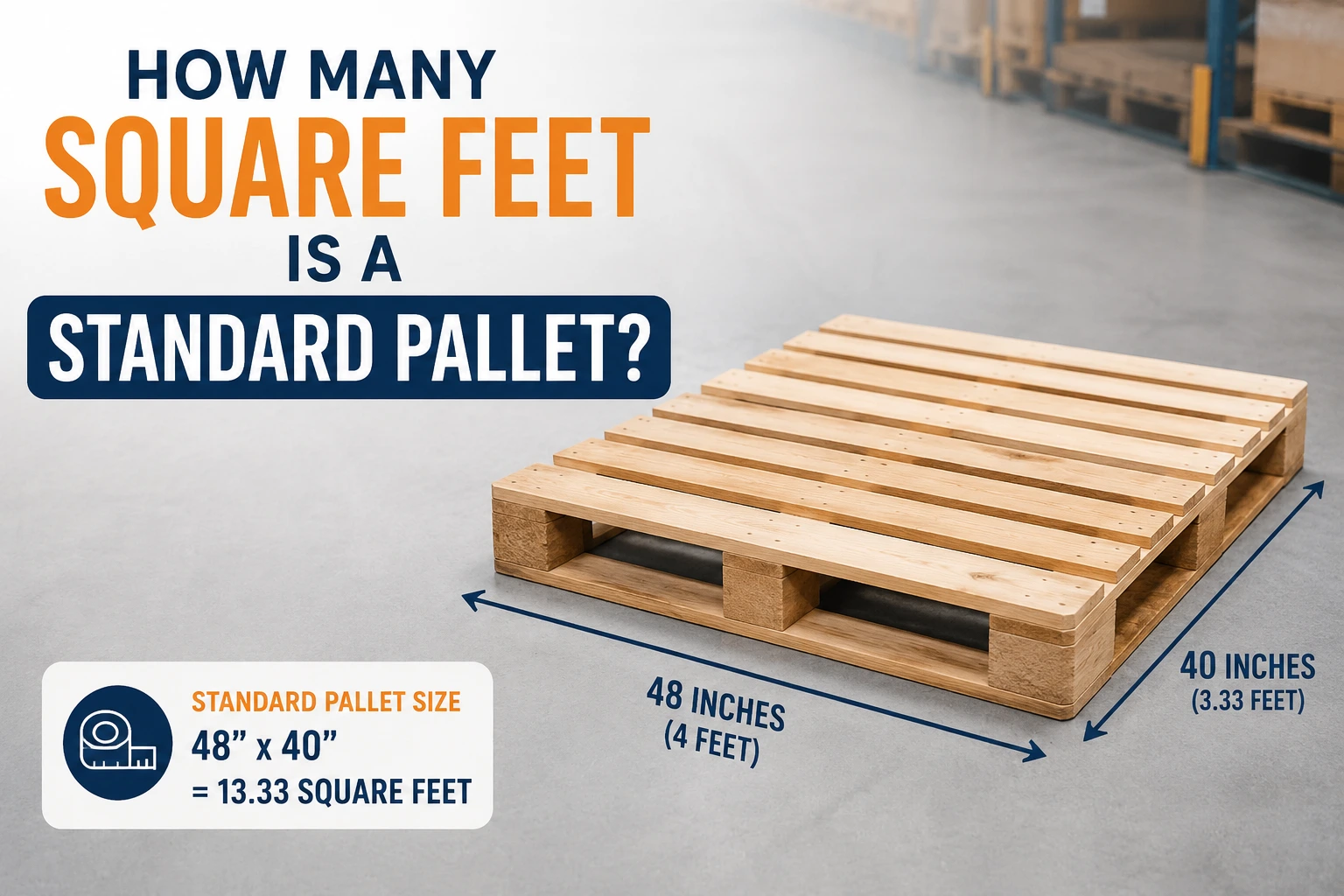
Although pallets come in several sizes worldwide, the most common pallet used in North America measures 48 inches by 40 inches. This size has become the industry standard because it works efficiently with forklifts, warehouse shelving, and truck trailers.
When converted into square feet, this standard pallet occupies approximately 13.33 square feet of floor space. However, different industries and countries use different pallet sizes, meaning the total square footage can vary.
In this guide, you’ll learn how pallet square footage is calculated, compare common pallet dimensions, understand why pallet size matters, and discover practical examples that make planning much easier.
Understanding Standard Pallet Dimensions
Before calculating square footage, it’s important to understand what a standard pallet actually is.
A pallet is a flat platform designed to support goods during storage, handling, and transportation. It allows forklifts, pallet jacks, and automated warehouse equipment to move products quickly and safely.
Most pallets are made from:
- Wood
- Plastic
- Metal
- Composite materials
Wood pallets remain the most widely used because they are affordable, durable, and easy to repair.
What Is a Standard Pallet?
In the United States and Canada, the Grocery Manufacturers Association (GMA) standard pallet measures:
- Width: 40 inches
- Length: 48 inches
This 48 × 40-inch pallet is commonly used in:
- Retail stores
- Distribution centers
- Manufacturing facilities
- Freight shipping
- E-commerce warehouses
- Amazon fulfillment centers
Because of its popularity, many warehouse systems and truck trailers are designed around this pallet size.
Why Pallet Size Matters
Knowing pallet dimensions isn’t just about measurements. It directly affects several areas of logistics and storage.
Warehouse Planning
Managers calculate how many pallets fit inside a warehouse using each pallet’s footprint.
Shipping Costs
Freight carriers often base shipping prices on pallet size and occupied floor space.
Storage Efficiency
Proper pallet sizing reduces wasted warehouse space and improves inventory organization.
Workplace Safety
Correct pallet spacing leaves enough room for forklifts and employees to move safely.
Inventory Management
Businesses use pallet measurements to estimate storage capacity and optimize warehouse layouts.
How Many Square Feet Is a Standard Pallet?
The answer depends on the pallet dimensions.
The most common pallet measures:
- 48 inches long
- 40 inches wide
To convert inches into square feet, use the following formula.
Step 1
Multiply the length by the width.
48 × 40 = 1,920 square inches
Step 2
Convert square inches into square feet.
Since one square foot contains 144 square inches:
1,920 ÷ 144 = 13.33 square feet
Final Answer
A standard 48 × 40-inch pallet occupies approximately 13.33 square feet of floor space.
This measurement refers only to the pallet’s footprint and does not include the height of stacked goods.
Formula for Calculating Pallet Square Footage
Calculating pallet area is straightforward.
Formula
Square Feet = (Length × Width) ÷ 144
Where:
- Length is measured in inches.
- Width is measured in inches.
- Divide by 144 because one square foot equals 144 square inches.
Example 1
48 × 40 pallet
(48 × 40) ÷ 144
= 13.33 square feet
Example 2
42 × 42 pallet
(42 × 42) ÷ 144
= 12.25 square feet
Example 3
48 × 48 pallet
(48 × 48) ÷ 144
= 16 square feet
This simple calculation works for any rectangular pallet.
Quick Pallet Square Footage Chart
| Pallet Size | Square Inches | Square Feet |
|---|---|---|
| 48 × 40 | 1,920 | 13.33 |
| 42 × 42 | 1,764 | 12.25 |
| 48 × 48 | 2,304 | 16.00 |
| 36 × 36 | 1,296 | 9.00 |
| 48 × 42 | 2,016 | 14.00 |
| 40 × 40 | 1,600 | 11.11 |
| 31.5 × 47.2 (Euro Pallet) | 1,486.8 | 10.32 |
This chart makes it easy to estimate floor space without performing calculations every time.
Common Pallet Sizes Around the World
Although the 48 × 40-inch pallet is the most common in North America, many industries use different sizes depending on shipping standards and product types.
North American Standard Pallet
Dimensions:
- 48 × 40 inches
Square footage:
13.33 square feet
Common uses:
- Grocery distribution
- Retail products
- Consumer goods
- Warehouse storage
- Freight transportation
It is the most widely recognized pallet size in the United States and Canada.
European Pallet (EUR/EPAL)
One of the most commonly used pallets in Europe measures:
- 47.24 × 31.50 inches
- 1,200 × 800 millimeters
Square footage:
Approximately 10.32 square feet
These pallets are designed to maximize truck and container space across European transportation networks.
Australian Standard Pallet
Australia commonly uses:
- 45.9 × 45.9 inches
- 1,165 × 1,165 millimeters
Its nearly square design makes it suitable for Australian rail and warehouse systems.
ISO Standard Pallet Sizes
The International Organization for Standardization (ISO) recognizes several pallet sizes to accommodate different industries and regions. These standardized dimensions make international shipping more efficient and improve compatibility with warehouse equipment.
Below are some of the most common ISO pallet sizes.
| Pallet Size | Region | Square Feet |
|---|---|---|
| 48 × 40 inches | North America | 13.33 |
| 47.24 × 31.50 inches | Europe | 10.32 |
| 45.9 × 45.9 inches | Australia | 14.63 |
| 42 × 42 inches | Telecommunications | 12.25 |
| 48 × 48 inches | Chemical Industry | 16.00 |
Each pallet size is designed to maximize transportation efficiency while minimizing unused cargo space.
Square Foot Comparison Table
The following table compares several popular pallet sizes and their floor space.
| Pallet Dimensions | Area (Square Feet) | Typical Use |
|---|---|---|
| 36 × 36 inches | 9.00 | Small shipments |
| 40 × 40 inches | 11.11 | Industrial storage |
| 42 × 42 inches | 12.25 | Telecommunications |
| 48 × 40 inches | 13.33 | Standard warehouse shipping |
| 48 × 42 inches | 14.00 | Beverage industry |
| 45.9 × 45.9 inches | 14.63 | Australia |
| 48 × 48 inches | 16.00 | Drums and bulk containers |
As shown above, the standard 48 × 40-inch pallet provides an excellent balance between storage efficiency and transportation capacity.
How Pallet Size Affects Shipping Costs
Pallet dimensions influence much more than storage space. They also affect transportation expenses.
Freight Charges
Many freight companies calculate shipping costs based on pallet dimensions and weight. Larger pallets occupy more trailer space, which can increase shipping fees.
Truck Capacity
Standard pallets allow carriers to maximize trailer capacity. A typical 53-foot trailer can hold approximately 26 standard 48 × 40-inch pallets in a single layer.
Container Loading
Using standard pallet sizes helps maximize the usable space inside shipping containers and reduces wasted room.
Fuel Efficiency
Proper pallet sizing minimizes empty space inside vehicles, allowing businesses to transport more products in fewer trips.
Warehouse Storage Planning
Understanding how many square feet a standard pallet occupies helps warehouse managers plan storage more effectively.
For example, suppose a warehouse has 4,000 square feet of available storage.
Since each standard pallet occupies approximately 13.33 square feet, the calculation is:
4,000 ÷ 13.33 = approximately 300 pallets
In reality, aisles, forklift lanes, fire safety clearances, and workstations reduce usable storage space. Most warehouses reserve 25% to 40% of the total floor area for movement and operations.
Practical Example
Warehouse Size:
5,000 square feet
Space reserved for aisles:
30%
Usable storage:
3,500 square feet
Maximum standard pallets:
3,500 ÷ 13.33 ≈ 262 pallets
This simple calculation helps businesses estimate storage capacity before purchasing inventory.
Choosing the Right Pallet Size
Not every shipment requires a standard 48 × 40-inch pallet. Choosing the right size depends on your products and transportation needs.
Use a Standard 48 × 40 Pallet When
- Shipping consumer goods
- Storing inventory in warehouses
- Using standard pallet racks
- Working with major freight carriers
- Selling through Amazon FBA
Choose Smaller Pallets When
- Shipping lightweight products
- Delivering to retail stores with limited space
- Transporting smaller equipment
- Managing compact warehouse layouts
Choose Larger Pallets When
- Handling industrial machinery
- Shipping large containers
- Transporting chemical drums
- Moving oversized products
Selecting the correct pallet size improves warehouse efficiency while reducing transportation costs.
Benefits of Standard Pallets
Using standard pallets offers several advantages.
Easy Equipment Compatibility
Forklifts, pallet jacks, conveyors, and warehouse shelving are designed around standard pallet dimensions.
Lower Shipping Costs
Efficient loading reduces wasted trailer space.
Faster Handling
Warehouse workers can move standard pallets more quickly.
Better Inventory Organization
Uniform pallet sizes simplify warehouse layouts and inventory tracking.
Global Availability
Replacement pallets are easy to purchase almost anywhere.
Drawbacks of Standard Pallets
Although standard pallets are versatile, they are not perfect for every situation.
Not Ideal for Oversized Products
Large machinery may require custom pallets.
Unused Space
Small products may not fully utilize the available pallet area.
Weight Restrictions
Every pallet has a maximum load capacity that must be respected.
Regional Differences
International shipments sometimes require different pallet dimensions.
Practical Examples
Example 1: Warehouse Expansion
A company plans to add storage for 150 pallets.
Each pallet occupies:
13.33 square feet
Required floor space:
150 × 13.33 = 1,999.5 square feet
The company should allocate at least 2,000 square feet, plus additional aisle space.
Example 2: Retail Inventory
A retailer receives 40 pallets every week.
40 × 13.33 = 533.2 square feet
To allow safe movement, the warehouse reserves approximately 700 square feet.
Example 3: Home DIY Storage
Someone stores gardening supplies on one standard pallet.
They need approximately 13.33 square feet of floor space inside the garage.
Expert Tips
- Always verify pallet dimensions before ordering freight.
- Consider both pallet footprint and stacked height.
- Leave enough aisle space for forklifts.
- Use pallet racks designed for your pallet size.
- Measure warehouse floor space before expanding inventory.
- Choose high-quality pallets for heavy loads.
- Inspect pallets regularly for damage.
- Label pallets clearly to improve warehouse efficiency.
Common Mistakes
Many people make simple mistakes when estimating pallet space.
Forgetting Unit Conversion
Always divide square inches by 144 to convert to square feet.
Ignoring Aisle Space
Storage calculations should include walking paths and forklift lanes.
Assuming Every Pallet Is Standard
Different industries use different pallet sizes.
Overlooking Product Overhang
Boxes extending beyond pallet edges require additional clearance.
Measuring Height Instead of Floor Space
Square footage measures only the pallet’s footprint, not its height.
FAQs
How many square feet is a standard pallet?
A standard 48 × 40-inch pallet occupies approximately 13.33 square feet of floor space.
What is the most common pallet size?
The most common pallet size in North America is 48 × 40 inches, often called the GMA standard pallet.
How do you calculate pallet square footage?
Multiply the pallet’s length by its width in inches, then divide the result by 144 to convert square inches into square feet.
Why are pallet dimensions important?
Pallet dimensions affect warehouse planning, freight costs, storage efficiency, and loading capacity.
Do all pallets have the same dimensions?
No. Pallet sizes vary by country, industry, and shipping requirements. While 48 × 40 inches is the most common in North America, Europe, Australia, and specialized industries often use different standard sizes.
Conclusion
Understanding how many square feet is a standard pallet is essential for anyone involved in shipping, warehousing, logistics, or inventory management. A standard 48 × 40-inch pallet covers approximately 13.33 square feet, making it the benchmark for storage planning and freight calculations across North America. However, pallet dimensions vary around the world, so it’s always important to confirm the size before estimating warehouse capacity or transportation costs. By knowing how to calculate pallet square footage, comparing different pallet sizes, and following best storage practices, you can improve space utilization, reduce shipping expenses, and create a more efficient warehouse operation.
Discover more