

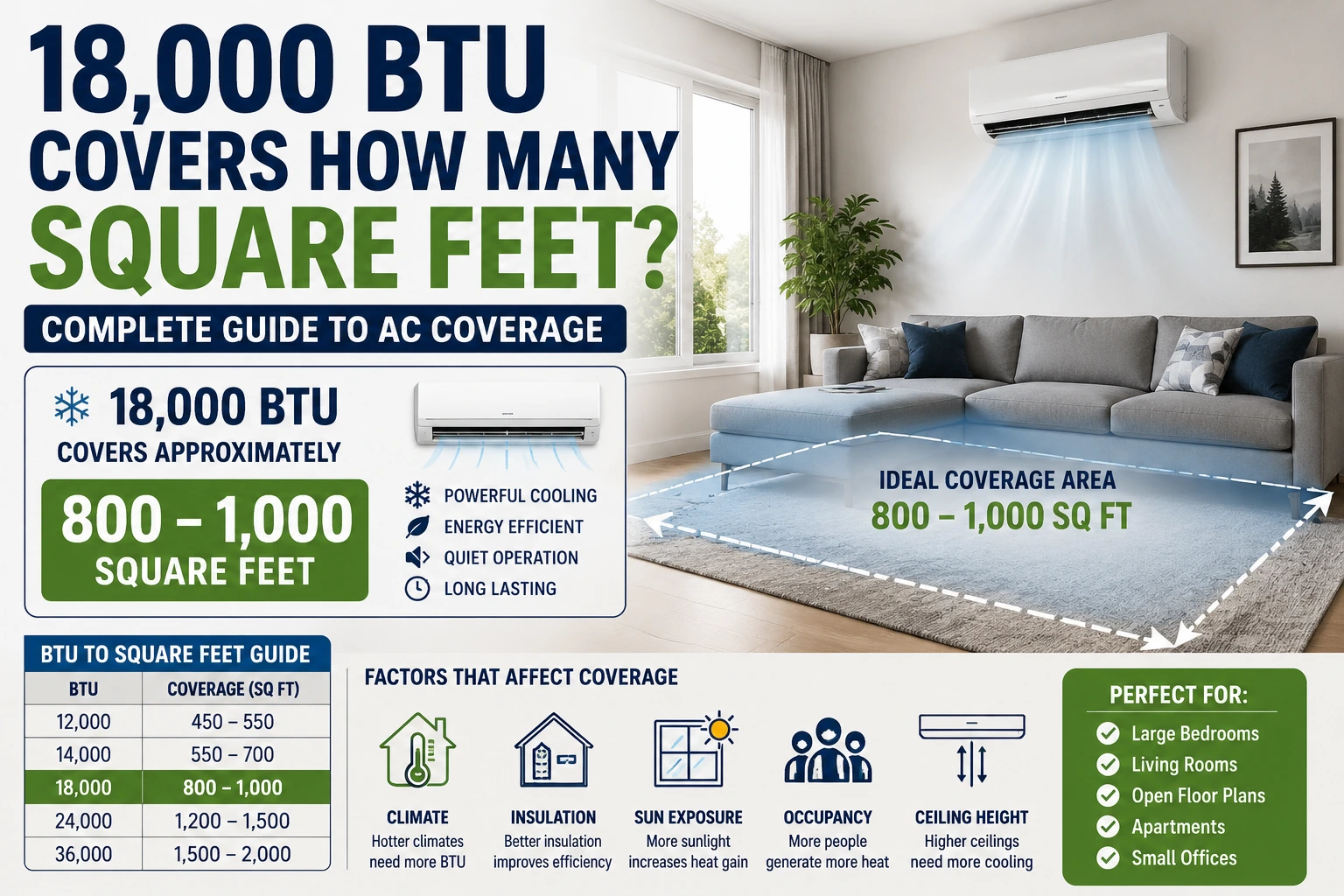
If you’re shopping for a new air conditioner or mini split system, one of the most common questions is: 18,000 BTU covers how many square feet?
Choosing the correct cooling capacity is important because an air conditioner that is too small may struggle to cool the space, while an oversized unit can waste energy and create uncomfortable temperature swings.
The good news is that an 18,000 BTU air conditioner typically cools between 800 and 1,000 square feet under normal conditions.
However, the exact coverage depends on several factors, including insulation, ceiling height, climate, window exposure, and the number of occupants.
In this comprehensive guide, you’ll learn exactly how much space an 18,000 BTU system can cool, how BTU ratings work, and how to determine whether this size is right for your home or business.
Quick Answer: 18,000 BTU Covers How Many Square Feet?
Under standard residential conditions:
| BTU Rating | Recommended Coverage |
|---|---|
| 18,000 BTU | 800–1,000 Square Feet |
This means an 18,000 BTU air conditioner is commonly suitable for:
- Large bedrooms
- Living rooms
- Open-concept apartments
- Small offices
- Studio spaces
- Multi-room areas with good airflow
Many HVAC sizing guides place 18,000 BTU units in the range of approximately 800 to 1,000 square feet.
What Does BTU Mean?
Before selecting an air conditioner, it’s helpful to understand what BTU actually measures.
Understanding Cooling Capacity
BTU stands for British Thermal Unit.
A BTU measures the amount of heat required to raise the temperature of one pound of water by one degree Fahrenheit.
For air conditioners, BTUs represent how much heat the unit can remove from a room every hour.
An 18,000 BTU air conditioner removes approximately:
18,000 BTU/hour
from the indoor space.
Why BTUs Matter
The BTU rating determines:
- Cooling performance
- Energy efficiency
- Comfort levels
- Operating costs
- Equipment lifespan
Proper sizing helps maximize comfort while minimizing electricity usage.
18,000 BTU Covers How Many Square Feet?
The most accepted guideline is:
18,000 BTU = approximately 800–1,000 square feet
However, actual performance varies.
Standard Coverage Range
| Condition | Coverage Area |
|---|---|
| Ideal Conditions | 1,000 sq ft |
| Average Conditions | 800–950 sq ft |
| Challenging Conditions | 700–850 sq ft |
Under ideal conditions, an 18,000 BTU system may cool spaces approaching 1,000 square feet efficiently.
Coverage Under Different Conditions
Not all homes are equal.
For example:
- A well-insulated 950 sq ft apartment may cool easily.
- A poorly insulated 850 sq ft home may require additional capacity.
- A sunny room with large windows may need a larger system.
This is why HVAC professionals evaluate more than square footage alone.
BTU to Square Feet Coverage Chart
Use this chart as a general reference.
| BTU Size | Coverage Area |
|---|---|
| 5,000 BTU | 100–250 sq ft |
| 6,000 BTU | 250–300 sq ft |
| 8,000 BTU | 300–350 sq ft |
| 10,000 BTU | 400–450 sq ft |
| 12,000 BTU | 450–550 sq ft |
| 14,000 BTU | 550–700 sq ft |
| 18,000 BTU | 800–1,000 sq ft |
| 24,000 BTU | 1,200–1,500 sq ft |
| 36,000 BTU | 1,500–2,000 sq ft |
These figures are estimates and should be adjusted based on real-world conditions.
Factors That Affect 18,000 BTU Coverage
Square footage alone does not determine cooling requirements.
Several factors influence performance.
Climate
Hot climates increase cooling demand.
Homes in:
- Arizona
- Texas
- Florida
- Nevada
often require more BTUs than similar homes in cooler regions.
Ceiling Height
Most BTU charts assume:
8-foot ceilings
Higher ceilings increase air volume and cooling requirements.
For example:
- 8 ft ceiling = standard load
- 10–12 ft ceiling = increased load
- Vaulted ceilings = significantly increased load
Insulation
Good insulation reduces heat gain.
Well-insulated homes generally allow an 18,000 BTU unit to cool closer to 1,000 square feet.
Poor insulation may reduce effective coverage.
Sun Exposure
Large south-facing windows can increase indoor temperatures dramatically.
Spaces with:
- Floor-to-ceiling glass
- Sunrooms
- Large skylights
often require additional cooling capacity.
Occupancy
People generate heat.
Rooms with:
- Large families
- Frequent gatherings
- High occupancy
may need more BTUs than standard calculations suggest.
Is an 18,000 BTU AC Enough for Your Room?
Let’s examine common room sizes.
| Room Type | Typical Size | Suitable? |
|---|---|---|
| Master Bedroom | 300–500 sq ft | Yes |
| Living Room | 400–800 sq ft | Yes |
| Small Apartment | 700–900 sq ft | Yes |
| Open Floor Plan | 900–1,000 sq ft | Usually |
| Large Home Floor | 1,200+ sq ft | No |
For most spaces under 1,000 square feet, an 18,000 BTU unit is often sufficient.
Real-World Examples
Living Room Example
Room dimensions:
25 ft × 30 ft
Area:
750 square feet
An 18,000 BTU system can typically cool this space comfortably.
Apartment Example
Apartment size:
900 square feet
Good insulation and average ceiling height.
An 18,000 BTU mini split is often a strong match.
Open Floor Plan Example
Open-concept space:
1,000 square feet
Large windows and direct sunlight.
The system may work, but a professional load calculation is recommended.
Small Office Example
Office size:
850 square feet
Moderate occupancy and standard equipment.
An 18,000 BTU unit usually provides adequate cooling.
Benefits of Choosing the Right BTU Size
Selecting the proper air conditioner size provides several advantages.
Better Comfort
Rooms cool evenly without hot spots.
Improved Energy Efficiency
Properly sized units consume less electricity.
Lower Utility Bills
Efficient operation reduces monthly costs.
Longer Equipment Life
Less strain means fewer repairs and longer lifespan.
Better Humidity Control
Correct sizing helps remove moisture effectively.
Problems Caused by Oversized or Undersized Units
Many buyers focus only on cooling power.
This can lead to expensive mistakes.
Undersized Air Conditioners
Units that are too small:
- Run constantly
- Struggle during heat waves
- Increase electricity bills
- Wear out faster
Oversized Air Conditioners
Units that are too large:
- Cycle on and off frequently
- Waste energy
- Reduce humidity removal
- Create inconsistent temperatures
Correct sizing is always the best approach.
How to Calculate the Right BTU Requirement
A quick estimate can be made using square footage.
Many HVAC professionals use:
20 BTU per square foot
Basic formula:
BTU Required=Square Feet×20
Example:
900 square feet
900 × 20 = 18,000 BTU
This explains why 18,000 BTU units are commonly recommended for spaces around 900 square feet.
Expert Tips Before Buying an 18,000 BTU Air Conditioner
Get a Load Calculation
A professional HVAC assessment is more accurate than simple square footage estimates.
Consider Future Needs
Renovations and room additions may change cooling requirements.
Look for High SEER Ratings
Higher efficiency models reduce long-term energy costs.
Check Climate Conditions
Hot regions may require additional capacity.
Evaluate Airflow
Poor airflow can make even correctly sized units less effective.
Strong Summary: 18,000 BTU Covers How Many Square Feet?
When asking 18,000 BTU covers how many square feet, the standard answer is approximately 800 to 1,000 square feet under normal residential conditions.
However, actual performance depends on insulation, ceiling height, climate, sunlight exposure, and occupancy levels. While square footage provides a useful starting point, a professional load calculation delivers the most accurate sizing recommendation.
Understanding BTU ratings helps homeowners and business owners choose cooling systems that provide comfort, efficiency, and long-term value.
Frequently Asked Questions
Does an 18,000 BTU mini split cool 1,000 square feet?
Yes, under ideal conditions an 18,000 BTU mini split can cool approximately 1,000 square feet.
Is 18,000 BTU enough for a two-bedroom apartment?
In many cases, yes. Most two-bedroom apartments fall within the recommended coverage range.
Can an 18,000 BTU AC cool multiple rooms?
Yes, if airflow is adequate and the total area remains within the recommended square footage range.
What happens if my AC has too many BTUs?
An oversized unit may short cycle, waste energy, and provide poor humidity control.
How many square feet does an 18,000 BTU window air conditioner cover?
Most 18,000 BTU window units are rated for approximately 800–1,000 square feet.
Conclusion
If you’re wondering 18,000 BTU covers how many square feet, the answer is generally 800 to 1,000 square feet. This makes an 18,000 BTU air conditioner or mini split an excellent option for large living rooms, apartments, offices, and open-concept spaces.
While square footage is a useful guideline, factors such as insulation quality, ceiling height, climate, occupancy, and sun exposure can significantly affect cooling performance. By understanding these variables and properly sizing your system, you can enjoy better comfort, improved energy efficiency, and lower operating costs for years to come.
Discover more