
Whether you’re pouring a sidewalk, setting fence posts, building a patio, or repairing a driveway, one of the first questions you’ll ask is how many cubic feet per bag of concrete. Knowing the yield of each bag helps you estimate how many bags to buy, avoid running short during a project, and reduce unnecessary material costs.
The amount of concrete produced by one bag depends on its weight. A standard 80-pound bag yields about 0.60 cubic feet, while smaller bags produce less concrete.
In this guide, you’ll learn the yield of every common concrete bag size, how to calculate the total volume needed, and practical examples to help you estimate concrete for your next project.
Quick Answer
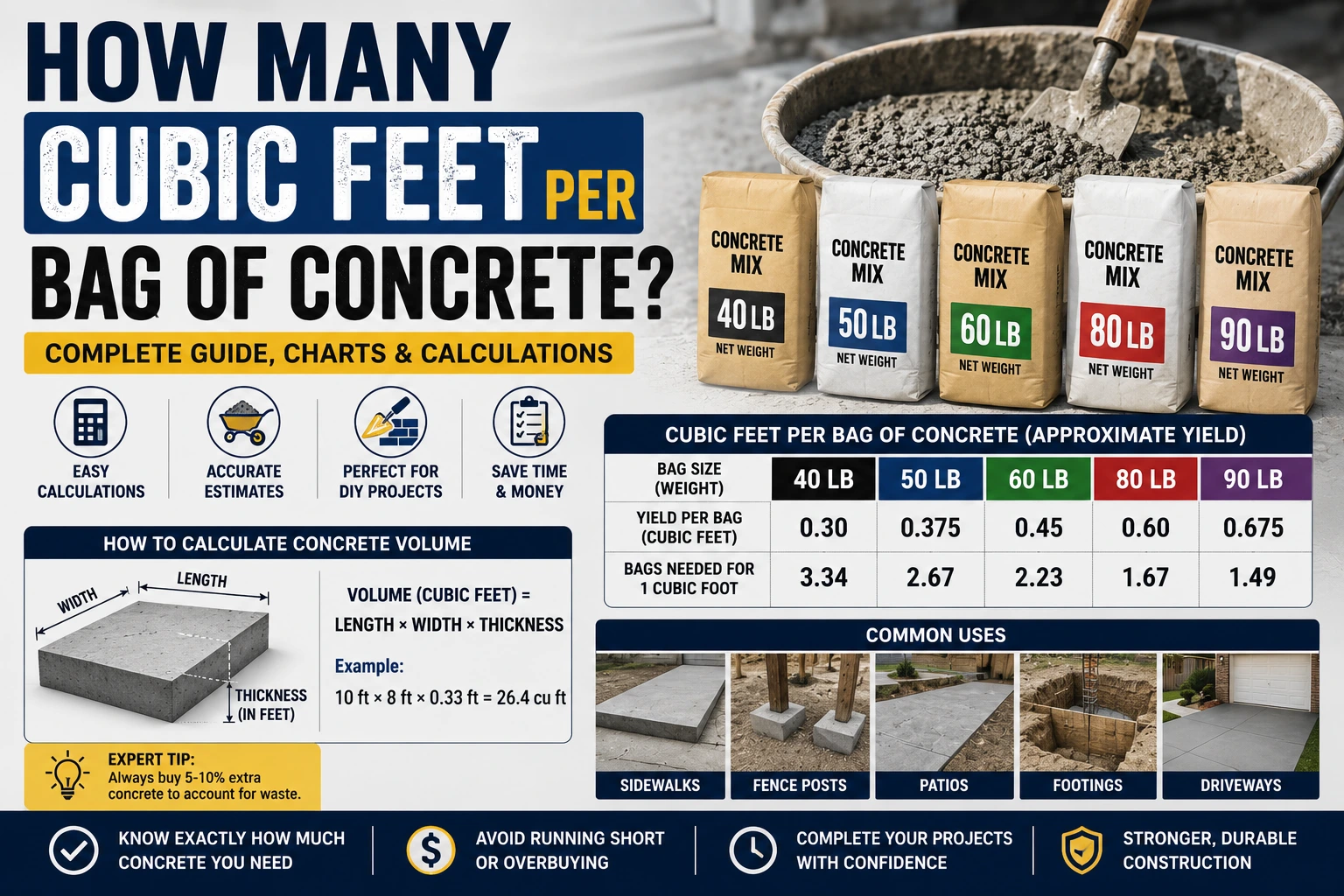
The table below shows the approximate yield for common concrete bag sizes.
| Bag Size | Approximate Yield |
|---|---|
| 40 lb | 0.30 cubic feet |
| 50 lb | 0.375 cubic feet |
| 60 lb | 0.45 cubic feet |
| 80 lb | 0.60 cubic feet |
| 90 lb | 0.675 cubic feet |
These values represent the approximate volume of mixed concrete after adding the recommended amount of water. Actual yield may vary slightly depending on the product and manufacturer.
Understanding Concrete Bag Yield
Before calculating how many bags you need, it’s important to understand what concrete yield means.
What Is Concrete Yield?
Concrete yield is the amount of finished concrete produced after mixing a bag with the correct amount of water.
For example:
- An 80-pound bag does not contain 80 pounds of finished concrete volume.
- Instead, it produces approximately 0.60 cubic feet of mixed concrete.
This yield value is what contractors use to estimate material quantities.
Why Bag Size Matters
Concrete bags are available in several standard sizes.
Each size produces a different volume.
Choosing the right bag depends on:
- Project size
- Budget
- Ease of handling
- Transportation
- Number of bags required
Smaller bags are easier to lift but require more mixing.
Larger bags reduce the number of bags needed but are heavier to move.
How Many Cubic Feet Per Bag of Concrete?
The amount of concrete each bag produces depends on its weight.
Below are the most common sizes.
40 lb Bag
Approximate yield:
0.30 cubic feet
Common uses:
- Small repairs
- Mailbox posts
- Fence posts
- Small footings
Because of its lighter weight, a 40-pound bag is easy for one person to carry.
50 lb Bag
Approximate yield:
0.375 cubic feet
Best for:
- Small sidewalks
- Minor slab repairs
- Garden projects
- Patio repairs
This size offers a balance between portability and productivity.
60 lb Bag
Approximate yield:
0.45 cubic feet
Common applications include:
- Medium-sized footings
- Walkways
- Deck posts
- Landscaping projects
Many DIY homeowners choose 60-pound bags because they are easier to handle than 80-pound bags.
80 lb Bag
Approximate yield:
0.60 cubic feet
This is the most commonly purchased concrete bag.
Typical uses:
- Concrete slabs
- Driveways
- Sidewalks
- Patios
- Garage floors
- Structural footings
Because each bag produces more concrete, fewer bags are needed for larger projects.
90 lb Bag
Approximate yield:
0.675 cubic feet
Although less common than 80-pound bags, 90-pound bags are sometimes preferred for:
- Commercial work
- Large foundations
- Heavy-duty projects
They reduce the total number of bags required but are more difficult to lift and transport.
Concrete Bag Yield Chart
Use this table for quick reference.
| Bag Weight | Cubic Feet |
|---|---|
| 40 lb | 0.30 |
| 50 lb | 0.375 |
| 60 lb | 0.45 |
| 80 lb | 0.60 |
| 90 lb | 0.675 |
This chart is one of the easiest ways to estimate concrete requirements before starting a project.
How to Calculate Concrete Volume
Knowing the size of your project allows you to determine exactly how many concrete bags you’ll need.
Formula
Use this simple formula:
Length × Width × Thickness = Cubic Feet
Make sure all measurements are converted to feet.
Step-by-Step Calculation
Suppose you’re pouring a slab measuring:
- Length = 10 feet
- Width = 5 feet
- Thickness = 4 inches
First, convert the thickness into feet.
4 inches = 0.33 feet
Now calculate:
10 × 5 × 0.33
Answer:
Approximately 16.5 cubic feet
Next, divide by the yield of your concrete bag.
Using 80-pound bags:
16.5 ÷ 0.60 = 27.5 bags
Round up.
You’ll need 28 bags.
Practical Examples
Understanding real-world projects makes concrete calculations much easier.
Example 1: Fence Post
A fence post hole measures:
- 1 foot deep
- 1 foot wide
- 1 foot long
Volume:
1 × 1 × 1 = 1 cubic foot
Using 80-pound bags:
1 ÷ 0.60 = 1.67 bags
Round up to:
2 bags
Example 2: Mailbox Post
A mailbox footing requires:
0.60 cubic feet
You’ll need:
1 eighty-pound bag
Example 3: Small Patio
A patio measures:
- 8 feet long
- 8 feet wide
- 4 inches thick
Volume:
8 × 8 × 0.33
Approximately:
21.1 cubic feet
Using 80-pound bags:
21.1 ÷ 0.60
Approximately:
36 bags
Example 4: Walkway
Dimensions:
- Length: 20 feet
- Width: 3 feet
- Thickness: 4 inches
Calculation:
20 × 3 × 0.33
Approximately:
19.8 cubic feet
Using 60-pound bags:
19.8 ÷ 0.45
Approximately:
44 bags
Comparing Different Bag Sizes
The table below illustrates how the number of bags changes depending on bag size for a project requiring 27 cubic feet of concrete.
| Bag Size | Yield per Bag | Bags Needed for 27 Cubic Feet |
|---|---|---|
| 40 lb | 0.30 cu ft | 90 bags |
| 50 lb | 0.375 cu ft | 72 bags |
| 60 lb | 0.45 cu ft | 60 bags |
| 80 lb | 0.60 cu ft | 45 bags |
| 90 lb | 0.675 cu ft | 40 bags |
As you can see, larger bags reduce the number of bags required, although they are heavier to lift and transport.
Coverage Tables for Common Concrete Projects
The number of concrete bags you need depends on both the project’s volume and the size of the bags you purchase. The following tables provide quick estimates for common project sizes.
Bags Needed Per Cubic Foot
| Bag Size | Yield Per Bag | Bags Needed for 1 Cubic Foot |
|---|---|---|
| 40 lb | 0.30 cu ft | 3.34 bags |
| 50 lb | 0.375 cu ft | 2.67 bags |
| 60 lb | 0.45 cu ft | 2.23 bags |
| 80 lb | 0.60 cu ft | 1.67 bags |
| 90 lb | 0.675 cu ft | 1.49 bags |
Always round up to the next whole bag to ensure you have enough concrete.
Estimating Bags for Common Projects
Concrete Slab
Suppose you’re pouring a slab measuring:
- Length: 12 feet
- Width: 10 feet
- Thickness: 4 inches (0.33 feet)
Volume:
12 × 10 × 0.33 = 39.6 cubic feet
Using different bag sizes:
| Bag Size | Bags Required |
|---|---|
| 40 lb | 132 bags |
| 60 lb | 88 bags |
| 80 lb | 66 bags |
| 90 lb | 59 bags |
For projects of this size, many homeowners choose ready-mix concrete instead of mixing dozens of bags by hand.
Fence Posts
A standard fence post hole typically requires about 1 cubic foot of concrete.
Approximate bag requirements:
- 40 lb bags: 4 bags
- 50 lb bags: 3 bags
- 60 lb bags: 3 bags
- 80 lb bags: 2 bags
- 90 lb bags: 2 bags
If you’re installing multiple fence posts, multiply the amount needed for one hole by the total number of posts.
Deck Footings
Deck footings often require between 1 and 3 cubic feet of concrete, depending on local building codes and footing dimensions.
Example:
A footing requiring 2.4 cubic feet would need approximately:
- 8 bags (40 lb)
- 7 bags (50 lb)
- 6 bags (60 lb)
- 4 bags (80 lb)
- 4 bags (90 lb)
Sidewalk
Suppose you’re building a sidewalk measuring:
- 30 feet long
- 4 feet wide
- 4 inches thick
Volume:
30 × 4 × 0.33 = 39.6 cubic feet
The required number of bags is the same as the slab example because both projects have the same total volume.
Choosing the Right Bag Size
Each concrete bag size has advantages depending on your project.
40 lb Bags
Advantages
- Easy to lift
- Good for small repairs
- Ideal for DIY beginners
Drawbacks
- More bags required
- Longer mixing time
- More packaging waste
60 lb Bags
Advantages
- Easier to handle than 80 lb bags
- Fewer bags than 40 lb options
- Suitable for medium-sized projects
Drawbacks
- Still requires many bags for larger pours
80 lb Bags
Advantages
- Most popular size
- Excellent balance between weight and yield
- Fewer bags needed
- Widely available
Drawbacks
- Heavy for some users
- May require assistance when moving multiple bags
90 lb Bags
Advantages
- Highest yield among common bag sizes
- Fewer bags to mix
- Efficient for larger projects
Drawbacks
- Difficult to lift
- Not stocked by every retailer
Benefits of Calculating Concrete Volume Accurately
Taking the time to calculate concrete requirements offers several benefits.
Avoid Running Out of Concrete
Stopping midway through a pour because you’ve run out of material can create weak joints and uneven finishes.
Reduce Waste
Ordering too much concrete increases costs and leaves unused material.
Save Time
Accurate estimates reduce unnecessary trips to the store.
Improve Project Quality
Having the correct amount of concrete allows you to complete the pour in one continuous operation, resulting in a stronger finished product.
Expert Tips for Concrete Projects
Professionals follow a few best practices to improve project outcomes.
Measure Twice
Double-check:
- Length
- Width
- Thickness
Small measurement errors can significantly affect the number of bags required.
Convert Thickness Correctly
Concrete thickness is often measured in inches.
Convert inches to feet before calculating volume.
Examples:
- 2 inches = 0.17 feet
- 4 inches = 0.33 feet
- 6 inches = 0.50 feet
Buy Extra Material
Many contractors recommend purchasing 5–10% more concrete than your calculated requirement.
This extra material accounts for:
- Spills
- Uneven ground
- Minor measuring errors
- Waste during mixing
Mix Consistently
Always follow the manufacturer’s water recommendations.
Too much water can weaken the concrete, while too little makes it difficult to work with.
Common Mistakes to Avoid
Many first-time DIY builders make avoidable errors.
Confusing Bag Weight with Yield
An 80-pound bag does not produce 80 pounds of volume.
Instead, it yields approximately 0.60 cubic feet of mixed concrete.
Always calculate using the yield, not the bag weight.
Forgetting to Convert Inches to Feet
Thickness must be expressed in feet before calculating cubic feet.
For example:
4 inches = 0.33 feet, not 4 feet.
Rounding Down
Always round up when calculating the number of bags.
Running short during a pour can delay the project and affect the quality of the finished concrete.
Ignoring Waste
Minor losses occur during:
- Mixing
- Transporting
- Pouring
- Finishing
Including a small safety margin helps prevent shortages.
FAQs
1. How many cubic feet does an 80-pound bag of concrete make?
An 80-pound bag typically yields approximately 0.60 cubic feet of mixed concrete, making it one of the most commonly used bag sizes for residential projects.
2. How many cubic feet does a 60-pound bag of concrete produce?
A 60-pound bag yields approximately 0.45 cubic feet of mixed concrete.
3. How many 80-pound bags are needed for one cubic yard of concrete?
Since one cubic yard equals 27 cubic feet, divide 27 by 0.60.
27 ÷ 0.60 = 45 bags
You’ll need approximately 45 eighty-pound bags.
4. Should I buy extra concrete bags?
Yes. Purchasing 5–10% extra helps account for waste, uneven surfaces, and minor measuring errors.
5. Is it cheaper to buy bagged concrete or ready-mix concrete?
Bagged concrete is often more economical for small projects such as fence posts, repairs, and patios. For larger jobs requiring many bags, ready-mix concrete is usually more cost-effective and significantly reduces labor.
Conclusion
If you’re wondering how many cubic feet per bag of concrete, the answer depends on the bag size. A typical 40-pound bag yields about 0.30 cubic feet, a 60-pound bag produces around 0.45 cubic feet, and an 80-pound bag yields approximately 0.60 cubic feet of mixed concrete. Understanding these yields allows you to accurately estimate the number of bags required for slabs, sidewalks, patios, footings, and other concrete projects.
By measuring your project carefully, converting all dimensions into feet, and using the appropriate yield chart, you can purchase the correct amount of concrete, minimize waste, and complete your project more efficiently. Whether you’re tackling a small DIY repair or a larger construction job, proper planning and accurate calculations will help ensure a successful and durable result.
Discover more