
If you’ve ever ordered mulch, gravel, concrete, or topsoil, you’ve probably wondered, a cubic yard is how many cubic feet? This is one of the most common questions in landscaping, gardening, and construction because suppliers often sell materials by the cubic yard, while many DIY calculations are done in cubic feet.
The answer is simple:
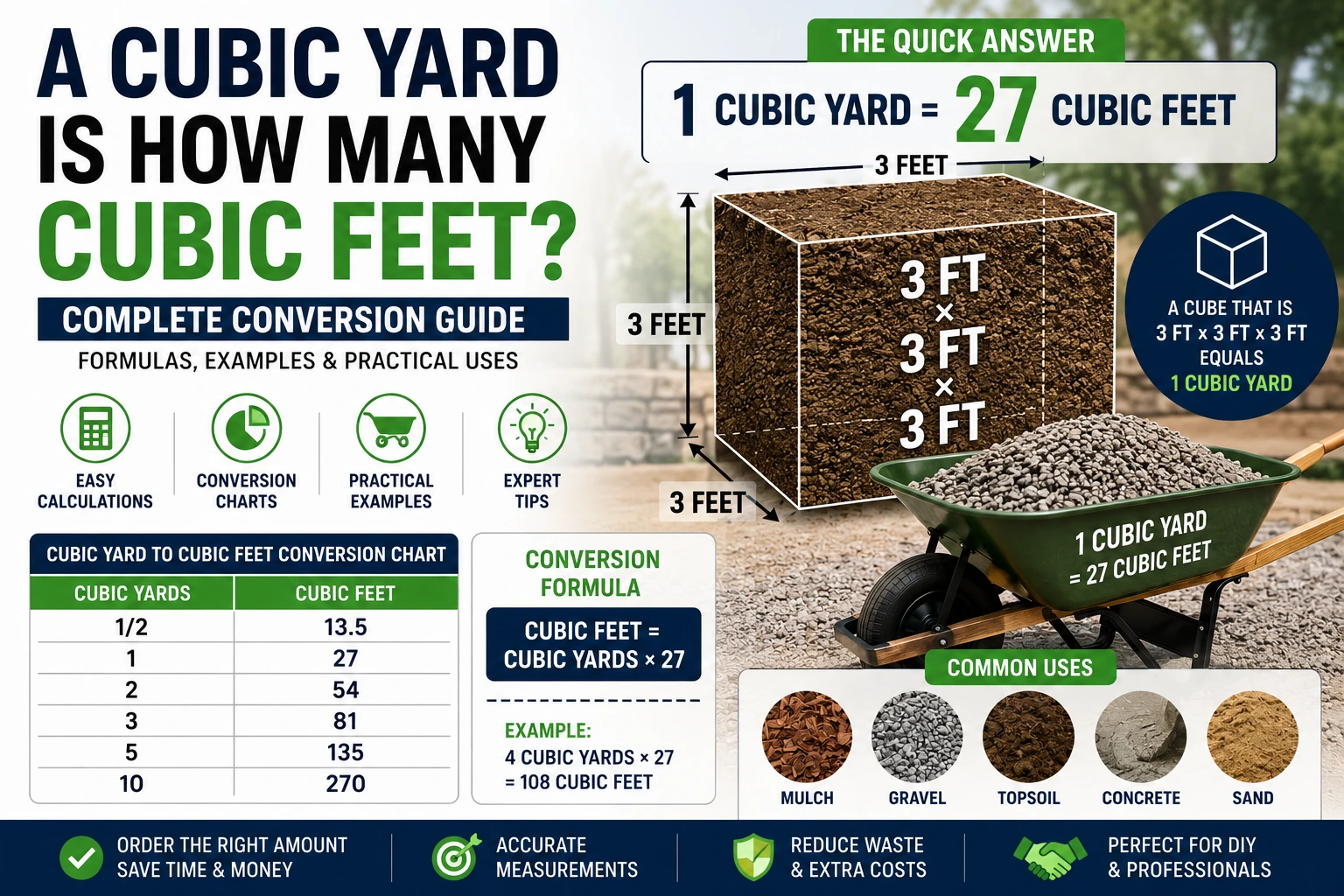
1 cubic yard = 27 cubic feet
This conversion is essential when estimating the amount of material needed for a project. Whether you’re filling a raised garden bed, pouring a concrete slab, or spreading decorative gravel, understanding how cubic yards convert to cubic feet helps you buy the right amount and avoid unnecessary costs.
In this guide, you’ll learn the conversion formula, practical examples, comparison charts, and expert tips for accurately measuring materials.
Quick Answer
One cubic yard equals:
| Unit | Equivalent |
|---|---|
| Cubic Feet | 27 cubic feet |
| Cubic Inches | 46,656 cubic inches |
| Cubic Meters | Approximately 0.765 cubic meters |
Remember:
1 Cubic Yard = 27 Cubic Feet
This conversion never changes, regardless of whether you’re measuring soil, gravel, mulch, concrete, or sand.
What Is a Cubic Yard?
A cubic yard is a unit of volume, not length or area.
It measures the amount of three-dimensional space something occupies.
Imagine a cube that measures:
- 3 feet long
- 3 feet wide
- 3 feet high
That cube equals exactly 1 cubic yard.
This unit is commonly used because many landscaping and construction materials are purchased by volume.
Common materials sold by the cubic yard include:
- Topsoil
- Gravel
- Sand
- Mulch
- Concrete
- Compost
- Decorative stone
Understanding Volume
Many people confuse volume with length or area.
Here’s a simple comparison.
| Measurement | What It Measures |
|---|---|
| Foot | Length |
| Square Foot | Area |
| Cubic Foot | Volume |
| Cubic Yard | Larger Volume |
For example:
- A foot measures how long something is.
- A square foot measures surface area.
- A cubic foot measures how much space something occupies.
- A cubic yard is simply a larger volume measurement.
Understanding this difference helps avoid mistakes when ordering bulk materials.
Cubic Yard vs Cubic Foot
Although both measure volume, they are not the same size.
| Unit | Volume |
|---|---|
| 1 Cubic Foot | 1 cubic foot |
| 1 Cubic Yard | 27 cubic feet |
Why?
Because:
1 yard equals 3 feet.
A cubic yard measures three dimensions:
3 × 3 × 3 = 27
That’s why one cubic yard always contains 27 cubic feet.
A Cubic Yard Is How Many Cubic Feet?
The exact answer is:
1 Cubic Yard = 27 Cubic Feet
This is the standard conversion used throughout:
- Construction
- Landscaping
- Gardening
- Home improvement
- Material estimation
Whenever you need to convert cubic yards into cubic feet, simply multiply by 27.
Conversion Formula
Use this simple equation:
Cubic Feet = Cubic Yards × 27
Examples:
| Cubic Yards | Cubic Feet |
|---|---|
| 1 | 27 |
| 2 | 54 |
| 3 | 81 |
| 4 | 108 |
| 5 | 135 |
| 10 | 270 |
This formula works every time.
Step-by-Step Calculation
Suppose you need to convert 1 cubic yard.
Step 1:
Remember:
1 yard = 3 feet
Step 2:
Multiply all three dimensions:
3 × 3 × 3
Step 3:
Answer:
27 cubic feet
Now let’s try another example.
Convert 4 cubic yards.
Formula:
4 × 27
Answer:
108 cubic feet
The process remains the same regardless of the number of cubic yards.
Cubic Yard to Cubic Feet Conversion Chart
Use this table for quick conversions.
| Cubic Yards | Cubic Feet |
|---|---|
| 0.25 | 6.75 |
| 0.5 | 13.5 |
| 0.75 | 20.25 |
| 1 | 27 |
| 2 | 54 |
| 3 | 81 |
| 4 | 108 |
| 5 | 135 |
| 6 | 162 |
| 7 | 189 |
| 8 | 216 |
| 9 | 243 |
| 10 | 270 |
This chart is especially helpful when ordering landscaping materials.
Visualizing One Cubic Yard
Understanding the numbers is useful, but visualizing one cubic yard makes estimating materials much easier.
Imagine a large cube with dimensions of:
- 3 feet long
- 3 feet wide
- 3 feet high
That cube contains exactly:
27 cubic feet
Another way to picture it is by comparing it to familiar objects.
One cubic yard is roughly comparable in volume to:
- A large household washing machine
- A full-size refrigerator
- Several loaded wheelbarrows (depending on wheelbarrow capacity)
- A stack of moving boxes arranged in a 3-foot cube
Although it may not seem enormous, one cubic yard holds a significant amount of material.
Practical Uses of Cubic Yard Measurements
Cubic yards are used every day in many industries because they simplify the measurement of bulk materials.
Landscaping
Landscapers commonly purchase:
- Mulch
- Decorative stone
- Gravel
- Bark
- Compost
- Topsoil
Using cubic yards makes estimating large projects much easier.
Construction
Builders frequently order materials by the cubic yard.
Examples include:
- Concrete
- Sand
- Fill dirt
- Crushed stone
- Base material
Contractors rely on cubic yard measurements for accurate project planning and budgeting.
Gardening
Gardeners often buy:
- Raised-bed soil
- Compost
- Organic mulch
- Garden mix
Knowing the cubic yard conversion helps prevent overordering or running short of materials.
Home Improvement
Homeowners use cubic yard calculations when:
- Installing patios
- Building retaining walls
- Leveling yards
- Filling low spots
- Creating drainage systems
Accurate volume estimates save both time and money.
Real-Life Examples
Understanding real-world calculations makes the conversion much easier.
Example 1: Mulch
A landscaping supplier delivers 1 cubic yard of mulch.
You receive:
27 cubic feet of mulch
If your flower beds require 27 cubic feet, one cubic yard is exactly enough.
Example 2: Gravel
A walkway project requires:
54 cubic feet of gravel.
Calculation:
54 ÷ 27 = 2 cubic yards
You’ll need to order 2 cubic yards.
Example 3: Concrete
A small concrete slab requires:
81 cubic feet of concrete.
Calculation:
81 ÷ 27 = 3 cubic yards
Your concrete order should be 3 cubic yards.
Example 4: Garden Soil
A raised garden bed needs approximately 13.5 cubic feet of soil.
Since:
13.5 cubic feet = 0.5 cubic yard
You would order approximately half a cubic yard.
Coverage Chart: How Much Area Does 1 Cubic Yard Cover?
Although 1 cubic yard always equals 27 cubic feet, the amount of ground it covers depends on how deeply the material is spread.
The thicker the layer, the smaller the coverage area.
| Material Depth | Approximate Coverage |
|---|---|
| 1 inch | 324 square feet |
| 2 inches | 162 square feet |
| 3 inches | 108 square feet |
| 4 inches | 81 square feet |
| 5 inches | 65 square feet |
| 6 inches | 54 square feet |
This chart is useful when ordering mulch, gravel, sand, compost, or topsoil.
Estimating Materials for Common Projects
Knowing that a cubic yard is 27 cubic feet helps you accurately estimate materials for landscaping and construction projects.
Mulch
Mulch is commonly spread 2–4 inches deep around plants and flower beds.
Example:
A flower bed measures:
- Length: 18 feet
- Width: 9 feet
Area:
18 × 9 = 162 square feet
If you spread mulch 2 inches deep, you’ll need approximately 1 cubic yard.
Topsoil
Topsoil is often applied 3–6 inches deep for lawns and gardens.
Example:
A garden bed covering 108 square feet at a depth of 3 inches requires approximately 1 cubic yard of topsoil.
Gravel
Gravel is frequently used for:
- Driveways
- Walkways
- Drainage systems
- Decorative landscaping
One cubic yard covers approximately:
- 108 square feet at 3 inches deep
- 81 square feet at 4 inches deep
Always calculate the desired depth before placing your order.
Sand
Sand is commonly used for:
- Paver bases
- Children’s play areas
- Leveling surfaces
- Masonry work
Like gravel and mulch, its coverage depends on the installation depth.
Concrete
Concrete requires accurate volume calculations because once mixed and poured, adjustments can be costly.
Example:
A slab measuring:
- Length: 9 feet
- Width: 6 feet
- Thickness: 6 inches (0.5 feet)
Calculation:
9 × 6 × 0.5 = 27 cubic feet
You’ll need exactly 1 cubic yard of concrete.
Material Comparison Table
Many bulk materials are sold by the cubic yard because it simplifies ordering and transportation.
| Material | Sold by Cubic Yard? | Common Uses |
|---|---|---|
| Mulch | ✔ Yes | Landscaping |
| Gravel | ✔ Yes | Driveways and paths |
| Sand | ✔ Yes | Pavers and leveling |
| Topsoil | ✔ Yes | Gardens and lawns |
| Concrete | ✔ Yes | Foundations and slabs |
| Compost | ✔ Yes | Soil improvement |
| Decorative Stone | ✔ Yes | Landscape design |
No matter which material you purchase, 1 cubic yard always equals 27 cubic feet.
Why Suppliers Use Cubic Yards
You may wonder why construction suppliers rarely sell materials by cubic feet.
There are several practical reasons.
Easier Bulk Ordering
Large projects often require hundreds of cubic feet of material.
Instead of ordering:
- 270 cubic feet
It’s much simpler to order:
- 10 cubic yards
This saves time and reduces confusion.
Industry Standard
Most suppliers, contractors, and engineers use cubic yards as the standard unit for bulk materials. Using a common unit helps ensure consistent estimates, quotes, and delivery schedules.
Equipment Capacity
Many trucks and loaders are rated by cubic yard capacity.
Typical examples include:
| Equipment | Approximate Capacity |
|---|---|
| Small dump truck | 5–7 cubic yards |
| Medium dump truck | 10–14 cubic yards |
| Large dump truck | 15–20 cubic yards |
Knowing the required number of cubic yards helps contractors schedule deliveries more efficiently.
Benefits of Understanding Cubic Yard Conversions
Learning how to convert cubic yards to cubic feet offers several practical advantages.
Order the Right Amount
Accurate calculations help prevent overordering or underordering materials.
Save Money
Buying too much material increases costs, while ordering too little can delay your project and require additional deliveries.
Improve Project Planning
Whether you’re installing a garden bed or pouring a concrete slab, knowing the correct volume makes planning much easier.
Communicate with Suppliers
Most landscaping and construction suppliers ask for quantities in cubic yards. Understanding the conversion ensures you can place orders confidently.
Common Mistakes to Avoid
Many DIY homeowners and first-time builders make simple measurement mistakes.
Confusing Feet with Cubic Feet
A foot measures length.
A cubic foot measures volume.
These are completely different units.
Forgetting the Third Dimension
Some people calculate:
3 × 3 = 9
Instead of:
3 × 3 × 3 = 27
Because a cubic yard measures length, width, and height, all three dimensions must be included.
Ignoring Material Depth
Coverage depends on the depth of the material.
One cubic yard covers much more ground at 2 inches than it does at 6 inches.
Always determine the required depth before ordering.
Guessing Instead of Measuring
Estimating without measuring often leads to:
- Material shortages
- Extra expenses
- Project delays
Measure carefully before calculating volume.
Expert Tips
Professionals follow a few best practices to ensure accurate material estimates.
Measure Carefully
Double-check all dimensions:
- Length
- Width
- Depth
Even a small measuring error can significantly affect the total volume.
Convert Inches to Feet
Depth is often measured in inches.
Convert it to feet before calculating:
- 2 inches = 0.17 feet
- 3 inches = 0.25 feet
- 4 inches = 0.33 feet
- 6 inches = 0.5 feet
Using consistent units improves accuracy.
Add a Small Extra Margin
Many contractors order slightly more material than the exact calculation requires to account for:
- Uneven surfaces
- Material settling
- Minor spills
- Measurement variations
A small buffer can prevent project interruptions.
Keep Units Consistent
Use feet for all measurements before calculating cubic feet or cubic yards. Mixing inches and feet without converting can lead to incorrect estimates.
FAQs
1. A cubic yard is how many cubic feet?
One cubic yard equals 27 cubic feet. This is because a cubic yard measures 3 feet × 3 feet × 3 feet, resulting in a volume of 27 cubic feet.
2. How do I convert cubic yards to cubic feet?
Multiply the number of cubic yards by 27.
For example:
- 2 cubic yards = 54 cubic feet
- 5 cubic yards = 135 cubic feet
3. Why do suppliers use cubic yards instead of cubic feet?
Cubic yards are easier for measuring and selling large quantities of bulk materials such as soil, gravel, mulch, and concrete. They are also the standard unit used in the construction and landscaping industries.
4. How much area does one cubic yard cover?
Coverage depends on the depth. At:
- 2 inches deep: about 162 square feet
- 3 inches deep: about 108 square feet
- 4 inches deep: about 81 square feet
5. What materials are commonly sold by the cubic yard?
Common materials include:
- Topsoil
- Mulch
- Gravel
- Sand
- Concrete
- Compost
- Decorative stone
Conclusion
If you’ve been asking a cubic yard is how many cubic feet, the answer is straightforward: 1 cubic yard equals 27 cubic feet. This conversion is a standard measurement used across landscaping, gardening, and construction projects. Understanding it helps you estimate materials accurately, compare supplier quotes, and avoid costly ordering mistakes.
Whether you’re spreading mulch, installing gravel, filling raised garden beds, or pouring concrete, knowing how to convert cubic yards to cubic feet ensures better planning and more efficient use of materials. By using the formulas, charts, and practical examples in this guide, you can confidently calculate the volume needed for projects of any size.
Discover more