
If you’re working on a landscaping, gardening, or construction project, you’ve probably asked yourself how many feet is 1 cubic yard. This is one of the most common questions when buying materials like mulch, soil, gravel, sand, or concrete.
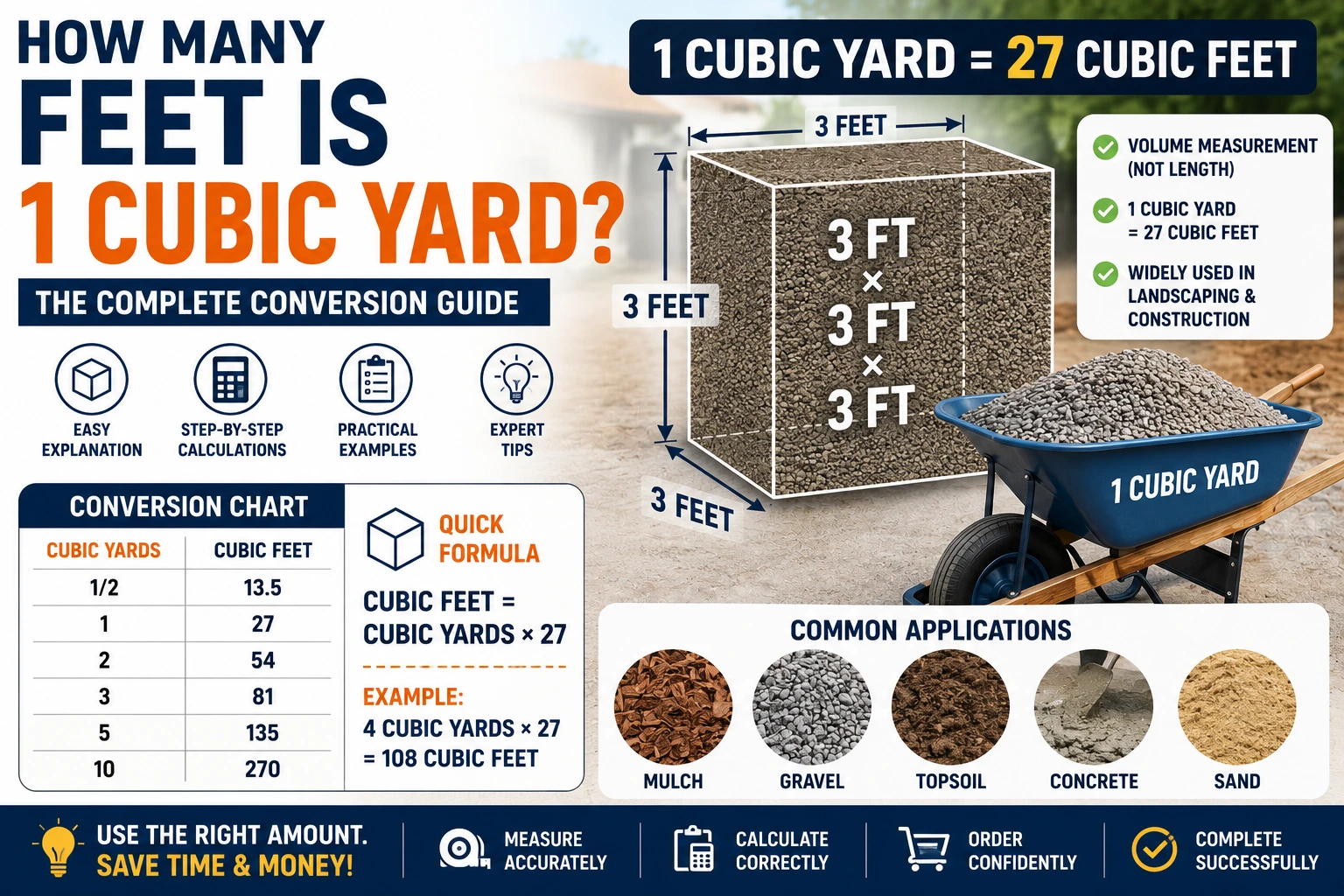
The simple answer is that 1 cubic yard equals 27 cubic feet.
Unlike regular feet, which measure length, a cubic yard measures volume the amount of three dimensional space an object or material occupies. Understanding this difference helps you order the correct amount of materials and avoid unnecessary costs.
In this guide, you’ll learn exactly how to convert cubic yards to cubic feet, understand the formulas, see practical examples, and discover how one cubic yard compares to everyday objects.
Quick Answer
One cubic yard equals:
| Measurement | Value |
|---|---|
| Cubic Feet | 27 cubic feet |
| Cubic Inches | 46,656 cubic inches |
| Cubic Meters | Approximately 0.765 cubic meters |
The conversion is based on the fact that:
- 1 yard = 3 feet
Since a cubic yard measures volume, all three dimensions are multiplied:
3 ft × 3 ft × 3 ft = 27 cubic feet
What Is a Cubic Yard?
A cubic yard is a unit used to measure volume.
Instead of measuring only length or width, it measures the amount of three-dimensional space something occupies.
Imagine a box that measures:
- 3 feet long
- 3 feet wide
- 3 feet high
That box contains exactly 1 cubic yard.
This unit is widely used because many construction and landscaping materials are sold by volume rather than by weight.
Examples include:
- Concrete
- Gravel
- Mulch
- Topsoil
- Sand
- Compost
- Decorative stone
Understanding Volume Measurements
Many people confuse length with volume.
Here’s the difference.
| Measurement Type | Measures |
|---|---|
| Foot | Length |
| Square Foot | Area |
| Cubic Foot | Volume |
| Cubic Yard | Larger volume |
Think of it this way:
- Feet tell you how long something is.
- Square feet tell you how much floor space something covers.
- Cubic feet and cubic yards tell you how much material fits inside a space.
This distinction is important when ordering bulk materials.
Cubic Yard vs. Cubic Foot
A cubic foot is much smaller than a cubic yard.
Here’s a comparison.
| Unit | Volume |
|---|---|
| 1 Cubic Foot | 1 cubic foot |
| 1 Cubic Yard | 27 cubic feet |
Because:
1 yard equals 3 feet.
So:
3 × 3 × 3 = 27
This conversion remains the same regardless of the material being measured.
How Many Feet Is 1 Cubic Yard?
The exact answer is:
1 cubic yard = 27 cubic feet
Many people ask this question expecting a measurement in linear feet, but it’s important to understand that a cubic yard cannot be converted directly into regular feet because they measure different things.
- Feet measure length.
- Cubic yards measure volume.
The correct conversion is:
1 cubic yard = 27 cubic feet
This is the standard measurement used in construction, landscaping, and home improvement projects.
Conversion Formula
To convert cubic yards into cubic feet, use this simple formula:
Cubic Feet = Cubic Yards × 27
Examples:
| Cubic Yards | Cubic Feet |
|---|---|
| 1 | 27 |
| 2 | 54 |
| 3 | 81 |
| 5 | 135 |
| 10 | 270 |
This formula works every time because one cubic yard always contains 27 cubic feet.
Step-by-Step Calculation
Let’s calculate the volume of one cubic yard.
Dimensions:
- Length = 3 feet
- Width = 3 feet
- Height = 3 feet
Calculation:
3 × 3 × 3 = 27 cubic feet
That’s all there is to it.
Whenever you see “one cubic yard,” picture a cube measuring three feet on each side.
Cubic Yard to Cubic Feet Conversion Chart
Use this table for quick conversions.
| Cubic Yards | Cubic Feet |
|---|---|
| 0.5 | 13.5 |
| 1 | 27 |
| 1.5 | 40.5 |
| 2 | 54 |
| 3 | 81 |
| 4 | 108 |
| 5 | 135 |
| 6 | 162 |
| 7 | 189 |
| 8 | 216 |
| 9 | 243 |
| 10 | 270 |
This chart is especially useful when ordering landscaping or construction materials.
Visualizing One Cubic Yard
Numbers are helpful, but visualizing the size of one cubic yard makes it easier to estimate materials.
Imagine a large cube measuring:
- 3 feet long
- 3 feet wide
- 3 feet tall
That equals 27 cubic feet.
You can also compare one cubic yard to familiar objects.
Approximate comparisons:
- A standard household washing machine
- A large refrigerator
- Several large wheelbarrow loads (depending on wheelbarrow size)
- A cube nearly as tall as a kitchen countertop
Although it doesn’t seem huge, one cubic yard contains a surprising amount of material.
Common Uses for One Cubic Yard
Many industries use cubic yards because they simplify ordering bulk materials.
Landscaping
Landscapers frequently purchase materials by the cubic yard, including:
- Mulch
- Decorative rock
- Topsoil
- Compost
- Bark chips
Buying the correct volume reduces waste and saves money.
Construction
Construction projects commonly measure:
- Concrete
- Gravel
- Fill dirt
- Crushed stone
- Sand
Most suppliers sell these materials by the cubic yard.
Gardening
Home gardeners often purchase:
- Garden soil
- Compost
- Raised-bed mix
- Organic mulch
Knowing the conversion helps estimate how much material is needed.
Home Improvement
DIY homeowners use cubic yards for projects such as:
- Building patios
- Installing walkways
- Leveling yards
- Filling planting beds
- Creating drainage systems
Accurate measurements help prevent ordering too much—or too little—material.
Practical Examples
Understanding real-world situations makes cubic yard calculations much easier.
Example 1: Mulch
Suppose you order 1 cubic yard of mulch.
You’ll receive:
27 cubic feet
If your flower bed needs 27 cubic feet of mulch, one cubic yard is exactly enough.
Example 2: Gravel
A driveway repair requires:
27 cubic feet of gravel.
Instead of ordering gravel by cubic feet, suppliers typically sell it by the cubic yard.
You’ll order:
1 cubic yard
Example 3: Concrete
A contractor estimates a small slab requires:
54 cubic feet of concrete.
Using the conversion formula:
54 ÷ 27 = 2 cubic yards
Ordering by cubic yards makes purchasing bulk concrete much easier.
Example 4: Soil
A raised garden bed requires approximately 13.5 cubic feet of soil.
Since:
13.5 cubic feet = 0.5 cubic yard
You would need about half a cubic yard of soil.
Material Comparison: How Much Does 1 Cubic Yard Cover?
Although 1 cubic yard always equals 27 cubic feet, the area it covers depends on the depth at which the material is spread.
The deeper the material, the less area it covers.
| Depth | Approximate Coverage |
|---|---|
| 1 inch | 324 square feet |
| 2 inches | 162 square feet |
| 3 inches | 108 square feet |
| 4 inches | 81 square feet |
| 5 inches | 65 square feet |
| 6 inches | 54 square feet |
This chart is especially useful for landscaping projects involving mulch, gravel, or topsoil.
Estimating Materials for Different Projects
Knowing that 1 cubic yard equals 27 cubic feet helps you estimate the amount of material needed for various home improvement and construction jobs.
Mulch
Mulch is commonly spread 2–4 inches deep.
Example:
A flower bed measures:
- Length: 18 feet
- Width: 9 feet
Area:
18 × 9 = 162 square feet
At a depth of 2 inches, you’ll need approximately 1 cubic yard of mulch.
Topsoil
Topsoil is typically spread 3–6 inches deep when preparing lawns or garden beds.
For example:
A 108-square-foot garden bed covered with 3 inches of topsoil requires approximately 1 cubic yard.
Gravel
Gravel is often used for:
- Walkways
- Driveways
- Drainage systems
- Decorative landscaping
One cubic yard covers approximately:
- 108 square feet at 3 inches deep
- 81 square feet at 4 inches deep
Sand
Sand is commonly used for:
- Paver bases
- Play areas
- Leveling surfaces
- Concrete mixes
Coverage depends on the depth required, using the same principles as other loose materials.
Concrete
Concrete projects usually require more precise calculations because once mixed and poured, adjustments are difficult.
For example:
A slab measuring:
- 9 feet long
- 6 feet wide
- 6 inches thick
Volume calculation:
9 × 6 × 0.5 = 27 cubic feet
You’ll need exactly 1 cubic yard of concrete.
Cubic Yard Comparison Chart
The table below compares one cubic yard of common materials.
| Material | Sold by Cubic Yard? | Common Uses |
|---|---|---|
| Mulch | ✔ Yes | Landscaping |
| Gravel | ✔ Yes | Driveways, paths |
| Sand | ✔ Yes | Pavers, leveling |
| Concrete | ✔ Yes | Foundations, slabs |
| Topsoil | ✔ Yes | Gardens, lawns |
| Compost | ✔ Yes | Soil improvement |
| Decorative Stone | ✔ Yes | Landscape design |
Regardless of the material, 1 cubic yard always equals 27 cubic feet.
Why Cubic Yards Are Used Instead of Cubic Feet
You may wonder why suppliers don’t simply sell materials in cubic feet.
There are several reasons.
Easier Bulk Ordering
Large landscaping and construction projects often require hundreds of cubic feet of material.
Ordering:
- 10 cubic yards
is much simpler than ordering:
- 270 cubic feet
Industry Standard
Most suppliers, contractors, and equipment operators use cubic yards as the standard unit for bulk materials.
This creates consistency across estimates, invoices, and delivery schedules.
Simplifies Equipment Loading
Many dump trucks and loaders are rated by cubic yard capacity.
For example:
- Small dump truck: 5–7 cubic yards
- Medium dump truck: 10–14 cubic yards
- Large dump truck: 15–20 cubic yards
Knowing the volume in cubic yards helps contractors schedule deliveries more efficiently.
Benefits of Understanding Cubic Yard Conversions
Learning how to convert cubic yards into cubic feet offers several practical advantages.
Order the Correct Amount
Accurate calculations reduce the risk of ordering too much or too little material.
Save Money
Bulk materials can be expensive.
Knowing the correct conversion helps avoid unnecessary costs.
Improve Project Planning
Whether you’re building a patio or installing a new garden, accurate measurements help projects run smoothly.
Communicate with Suppliers
Most landscaping suppliers ask for cubic yards rather than cubic feet.
Understanding the conversion makes ordering much easier.
Common Mistakes to Avoid
Many people misunderstand cubic yard measurements.
Avoid these common mistakes.
Confusing Feet with Cubic Feet
A foot measures length.
A cubic foot measures volume.
These are completely different measurements.
Forgetting There Are Three Dimensions
Some people multiply:
3 × 3
instead of:
3 × 3 × 3
Remember:
A cubic yard measures:
- Length
- Width
- Height
All three dimensions matter.
Ignoring Material Depth
Coverage depends on how deep the material is spread.
One cubic yard covers:
- More area at 2 inches
- Less area at 6 inches
Always calculate depth before ordering.
Ordering Without Measuring
Guessing almost always leads to:
- Extra expense
- Project delays
- Additional deliveries
Measure first.
Then calculate.
Finally, place your order.
Expert Tips
Professionals use a few simple strategies to improve accuracy.
Measure Carefully
Always double-check:
- Length
- Width
- Depth
Even small measurement errors can significantly affect the required volume.
Convert Inches to Feet
Depth is often measured in inches.
Before calculating volume, convert inches into feet.
Examples:
- 3 inches = 0.25 feet
- 4 inches = 0.33 feet
- 6 inches = 0.5 feet
Add a Small Safety Margin
Many contractors order slightly more material than the exact calculation suggests.
This helps account for:
- Uneven ground
- Spillage
- Compaction
- Minor measuring errors
Use Consistent Units
Keep all measurements in feet before calculating cubic feet or cubic yards.
Mixing feet and inches without converting first is one of the most common sources of error.
FAQs
1. How many feet is 1 cubic yard?
A cubic yard is a unit of volume, not length. 1 cubic yard equals 27 cubic feet, which represents a space measuring 3 feet × 3 feet × 3 feet.
2. Why can’t I convert a cubic yard directly into feet?
Feet measure length, while cubic yards measure volume. Because they describe different types of measurements, a direct conversion isn’t possible. The correct volume conversion is 1 cubic yard = 27 cubic feet.
3. How many cubic feet are in 2 cubic yards?
Multiply the number of cubic yards by 27:
2 × 27 = 54 cubic feet
4. How much area does 1 cubic yard cover?
Coverage depends on the material depth. At:
- 2 inches deep, it covers about 162 square feet
- 3 inches deep, about 108 square feet
- 4 inches deep, about 81 square feet
5. What materials are commonly sold by the cubic yard?
Materials typically sold by the cubic yard include:
- Mulch
- Topsoil
- Gravel
- Sand
- Concrete
- Compost
- Decorative stone
Conclusion
If you’ve been asking how many feet is 1 cubic yard, the correct answer is 27 cubic feet. A cubic yard measures volume, not length, and represents a cube that is 3 feet long, 3 feet wide, and 3 feet high. Understanding this conversion is essential for accurately estimating materials such as mulch, gravel, topsoil, sand, and concrete.
Whether you’re planning a landscaping project, pouring a concrete slab, or improving your garden, knowing how to convert cubic yards into cubic feet helps you order the right amount of material, avoid unnecessary expenses, and complete your project more efficiently. With the formulas, charts, and practical examples in this guide, you can confidently calculate volume requirements for projects of any size.
Discover more