
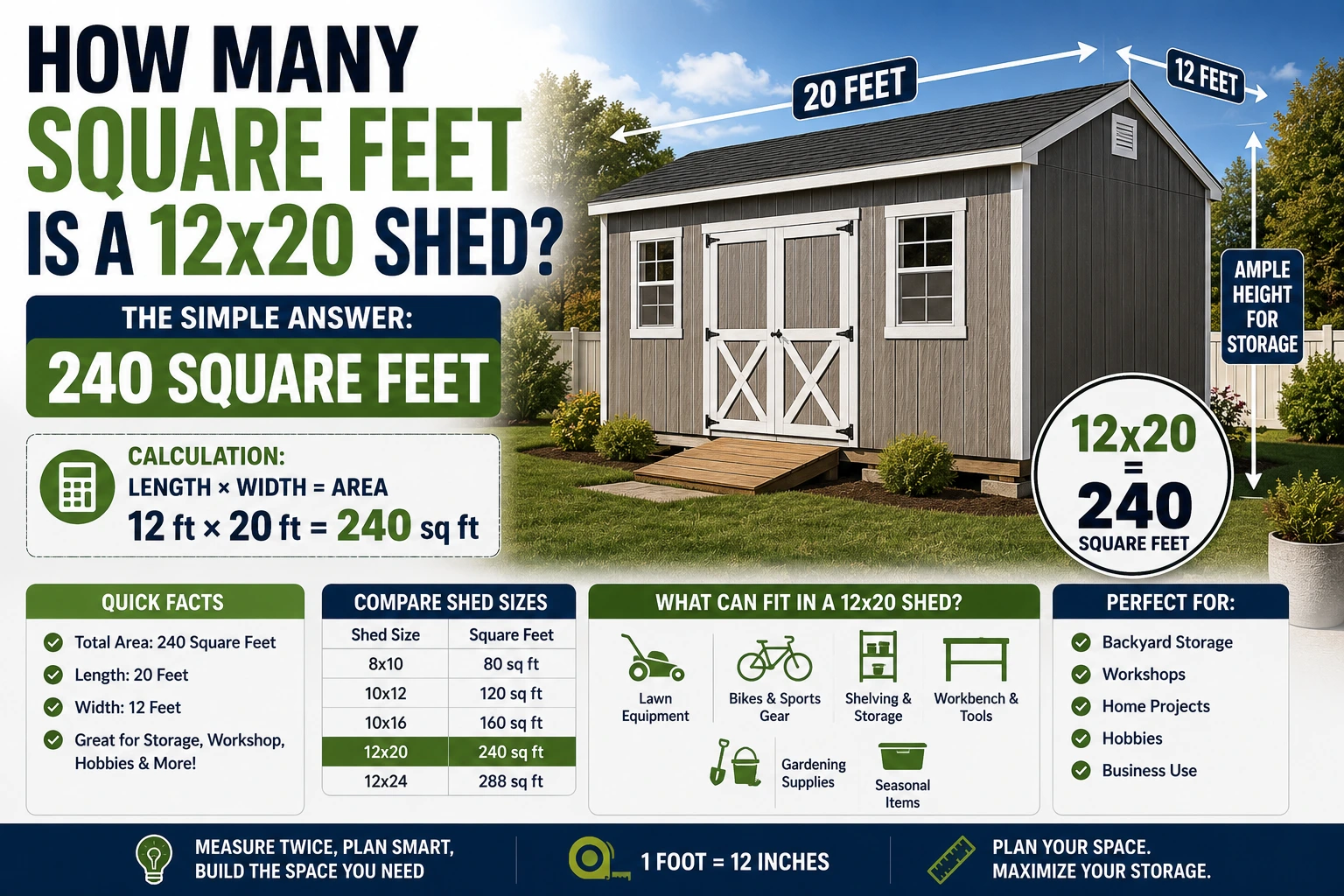
If you are wondering how many square feet is a 12×20 shed, the answer is 240 square feet.
The calculation is simple. A 12×20 shed has a width of 12 feet and a length of 20 feet. To find the floor area, multiply the two measurements:
12 × 20 = 240 square feet
So, a 12×20 shed provides 240 square feet of floor area based on its stated dimensions.
That is a substantial amount of space for a backyard shed. Depending on how you organize it, 240 square feet can accommodate garden equipment, lawn tools, bicycles, shelving, a workbench, seasonal items, or even a dedicated workshop area.
However, the actual usable space inside may be slightly smaller if the stated 12×20 dimensions describe the outside of the structure. Wall thickness, framing, doors, windows, and other features can reduce the interior floor area.
How Many Square Feet Is a 12×20 Shed?
A 12×20 shed has 240 square feet of area.
The formula for calculating the area of a rectangular shed is:
Length × Width = Square Feet
For a 12×20 shed:
20 feet × 12 feet = 240 square feet
Therefore:
12×20 shed = 240 square feet
The order of the measurements does not matter. You can multiply 12 by 20 or 20 by 12 and get the same result.
This calculation describes the rectangular floor area. It does not describe the volume of the shed or the amount of vertical storage available.
For example, a shed with 240 square feet of floor area and tall walls can provide more storage potential than a shed with the same floor area but lower walls.
How to Calculate the Square Footage of a 12×20 Shed
Calculating the square footage of a rectangular shed requires only basic multiplication.
Step 1 Identify the Length
The first measurement is 20 feet.
This is the longer dimension of the shed.
Step 2 Identify the Width
The second measurement is 12 feet.
This is the shorter dimension.
Step 3 Multiply Length by Width
Multiply the two measurements:
20 × 12 = 240
The result is:
240 square feet
Therefore, a 12×20 shed has a floor area of 240 square feet.
The same formula works for most rectangular sheds.
For example, a 10×12 shed has:
10 × 12 = 120 square feet
A 10×20 shed has:
10 × 20 = 200 square feet
A 12×24 shed has:
12 × 24 = 288 square feet
Once you know the length and width, finding the basic floor area is straightforward.
Understanding 12×20 Shed Dimensions
The term 12×20 usually refers to the basic width and length of the shed.
One side measures 12 feet, while the other measures 20 feet.
This creates a rectangular footprint.
The total footprint is:
12 feet × 20 feet = 240 square feet
However, it is important to understand that advertised shed dimensions may refer to different measurements depending on the manufacturer or builder.
Exterior Dimensions
If the 12×20 measurement represents the exterior dimensions, the outside footprint is approximately 240 square feet.
The interior floor area will normally be somewhat smaller because the walls and framing occupy some space.
For example, if the walls are several inches thick, the interior width and length will not be exactly 12 feet and 20 feet.
This difference can be important when planning shelving, workbenches, cabinets, or equipment.
Interior Dimensions
If a manufacturer specifically states that the interior floor measures 12 feet by 20 feet, then the usable floor area is 240 square feet before considering any permanent objects or interior features.
When purchasing or building a shed, always check whether the listed dimensions refer to exterior size or interior size.
This can prevent surprises when you start organizing the space.
12×20 Shed Square Footage Compared With Other Shed Sizes
A 12×20 shed is considerably larger than many common backyard storage sheds.
| Shed Size | Square Feet |
|---|---|
| 8×10 | 80 square feet |
| 8×12 | 96 square feet |
| 10×10 | 100 square feet |
| 10×12 | 120 square feet |
| 10×16 | 160 square feet |
| 10×20 | 200 square feet |
| 12×16 | 192 square feet |
| 12×20 | 240 square feet |
| 12×24 | 288 square feet |
| 16×20 | 320 square feet |
This comparison shows why a 12×20 shed can provide a significant amount of storage.
For example, it has twice the floor area of a 10×12 shed.
A 10×12 shed provides 120 square feet, while a 12×20 shed provides 240 square feet.
That additional floor space can make a major difference when you need room for large equipment or want to create separate storage and working areas.
How Much Storage Space Does a 12×20 Shed Provide?
A 240 square foot shed can provide plenty of storage, but the amount you can actually store depends on how efficiently you use the space.
Simply filling the floor with boxes is usually not the best approach.
Vertical storage can significantly increase your usable capacity.
Consider using:
• Wall mounted shelves
• Tall storage cabinets
• Pegboards
• Overhead storage
• Hooks for garden tools
• Bicycle racks
• Heavy duty shelving
• Corner storage
• Storage bins
• A dedicated workbench
Keeping frequently used items near the entrance can also make the shed easier to use.
Larger or heavier equipment can be placed toward the back if it is not needed often.
What Can You Fit in a 12×20 Shed?
The possibilities depend on your needs and the layout of the shed.
Garden Equipment
A 12×20 shed can provide enough room for many gardening supplies.
You could potentially store:
• Lawn tools
• Shovels
• Rakes
• Wheelbarrows
• Plant containers
• Soil bags
• Garden hoses
• Pruning equipment
Shelving can help keep smaller items organized while leaving the main floor open.
Lawn Equipment
The extra floor area can also accommodate larger lawn equipment.
Depending on the actual equipment and shed door size, you might have room for a lawn mower, snow blower, garden tractor, or other outdoor equipment.
Make sure the entrance is wide enough for the equipment you intend to move inside.
A large shed does not help if the doorway is too narrow for your largest item.
Workshop Tools
A 12×20 shed can also be used as a workshop.
You may have enough room for a workbench, tool storage, shelving, and equipment while maintaining a central walking area.
Good organization becomes increasingly important as you add tools.
Seasonal Storage
The shed can also be used for seasonal household storage.
Possible items include:
• Holiday decorations
• Patio furniture
• Bicycles
• Camping equipment
• Sports equipment
• Outdoor cushions
• Seasonal gardening supplies
Using labeled storage containers makes it easier to find items later.
12×20 Shed Layout Ideas
A good floor plan can make 240 square feet feel much more useful.
One approach is to divide the shed into functional zones.
For example, you could dedicate one wall to garden equipment and another wall to workshop tools.
A central walkway can provide easy access.
Another option is to place shelving around the perimeter and keep the middle area open for larger equipment.
If you plan to use the shed as a workshop, consider placing the workbench against a wall.
This leaves more open floor space for movement.
You should also consider door placement before finalizing the layout.
A door positioned on the short side can create a long central layout. A door positioned on the long side may make it easier to divide the interior into separate zones.
Is a 12×20 Shed Big Enough for a Workshop?
For many homeowners, a 12×20 shed can be large enough for a comfortable workshop.
With 240 square feet of floor area, there is room for more than just basic storage.
A workshop could include:
• Workbench
• Tool chest
• Shelving
• Hand tools
• Power tools
• Lumber storage
• Small machinery
• Workspace for projects
However, the actual setup depends on the type of work you plan to perform.
A woodworking workshop may require more open space because of long materials and machinery.
A small repair workshop may require less open floor space.
Think about your largest tools and materials first. Then plan the remaining storage around them.
Is a 12×20 Shed Big Enough for a Garage or Vehicle?
A 12×20 structure provides 240 square feet, but whether it can accommodate a vehicle depends on the vehicle dimensions, door opening, local regulations, and required clearance.
A typical vehicle may fit within the overall footprint of a structure of this size, but the available width can make vehicle access and door clearance important considerations.
You also need enough space to enter and exit the vehicle comfortably.
If your goal is vehicle storage, measure the vehicle itself and compare those measurements with the actual interior dimensions of the structure.
Do not rely only on the advertised shed size.
Usable Space Versus Total Square Footage
One of the most important things to understand is the difference between total floor area and usable storage area.
A 12×20 shed has a calculated area of 240 square feet.
However, you may not have 240 square feet of completely open floor space.
Walls occupy some area.
Doors require clearance.
Shelving and cabinets take up floor or wall space.
A workbench also occupies part of the room.
For this reason, the practical storage capacity depends on the design and organization of the shed.
The 240 square foot figure is the starting point, not necessarily the amount of open space available for storage.
Common Mistakes When Calculating Shed Square Footage
Several mistakes can lead to an incorrect estimate.
Confusing Square Feet With Linear Feet
A 12×20 shed has dimensions measured in feet, but its area is measured in square feet.
You must multiply the two dimensions.
Simply adding 12 and 20 gives 32 feet, not 240 square feet.
Using the Wrong Measurements
Make sure you know whether the measurements are interior or exterior.
This distinction can affect your actual available floor space.
Ignoring Irregular Features
If a shed has an extension, porch, alcove, or unusual shape, multiplying two measurements may not describe the entire structure.
In those cases, divide the floor plan into separate rectangular sections and calculate each area individually.
Forgetting Door Clearance
When planning storage, remember that doors need space to open.
Avoid placing permanent objects where they interfere with the door.
Tips for Getting the Most From a 12×20 Shed
A well organized shed can provide significantly more practical storage than a poorly organized one.
Use the walls whenever possible.
Tall shelves allow you to use vertical space instead of spreading everything across the floor.
Keep heavy items lower and frequently used tools within easy reach.
You can also group similar items together.
For example:
• Garden tools in one area
• Lawn equipment in another area
• Workshop tools near the workbench
• Seasonal items on higher shelves
• Small hardware in labeled containers
Leave enough space for safe movement.
A shed packed from floor to ceiling may technically contain many items, but it will be difficult to use.
12×20 Shed Planning Considerations
Before building or purchasing a 12×20 shed, think beyond the basic square footage.
Consider the following:
• Local building requirements
• Property setbacks
• Foundation requirements
• Door size
• Window placement
• Wall height
• Roof design
• Electrical needs
• Ventilation
• Lighting
• Insulation
• Interior storage
• Drainage around the structure
The foundation is especially important because the shed needs a stable and suitable base.
If you plan to store heavy machinery or use the building as a workshop, the foundation and floor system should be appropriate for the expected load.
You should also plan electrical outlets and lighting before the interior becomes crowded with storage.
Benefits of a 12×20 Shed
A 12×20 shed offers several practical advantages.
Large Floor Area
With 240 square feet, you have considerably more space than many basic storage sheds.
Flexible Use
The structure can potentially serve as storage, a workshop, hobby room, equipment building, or another functional space, depending on its construction and local requirements.
Better Organization
The additional floor area allows you to create separate zones for different types of belongings.
Room for Larger Equipment
The dimensions may accommodate larger outdoor equipment that would not fit comfortably in a smaller shed.
Potential Drawbacks of a 12×20 Shed
A larger shed also requires more planning.
It may cost more to build because it requires more materials.
The foundation may need to be larger and stronger.
You may also need to consider local permit requirements and property restrictions.
A larger structure can also take more time to organize and maintain.
Before choosing this size, consider whether you actually need 240 square feet.
If you only need basic garden storage, a smaller shed may be more practical.
FAQs
How many square feet is a 12×20 shed?
A 12×20 shed has 240 square feet of floor area. The calculation is 12 feet multiplied by 20 feet, which equals 240 square feet.
Is a 12×20 shed considered large?
Yes. A 12×20 shed provides 240 square feet, making it substantially larger than many common backyard storage sheds. It can provide room for equipment, storage, and potentially a workshop.
What can fit inside a 12×20 shed?
Depending on the layout, a 12×20 shed can hold garden equipment, lawn equipment, bicycles, seasonal items, shelving, tools, workbenches, and workshop equipment.
Is a 12×20 shed big enough for a workshop?
Yes, 240 square feet can provide enough space for many types of workshops. The best layout depends on the tools, equipment, materials, and working space you need.
How do you calculate the square footage of a shed?
For a rectangular shed, multiply the length by the width. For a 12×20 shed, multiply 12 by 20 to get 240 square feet.
Conclusion
If you are asking how many square feet is a 12×20 shed, the answer is 240 square feet.
The calculation is simple:
12 feet × 20 feet = 240 square feet
This gives you the basic floor area of the shed. However, the actual usable interior space can be somewhat smaller if the 12×20 dimensions describe the exterior of the building.
A 240 square foot shed provides plenty of flexibility. It can be used for garden equipment, lawn machinery, seasonal storage, bicycles, tools, or a workshop. With smart shelving, wall storage, and a well planned floor layout, you can make efficient use of the available space.
Before purchasing or building one, check the actual interior dimensions, door size, wall thickness, foundation requirements, and local building rules. These details can affect how much space you can practically use.
For the basic calculation, though, the answer is clear: a 12×20 shed has 240 square feet of floor area.
Discover more