

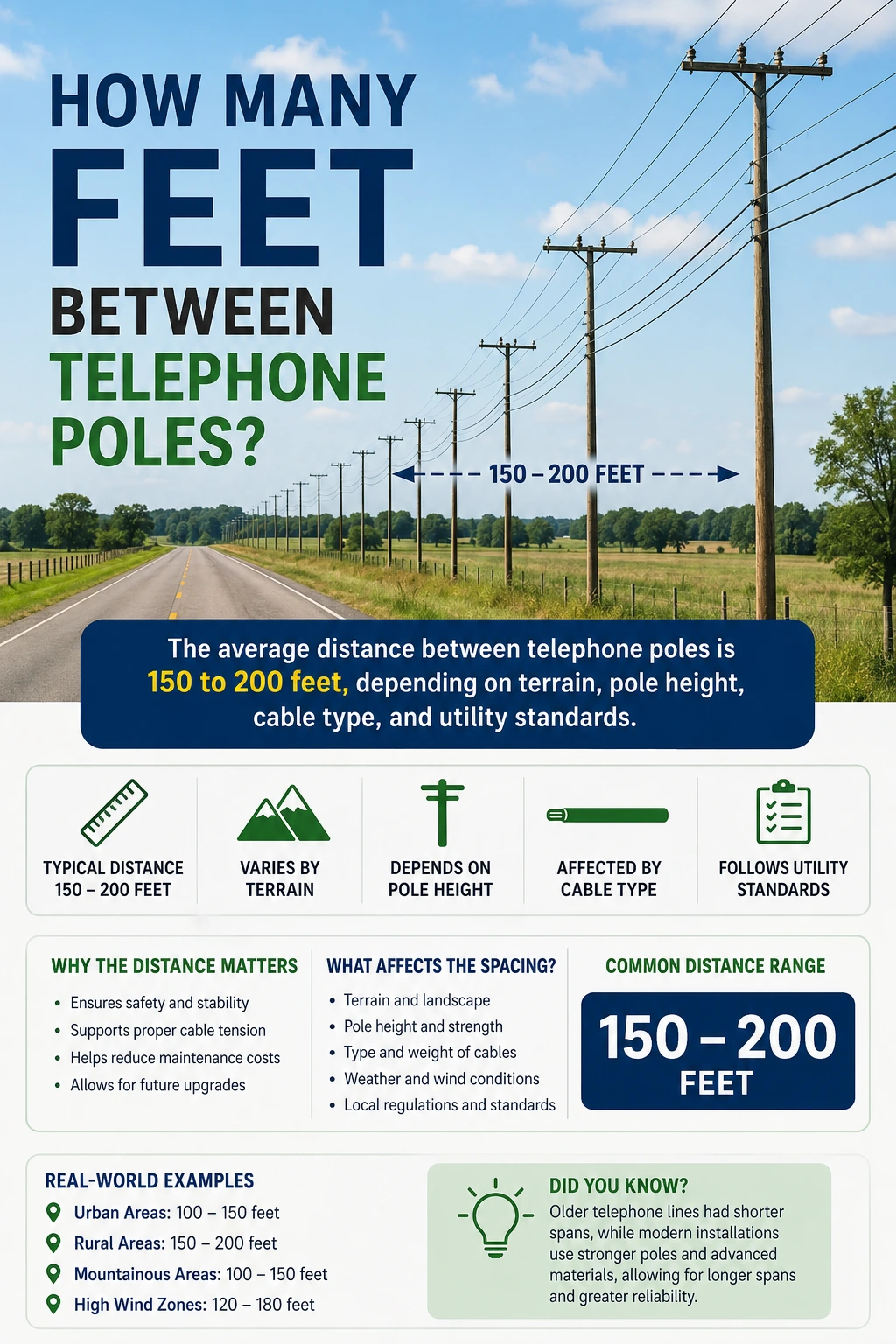
If you have ever driven down a road and looked at utility lines, you may have wondered: how many feet between telephone poles?
In most areas, the average distance between telephone poles is:
150 to 200 feet
However, the exact spacing depends on several factors, including:
- Terrain
- Pole height
- Cable type
- Weather conditions
- Utility regulations
Some poles are placed closer together in cities, while others are farther apart in rural areas.
In this guide, you will learn:
- Standard telephone pole spacing
- Why spacing matters
- How utility companies calculate distances
- Real-world examples
- Safety and engineering considerations
By the end, you will clearly understand how utility pole spacing works and why it varies.
What Is the Standard Distance Between Telephone Poles?
The standard spacing for telephone poles usually falls between:
150–200 feet
This range is common for:
- Telephone lines
- Local power distribution
- Cable and internet infrastructure
Typical Pole Spacing by Area
| Area Type | Average Pole Distance |
|---|---|
| Urban areas | 100–150 feet |
| Suburban areas | 125–175 feet |
| Rural areas | 150–200 feet |
| High-voltage lines | 300–1,000+ feet |
In many neighborhoods, you will notice poles appearing roughly every 150 feet along the road.
Why Telephone Pole Spacing Matters
Pole spacing is not random. Utility companies carefully calculate the distance between poles to ensure:
- Safety
- Stability
- Proper wire tension
- Cost efficiency
- Reliable electrical service
Too Much Distance Can Cause:
- Excessive wire sag
- Pole stress
- Higher wind damage risk
- Cable failure
Too Little Distance Can Cause:
- Higher installation costs
- Unnecessary maintenance
- Visual clutter
- More poles than needed
Finding the right balance is essential.
Factors That Affect Telephone Pole Distance
Several engineering and environmental factors determine how many feet between telephone poles are needed.
Terrain and Landscape
Terrain has a major impact on spacing.
Flat Land
On level ground, poles can usually be placed farther apart because:
- Wire tension remains stable
- Installation is easier
- Wind stress is lower
Hilly or Mountainous Areas
In rough terrain:
- Poles are often closer together
- Elevation changes increase cable stress
- Additional support is needed
Pole Height
Taller poles can support longer spans between installations.
Shorter Poles
Require:
- Closer spacing
- Less cable tension
Taller Poles
Allow:
- Longer distances
- Higher clearance for roads and buildings
Most telephone poles range from:
- 30 to 60 feet tall
Type of Utility Line
Different lines require different spacing.
| Utility Type | Typical Spacing |
|---|---|
| Telephone lines | 150–200 feet |
| Local power lines | 125–300 feet |
| High-voltage transmission | 500–1,000+ feet |
| Fiber optic cables | Varies by terrain |
Heavier cables often require shorter spans.
Weather Conditions
Strong weather conditions affect wire performance.
Wind
High winds place pressure on:
- Poles
- Crossarms
- Wires
Ice and Snow
Heavy ice increases cable weight, which may require:
- Stronger poles
- Reduced spacing
Areas with severe storms often use shorter distances for added reliability.
Local Regulations and Utility Standards
Utility companies follow engineering standards and government regulations.
Spacing must meet:
- Electrical safety codes
- Road clearance rules
- Utility company policies
These standards vary by country and region.
Average Pole Spacing in Different Areas
Let’s look at real-world examples of telephone pole spacing.
Urban Areas
In cities, poles are often:
- Closer together
- Shorter
- Surrounded by buildings and traffic
Typical spacing:
100–150 feet
This helps manage:
- Dense infrastructure
- Narrow streets
- Heavy utility demand
Rural Areas
Rural regions usually have:
- Longer stretches of open land
- Fewer obstacles
- Less infrastructure congestion
Typical spacing:
150–200 feet
Some rural power lines may stretch even farther.
Highway Installations
Telephone poles along highways are often spaced farther apart because:
- Roads are wider
- Pole height is greater
- Fewer obstacles exist
Spacing may reach:
- 200–300 feet
Telephone Pole Heights and Their Relationship to Spacing
Pole height directly impacts distance.
Common Pole Heights
| Pole Type | Average Height |
|---|---|
| Residential utility poles | 30–40 feet |
| Commercial poles | 40–50 feet |
| Transmission poles | 60–140 feet |
Why Height Matters
Taller poles:
- Reduce ground interference
- Improve wire clearance
- Support longer spans
However, taller poles also:
- Cost more
- Require stronger foundations
How Utility Companies Decide Pole Placement
Utility engineers use calculations and inspections before installing poles.
Step 1: Survey the Area
Engineers examine:
- Terrain
- Soil conditions
- Roads
- Buildings
Step 2: Calculate Cable Load
They estimate:
- Cable weight
- Wind pressure
- Ice accumulation
Step 3: Determine Wire Sag
All wires sag slightly between poles.
The amount of sag depends on:
- Temperature
- Cable material
- Span length
Longer Spans Create More Sag
Longer Span⇒More Wire Sag
This is why poles cannot be placed too far apart.
Step 4: Install According to Standards
Utility companies follow national safety guidelines and engineering standards.
Real World Examples of Telephone Pole Spacing
Here are some practical examples.
Neighborhood Streets
Typical spacing:
- Around 125–175 feet
These poles support:
- Electricity
- Internet cables
- Street lighting
Country Roads
Spacing:
- 150–250 feet
Open terrain allows wider spans.
Industrial Areas
Industrial locations often use:
- Taller poles
- Heavier cables
- Extra transformers
Spacing varies depending on power demand.
Comparing Telephone Poles to Power Transmission Towers
Many people confuse telephone poles with transmission towers.
Telephone Poles
Used for:
- Local electricity
- Internet
- Cable TV
- Telephone service
Spacing:
- Usually 150–200 feet
Transmission Towers
Used for:
- High-voltage power transport
Spacing:
- Often 500–1,500 feet apart
Transmission towers are much taller and stronger.
How to Estimate the Distance Between Telephone Poles
You can estimate spacing yourself using simple methods.
Walking Method
Average adult walking stride:
- About 2.5 feet
If you count 60 steps between poles:
60×2.5=150 feet
That means the poles are roughly 150 feet apart.
Vehicle Method
Use your car’s odometer while driving slowly.
Measure:
- Distance from one pole to the next
Mapping Tools
Google Maps and GIS tools can help estimate pole spacing from aerial views.
Common Mistakes When Measuring Pole Spacing
People often misunderstand utility pole distances.
Confusing Pole Height With Pole Distance
A 40-foot pole does not mean poles are 40 feet apart.
Ignoring Terrain Changes
Hills and curves can make spacing appear uneven.
Assuming Every Pole Uses the Same Distance
Different utilities use different spacing standards.
Forgetting Wire Sag
Wires always sag slightly between poles.
This affects:
- Clearance
- Safety
- Span length
Safety and Maintenance Considerations
Proper pole spacing improves public safety.
Benefits of Correct Spacing
Better Structural Stability
Poles experience less stress.
Reduced Outages
Strong spacing helps prevent storm damage.
Easier Maintenance
Utility crews can access poles safely.
Improved Wire Performance
Correct tension prevents cable damage.
Expert Tips for Understanding Utility Pole Layouts
Look at Pole Height
Taller poles usually indicate longer spans.
Observe Wire Thickness
Heavier cables require shorter distances.
Check Terrain
Steep areas often have closer pole spacing.
Understand Utility Types
Telephone, internet, and power lines may share the same poles.
FAQs
How many feet are usually between telephone poles?
Most telephone poles are spaced between 150 and 200 feet apart.
Why are some telephone poles closer together?
Poles may be closer due to:
- Hills
- Heavy cables
- Strong winds
- Urban infrastructure
Are power poles and telephone poles the same?
Not always. Many utility poles carry both power and communication lines, but transmission towers are different structures.
How tall is a typical telephone pole?
Most residential utility poles are:
- 30 to 40 feet tall
Can telephone poles be farther than 200 feet apart?
Yes. In some rural or transmission systems, spacing may exceed 300 feet depending on pole design and cable strength.
Conclusion
If you have wondered how many feet between telephone poles, the most common answer is:
- 150 to 200 feet apart
However, spacing changes based on:
- Terrain
- Pole height
- Cable type
- Weather conditions
- Utility standards
Urban poles are usually closer together, while rural poles may be spaced farther apart. Utility companies carefully calculate these distances to maintain safety, reliability, and efficient electrical service.
Understanding telephone pole spacing gives you a better appreciation of the engineering behind everyday infrastructure. Whether you are studying utilities, planning construction, or simply curious about roadside poles, knowing how these systems work can help you better understand the world around you.
Discover more