

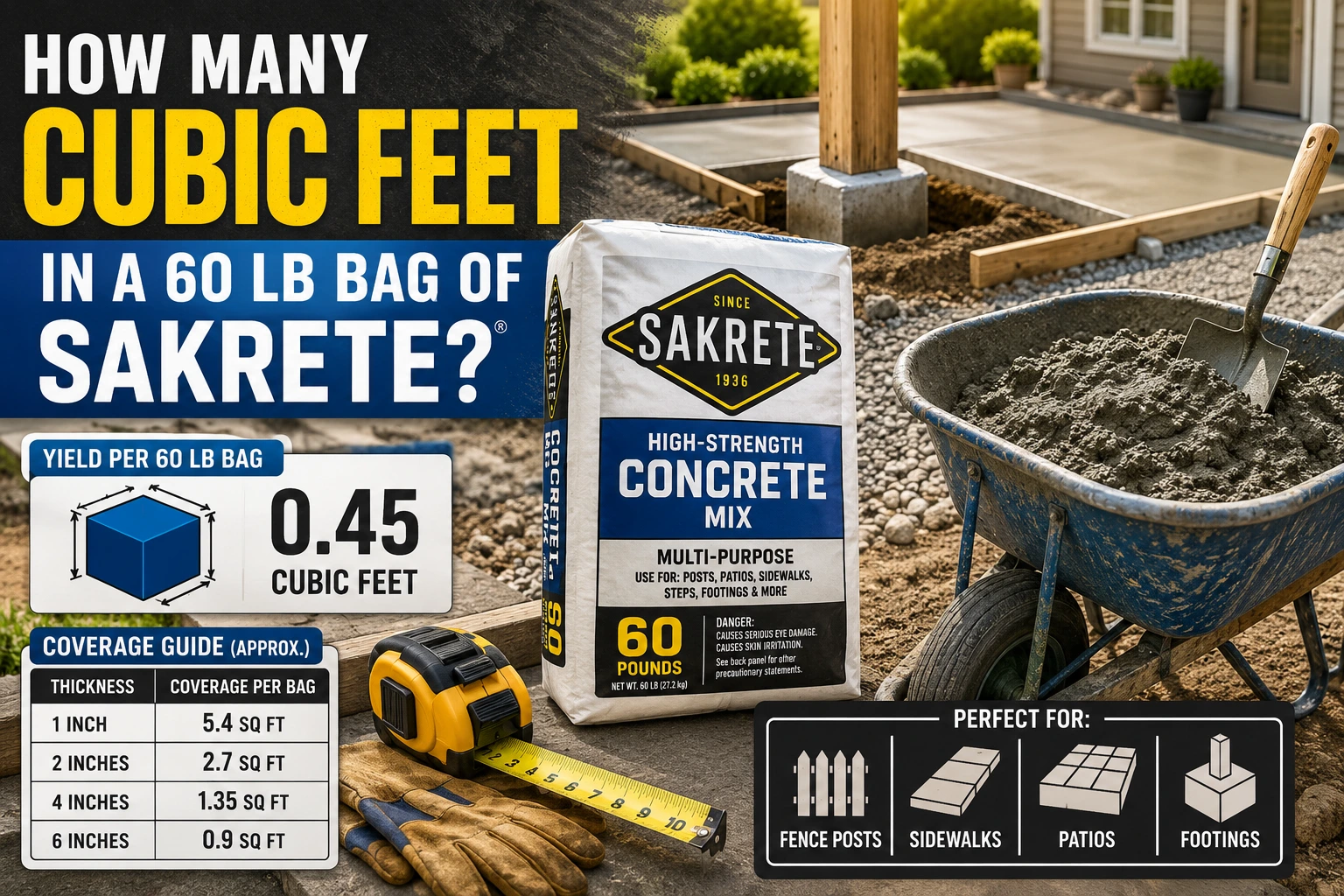
If you’re planning a concrete project, one of the first questions you’ll likely ask is: how many cubic feet in a 60 lb bag of Sakrete?
Knowing the yield of a concrete bag is essential for estimating materials, budgeting costs, and preventing project delays. Whether you’re installing fence posts, pouring a small slab, repairing a sidewalk, or building deck footings, understanding the volume produced by a 60-pound bag of Sakrete helps ensure you buy the right amount of concrete.
The short answer is:
A 60 lb bag of Sakrete concrete mix typically yields approximately 0.45 cubic feet of cured concrete when mixed according to the manufacturer’s instructions.
However, there is much more to know about concrete yield, coverage, and project planning. This guide explains everything you need to calculate your concrete needs accurately.
Quick Answer
For most standard Sakrete concrete mixes:
| Bag Size | Approximate Yield |
|---|---|
| 40 lb | 0.30 cubic feet |
| 60 lb | 0.45 cubic feet |
| 80 lb | 0.60 cubic feet |
Therefore:
A 60 lb bag of Sakrete yields approximately 0.45 cubic feet of concrete.
This number may vary slightly depending on the specific Sakrete product and the amount of water used during mixing.
Understanding Concrete Yield
Before calculating coverage, it’s important to understand what “yield” means.
What Is Concrete Yield?
Concrete yield refers to the amount of finished concrete produced after the dry mix is combined with water.
The bag weight itself does not indicate volume directly. Instead, manufacturers test their products and provide an estimated cured volume.
For example:
- 60 pounds of dry mix does not equal 60 pounds of finished concrete.
- Water activates the cement and fills voids.
- The finished concrete occupies a measurable volume.
That finished volume is called the yield.
Why Yield Matters
Knowing concrete yield helps you:
- Estimate material costs
- Prevent shortages
- Avoid purchasing too much material
- Calculate project coverage
- Plan transportation requirements
Even a small miscalculation can result in extra trips to the store or wasted materials.
How Many Cubic Feet in a 60 lb Bag of Sakrete?
The answer depends slightly on the specific product line, but most standard Sakrete concrete mixes produce:
Manufacturer Yield Specifications
| Product | Weight | Approximate Yield |
|---|---|---|
| Sakrete High Strength Concrete Mix | 60 lb | 0.45 cubic feet |
| Sakrete Maximizer | 60 lb | Up to 0.53 cubic feet |
| Standard Concrete Mix | 60 lb | About 0.45 cubic feet |
For general calculations, builders commonly use:
1 Bag (60 lb) = 0.45 Cubic Feet
This estimate works well for most residential and DIY projects.
Factors That Affect Actual Yield
Several factors can influence the final amount of concrete produced:
Water Content
Adding too much water can weaken concrete and slightly affect volume.
Mixing Technique
Improper mixing may create air pockets or uneven consistency.
Product Type
Different Sakrete formulations have different aggregate sizes and cement ratios.
Waste
Spillage and leftover material can reduce usable concrete.
For planning purposes, many contractors add a 5–10% waste allowance.
Coverage Chart for a 60 lb Bag of Sakrete
One cubic foot can cover different areas depending on thickness.
Since a 60 lb bag yields approximately 0.45 cubic feet, coverage varies based on depth.
Coverage at 1 Inch Thickness
A cubic foot contains 12 cubic inches of depth over one square foot.
Coverage calculation:
0.45 × 12 = 5.4 square feet
A 60 lb bag covers approximately:
5.4 square feet at 1 inch thick
Coverage at 2 Inches Thickness
At double the depth:
5.4 ÷ 2 = 2.7 square feet
Coverage:
2.7 square feet at 2 inches thick
Coverage at 4 Inches Thickness
At four inches thick:
5.4 ÷ 4 = 1.35 square feet
Coverage:
1.35 square feet at 4 inches thick
Quick Coverage Table
| Thickness | Coverage per 60 lb Bag |
|---|---|
| 1 inch | 5.4 sq ft |
| 2 inches | 2.7 sq ft |
| 3 inches | 1.8 sq ft |
| 4 inches | 1.35 sq ft |
| 6 inches | 0.9 sq ft |
How to Calculate Concrete Coverage
If you’re wondering exactly how many bags you’ll need, use a simple formula.
Step 1: Calculate Volume
Use:
Volume=Length×Width×Depth
Convert all dimensions to feet.
Step 2: Determine Cubic Feet Needed
Example slab:
- Length = 10 feet
- Width = 8 feet
- Thickness = 4 inches
Convert thickness:
4 inches = 0.333 feet
Volume:
10 × 8 × 0.333
= 26.64 cubic feet
Step 3: Divide by Yield Per Bag
Since each 60 lb bag yields 0.45 cubic feet:
26.64 ÷ 0.45 = 59.2
Round up:
60 bags required
Always round upward because partial bags cannot be purchased.
Comparing Sakrete Bag Sizes
Many shoppers compare bag sizes to find the most economical option.
40 lb vs 60 lb vs 80 lb Bags
| Bag Size | Yield | Relative Output |
|---|---|---|
| 40 lb | 0.30 cu ft | Small projects |
| 60 lb | 0.45 cu ft | Medium projects |
| 80 lb | 0.60 cu ft | Larger pours |
Advantages of 60 lb Bags
- Easier to lift than 80 lb bags
- Produces more concrete than 40 lb bags
- Popular for DIY projects
- Good balance between volume and handling
Many homeowners find the 60-pound size ideal for projects requiring multiple bags.
Common Projects and Bag Requirements
Understanding real-world examples makes planning easier.
Fence Posts
Typical hole:
- Diameter: 12 inches
- Depth: 24 inches
Volume:
Approximately 1.57 cubic feet
Required bags:
1.57 ÷ 0.45 = 3.5
Round up:
4 bags per fence post
Sidewalk Repair
Area:
- 3 ft × 3 ft
- 4 inches thick
Volume:
3 × 3 × 0.333
= 3 cubic feet
Required bags:
3 ÷ 0.45
= 6.67
Round up:
7 bags
Small Patio Slab
Dimensions:
- 8 ft × 8 ft
- 4 inches thick
Volume:
8 × 8 × 0.333
= 21.3 cubic feet
Required bags:
21.3 ÷ 0.45
= 47.3
Round up:
48 bags
Deck Footings
Typical footing:
- 12-inch diameter
- 36-inch depth
Volume:
Approximately 2.35 cubic feet
Required bags:
2.35 ÷ 0.45
= 5.2
Round up:
6 bags per footing
Common Mistakes When Estimating Concrete
Many DIYers underestimate the amount of concrete needed.
Ignoring Thickness
Small increases in depth can significantly increase required volume.
Forgetting Waste
Concrete spills happen.
Plan for:
- 5% extra for experienced installers
- 10% extra for beginners
Using Incorrect Measurements
Mixing inches and feet often causes major calculation errors.
Convert all dimensions before calculating.
Not Rounding Up
Always round to the next full bag.
Running short can interrupt a pour and create weak joints.
Expert Tips for Buying the Right Amount
Use a Safety Margin
Order 5–10% more concrete than calculations suggest.
Buy All Bags at Once
Different batches may vary slightly in color and consistency.
Check Product Specifications
Some specialty Sakrete products have different yields.
Always read the package label.
Consider Delivery for Large Projects
For projects requiring dozens of bags, ready-mix concrete may be more cost-effective than purchasing individual bags.
Store Bags Properly
Keep unused bags:
- Dry
- Elevated off the ground
- Protected from moisture
Moisture can ruin concrete mix before use.
Benefits of Using Sakrete Concrete Mix
Sakrete remains a popular choice because it offers:
- Consistent quality
- Widely available products
- Easy mixing
- Strong finished concrete
- Suitable options for DIY and professional use
For most residential applications, a 60 lb bag provides a practical balance between coverage and handling convenience.
9. FAQs
1. How many cubic feet in a 60 lb bag of Sakrete?
A standard 60 lb bag of Sakrete yields approximately 0.45 cubic feet of finished concrete.
2. How many 60 lb bags make one cubic yard?
One cubic yard equals 27 cubic feet.
27 ÷ 0.45 = 60
You will need approximately 60 bags.
3. How much area does a 60 lb bag cover?
At 1 inch thickness, a 60 lb bag covers about 5.4 square feet.
Coverage decreases as thickness increases.
4. Is a 60 lb bag better than an 80 lb bag?
A 60 lb bag is easier to handle, while an 80 lb bag provides more concrete per bag. The best choice depends on project size and lifting ability.
5. Should I buy extra concrete mix?
Yes. Most professionals recommend purchasing 5–10% extra to account for waste, uneven ground, and measurement errors.
10. Conclusion
If you’ve been asking how many cubic feet in a 60 lb bag of Sakrete, the standard answer is approximately 0.45 cubic feet of finished concrete per bag. This figure is essential for estimating project volume, calculating coverage, and determining how many bags you’ll need.
Whether you’re pouring fence posts, deck footings, sidewalk repairs, or a small patio slab, understanding concrete yield helps you avoid shortages and unnecessary expenses. By using the formulas and coverage charts in this guide, you can confidently plan your next project and purchase the correct amount of Sakrete concrete mix the first time.
discover more