

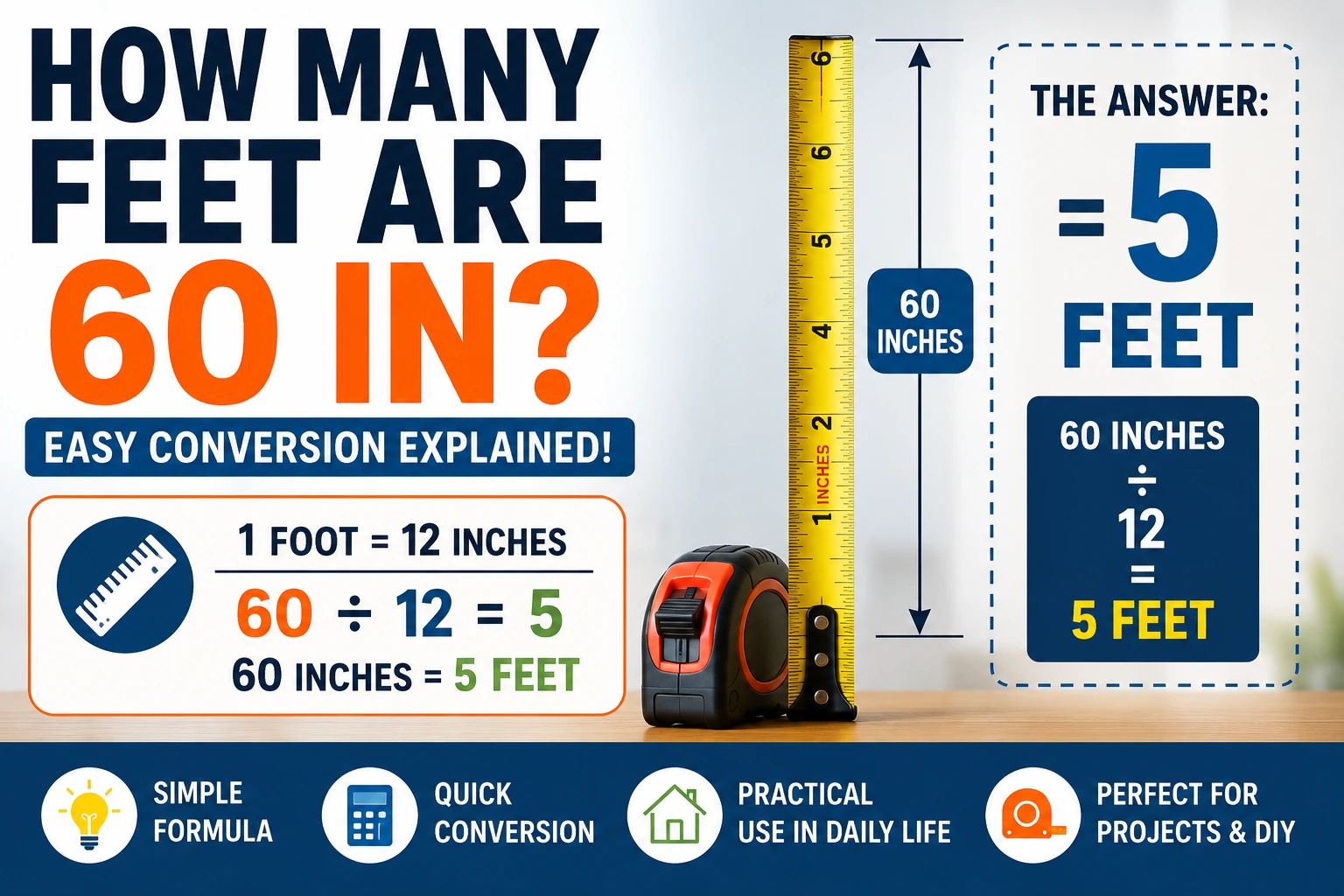
If you’re asking how many feet are 60 in, the answer is simple:
60 inches equals 5 feet.
This is one of the most common measurement conversions used in construction, home improvement, furniture shopping, interior design, and education.
Since feet and inches are both part of the imperial measurement system, converting between them is straightforward once you know the basic relationship:
1 foot = 12 inches
By dividing the number of inches by 12, you can quickly determine the equivalent measurement in feet.
In this complete guide, you’ll learn exactly how to convert 60 inches into feet, understand the conversion formula, explore real-world examples, and use conversion charts for other measurements.
Quick Answer
The direct conversion is:
60÷12=5
Answer:
60 inches = 5 feet
There are no remaining inches because 60 divides evenly by 12.
Understanding Inches and Feet
Before converting measurements, it helps to understand the units involved.
What Is an Inch?
An inch is a unit of length commonly used in:
- Construction
- Manufacturing
- Furniture dimensions
- Electronics
- Home improvement
The inch is represented by:
- in
- “
Example:
- 24 inches
- 36 inches
- 60 inches
What Is a Foot?
A foot is another unit of length in the imperial system.
A foot contains:
1 foot=12 inches
The symbol for feet is:
- ft
- ‘
Examples:
- 5 feet
- 6 feet
- 10 feet
Because a foot equals 12 inches, larger measurements are often easier to express in feet.
How Many Feet Are 60 In? Step-by-Step Calculation
Let’s work through the conversion manually.
Conversion Formula
The standard formula is:
Feet=12Inches
Solving the Calculation
Insert 60 inches into the formula:
60 ÷ 12 = 5
Therefore:
60 inches = 5 feet
This conversion is exact.
Inches to Feet Conversion Chart
The following chart helps convert common inch measurements into feet.
| Inches | Feet |
|---|---|
| 12 in | 1 ft |
| 24 in | 2 ft |
| 36 in | 3 ft |
| 48 in | 4 ft |
| 60 in | 5 ft |
| 72 in | 6 ft |
| 84 in | 7 ft |
| 96 in | 8 ft |
| 108 in | 9 ft |
| 120 in | 10 ft |
This chart is useful for quick reference when measuring furniture, walls, or building materials.
Why Convert Inches to Feet?
Many measurements are initially provided in inches, but feet are easier to understand for larger dimensions.
Construction Projects
Builders frequently convert inches into feet when working with:
- Lumber
- Drywall
- Framing materials
- Room dimensions
For example:
- 60 inches becomes 5 feet
- Easier to visualize and measure
Furniture Measurements
Furniture specifications often use inches.
Examples include:
- Sofas
- Beds
- Tables
- Cabinets
Knowing that 60 inches equals 5 feet helps determine whether furniture will fit in a room.
Interior Design
Interior designers regularly convert measurements when planning:
- Wall layouts
- Curtains
- Shelving
- Artwork placement
Feet provide a clearer overview of room proportions.
Education and Math
Students frequently encounter inch-to-foot conversions in:
- Basic mathematics
- Geometry
- Measurement lessons
- Science projects
Understanding the conversion formula simplifies many classroom problems.
Real-World Examples of 60 Inches
Many everyday objects are close to 60 inches in length or height.
Average Sofa Length
Many compact sofas measure approximately:
- 60 inches long
- 5 feet long
This makes 60 inches a familiar furniture dimension.
Television Width
Large televisions often approach:
- 55–60 inches wide
Converting these dimensions into feet helps homeowners plan wall placement.
Children’s Height
Some children between ages 9 and 12 may be around:
- 60 inches tall
- 5 feet tall
This comparison makes the measurement easy to visualize.
Bookshelves and Cabinets
Many shelving units and storage cabinets are:
- Around 60 inches tall
- Equal to 5 feet
This is a common size for residential furniture.
Comparing 60 Inches to Other Common Measurements
Seeing how 60 inches compares to other lengths provides better context.
| Measurement | Equivalent |
|---|---|
| 12 inches | 1 foot |
| 24 inches | 2 feet |
| 36 inches | 3 feet |
| 48 inches | 4 feet |
| 60 inches | 5 feet |
| 72 inches | 6 feet |
| 84 inches | 7 feet |
This progression shows how measurements increase in one-foot increments.
Compared to Human Height
A person who is:
- 5 feet tall
Measures exactly:
- 60 inches
This provides one of the easiest visual references.
Compared to a Door
A standard interior door is approximately:
- 80 inches tall
Compared to 60 inches:
- The door is 20 inches taller
This comparison helps estimate lengths without measuring tools.
Practical Uses for Knowing That 60 Inches Equals 5 Feet
Understanding this conversion is useful in many situations.
Shopping for Furniture
Before purchasing:
- Sofas
- Benches
- TV stands
Convert inches to feet to understand actual size.
Planning Room Layouts
Knowing dimensions in feet helps:
- Arrange furniture
- Maintain walking space
- Maximize room functionality
DIY Home Projects
When installing:
- Shelves
- Cabinets
- Artwork
Feet often provide a more convenient measurement scale.
Reading Product Specifications
Many products list dimensions in inches.
Quickly converting 60 inches to 5 feet helps you make informed buying decisions.
Common Mistakes When Converting Inches to Feet
Even simple conversions can cause confusion.
Forgetting That a Foot Contains 12 Inches
Some people mistakenly divide by:
- 10
- 100
The correct divisor is always:
12
Mixing Feet and Inches
Remember:
- Feet measure larger lengths
- Inches measure smaller lengths
Use the proper unit when communicating dimensions.
Rounding Unnecessarily
For 60 inches:
- Exact answer = 5 feet
No rounding is required.
Using Incorrect Conversion Charts
Always verify measurements using reliable formulas.
A small mistake can affect construction and design projects significantly.
Expert Tips for Quick Inch-to-Foot Conversions
Need a fast estimate?
Remember these common benchmarks:
| Inches | Feet |
|---|---|
| 12 | 1 |
| 24 | 2 |
| 36 | 3 |
| 48 | 4 |
| 60 | 5 |
| 72 | 6 |
Memorizing these values allows quick mental conversions.
Shortcut Method
Ask:
“How many groups of 12 are in the measurement?”
For 60 inches:
- 12 × 5 = 60
Answer:
5 feet
Summary: How Many Feet Are 60 In?
The answer is straightforward.
A measurement of:
60 inches
Converts to:
5 feet
The calculation is performed by dividing inches by 12.
This conversion is commonly used in:
- Construction
- Interior design
- Furniture shopping
- Education
- Home improvement
Understanding how inches and feet relate helps simplify everyday measurements.
Frequently Asked Questions
Is 60 inches equal to 5 feet?
Yes. Since 1 foot equals 12 inches, dividing 60 by 12 gives 5 feet.
How do I convert 60 inches into feet?
Use the formula:
Feet = Inches ÷ 12
60 ÷ 12 = 5
What is 60 inches in feet and inches?
60 inches equals exactly 5 feet and 0 inches.
Is 60 inches considered tall?
For a person, 60 inches equals 5 feet tall. Whether that is considered tall depends on age and context.
Why do people convert inches to feet?
Feet are easier to visualize and communicate when dealing with larger measurements such as furniture, room dimensions, and construction projects.
10. Conclusion
Final Thoughts
If you’re wondering how many feet are 60 in, the answer is simple: 60 inches equals 5 feet. By dividing inches by 12, you can quickly convert any inch measurement into feet.
Understanding this conversion is useful for home improvement projects, furniture shopping, education, construction, and everyday measurements. Whether you’re planning a room layout or reading product dimensions, knowing that 60 inches equals 5 feet makes measurements easier to understand and apply in real life.
Discover more