

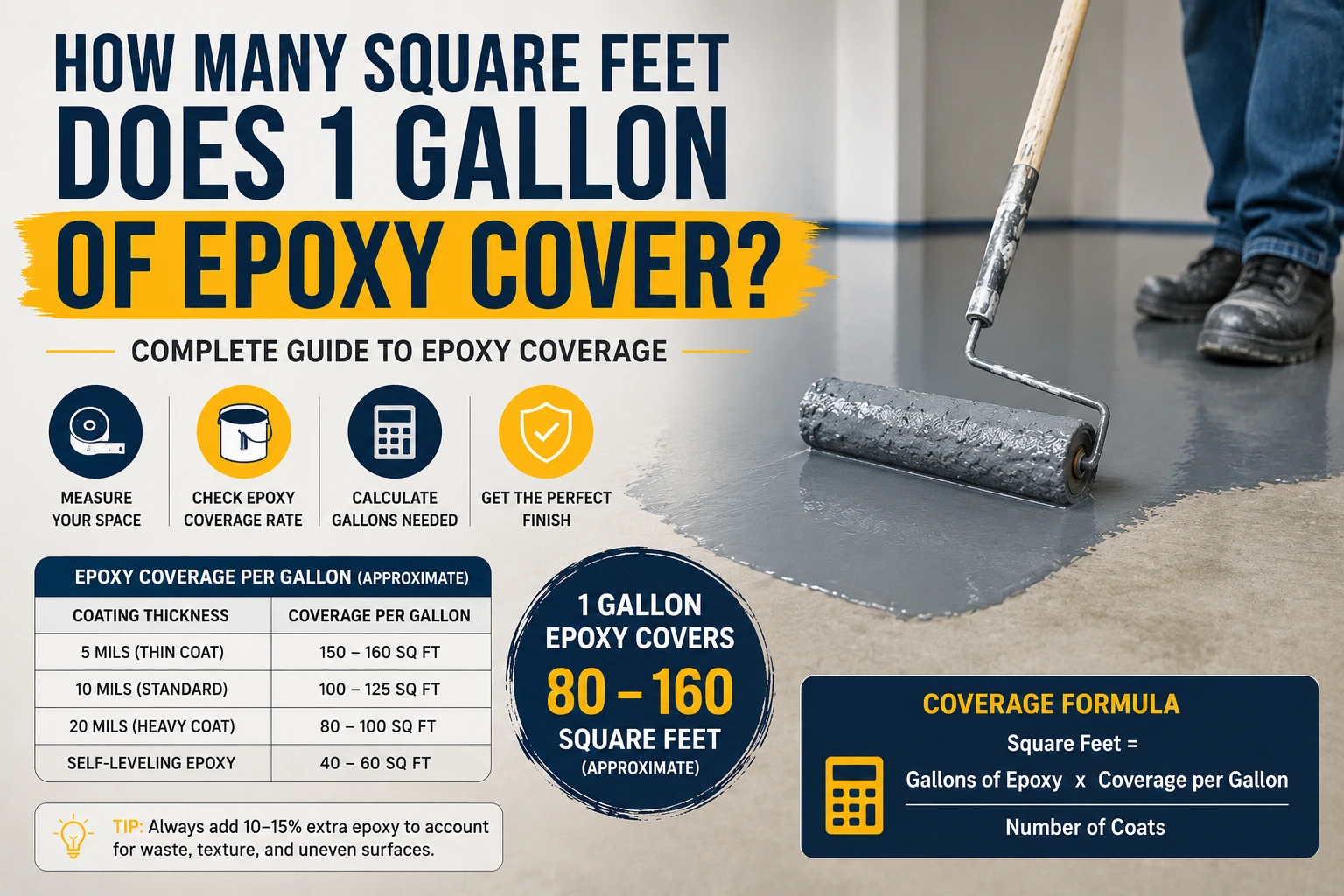
If you are planning a garage floor makeover, basement renovation, or countertop project, one of the first questions you will probably ask is: “How many square feet does 1 gallon of epoxy cover?”
The answer depends on several factors, including the type of epoxy, coating thickness, and surface condition. However, in most cases:
- 1 gallon of epoxy covers approximately 80 to 160 square feet.
Thin coats can stretch farther, while thicker applications cover less area. Understanding epoxy coverage helps you avoid buying too much or too little material.
In this detailed guide, you will learn how epoxy coverage works, how to calculate square footage, coverage charts, practical examples, and expert tips for achieving professional-looking results.
Understanding Epoxy Coverage Basics
Before calculating coverage, it helps to understand what epoxy is and why coverage rates vary.
What Is Epoxy?
Epoxy is a durable resin coating commonly used on:
- Garage floors
- Basement floors
- Warehouse surfaces
- Countertops
- Industrial flooring
- Decorative concrete
It creates a hard, glossy, and protective finish that resists:
- Moisture
- Chemicals
- Stains
- Scratches
Epoxy coatings are popular because they are long-lasting and visually appealing.
Why Coverage Varies
Not every gallon of epoxy covers the same amount of space. Coverage depends on:
- Surface texture
- Concrete porosity
- Application thickness
- Product type
- Number of coats
For example:
- Smooth surfaces require less epoxy
- Rough concrete absorbs more epoxy
- Thick coatings reduce coverage area
How Many Square Feet Does 1 Gallon of Epoxy Cover?
The average coverage for 1 gallon of epoxy is:
| Epoxy Type | Approximate Coverage |
|---|---|
| Thin coat epoxy | 150–160 sq ft |
| Standard floor epoxy | 100–125 sq ft |
| Thick self-leveling epoxy | 40–80 sq ft |
| Countertop epoxy | 50–60 sq ft |
In general:
- Thin coats cover more square footage
- Thick coatings provide more durability
Most homeowners use standard floor epoxy, which usually covers about 100 to 125 square feet per gallon.
Epoxy Coverage Formula Explained
You can estimate epoxy needs using a simple formula.
Simple Coverage Formula
Coverage Area=Desired ThicknessTotal Epoxy Volume
For most DIY projects, manufacturers provide coverage rates directly on the label.
Step-by-Step Calculation Example
Imagine you have:
- A 500 sq ft garage
- Epoxy covering 125 sq ft per gallon
The formula becomes:
500÷125=4
You would need:
- 4 gallons of epoxy
However, professionals often recommend buying 10–15% extra for waste and touch-ups.
Epoxy Coverage Chart
Here is a practical epoxy coverage chart.
| Epoxy Thickness | Coverage Per Gallon |
|---|---|
| 5 mil thin coat | 160 sq ft |
| 10 mil medium coat | 100–125 sq ft |
| 20 mil heavy coat | 80 sq ft |
| Self-leveling epoxy | 40–60 sq ft |
The thicker the application:
- The stronger the protection
- The lower the coverage area
Factors That Affect Epoxy Coverage
Many homeowners underestimate how surface conditions impact epoxy use.
Surface Texture
Rough concrete absorbs more epoxy than polished surfaces.
Examples:
- Smooth concrete = higher coverage
- Cracked concrete = lower coverage
Concrete Porosity
Porous concrete acts like a sponge.
Older floors may absorb:
- Primer
- Base coat
- Additional epoxy layers
This increases total epoxy usage.
Coating Thickness
A thick coating:
- Improves durability
- Hides imperfections
- Provides better chemical resistance
But it also reduces square footage coverage.
Application Method
Application tools affect coverage efficiency.
Rollers
- Most common
- Good for even application
Squeegees
- Used for thicker epoxy systems
Brushes
- Useful for edges and corners
Poor technique can waste material.
How to Calculate Epoxy Needed for Your Project
The easiest way to avoid shortages is by measuring carefully.
Step 1: Measure Square Footage
Use this formula:
Square Feet=Length×Width
Example:
- Garage = 20 ft × 25 ft
20×25=500
Total:
- 500 sq ft
Step 2: Check Product Coverage
Suppose the epoxy states:
- 125 sq ft per gallon
Step 3: Divide Total Area by Coverage
500÷125=4
You need:
- 4 gallons
Step 4: Add Extra Material
Always purchase:
- 10–15% more epoxy
This covers:
- Spills
- Uneven absorption
- Future repairs
Real-World Epoxy Coverage Examples
Garage Floor Example
A two-car garage averages:
- 400–500 sq ft
Typical epoxy required:
- 3–5 gallons
Basement Floor Example
A basement may measure:
- 800 sq ft
At 100 sq ft per gallon:
800÷100=8
You need:
- About 8 gallons
Countertop Example
Kitchen countertops often require:
- 1–2 gallons
Coverage depends heavily on:
- Thickness
- Decorative effects
- Edge coating
Common Types of Epoxy and Their Coverage
Different epoxy products provide different coverage levels.
Water-Based Epoxy
Pros
- Affordable
- Easy to apply
- Low odor
Cons
- Less durable
- Thinner coating
Coverage:
- Around 150 sq ft per gallon
Solid Epoxy
Pros
- Extremely durable
- Strong chemical resistance
Cons
- More expensive
- Harder to apply
Coverage:
- Around 100 sq ft per gallon
Self-Leveling Epoxy
Pros
- Smooth finish
- Great for damaged floors
Cons
- Requires more product
Coverage:
- 40–60 sq ft per gallon
Common Epoxy Coverage Mistakes
Many DIY users make costly errors during epoxy projects.
Underestimating Material Needs
Running out of epoxy mid-project creates:
- Uneven finishes
- Visible seams
- Color inconsistencies
Always buy extra.
Skipping Surface Preparation
Dirty or oily surfaces reduce adhesion and increase epoxy waste.
Preparation should include:
- Cleaning
- Degreasing
- Crack repair
- Grinding or etching
Ignoring Manufacturer Instructions
Every epoxy product has different:
- Mixing ratios
- Coverage rates
- Drying times
Read instructions carefully.
Expert Tips to Maximize Epoxy Coverage
Professionals use several tricks to improve efficiency.
Use a Primer First
Primers:
- Seal porous concrete
- Reduce epoxy absorption
- Improve adhesion
This often lowers total epoxy usage.
Apply Even Coats
Uneven rolling wastes material and creates visible texture differences.
Use:
- Consistent pressure
- Proper roller nap
- Slow application
Watch Temperature and Humidity
Hot temperatures can thin epoxy and change spreading behavior.
Ideal conditions are usually:
- 60°F to 85°F
Mix Small Batches
Epoxy hardens quickly after mixing.
Smaller batches:
- Reduce waste
- Improve control
- Prevent premature curing
Epoxy Coverage vs Paint Coverage
Many people compare epoxy with standard floor paint.
| Feature | Epoxy | Floor Paint |
|---|---|---|
| Durability | Excellent | Moderate |
| Chemical Resistance | High | Low |
| Coverage Per Gallon | Lower | Higher |
| Lifespan | 10–20 years | 2–5 years |
| Cost | Higher | Lower |
Although epoxy covers less area per gallon, it lasts significantly longer.
Benefits of Epoxy Flooring
Epoxy coatings offer many advantages.
Durability
Epoxy resists:
- Heavy traffic
- Chemicals
- Abrasion
Attractive Finish
Available finishes include:
- Glossy
- Metallic
- Decorative flakes
- Matte
Easy Maintenance
Epoxy floors are easy to:
- Sweep
- Mop
- Clean
Dust and stains do not penetrate easily.
When You May Need More Than One Coat
Most professional epoxy systems include:
- Primer coat
- Base coat
- Topcoat
Multiple coats improve:
- Strength
- Appearance
- Longevity
However, they increase total material needs.
FAQs
1. How many square feet does 1 gallon of epoxy cover on a garage floor?
Most garage floor epoxy products cover around 100–125 square feet per gallon.
2. Does thicker epoxy reduce coverage?
Yes. Thicker applications use more material and cover fewer square feet.
3. How do I calculate epoxy coverage?
Divide the total square footage by the product’s coverage rate.
4. How much epoxy do I need for a 2-car garage?
Most two-car garages require 3–5 gallons depending on thickness and floor condition.
5. Can rough concrete absorb more epoxy?
Yes. Porous or damaged concrete absorbs more epoxy, reducing total coverage.
Conclusion
If you are wondering “how many square feet does 1 gallon of epoxy cover,” the general answer is:
- Around 80 to 160 square feet per gallon depending on thickness and surface conditions.
Thin epoxy coats stretch farther, while thick self-leveling systems provide greater durability with lower coverage. To estimate your needs accurately, always measure your square footage carefully, review manufacturer guidelines, and purchase a little extra material for safety.
Understanding epoxy coverage helps you save money, avoid project delays, and achieve a smoother professional finish. Whether you are coating a garage floor, basement, workshop, or countertop, proper planning ensures your epoxy project looks great and lasts for years.
Discover more