

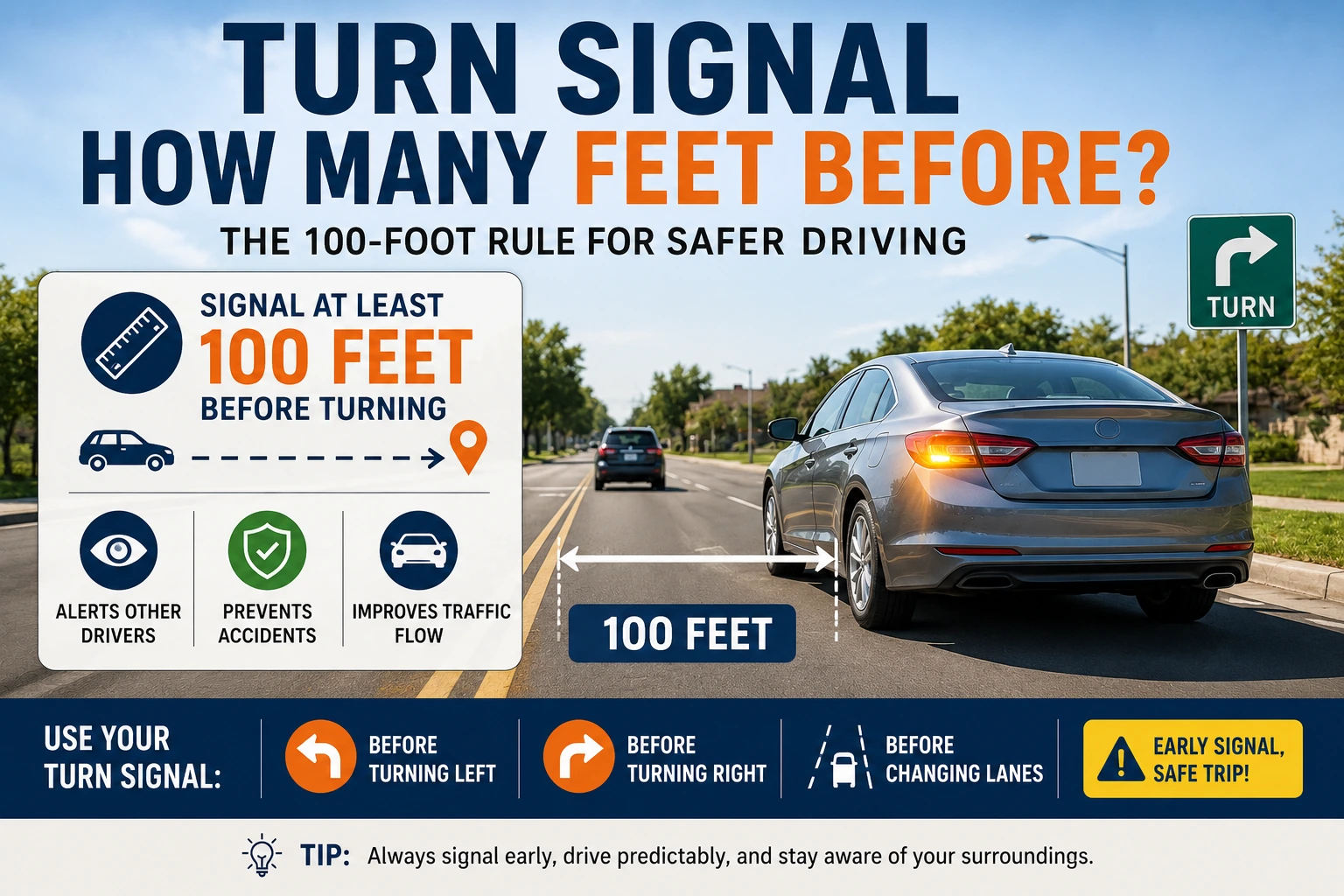
If you are learning to drive or preparing for a driving test, one important question is: “Turn signal how many feet before turning?”
In most states and driving guidelines, drivers should activate their turn signal at least:
100 feet before turning
This gives other drivers, cyclists, and pedestrians enough time to react safely. Proper signaling is one of the most basic yet important driving habits because it improves communication on the road and helps prevent accidents.
In this guide, you will learn:
- The standard turn signal distance
- Why signaling matters
- State law variations
- Proper signaling techniques
- Common mistakes
- Driving test tips
- Defensive driving strategies
Understanding these rules can help you become a safer and more confident driver.
Why Turn Signals Matter
Turn signals are one of the simplest safety tools in a vehicle. They communicate your intentions to everyone around you.
Without proper signaling:
- Drivers may brake suddenly
- Accidents can happen
- Traffic flow becomes unpredictable
Using signals correctly helps:
- Prevent rear-end collisions
- Reduce side-swipe accidents
- Improve traffic movement
- Protect pedestrians and cyclists
Communication on the Road
Driving is all about communication.
Your turn signals tell others:
- You plan to turn
- You intend to change lanes
- You are merging
- You are pulling over
Clear communication reduces confusion and helps drivers react calmly.
Legal Requirement in Most States
In most parts of the United States, using turn signals is legally required.
Failing to signal may result in:
- Traffic citations
- Fines
- Points on your license
- Increased accident liability
Although laws vary slightly by state, the general rule remains the same.
Turn Signal How Many Feet Before Turning?
The most common driving rule says drivers should signal:
100 feet before a turn
This applies to:
- Left turns
- Right turns
- Lane changes in many situations
The 100-foot rule allows surrounding drivers enough time to react safely.
Understanding the 100-Foot Rule
Many driving schools teach the 100-foot rule because it is simple and effective.
Why 100 Feet?
At normal city driving speeds, 100 feet provides:
- Adequate reaction time
- Better traffic awareness
- Safer stopping distance
It also helps drivers behind you:
- Slow down smoothly
- Change lanes safely
- Avoid sudden braking
What Does 100 Feet Look Like?
Many people struggle to visualize 100 feet.
Here are some easy comparisons:
- About 5–6 car lengths
- Roughly one-third of a city block
- Around the length of a basketball court
These comparisons help drivers estimate signaling distance without measuring.
Signaling on Residential Roads
On slower residential streets, signaling 100 feet before turning is usually enough.
Examples include:
- Neighborhood intersections
- School zones
- Residential corners
Even at low speeds, signaling early remains important.
Signaling on Highways and Fast Roads
On highways, earlier signaling is often safer.
Drivers traveling at higher speeds need:
- More reaction time
- Longer braking distance
Many defensive driving instructors recommend signaling:
- 5 seconds before lane changes
- Earlier before exits
This improves highway safety significantly.
How to Properly Use Turn Signals
Correct signaling is about timing and consistency.
Turning Left
Before making a left turn:
- Check mirrors
- Activate left signal 100 feet before turning
- Slow down gradually
- Check traffic and pedestrians
- Complete the turn safely
Turning Right
For right turns:
- Signal early
- Move closer to the curb if appropriate
- Watch for cyclists and pedestrians
- Turn carefully
Right turns often involve pedestrians, so awareness is critical.
Changing Lanes
Lane changes also require signaling.
Most experts recommend:
- Signaling 3–5 seconds before changing lanes
Proper lane-change steps:
- Check mirrors
- Use turn signal
- Check blind spots
- Move smoothly
Never rely only on mirrors.
Turn Signal Rules by Situation
Different driving situations may require slightly different signaling habits.
Parking
Signal before:
- Pulling into a parking spot
- Parallel parking
- Leaving a curbside position
This warns nearby drivers and cyclists.
Roundabouts
Roundabout rules vary slightly by location, but generally:
- Signal when exiting
- Use signals consistently
This helps drivers understand your intended exit.
Highway Exits
Signal well before:
- Exit ramps
- Lane reductions
- Merging areas
Highway traffic moves quickly, so earlier signals improve safety.
Merging Traffic
Always signal when merging into:
- Highway lanes
- Traffic lanes
- Construction detours
Merging without signaling creates dangerous situations.
Why Early Signaling Improves Safety
Early signaling provides several major safety benefits.
Gives Drivers More Reaction Time
Other drivers need time to:
- Adjust speed
- Change lanes
- Maintain safe distance
Late signaling causes sudden reactions.
Reduces Accidents
Proper turn signal use lowers the risk of:
- Rear-end crashes
- Side collisions
- Intersection accidents
Studies consistently show communication improves road safety.
Improves Traffic Flow
Predictable driving reduces:
- Sudden braking
- Traffic confusion
- Congestion
Good signaling habits help everyone on the road.
Common Turn Signal Mistakes
Even experienced drivers make signaling mistakes.
Signaling Too Late
One of the biggest mistakes is turning on the signal at the last second.
This defeats the purpose because other drivers:
- Cannot react safely
- May brake suddenly
- Become confused
Forgetting to Turn Signals Off
Leaving signals on accidentally can mislead nearby drivers.
Always check:
- Dashboard indicators
- Signal clicking sounds
Not Signaling During Lane Changes
Some drivers only signal for turns but ignore lane changes.
Lane changes are one of the most dangerous driving actions, so signaling is essential.
Signaling Without Checking Blind Spots
Turn signals do not give automatic right-of-way.
Always:
- Check mirrors
- Check blind spots
- Confirm space availability
Driving Test Tips for Turn Signals
Driving examiners pay close attention to signaling habits.
What Examiners Watch For
During a driving test, instructors check whether you:
- Signal early
- Use the correct signal
- Turn signals off properly
- Check mirrors and blind spots
Common Student Mistakes
Frequent driving test errors include:
- Forgetting to signal
- Signaling too late
- Leaving signals on
- Changing lanes without signaling
These mistakes may cost points or cause failure.
Turn Signal Distance Comparison Table
| Driving Situation | Recommended Signal Distance |
|---|---|
| City turns | 100 feet |
| Residential roads | 100 feet |
| Highway exits | 300+ feet when possible |
| Lane changes | 3–5 seconds before |
| Roundabout exits | Before exiting |
This table provides general guidance for safe driving.
Legal Consequences of Not Signaling
Ignoring turn signal laws can have serious consequences.
Traffic Tickets
Police officers may issue citations for:
- Failure to signal
- Improper lane changes
- Unsafe turns
Fines vary by state.
Increased Accident Liability
If an accident occurs and you failed to signal, you may be considered partially or fully responsible.
Insurance companies may also increase premiums after violations.
Expert Defensive Driving Tips
Professional drivers follow habits that improve safety.
Signal Earlier Than Necessary
Early signals are usually safer than late signals.
However:
- Avoid signaling so early that drivers misunderstand your intentions.
Balance is important.
Combine Signals With Smooth Driving
Avoid:
- Sudden braking
- Sharp steering
- Aggressive lane changes
Signals work best with predictable driving behavior.
Stay Aware of Pedestrians
Pedestrians often rely on turn signals to decide when it is safe to cross streets.
Always remain alert near:
- Crosswalks
- Schools
- Parking lots
Benefits of Proper Turn Signal Use
Good signaling habits provide many advantages.
Better Road Safety
Signals reduce uncertainty and accidents.
Lower Stress Driving
Predictable traffic movement creates calmer driving conditions.
Improved Driving Test Performance
Correct signaling improves:
- Driving scores
- Confidence
- Examiner impressions
FAQs
1. Turn signal how many feet before turning?
Most driving laws recommend signaling at least 100 feet before turning.
2. Do you need to signal before changing lanes?
Yes. Drivers should signal several seconds before changing lanes.
3. Is failing to signal illegal?
In most states, yes. Failure to signal can lead to traffic tickets.
4. Why is signaling early important?
Early signaling gives other drivers time to react safely and avoid collisions.
5. Should you signal in parking lots?
Yes. Signaling in parking lots improves safety for drivers and pedestrians.
Conclusion
If you are asking “turn signal how many feet before turning,” the standard answer is:
100 feet before turning
This simple driving habit greatly improves road safety, communication, and traffic flow. Proper signaling helps prevent accidents, protects pedestrians, and ensures smoother driving experiences for everyone on the road.
Discover more