

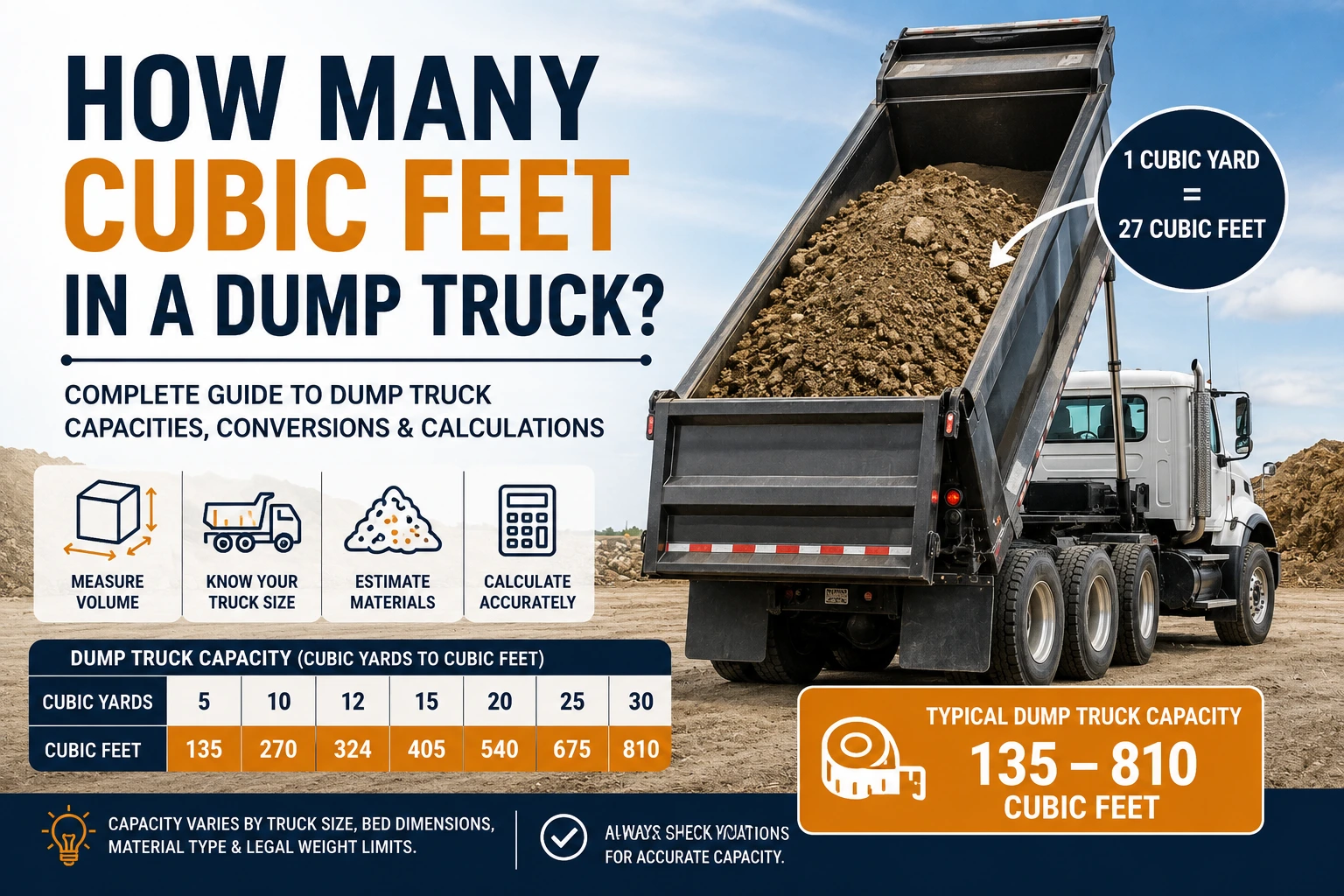
If you’re planning a construction, landscaping, excavation, or hauling project, one of the most important questions you may ask is: how many cubic feet in a dump truck?
The answer depends on the size and type of dump truck. Most standard dump trucks carry between 270 and 810 cubic feet of material, while larger commercial and mining trucks can hold several thousand cubic feet.
Knowing a dump truck’s capacity helps you:
- Estimate material requirements
- Calculate delivery costs
- Avoid ordering too much or too little material
- Plan construction projects efficiently
- Compare truck sizes before hiring
This guide explains dump truck capacities, cubic foot conversions, load calculations, practical examples, and expert tips to help you accurately estimate your material needs.
Understanding Dump Truck Capacity
Dump truck capacity refers to the amount of material a truck can safely transport in its bed.
Capacity is usually measured in:
- Cubic feet
- Cubic yards
- Tons (weight)
Since construction materials vary greatly in density, volume and weight are not always the same.
For example:
- A truck full of mulch weighs much less than a truck full of gravel.
- A truck can reach its weight limit before reaching its volume limit.
That is why understanding cubic feet is important when estimating loads.
How Many Cubic Feet in a Dump Truck on Average?
The average dump truck capacity varies based on truck size.
Small Dump Trucks
Small dump trucks are commonly used for:
- Residential landscaping
- Small construction projects
- Property maintenance
Typical capacity:
| Capacity | Cubic Feet |
|---|---|
| 5 Cubic Yards | 135 Cubic Feet |
| 7 Cubic Yards | 189 Cubic Feet |
| 10 Cubic Yards | 270 Cubic Feet |
Medium Dump Trucks
Medium-duty trucks are popular among contractors.
Typical capacity:
| Capacity | Cubic Feet |
|---|---|
| 12 Cubic Yards | 324 Cubic Feet |
| 14 Cubic Yards | 378 Cubic Feet |
| 16 Cubic Yards | 432 Cubic Feet |
Large Dump Trucks
Large commercial dump trucks are frequently used on major construction projects.
Typical capacity:
| Capacity | Cubic Feet |
|---|---|
| 20 Cubic Yards | 540 Cubic Feet |
| 25 Cubic Yards | 675 Cubic Feet |
| 30 Cubic Yards | 810 Cubic Feet |
Therefore, when asking how many cubic feet in a dump truck, a typical answer for a standard construction dump truck is between 540 and 810 cubic feet.
Dump Truck Capacity Chart
Use this quick-reference chart.
| Cubic Yards | Cubic Feet |
|---|---|
| 5 | 135 |
| 10 | 270 |
| 12 | 324 |
| 14 | 378 |
| 15 | 405 |
| 16 | 432 |
| 20 | 540 |
| 25 | 675 |
| 30 | 810 |
This chart helps convert common truck capacities into cubic feet.
Cubic Yards vs Cubic Feet Explained
Dump truck capacities are often advertised in cubic yards.
To understand cubic feet, you need to know the conversion.
Conversion Formula
A cubic yard equals:
3 feet × 3 feet × 3 feet
Which equals:
27 cubic feet
Therefore:
1 Cubic Yard=27 Cubic Feet
This simple conversion is used throughout construction and landscaping industries.
Quick Examples
| Cubic Yards | Cubic Feet |
|---|---|
| 1 | 27 |
| 5 | 135 |
| 10 | 270 |
| 20 | 540 |
How to Calculate Cubic Feet in a Dump Truck
Sometimes you may know the truck bed dimensions but not the advertised capacity.
In that case, calculate the volume manually.
Formula
Multiply:
Length × Width × Height
The result equals cubic feet.
V=L×W×H
Example Calculation
Suppose a dump bed measures:
- Length: 15 feet
- Width: 8 feet
- Height: 4 feet
Calculation:
15 × 8 × 4 = 480 cubic feet
This truck could theoretically hold approximately 480 cubic feet of material.
Keep in mind that manufacturers may reduce usable capacity based on safety limits.
Common Materials Transported in Dump Trucks
Different materials affect how much a truck can carry.
Gravel
Gravel is dense and heavy.
Common uses:
- Driveways
- Road construction
- Drainage systems
Dirt and Topsoil
Used for:
- Landscaping
- Site grading
- Gardening projects
Sand
Frequently used in:
- Concrete production
- Masonry work
- Construction foundations
Mulch
Mulch occupies a large volume but weighs less than gravel.
Crushed Stone
A common material for roads and building foundations.
Each material affects loading capacity differently because weight limits often become the controlling factor.
Weight vs Volume Capacity
One common misconception is that a dump truck can always be filled completely.
In reality, weight limits matter.
For example:
| Material | Approximate Weight per Cubic Yard |
|---|---|
| Mulch | 400–800 lbs |
| Topsoil | 2,000 lbs |
| Sand | 2,700 lbs |
| Gravel | 3,000 lbs |
A truck hauling gravel may reach its legal weight limit before the bed is completely full.
Meanwhile, a mulch truck may fill the entire bed without approaching the weight limit.
Factors That Affect Dump Truck Capacity
Several factors determine actual hauling capacity.
Truck Size
Larger trucks naturally hold more material.
Bed Dimensions
Length, width, and sidewall height influence volume.
Material Density
Heavy materials reduce usable volume.
Legal Weight Restrictions
Road regulations limit maximum truck weight.
Moisture Content
Wet soil or sand weighs more than dry material.
Load Distribution
Improper loading may reduce safe carrying capacity.
Real-World Examples
Let’s look at practical scenarios.
Landscaping Project
A homeowner needs:
- 15 cubic yards of mulch
Conversion:
15 × 27 = 405 cubic feet
A medium-sized dump truck could typically handle this in one trip.
Driveway Gravel Installation
Required gravel:
- 25 cubic yards
Conversion:
25 × 27 = 675 cubic feet
A large dump truck may transport this amount in a single load.
Excavation Project
Excavated soil:
- 60 cubic yards
Conversion:
60 × 27 = 1,620 cubic feet
This would require multiple truckloads depending on truck size.
Common Mistakes When Estimating Dump Truck Loads
Many project owners underestimate material requirements.
Avoid these mistakes.
Confusing Cubic Feet and Cubic Yards
Remember:
- 1 cubic yard = 27 cubic feet
Ignoring Material Weight
Heavy materials often hit weight limits first.
Overestimating Truck Capacity
Always verify manufacturer specifications.
Not Accounting for Compaction
Materials such as soil settle after placement.
Ordering Exact Quantities
Most professionals order 5–10% extra material.
Expert Tips for Ordering Materials
Know Your Project Dimensions
Measure carefully before ordering.
Ask Suppliers About Truck Size
Different suppliers use different trucks.
Confirm Weight Limits
This is especially important for gravel, rock, and sand.
Plan Delivery Access
Ensure trucks can safely enter and exit your property.
Consider Multiple Loads
Sometimes multiple smaller deliveries are more practical than one oversized load.
Summary: How Many Cubic Feet in a Dump Truck?
The answer to how many cubic feet in a dump truck depends on the truck size.
Typical capacities include:
| Truck Size | Cubic Feet |
|---|---|
| Small | 135–270 |
| Medium | 324–432 |
| Large | 540–810 |
Most standard construction dump trucks carry between 540 and 810 cubic feet of material.
Understanding cubic feet, cubic yards, and weight limitations helps you estimate material needs accurately, reduce project costs, and avoid delivery surprises. Whether you’re ordering mulch, gravel, dirt, or sand, knowing dump truck capacity ensures smoother project planning.
9. FAQs
How many cubic feet does a standard dump truck hold?
A standard construction dump truck typically holds between 540 and 810 cubic feet, depending on its size.
How many cubic feet are in a 10-yard dump truck?
A 10-cubic-yard dump truck holds:
10 × 27 = 270 cubic feet.
How many cubic feet are in a 20-yard dump truck?
A 20-yard dump truck can carry approximately 540 cubic feet.
Is dump truck capacity measured by volume or weight?
Both measurements are important. Capacity is often listed by volume, but legal hauling limits are based on weight.
How do I convert cubic yards to cubic feet?
Multiply the number of cubic yards by 27 to get cubic feet.
10. Conclusion
Understanding how many cubic feet in a dump truck is essential for construction, landscaping, excavation, and hauling projects. While capacities vary by truck size, most dump trucks hold between 135 and 810 cubic feet, with large commercial models carrying even more. By learning how to convert cubic yards to cubic feet, calculate volume, and account for material weight, you can order the right amount of material, control costs, and keep your project running efficiently from start to finish.
Discover more