

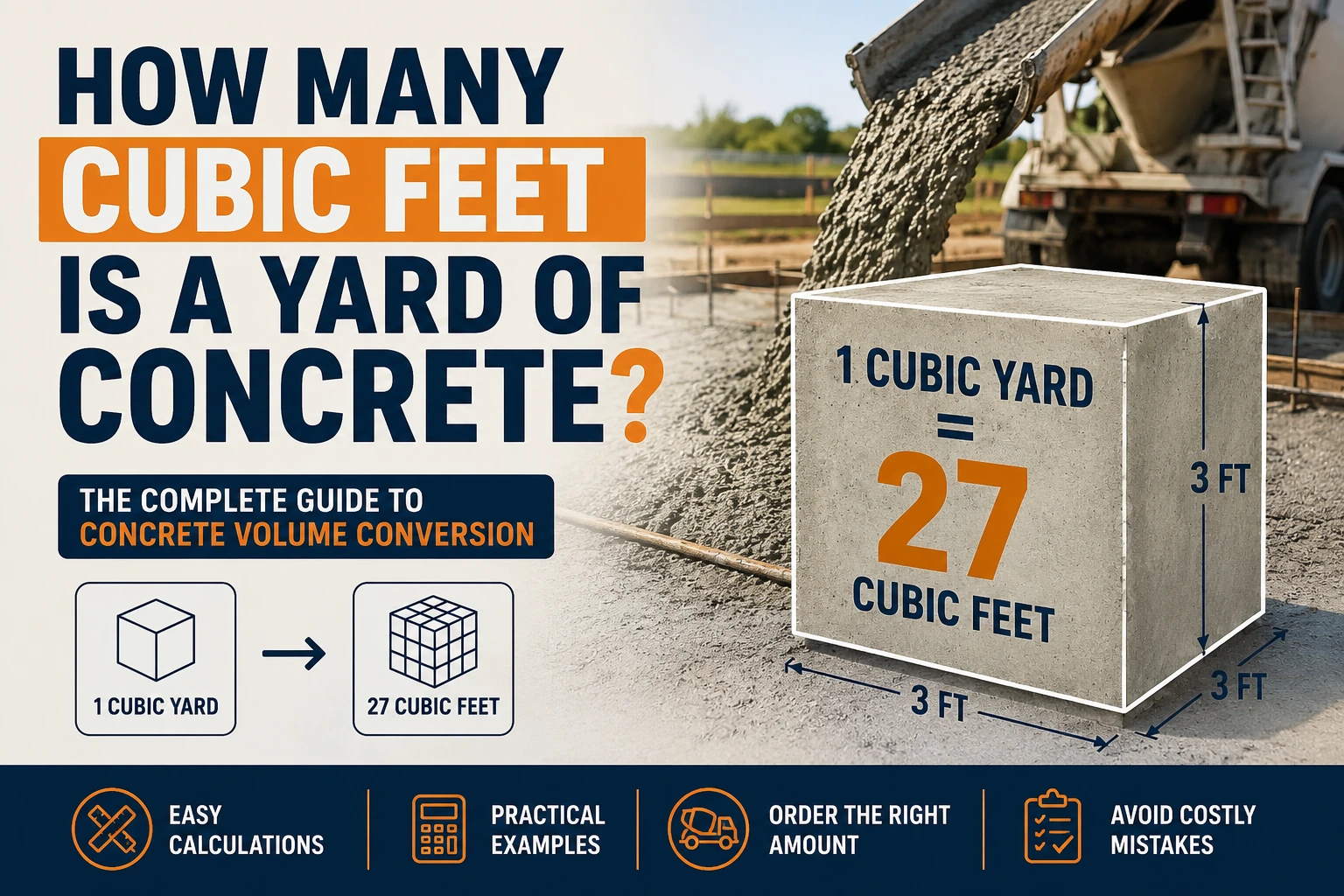
If you’re planning a concrete project, one of the most common questions is: how many cubic feet is a yard of concrete?
Whether you’re pouring a driveway, patio, sidewalk, slab, or footing, understanding concrete volume measurements helps you estimate material needs accurately and avoid costly mistakes.
The simple answer is:
1 cubic yard=27 cubic feet
So, one yard of concrete contains exactly 27 cubic feet of concrete.
However, there is much more to know if you want accurate concrete estimates. In this guide, you’ll learn how cubic yards and cubic feet relate, how to calculate concrete volume, practical examples, conversion charts, and expert tips for ordering the right amount of concrete.
Understanding the Basic Conversion
Before calculating concrete requirements, it helps to understand the units being used.
What Is a Cubic Yard?
A cubic yard is a unit of volume commonly used in construction and landscaping.
A cubic yard represents a space measuring:
- 3 feet long
- 3 feet wide
- 3 feet high
The volume formula is:
V=l×w×h
For one cubic yard:
- Length = 3 ft
- Width = 3 ft
- Height = 3 ft
Therefore:
3 × 3 × 3 = 27 cubic feet
What Is a Cubic Foot?
A cubic foot is the volume of a cube that measures:
- 1 foot long
- 1 foot wide
- 1 foot high
Cubic feet are often used for smaller measurements, while cubic yards are preferred for larger construction projects.
How Many Cubic Feet Is a Yard of Concrete?
The exact conversion is straightforward:
| Measurement | Equivalent Volume |
|---|---|
| 1 Cubic Yard | 27 Cubic Feet |
| 2 Cubic Yards | 54 Cubic Feet |
| 3 Cubic Yards | 81 Cubic Feet |
| 4 Cubic Yards | 108 Cubic Feet |
| 5 Cubic Yards | 135 Cubic Feet |
Whenever someone asks how many cubic feet is a yard of concrete, the answer remains the same regardless of the concrete mix:
1 cubic yard = 27 cubic feet.
This conversion applies to:
- Ready-mix concrete
- Reinforced concrete
- Decorative concrete
- High-strength concrete
- Standard residential concrete
The composition may change, but the volume conversion does not.
Why Concrete Is Measured in Cubic Yards
Concrete suppliers generally sell concrete by the cubic yard rather than the cubic foot.
There are several reasons for this:
Easier Estimation
Large projects often require substantial volumes. Using cubic yards simplifies calculations.
Industry Standard
Most concrete plants and contractors use cubic yards as the standard measurement.
Truck Capacity
Concrete trucks are rated by cubic yards.
For example:
| Truck Type | Approximate Capacity |
|---|---|
| Small Mixer | 3–5 Cubic Yards |
| Standard Mixer | 8–10 Cubic Yards |
| Large Mixer | 10–12 Cubic Yards |
Because suppliers think in cubic yards, customers usually convert their project volume into yards before ordering.
Cubic Yard to Cubic Feet Conversion Chart
Here is a quick reference chart:
| Cubic Yards | Cubic Feet |
|---|---|
| 0.25 | 6.75 |
| 0.50 | 13.5 |
| 0.75 | 20.25 |
| 1.00 | 27 |
| 1.50 | 40.5 |
| 2.00 | 54 |
| 2.50 | 67.5 |
| 3.00 | 81 |
| 4.00 | 108 |
| 5.00 | 135 |
| 10.00 | 270 |
This chart is useful when estimating concrete for home improvement and construction projects.
How to Calculate Concrete Volume
Knowing the conversion is only half the process. You also need to determine how much concrete your project requires.
Step 1: Measure Length
Measure the project length in feet.
Example:
20 feet
Step 2: Measure Width
Measure the width in feet.
Example:
10 feet
Step 3: Measure Depth
Convert depth to feet.
Example:
4 inches ÷ 12 = 0.333 feet
Step 4: Calculate Cubic Feet
Use:
Length × Width × Depth
Example:
20 × 10 × 0.333 = 66.6 cubic feet
Step 5: Convert Cubic Feet to Cubic Yards
Use:
Cubic Yards=27Cubic Feet
66.6 ÷ 27 = 2.47 cubic yards
You would typically order about 2.5 cubic yards of concrete.
Real-World Concrete Calculation Examples
Concrete Patio Example
Suppose you want to build a patio measuring:
- Length: 12 feet
- Width: 12 feet
- Thickness: 4 inches
Convert thickness:
4 ÷ 12 = 0.333 feet
Calculate volume:
12 × 12 × 0.333 = 47.95 cubic feet
Convert to yards:
47.95 ÷ 27 = 1.78 cubic yards
Recommended order:
Approximately 2 cubic yards.
Concrete Driveway Example
Driveway dimensions:
- Length: 40 feet
- Width: 12 feet
- Thickness: 5 inches
Thickness:
5 ÷ 12 = 0.417 feet
Volume:
40 × 12 × 0.417 = 200.16 cubic feet
Convert:
200.16 ÷ 27 = 7.41 cubic yards
Recommended order:
Around 7.5 to 8 cubic yards.
Concrete Footing Example
Footing dimensions:
- Length: 50 feet
- Width: 2 feet
- Depth: 1 foot
Volume:
50 × 2 × 1 = 100 cubic feet
Convert:
100 ÷ 27 = 3.7 cubic yards
Recommended order:
4 cubic yards.
Common Concrete Project Volumes
Below are approximate concrete requirements for typical projects.
| Project | Approximate Concrete Needed |
|---|---|
| Small Sidewalk | 1–2 Cubic Yards |
| Backyard Patio | 2–5 Cubic Yards |
| Garage Slab | 6–12 Cubic Yards |
| Residential Driveway | 7–15 Cubic Yards |
| House Foundation | 20–50+ Cubic Yards |
| Commercial Foundation | 100+ Cubic Yards |
Understanding that each cubic yard equals 27 cubic feet helps estimate these projects more accurately.
Mistakes People Make When Calculating Concrete
Many homeowners underestimate concrete requirements.
Here are common errors to avoid.
Forgetting to Convert Inches to Feet
Depth measurements are often taken in inches.
Always convert inches into feet before calculating volume.
Ignoring Waste
Concrete projects rarely use exactly the calculated amount.
Spillage, uneven surfaces, and grading can increase requirements.
Ordering Too Little
Running short during a pour can create structural and cosmetic issues.
Not Accounting for Irregular Shapes
Curved patios, steps, and custom designs may require more complex calculations.
Confusing Square Feet With Cubic Feet
Square feet measure area.
Cubic feet measure volume.
Concrete estimates always require volume calculations.
Expert Tips for Ordering Concrete
Professional contractors use several strategies to avoid shortages and delays.
Add Extra Material
Order 5–10% more concrete than calculated.
Double-Check Measurements
Even small measurement mistakes can significantly impact total volume.
Use Online Calculators
A concrete volume calculator can simplify estimates for slabs, footings, and columns.
Consider Truck Minimums
Some suppliers charge additional fees for small orders.
Plan for Reinforcement
Rebar and mesh don’t change volume but may affect project design and scheduling.
Cubic Feet vs Cubic Yards: Which Should You Use?
Both units describe volume, but each serves a different purpose.
| Cubic Feet | Cubic Yards |
|---|---|
| Better for small measurements | Better for large projects |
| Easier for room-sized calculations | Industry standard for concrete |
| Used in DIY planning | Used when ordering concrete |
| Smaller unit | Larger unit |
Most homeowners calculate volume in cubic feet first and then convert to cubic yards for ordering.
Practical Quick Reference
Here are some useful conversions:
| Cubic Yards | Cubic Feet |
|---|---|
| 1 | 27 |
| 2 | 54 |
| 3 | 81 |
| 4 | 108 |
| 5 | 135 |
| 6 | 162 |
| 7 | 189 |
| 8 | 216 |
| 9 | 243 |
| 10 | 270 |
Bookmark this chart if you frequently work with concrete calculations.
Frequently Asked Questions
How many cubic feet are in a cubic yard of concrete?
A cubic yard of concrete contains exactly 27 cubic feet.
Why is concrete sold by the cubic yard?
Concrete suppliers use cubic yards because it is the standard unit for large construction volumes and truck capacities.
How do I convert cubic feet to cubic yards?
Divide the number of cubic feet by 27.
Example:
54 cubic feet ÷ 27 = 2 cubic yards.
How much area does one cubic yard of concrete cover?
Coverage depends on thickness. At a depth of 4 inches, one cubic yard covers approximately 81 square feet.
Should I order extra concrete?
Yes. Most professionals recommend ordering 5–10% more than the calculated volume to account for waste and variations.
Conclusion
If you’ve been wondering how many cubic feet is a yard of concrete, the answer is simple: one cubic yard equals 27 cubic feet. Understanding this conversion is essential for estimating concrete accurately, whether you’re pouring a patio, driveway, slab, sidewalk, or foundation.
By measuring your project’s length, width, and depth, calculating cubic feet, and then converting to cubic yards, you can order the right amount of concrete with confidence. Adding a small safety margin and double-checking measurements will help prevent costly shortages and project delays.
For any concrete project, remembering the key conversion—1 yard of concrete = 27 cubic feet—will make planning, budgeting, and ordering much easier.
Discover more