
f you are planning a landscaping, driveway, or construction project, one of the first questions you may ask is: how many cubic feet in a ton of gravel?
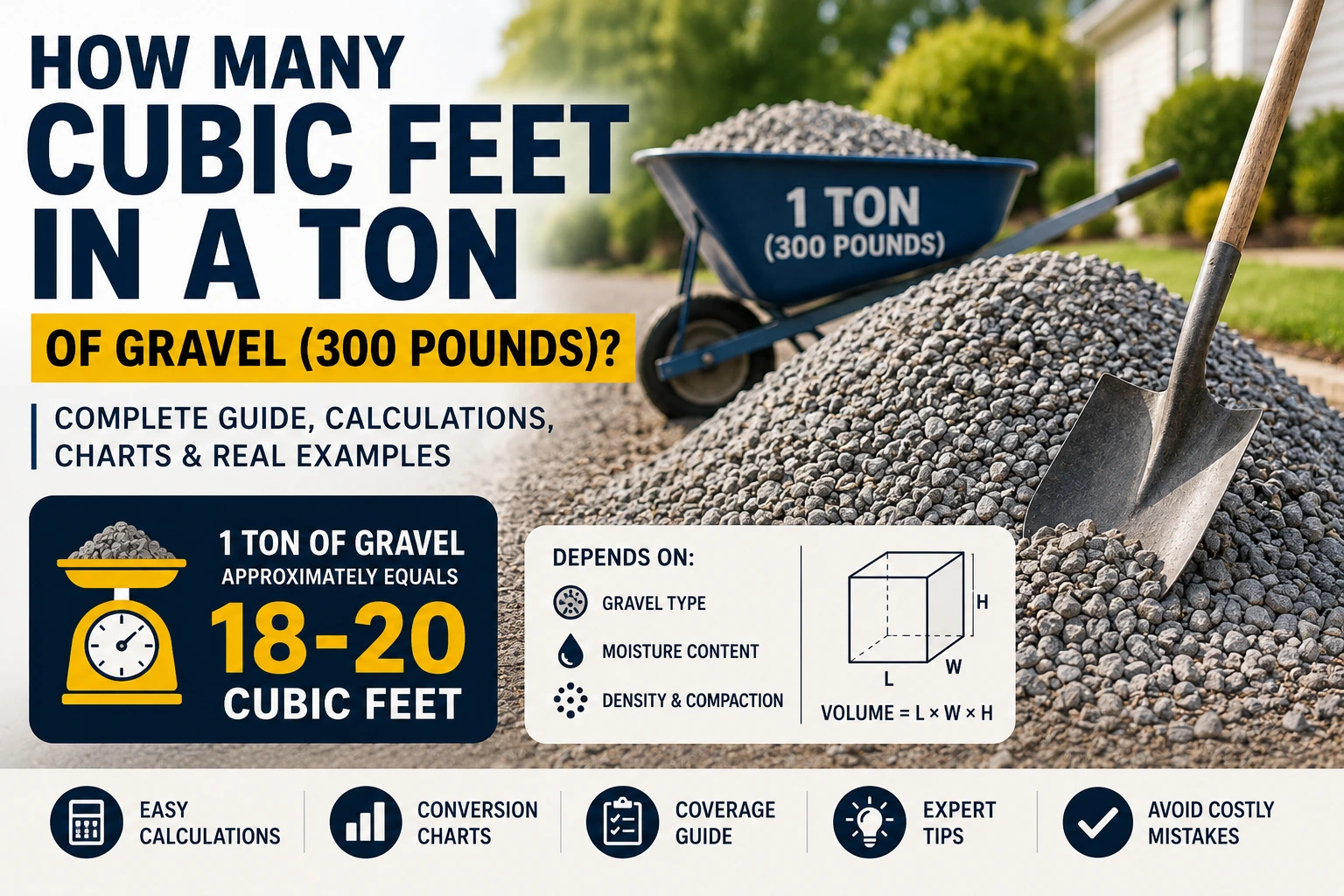
The simple answer is that one ton of gravel typically equals about 18 to 20 cubic feet. However, the exact amount depends on the type of gravel, moisture content, and density.
Understanding this conversion is extremely important because gravel is usually sold by weight, while most projects require measurements by volume or coverage area.
In this detailed guide, you will learn:
- How gravel volume works
- Tons-to-cubic-feet conversions
- Gravel coverage charts
- Real-world examples
- Expert calculation tips
By the end, you will know exactly how much gravel your project needs.
What Does a Ton of Gravel Mean?
Before calculating cubic feet, it helps to understand what a “ton” means in gravel measurements.
Weight Measurement Explained
In the United States, one ton equals:
1\text{ ton}=2000\text{ pounds}
Gravel suppliers usually sell materials by:
- Ton
- Cubic yard
- Truckload
Because gravel is heavy, weight-based pricing is common.
Different Gravel Types and Density
Not all gravel weighs the same.
For example:
- Pea gravel is lighter
- Crushed stone is denser
- Wet gravel weighs more than dry gravel
That is why the cubic feet per ton can vary slightly.
How Many Cubic Feet in a Ton of Gravel?
On average:
1\text{ ton of gravel}\approx18\text{ to }20\text{ cubic feet}
A commonly used estimate is:
- 1 ton = 20 cubic feet
This estimate works well for:
- Driveways
- Landscaping
- Walkways
- Drainage projects
Standard Gravel Conversion
Most suppliers use a gravel density of:
- 100–110 pounds per cubic foot
Using the average density:
\frac{2000\text{ pounds}}{100\text{ pounds per cubic foot}}=20\text{ cubic feet}
This is why one ton of gravel is commonly estimated at around 20 cubic feet.
Why Gravel Density Changes Volume
The same weight of gravel can occupy different amounts of space because of:
- Stone size
- Shape
- Air gaps
- Moisture
- Material type
Larger rocks create more empty space, while crushed stone packs tightly together.
Gravel Conversion Formula
Knowing the formula makes estimating gravel much easier.
Basic Formula
Use this simple equation:
\text{Cubic Feet}=\frac{\text{Weight in Pounds}}{\text{Density}}
Where:
- Weight is measured in pounds
- Density is pounds per cubic foot
Example Calculations
Example 1: Standard Gravel
If gravel density is 100 pounds per cubic foot:
\frac{2000}{100}=20\text{ cubic feet}
Example 2: Dense Crushed Stone
If density is 110 pounds per cubic foot:
\frac{2000}{110}=18.18\text{ cubic feet}
Tons to Cubic Feet Gravel Chart
This quick-reference table helps estimate gravel volume faster.
| Tons of Gravel | Approximate Cubic Feet |
|---|---|
| 0.5 ton | 10 cubic feet |
| 1 ton | 18–20 cubic feet |
| 2 tons | 36–40 cubic feet |
| 3 tons | 54–60 cubic feet |
| 5 tons | 90–100 cubic feet |
| 10 tons | 180–200 cubic feet |
These are average estimates for standard gravel.
Gravel Types and Cubic Feet Per Ton
Different gravel materials have different densities.
Pea Gravel
Pea gravel is lightweight and decorative.
Average volume:
- 20–22 cubic feet per ton
Best for:
- Walkways
- Gardens
- Decorative landscaping
Crushed Stone
Crushed stone is compact and dense.
Average volume:
- 18–20 cubic feet per ton
Best for:
- Driveways
- Foundations
- Drainage
River Rock
River rock is larger and less compact.
Average volume:
- 19–21 cubic feet per ton
Best for:
- Water features
- Landscaping
- Erosion control
Limestone Gravel
Limestone gravel compacts well and is often used for roads.
Average volume:
- 18 cubic feet per ton
How Much Area Does One Ton of Gravel Cover?
Coverage depends heavily on depth.
Coverage at 1 Inch Depth
One ton of gravel covers approximately:
- 240 square feet at 1 inch deep
Coverage at 2 Inches Depth
One ton covers:
- About 120 square feet
This is common for:
- Decorative gravel
- Pathways
Coverage at 4 Inches Depth
One ton covers:
- About 60 square feet
This depth is better for:
- Driveways
- Heavy traffic areas
Gravel Coverage Chart
| Gravel Depth | Coverage Per Ton |
| 1 inch | 240 sq ft |
| 2 inches | 120 sq ft |
| 3 inches | 80 sq ft |
| 4 inches | 60 sq ft |
How to Calculate Gravel for Your Project
Calculating gravel correctly prevents wasted money and extra deliveries.
Step 1: Measure Length and Width
Measure your project area in feet.
Example:
- Length = 20 feet
- Width = 10 feet
Step 2: Choose Desired Depth
Decide how deep the gravel should be.
Example:
- Depth = 2 inches
Convert inches to feet:
2\text{ inches}=\frac{2}{12}=0.167\text{ feet}
Step 3: Calculate Cubic Feet
Use this formula:
\text{Length}\times\text{Width}\times\text{Depth}
Example:
20\times10\times0.167=33.4\text{ cubic feet}
Step 4: Convert Cubic Feet to Tons
If one ton equals 20 cubic feet:
\frac{33.4}{20}=1.67\text{ tons}
You would need about:
- 1.7 tons of gravel
Step 5: Add Extra Material
Experts recommend ordering:
- 5–10% extra
This covers:
- Spillage
- Settling
- Uneven surfaces
Real World Gravel Examples
Driveway Projects
A small single-car driveway may need:
- 5–8 tons
A larger driveway could require:
- 10–20 tons
Walkways
Most garden paths need:
- 1–2 tons
depending on width and depth.
Garden Landscaping
Decorative landscaping projects often use:
- Pea gravel
- River rock
- Crushed granite
These projects usually need shallower coverage.
Benefits of Gravel
Gravel remains one of the most popular landscaping materials.
Affordable
Gravel is cheaper than:
- Concrete
- Pavers
- Asphalt
Easy to Install
Many DIY homeowners can install gravel themselves.
Excellent Drainage
Water passes through gravel easily, reducing puddles and erosion.
Versatile
Gravel works for:
- Paths
- Driveways
- Gardens
- Drainage systems
Drawbacks of Gravel
Despite its advantages, gravel also has limitations.
Requires Maintenance
Gravel may shift over time and need leveling.
Weed Growth
Without landscape fabric, weeds may grow through gravel.
Difficult for Snow Removal
Snow shovels can move gravel unintentionally.
Common Gravel Calculation Mistakes
Many people underestimate gravel needs.
Ignoring Depth
Too little depth causes poor coverage and weak surfaces.
Forgetting Compaction
Compacted gravel settles lower over time.
Using Incorrect Density
Different gravel types weigh differently.
Always ask suppliers for exact density information.
Expert Tips for Buying Gravel
Order Slightly More Than Needed
Running short can delay projects and increase delivery costs.
Compare Supplier Prices
Local prices vary significantly.
Use Landscape Fabric
This reduces weeds and improves stability.
Choose the Right Gravel Size
- Small gravel = decorative use
- Medium gravel = pathways
- Large gravel = drainage
FAQs
1. How many cubic feet are in one ton of gravel?
One ton of gravel typically equals 18–20 cubic feet depending on density and gravel type.
2. How much area does a ton of gravel cover?
At 2 inches deep, one ton covers about 120 square feet.
3. Does wet gravel weigh more?
Yes. Moisture increases the total weight of gravel.
4. How many cubic yards are in a ton of gravel?
One ton of gravel is usually around 0.75 cubic yards.
5. What type of gravel is best for driveways?
Crushed stone is commonly preferred because it compacts well and provides stability.
Conclusion
If you have been wondering how many cubic feet in a ton of gravel, the average answer is approximately 18 to 20 cubic feet per ton.
The exact amount depends on:
- Gravel type
- Density
- Moisture content
- Stone size
Understanding these conversions helps you:
- Avoid overbuying
- Prevent shortages
- Estimate project costs accurately
- Plan landscaping more efficiently
Whether you are building a driveway, garden path, drainage system, or decorative landscape, proper gravel calculations save both time and money.
Before ordering gravel, always:
- Measure carefully
- Choose the correct depth
- Confirm density with suppliers
- Add extra material for safety
With the right planning, your gravel project will look better, last longer, and stay within budget.
Discover more