

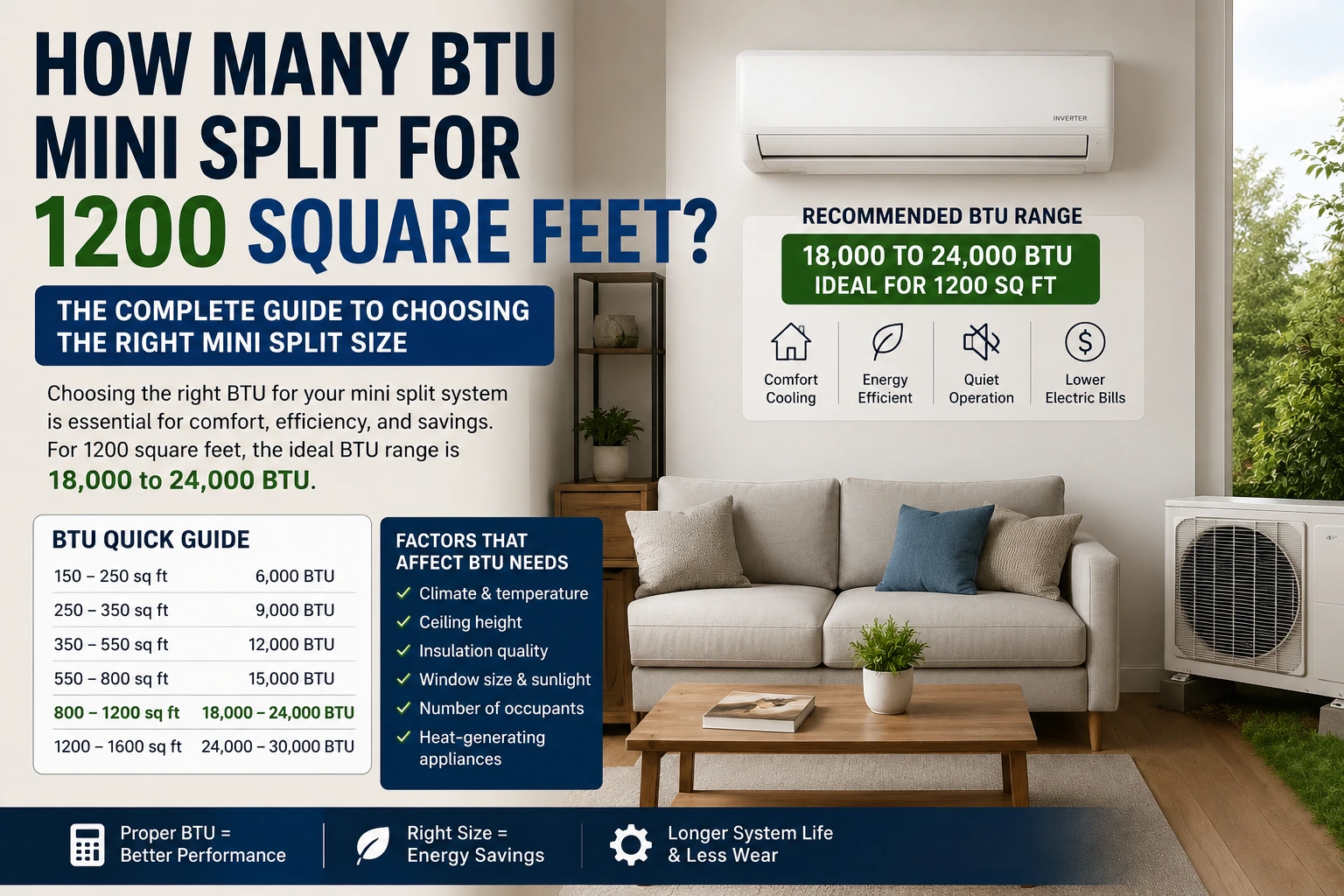
If you are wondering how many BTU mini split for 1200 square feet, the short answer is that most homes need between 24,000 and 30,000 BTUs depending on climate, insulation, ceiling height, and room layout. In hotter regions or poorly insulated homes, you may even need a 36,000 BTU mini split system.
Choosing the correct mini split size is extremely important. A system that is too small will struggle to cool or heat your home, while an oversized system can waste energy and create humidity problems.
In this complete guide, you will learn exactly how many BTU mini split for 1200 square feet is recommended, how BTU sizing works, what factors affect cooling capacity, and how to choose the best ductless system for your home.
Understanding BTU and Mini Splits
Before choosing a mini split system, it helps to understand some HVAC basics.
What Is BTU?
BTU stands for British Thermal Unit. It measures how much heat an air conditioning or heating system can remove or produce.
In simple terms:
- Higher BTU = more heating and cooling power
- Lower BTU = less cooling capacity
Mini split systems are commonly available in:
- 9000 BTU
- 12000 BTU
- 18000 BTU
- 24000 BTU
- 36000 BTU
The correct size depends mainly on square footage and home conditions.
What Is a Mini Split System?
A mini split is a ductless heating and cooling system that includes:
- An indoor air handler
- An outdoor compressor
Unlike traditional HVAC systems, mini splits do not require ductwork. They are popular because they are:
- Energy efficient
- Quiet
- Flexible
- Easy to install
- Great for zoning rooms
Why Proper Sizing Matters
Correct sizing affects:
- Comfort
- Energy bills
- System lifespan
- Humidity control
- Airflow quality
A properly sized mini split keeps temperatures stable and efficient.
How Many BTU Mini Split for 1200 Square Feet?
For most homes, the recommended mini split size for 1200 square feet is:
24,000 to 30,000 BTU
Recommended BTU Range
Here is a quick guideline:
| Home Size | Recommended BTU |
|---|---|
| 800–1000 sq ft | 18000 BTU |
| 1000–1200 sq ft | 24000 BTU |
| 1200–1400 sq ft | 24000–30000 BTU |
| 1400–1600 sq ft | 30000–36000 BTU |
For average insulation and moderate climates, 24,000 BTU is usually enough for 1200 square feet.
General HVAC Rule
HVAC professionals often estimate cooling needs using this formula:
Square Feet×20 to 25=Estimated BTU
Quick Sizing Formula
For 1200 square feet:
1200×20=24,000 BTU
In hotter climates:
1200×25=30,000 BTU
This explains why many homeowners choose systems between 24k and 30k BTU.
Mini Split BTU Sizing Chart
A sizing chart helps compare room sizes quickly.
| Square Footage | Recommended BTU |
|---|---|
| 150–300 sq ft | 6000 BTU |
| 300–500 sq ft | 9000–12000 BTU |
| 500–800 sq ft | 18000 BTU |
| 800–1200 sq ft | 24000 BTU |
| 1200–1500 sq ft | 30000 BTU |
| 1500–1800 sq ft | 36000 BTU |
This chart provides general recommendations only. Actual needs may vary.
1200 Sq Ft Comparison
A 1200-square-foot home may include:
- Two bedrooms
- Small living room
- Kitchen
- Bathroom
- Hallways
The layout greatly affects airflow and cooling efficiency.
Factors That Affect BTU Requirements
Square footage alone does not determine mini split size.
Climate Zone
Hot climates require more BTUs.
For example:
- Arizona or Texas homes often need higher BTU systems
- Northern climates may need fewer cooling BTUs but stronger heating performance
Ceiling Height
Standard calculations assume 8-foot ceilings.
If ceilings are taller:
- More air volume must be cooled
- Higher BTU capacity may be necessary
Vaulted ceilings especially increase cooling demands.
Insulation Quality
Well-insulated homes hold temperature better.
Poor insulation causes:
- Heat gain in summer
- Heat loss in winter
- Increased energy bills
Older homes usually need larger systems.
Sunlight Exposure
Homes with large windows or direct sunlight heat up faster.
South-facing rooms often require:
- Additional cooling power
- Better airflow
- Window coverings
Number of Occupants
People generate heat naturally.
More occupants mean:
- More body heat
- Higher cooling demand
- Increased airflow needs
Appliances and Electronics
Kitchen appliances, computers, and televisions also create heat.
Large kitchens or home offices may require extra BTUs.
24000 vs 36000 BTU Mini Split for 1200 Square Feet
Many homeowners compare these two system sizes.
When 24000 BTU Works
A 24k BTU mini split usually works well if:
- The home is insulated properly
- Climate is moderate
- Layout is open
- Ceilings are standard height
This is the most common choice for 1200 square feet.
When 36000 BTU Is Better
A 36k BTU system may be better if:
- You live in an extremely hot climate
- The house has poor insulation
- Ceilings are high
- The layout is divided into many rooms
- Sun exposure is heavy
Larger systems also help homes with higher occupancy.
Pros and Cons
| BTU Size | Advantages | Disadvantages |
|---|---|---|
| 24000 BTU | Efficient, lower cost | May struggle in extreme heat |
| 36000 BTU | Strong cooling power | Higher energy use |
Choosing the correct size is more important than simply buying the largest unit.
Single Zone vs Multi Zone Mini Split
The layout of your home matters significantly.
What Is a Single Zone System?
Single-zone systems cool one main area.
Best for:
- Open floor plans
- Studios
- Small homes
- Large living spaces
What Is a Multi Zone System?
Multi-zone systems use multiple indoor units connected to one outdoor compressor.
Best for:
- Multiple bedrooms
- Separated rooms
- Larger homes
- Different temperature preferences
Best Option for 1200 Sq Ft Homes
Many 1200-square-foot homes work better with multi-zone systems because airflow between rooms can be uneven.
For example:
- Living room = 12000 BTU
- Bedroom 1 = 9000 BTU
- Bedroom 2 = 9000 BTU
This setup improves comfort and efficiency.
Best Room Layouts for Mini Splits
Home design affects system performance.
Open Floor Plans
Open spaces allow air to circulate more easily.
Advantages include:
- Better airflow
- More efficient cooling
- Fewer indoor units needed
Multiple Bedrooms
Homes with several rooms may need:
- More indoor air handlers
- Separate temperature zones
- Better airflow planning
Small Homes and Apartments
Mini splits are ideal for:
- Apartments
- Tiny homes
- Additions
- Garages
- Basements
They provide efficient heating and cooling without ducts.
Energy Efficiency and Cost Savings
Mini splits are among the most efficient HVAC systems available.
SEER Ratings Explained
SEER stands for Seasonal Energy Efficiency Ratio.
Higher SEER ratings mean:
- Better efficiency
- Lower electricity costs
- Improved performance
Many modern mini splits offer:
- 18 SEER
- 20 SEER
- 25+ SEER
Inverter Technology Benefits
Inverter mini splits adjust compressor speed automatically.
Benefits include:
- Lower energy consumption
- Quieter operation
- Better temperature control
- Longer system lifespan
Monthly Energy Savings
Compared to traditional systems, mini splits can lower:
- Electricity bills
- Maintenance costs
- Heating expenses
Proper sizing maximizes these savings.
Common Mini Split Sizing Mistakes
Many homeowners choose the wrong size.
Oversizing Problems
An oversized mini split may:
- Cycle on and off frequently
- Waste electricity
- Cause humidity issues
- Wear out faster
Bigger is not always better.
Undersizing Issues
A small system may:
- Run constantly
- Fail to cool properly
- Increase energy bills
- Shorten compressor lifespan
Ignoring Insulation
Many people focus only on square footage and forget insulation quality.
Good insulation can reduce cooling needs significantly.
Expert Tips for Choosing the Right Mini Split
Professional HVAC planning helps avoid expensive mistakes.
Get a Load Calculation
HVAC professionals perform Manual J load calculations that consider:
- Climate
- Windows
- Insulation
- Ceiling height
- Occupancy
- Sun exposure
This is the most accurate sizing method.
Think About Future Needs
Consider future upgrades such as:
- Home additions
- More occupants
- Workspace conversions
- Garage cooling
Planning ahead prevents undersized systems later.
Hire a Professional Installer
Proper installation affects:
- Energy efficiency
- Warranty coverage
- Airflow
- Refrigerant performance
Professional installation often improves long-term reliability.
FAQs
How many BTU do I need for 1200 square feet?
Most homes need between 24,000 and 30,000 BTU for 1200 square feet.
Is 24000 BTU enough for 1200 sq ft?
Yes, 24000 BTU is usually enough for well-insulated homes in moderate climates.
Can a 36000 BTU mini split cool 1200 square feet?
Yes, a 36000 BTU system can cool 1200 square feet, especially in hot climates or poorly insulated homes.
What happens if my mini split is too small?
An undersized system may run continuously, struggle to cool the home, and increase energy costs.
Is a multi-zone mini split better for 1200 square feet?
It depends on the layout. Multi-zone systems work better for homes with multiple rooms or separated spaces.
Conclusion
If you were searching for how many BTU mini split for 1200 square feet, the ideal range is usually between 24,000 and 30,000 BTU. However, the exact size depends on climate, insulation, room layout, ceiling height, and sunlight exposure.
A properly sized mini split improves comfort, reduces energy bills, and extends system lifespan. While 24k BTU systems work well for many homes, larger systems may be necessary in hotter climates or challenging layouts.
Before buying a mini split, consider getting a professional load calculation to ensure the perfect fit for your space. Understanding how many BTU mini split for 1200 square feet you need will help you choose a system that keeps your home comfortable and energy efficient year-round.
Discover more