

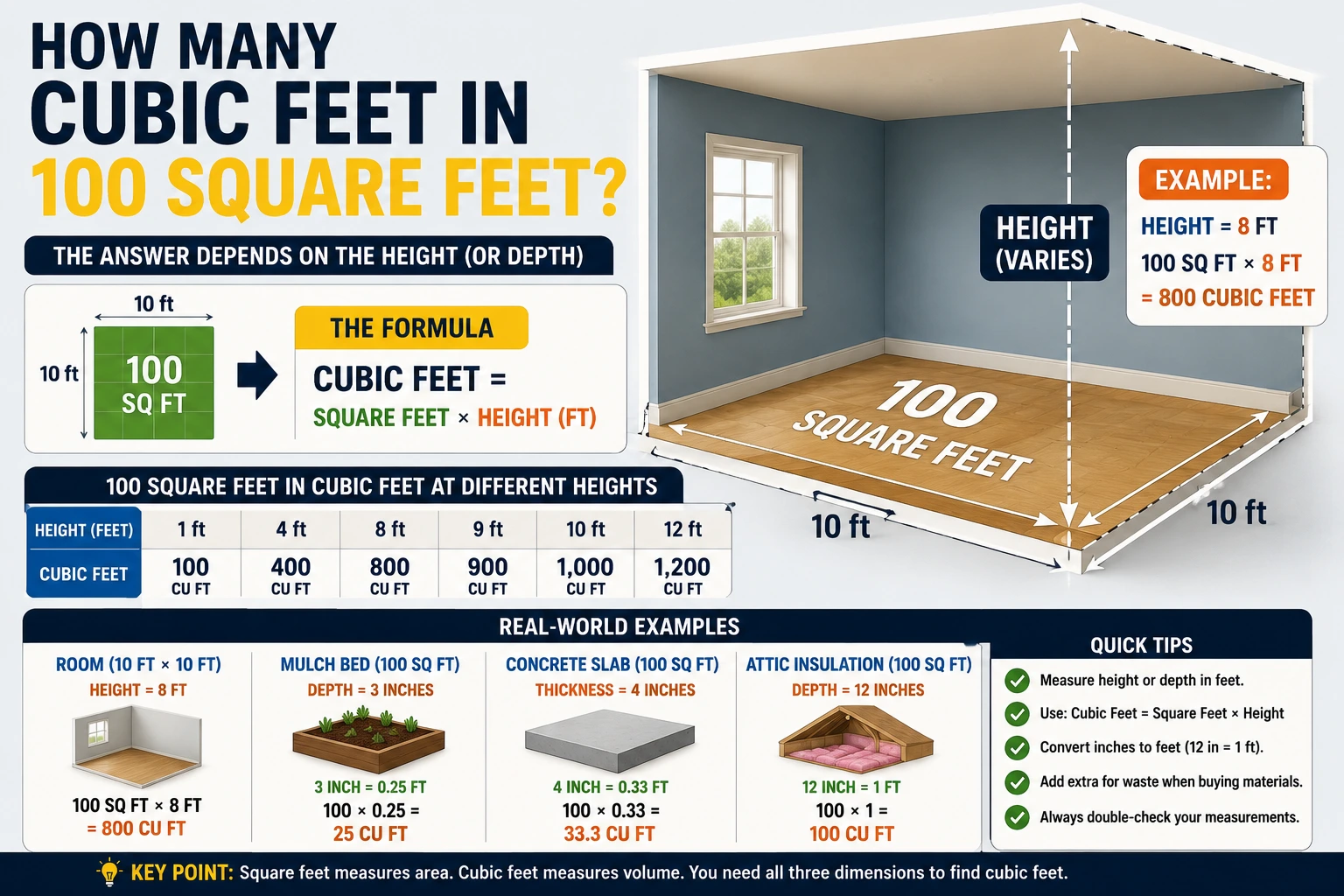
If you are asking how many cubic feet in 100 square feet, the answer depends on one important measurement: height or depth.
You cannot convert square feet directly into cubic feet because square feet measure area, while cubic feet measure volume. To find cubic feet, you need to know how high, deep, or tall the space is.
For example:
- 100 square feet at 1 foot deep = 100 cubic feet
- 100 square feet at 8 feet high = 800 cubic feet
- 100 square feet at 10 feet high = 1,000 cubic feet
The formula is simple:
Cubic Feet = Square Feet × Height or Depth in Feet
This guide explains how to convert 100 square feet to cubic feet, why height matters, common room examples, material calculations, and mistakes to avoid.
Quick Answer: How Many Cubic Feet in 100 Square Feet?
There is no single answer unless you know the height or depth.
Use this formula:
Cubic Feet = Square Feet × Height
For 100 square feet:
| Height or Depth | Cubic Feet |
|---|---|
| 1 foot | 100 cubic feet |
| 2 feet | 200 cubic feet |
| 4 feet | 400 cubic feet |
| 8 feet | 800 cubic feet |
| 9 feet | 900 cubic feet |
| 10 feet | 1,000 cubic feet |
| 12 feet | 1,200 cubic feet |
So, if you have a 100-square-foot room with an 8-foot ceiling, it contains 800 cubic feet of air space.
Why You Cannot Convert 100 Square Feet to Cubic Feet Without Height
Square feet and cubic feet measure different things.
- Square feet measure a flat surface, such as a floor, wall, roof, or garden bed.
- Cubic feet measure three-dimensional space, such as a room, box, storage unit, pile of mulch, or amount of concrete.
Imagine a floor that is 10 feet long and 10 feet wide.
10 × 10 = 100 square feet
That tells you the floor area. But it does not tell you the size of the room until you know the ceiling height.
If the room is 8 feet high:
10 × 10 × 8 = 800 cubic feet
If the room is 10 feet high:
10 × 10 × 10 = 1,000 cubic feet
The floor stays the same size, but the volume changes because the height changes.
How Many Cubic Feet in 100 Square Feet at Different Heights?
The answer to how many cubic feet in 100 square feet changes as the height or depth changes.
100 Square Feet at 1 Foot High
100 × 1 = 100 cubic feet
This could describe a shallow storage bin, a garden bed filled 1 foot deep, or a 10-foot by 10-foot space with 1 foot of material.
100 Square Feet at 8 Feet High
100 × 8 = 800 cubic feet
This is common for a room with a standard ceiling height.
A 10-foot by 10-foot room with an 8-foot ceiling contains 800 cubic feet.
100 Square Feet at 9 Feet High
100 × 9 = 900 cubic feet
Many newer homes have 9-foot ceilings. The same 100-square-foot room holds 100 more cubic feet of air than it would with an 8-foot ceiling.
100 Square Feet at 10 Feet High
100 × 10 = 1,000 cubic feet
A 10-foot ceiling creates a larger air volume. This can matter when planning HVAC, heating, cooling, ventilation, and insulation.
100 Square Feet at 12 Feet High
100 × 12 = 1,200 cubic feet
A 12-foot ceiling is common in some garages, workshops, commercial spaces, and rooms with vaulted ceilings.
How to Convert 100 Square Feet to Cubic Feet Step by Step
You can calculate cubic feet in a few simple steps.
Step 1: Confirm the Area
First, make sure you have the correct area in square feet.
For example:
10 feet × 10 feet = 100 square feet
You may also have a different shape, such as:
5 feet × 20 feet = 100 square feet
Both spaces have the same floor area.
Step 2: Measure the Height or Depth
Measure the third dimension in feet.
For rooms, measure from the floor to the ceiling.
For mulch, soil, gravel, or concrete, measure the material depth.
For boxes or storage spaces, measure the internal height.
If your measurement is in inches, convert it to feet first.
For example:
- 6 inches = 0.5 feet
- 12 inches = 1 foot
- 18 inches = 1.5 feet
- 24 inches = 2 feet
Step 3: Use the Cubic Feet Formula
Multiply the square footage by the height or depth.
Cubic Feet = Square Feet × Height
Example:
- Area: 100 square feet
- Height: 8 feet
100 × 8 = 800 cubic feet
Step 4: Check Your Units
Make sure all measurements are in feet before multiplying.
If you multiply square feet by inches, you will not get cubic feet. Convert inches to feet first.
For example, if a 100-square-foot garden bed is 6 inches deep:
6 inches ÷ 12 = 0.5 feet
Then:
100 × 0.5 = 50 cubic feet
100 Square Feet to Cubic Feet Conversion Chart
This chart shows common results for a 100-square-foot area.
| Height or Depth | Cubic Feet | Common Use |
| 2 inches | 16.7 cu ft | Thin concrete or gravel layer |
| 4 inches | 33.3 cu ft | Standard concrete slab depth |
| 6 inches | 50 cu ft | Garden soil or mulch layer |
| 8 inches | 66.7 cu ft | Deep mulch or raised bed fill |
| 1 foot | 100 cu ft | Storage or soil volume |
| 4 feet | 400 cu ft | Small storage area |
| 8 feet | 800 cu ft | Standard-height room |
| 9 feet | 900 cu ft | Room with 9-foot ceiling |
| 10 feet | 1,000 cu ft | Taller room or workshop |
| 12 feet | 1,200 cu ft | Garage or commercial space |
This is why the height or depth is essential. A 100-square-foot area can hold a very small or very large volume depending on the third measurement.
Real-World Examples of 100 Square Feet in Cubic Feet
A Small Room
A 10-foot by 10-foot room is 100 square feet.
If it has an 8-foot ceiling:
100 × 8 = 800 cubic feet
This is useful for estimating room air volume, ventilation needs, or heating and cooling requirements.
A Storage Unit
Imagine a storage space with a 10-foot by 10-foot floor and an 8-foot ceiling.
It has:
- 100 square feet of floor space
- 800 cubic feet of storage volume
However, the usable storage space may be lower because you need room for walking, shelving, and safe stacking.
Mulch for a Garden Bed
A garden bed is 100 square feet and needs mulch 3 inches deep.
First, convert 3 inches to feet:
3 ÷ 12 = 0.25 feet
Then calculate:
100 × 0.25 = 25 cubic feet
You need 25 cubic feet of mulch.
Since mulch is often sold in cubic feet or cubic yards, this calculation helps you buy the right amount.
Concrete for a Slab
A 100-square-foot slab that is 4 inches thick needs:
4 ÷ 12 = 0.333 feet
100 × 0.333 = about 33.3 cubic feet
Concrete is often ordered in cubic yards, so divide cubic feet by 27:
33.3 ÷ 27 = about 1.23 cubic yards
It is wise to add a small extra amount for waste, uneven ground, and finishing.
Attic Insulation
If an attic floor is 100 square feet and you need insulation 12 inches deep:
100 × 1 = 100 cubic feet
This helps when comparing loose-fill insulation products, which may list coverage based on depth and area.
Square Feet vs Cubic Feet: What Is the Difference?
The difference is easy to remember:
| Measurement | What It Measures | Example |
| Feet | Length | A wall is 10 feet long |
| Square feet | Area | A floor is 100 square feet |
| Cubic feet | Volume | A room contains 800 cubic feet |
Square feet use two measurements:
Length × Width
Cubic feet use three measurements:
Length × Width × Height
For a 10-foot by 10-foot by 8-foot room:
- Floor area: 10 × 10 = 100 square feet
- Volume: 10 × 10 × 8 = 800 cubic feet
When You Need Cubic Feet Instead of Square Feet
You need cubic feet when you are measuring space that has depth, height, or thickness.
Common uses include:
- Estimating air volume in a room
- Choosing a heater, fan, air purifier, or dehumidifier
- Planning insulation
- Ordering mulch, soil, gravel, or sand
- Calculating concrete
- Measuring storage capacity
- Estimating moving truck space
- Filling a raised garden bed
- Planning a fish tank or pond
- Measuring a refrigerator or freezer
Square feet are enough when you only need a flat surface measurement, such as flooring, carpet, paint coverage, roofing, or lawn size.
Common Mistakes When Calculating Cubic Feet
Forgetting the Height or Depth
You cannot find cubic feet from square feet alone. Always include the third measurement.
Using Inches Without Converting Them
Convert inches to feet before calculating.
For example, 6 inches is 0.5 feet, not 6 feet.
Mixing Up Square Feet and Cubic Feet
A 100-square-foot floor does not equal 100 cubic feet unless the height or depth is exactly 1 foot.
Ignoring Irregular Shapes
For sloped ceilings, uneven ground, or tapered piles, use an average height or divide the area into smaller sections.
Forgetting Waste Allowance
For materials such as mulch, gravel, concrete, and insulation, buy a little extra to cover settling, spillage, uneven depth, and project changes.
Expert Tips for Accurate Volume Calculations
Use these tips to get better results.
- Measure inside dimensions for rooms, boxes, and storage units.
- Use a tape measure or laser measure for long spaces.
- Convert all inches into feet before multiplying.
- Break irregular spaces into rectangles and add the totals.
- Use average depth for uneven soil, mulch, or gravel.
- Add 5% to 10% extra for loose materials when appropriate.
- Check product labels because coverage can vary by material type.
- Use cubic yards for large concrete, soil, and gravel orders.
- Recheck your calculation before placing an expensive order.
Frequently Asked Questions About 100 Square Feet and Cubic Feet
How many cubic feet is 100 square feet at 8 feet high?
A 100-square-foot area with an 8-foot height contains 800 cubic feet.
How many cubic feet is 100 square feet at 10 feet high?
A 100-square-foot area with a 10-foot height contains 1,000 cubic feet.
Can I convert square feet directly to cubic feet?
No. You need the height or depth in feet. Multiply square feet by height or depth to calculate cubic feet.
How do I calculate cubic feet for mulch or soil?
Multiply the garden bed’s square footage by the material depth in feet. For example, 100 square feet at 3 inches deep equals 25 cubic feet because 3 inches is 0.25 feet.
How many cubic feet are in a 10×10 room?
A 10×10 room has 100 square feet of floor area. Its cubic feet depend on ceiling height. At 8 feet high, it contains 800 cubic feet.
Conclusion: How Many Cubic Feet in 100 Square Feet?
So, how many cubic feet in 100 square feet? There is no single answer until you know the height or depth.
Use this formula:
Cubic Feet = Square Feet × Height or Depth in Feet
For example, 100 square feet at 8 feet high equals 800 cubic feet, while 100 square feet at 10 feet high equals 1,000 cubic feet.
Whether you are measuring a room, planning insulation, ordering mulch, pouring concrete, or estimating storage space, always include the third dimension. Once you know the height or depth, the calculation is quick, accurate, and easy to repeat.
Discover more