

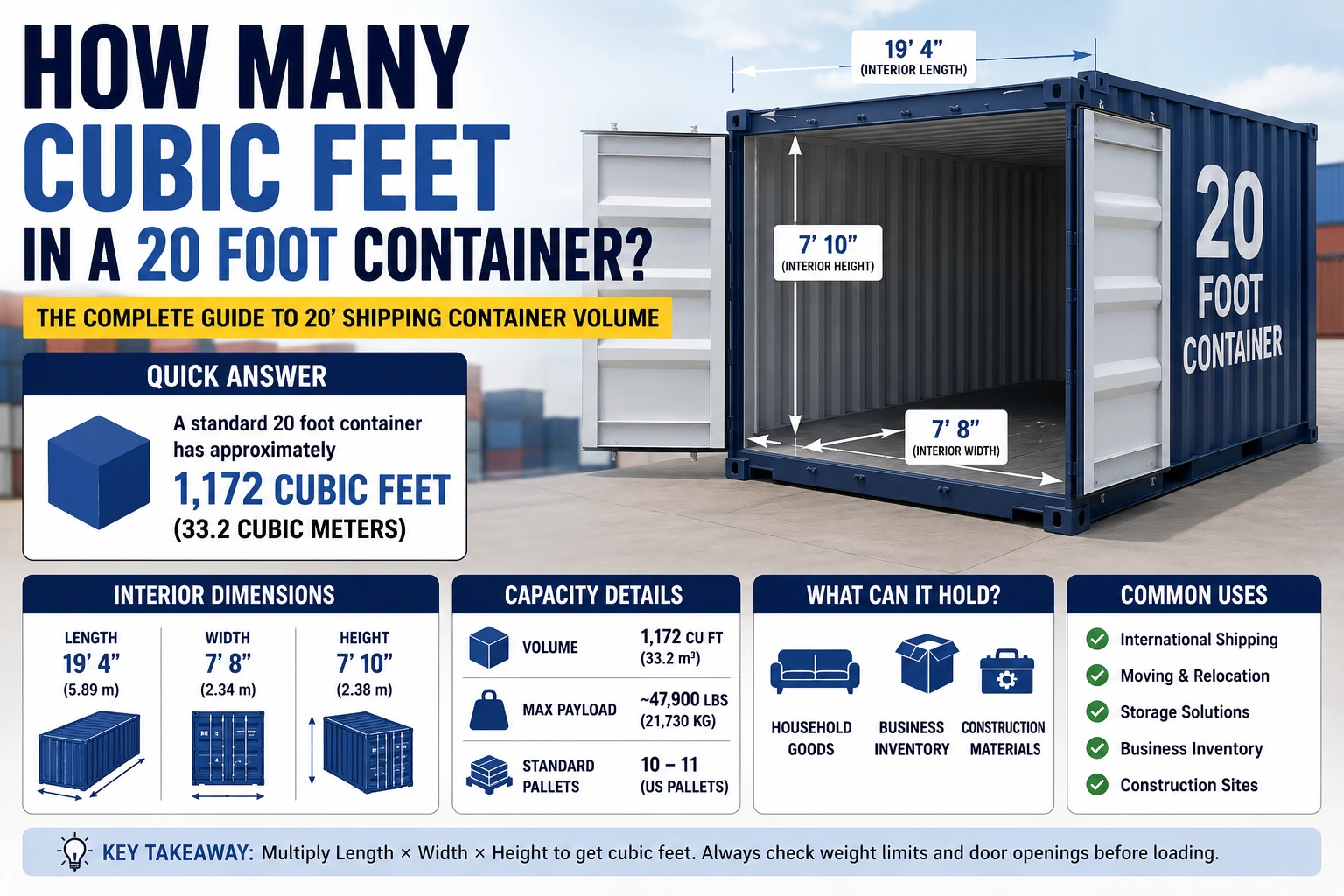
f you’re wondering how many cubic feet in a 20 foot container, the short answer is about 1,170 to 1,180 cubic feet of usable interior cargo space.
A standard ISO 20-foot dry shipping container typically provides approximately 1,172 cubic feet (33.2 cubic meters) of internal storage volume. This makes it one of the most popular container sizes for international shipping, business storage, construction projects, and household moves.
However, cubic-foot capacity is only one factor to consider. Interior dimensions, door opening size, payload weight, and pallet configuration all affect how much cargo you can actually load.
This guide explains everything you need to know about 20-foot container capacity, dimensions, cargo limits, pallet space, and practical examples.
Quick Answer: How Many Cubic Feet in a 20 Foot Container?
A standard 20-foot dry shipping container offers approximately:
| Specification | Value |
|---|---|
| Interior Volume | 1,172 cubic feet |
| Cubic Meters | 33.2 m³ |
| Interior Length | 19 ft 4 in |
| Interior Width | 7 ft 8 in |
| Interior Height | 7 ft 10 in |
So, if someone asks:
“How many cubic feet are in a 20 foot container?”
The answer is:
About 1,172 cubic feet.
Standard 20-Foot Shipping Container Dimensions
A container’s outside dimensions differ from its usable inside space.
Exterior Dimensions
Typical outside measurements are:
| Measurement | Size |
| Length | 20 ft |
| Width | 8 ft |
| Height | 8 ft 6 in |
These measurements follow ISO shipping standards.
Interior Dimensions
The interior dimensions are slightly smaller because of wall thickness.
Typical interior measurements include:
- Length: 19 ft 4 in
- Width: 7 ft 8 in
- Height: 7 ft 10 in
These dimensions create roughly 1,172 cubic feet of storage space.
Door Opening Size
The cargo doors are smaller than the inside dimensions.
Typical opening:
- Width: about 7 ft 8 in
- Height: about 7 ft 5 in
Large equipment must fit through the doors before it can fit inside the container.
How Many Cubic Feet in a 20 Foot Container?
The volume comes from multiplying:
Length × Width × Height
Example:
- Length = 19.35 ft
- Width = 7.7 ft
- Height = 7.83 ft
19.35 × 7.7 × 7.83 ≈ 1,172 cubic feet
That is why most logistics companies advertise approximately 1,170 cubic feet.
Cubic Meters Conversion
International shipping often uses cubic meters.
| Unit | Capacity |
| Cubic Feet | 1,172 cu ft |
| Cubic Meters | 33.2 m³ |
Both values describe exactly the same cargo space.
20-Foot Container Capacity Chart
| Feature | Standard 20-ft Container |
| Interior Volume | 1,172 cu ft |
| Interior Length | 19.35 ft |
| Interior Width | 7.7 ft |
| Interior Height | 7.83 ft |
| Exterior Length | 20 ft |
| Exterior Width | 8 ft |
| Exterior Height | 8.5 ft |
| Empty Weight | ~5,000 lb |
| Maximum Gross Weight | ~52,900 lb |
| Typical Payload | ~47,900 lb |
Specifications may vary slightly by manufacturer.
How Much Can a 20-Foot Container Hold?
Capacity depends on both volume and weight.
Weight Capacity
Most standard containers can carry approximately:
- Payload: 47,000–48,000 pounds
Heavy cargo like machinery reaches the weight limit before filling the container.
Volume Capacity
Bulky but lightweight cargo fills the container long before reaching its maximum weight.
Examples include:
- Furniture
- Mattresses
- Clothing
- Plastic products
- Paper goods
Pallet Capacity
Most 20-foot containers hold:
- 10–11 standard US pallets
- 11 Euro pallets
The exact number depends on pallet size and loading pattern.
How to Calculate Cubic Feet in Any Shipping Container
The formula is straightforward.
Cubic Feet = Length × Width × Height
Example:
Interior:
- 19.35 ft
- 7.7 ft
- 7.83 ft
Multiply all three numbers:
19.35 × 7.7 × 7.83 = about 1,172 cubic feet
You can use the same method for any container size.
Real-Life Uses for a 20-Foot Container
Household Moving
A 20-foot container is commonly used for:
- Two-bedroom homes
- Apartments
- Furniture
- Appliances
- Boxes
- Garage storage
Most families can move an average home using one container.
Business Inventory
Retail businesses often store:
- Clothing
- Electronics
- Office supplies
- Seasonal inventory
- Promotional products
The enclosed design protects inventory from weather.
Construction Storage
Construction companies use 20-foot containers to store:
- Power tools
- Building materials
- Equipment
- Spare parts
- Safety supplies
Many sites use containers as secure temporary storage.
International Freight
Importers ship:
- Consumer products
- Automotive parts
- Furniture
- Industrial equipment
- Machinery
- Food products (with specialized containers)
The 20-foot container is the global standard for ocean freight.
20-Foot vs 40-Foot Shipping Container
| Feature | 20-ft | 40-ft |
| Cubic Feet | 1,172 | 2,390 |
| Cubic Meters | 33.2 | 67.7 |
| US Pallets | 10–11 | 20–21 |
| Typical Household | 2-bedroom | 4–5-bedroom |
| Easier Transport | Yes | Less maneuverable |
If your shipment is bulky but lightweight, a 40-foot container may provide better value.
Common Mistakes When Estimating Container Space
Avoid these common errors.
Using Exterior Dimensions
Always use interior dimensions when calculating cargo volume.
Ignoring Door Clearance
An item may fit inside but still be too large to pass through the doors.
Forgetting Weight Limits
Heavy cargo may exceed the payload before filling the available space.
Ignoring Packaging
Pallets, crates, wrapping, and protective materials reduce usable space.
Assuming Every Container Is Identical
Different manufacturers and container types can have slightly different interior dimensions.
Expert Tips Before Renting or Buying a Container
Follow these best practices.
- Measure your cargo before booking.
- Confirm the container’s interior dimensions.
- Check both cubic volume and payload weight.
- Use pallets for easier loading.
- Stack lighter items on top.
- Leave access space if unloading in stages.
- Secure cargo with straps and load bars.
- Consider a high-cube container if extra height is needed.
- Inspect the container floor before loading.
- Distribute weight evenly.
These steps help maximize space while protecting your shipment.
Frequently Asked Questions
How many cubic feet are in a standard 20-foot container?
A standard dry shipping container holds approximately 1,172 cubic feet of interior space.
How many pallets fit in a 20-foot container?
Most containers accommodate 10 to 11 standard US pallets or about 11 Euro pallets, depending on loading configuration.
What is the maximum weight of a 20-foot container?
Most ISO containers have a maximum gross weight of about 52,900 pounds, with a payload capacity near 47,900 pounds.
Is every 20-foot container the same size?
Most follow ISO standards, but small differences may exist between manufacturers or specialized containers such as refrigerated or high-cube models.
Can a 20-foot container fit a two-bedroom home?
Yes. A standard 20-foot container is commonly used for moving the contents of an average two-bedroom apartment or small house, depending on furniture size and packing efficiency.
Conclusion
If you’re asking how many cubic feet in a 20 foot container, the answer is approximately 1,172 cubic feet (33.2 cubic meters) of usable interior volume.
This capacity makes a 20-foot container an excellent choice for household moves, business inventory, construction storage, and international freight. However, successful loading requires more than knowing the volume. You should also consider interior dimensions, door clearance, pallet layout, and maximum payload weight.
Before renting or purchasing a container, measure your cargo carefully and compare it with the container’s interior specifications. Doing so will help you maximize space, avoid costly shipping mistakes, and ensure your goods arrive safely.
Discover more