

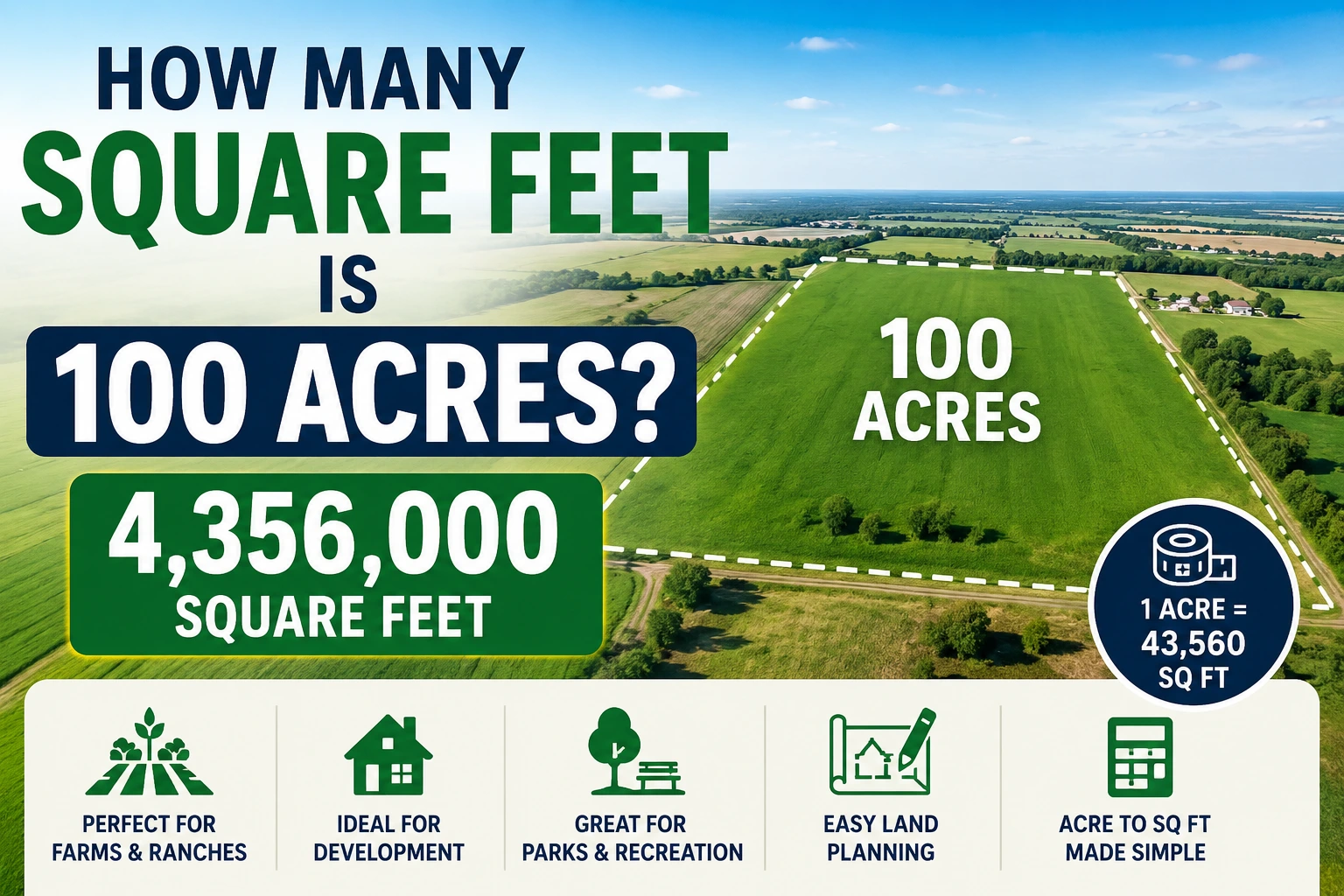
Knowing how many square feet is 100 acres is useful in many industries. Whether you’re buying land, planning a construction project, or studying property measurements, this conversion helps you better understand the true size of a large piece of land.
Agriculture
Farmers often measure fields in acres, but irrigation systems, fencing, and crop planning may require square feet.
For example:
- Planning irrigation coverage
- Calculating fertilizer requirements
- Estimating crop spacing
- Designing storage facilities
A 100-acre farm provides enough space for multiple crops, livestock areas, and farm buildings.
Residential Development
Developers use square feet to calculate:
- Building footprints
- Road layouts
- Parks
- Utility installations
- Parking lots
Knowing that 100 acres equals 4,356,000 square feet makes planning much easier.
Commercial Projects
Large commercial developments commonly use land measurements in square feet for:
- Shopping centers
- Warehouses
- Industrial parks
- Distribution centers
- Manufacturing facilities
Architects often convert acres into square feet because building codes are written using square-foot measurements.
Public Parks
Many city parks are measured in acres.
Examples include:
- Walking trails
- Picnic areas
- Sports fields
- Playgrounds
- Lakes
- Botanical gardens
A 100-acre park provides enough room for several recreational facilities while preserving natural landscapes.
Wildlife Conservation
Conservation organizations frequently purchase land measured in acres.
Square-foot measurements help calculate:
- Habitat restoration
- Tree planting density
- Wetland protection
- Conservation zoning
100 Acres Compared to Everyday Landmarks
Understanding millions of square feet is difficult, so comparing the area to familiar places makes it easier.
| Comparison | Approximate Size |
|---|---|
| Football fields | About 75 fields |
| Soccer fields | Around 70–80 fields |
| Tennis courts | Over 900 courts |
| Basketball courts | More than 950 courts |
| Standard suburban lots | About 320–400 lots |
| Walmart Supercenters | Around 20–25 stores |
These comparisons help visualize just how massive 100 acres really is.
H2: Acres vs Square Feet
Although both measure area, each serves a different purpose.
| Acres | Square Feet |
|---|---|
| Best for large land parcels | Best for precise measurements |
| Used in farming | Used in home construction |
| Common in real estate | Common in architecture |
| Easier for describing land | Easier for design calculations |
Professionals frequently convert between these units depending on the project.
Why Convert Acres to Square Feet?
Converting acreage into square feet provides greater accuracy for planning and budgeting.
Benefits include:
- Easier property planning
- Better construction estimates
- Accurate landscaping calculations
- Simplified zoning applications
- Improved project budgeting
Many legal documents also require land dimensions in square feet.
Common Mistakes When Converting Acres
Even though the conversion is simple, people often make errors.
Forgetting the Standard Conversion
Some assume one acre equals 40,000 square feet.
The correct value is:
1 acre = 43,560 square feet
Using the wrong number leads to significant errors on large properties.
Multiplication Errors
For 100 acres, remember to multiply:
100 × 43,560
Not:
43,560 ÷ 100
Always verify your calculations.
Confusing Square Feet with Linear Feet
Square feet measure area.
Linear feet measure length.
These units cannot be used interchangeably.
Ignoring Property Shape
Two 100-acre properties can have completely different shapes.
One may be long and narrow.
Another may be nearly square.
Although both contain the same area, their dimensions differ greatly.
Expert Tips for Understanding Large Land Areas
Professionals recommend these strategies when working with acreage.
Use Online Conversion Tools
Reliable conversion calculators reduce errors and save time.
Keep the Conversion Number Handy
Remember:
1 acre = 43,560 square feet
This single number allows quick conversions for almost any property.
Think in Real-World Comparisons
Instead of imagining millions of square feet, compare land to:
- Football fields
- Soccer pitches
- Parks
- Shopping centers
- Residential neighborhoods
Visualization improves understanding.
Double-Check Important Calculations
If you’re purchasing land or planning construction, verify measurements using official property surveys or professional mapping tools.
Frequently Asked Questions
How many square feet is 100 acres exactly?
Exactly 100 acres equals 4,356,000 square feet. Simply multiply 100 by 43,560.
How many football fields fit into 100 acres?
Approximately 75 American football fields, including end zones, can fit within 100 acres.
Is 100 acres considered a large property?
Yes. A 100-acre property is considered very large and is commonly used for farming, ranching, conservation, commercial development, and recreational parks.
Why do people convert acres into square feet?
Square feet provide more precise measurements for construction, architecture, landscaping, zoning, and property planning.
What is the easiest way to remember the conversion?
Remember this simple rule:
1 acre = 43,560 square feet
Multiply the number of acres by 43,560 to find the area in square feet.
Conclusion
If you’ve been wondering how many square feet is 100 acres, the answer is straightforward: 100 acres equals 4,356,000 square feet. This simple conversion is valuable for homeowners, farmers, developers, surveyors, and anyone involved in land management.
Understanding acreage in square feet makes it easier to visualize property size, estimate project costs, comply with zoning requirements, and plan construction or landscaping projects with confidence. Whether you’re buying land, comparing properties, or working on a large-scale development, knowing this conversion provides a practical foundation for informed decisions.
The next time someone asks how many square feet is 100 acres, you’ll know not only the exact number but also how that area compares to football fields, parks, neighborhoods, and other real-world landmarks, making the measurement much easier to understand and apply.
Discover more