
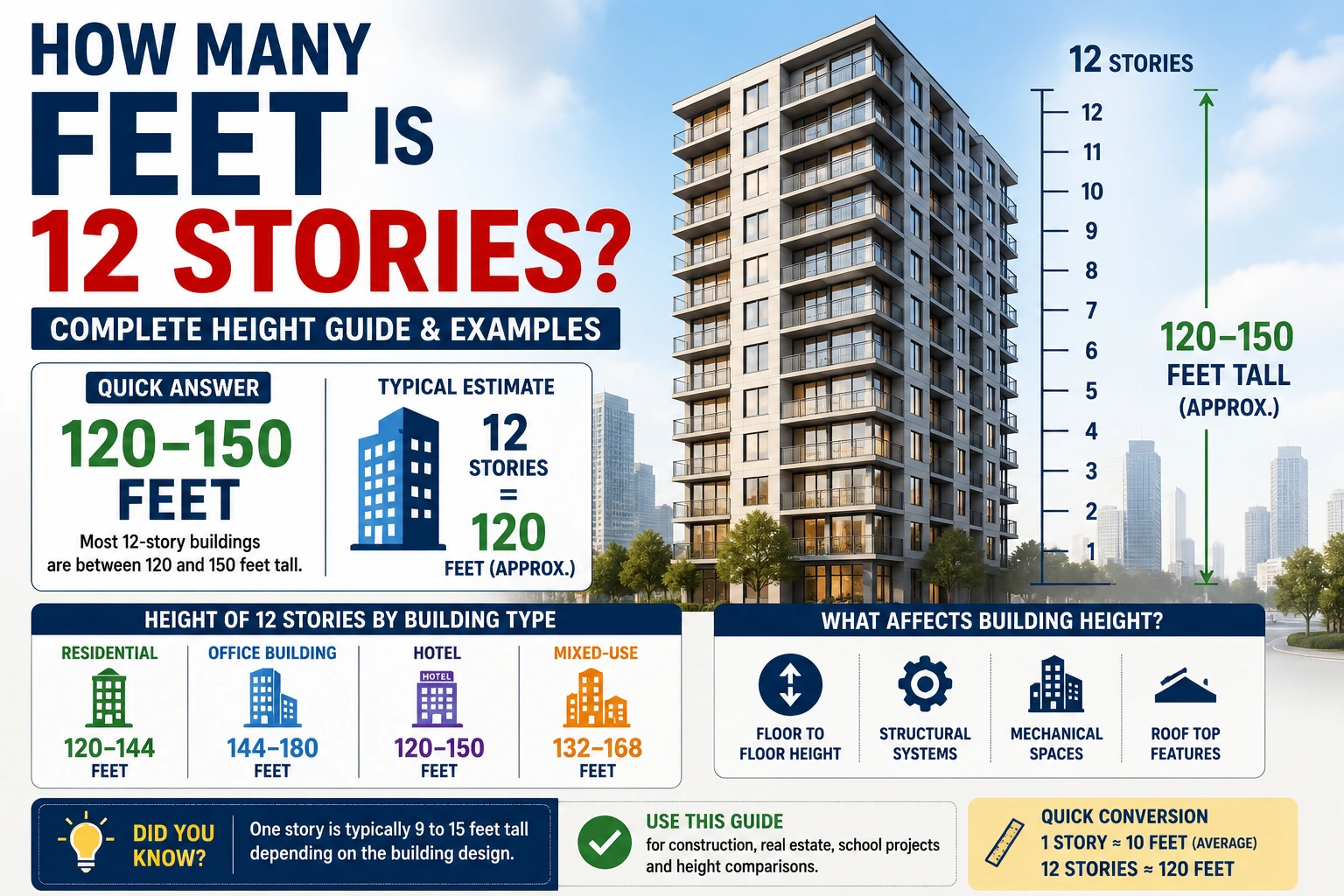
If you are wondering how many feet is 12 stories, the most common estimate is between 120 and 150 feet tall. A typical residential floor is often around 10 feet from one floor level to the next. Using that estimate, a 12-story building would be about:
12 stories × 10 feet = 120 feet
However, not every building has the same floor height. Offices, hotels, luxury apartments, hospitals, and mixed-use buildings may have taller ceilings, thicker floors, or mechanical spaces. Because of this, a 12-story building can range from roughly 110 feet to more than 180 feet.
For a quick estimate, you can use:
A 12-story building is usually about 120 to 150 feet tall.
This guide explains how story height works, why buildings vary, and how to estimate the height of a 12-floor building more accurately.
Quick Answer: How Many Feet Is 12 Stories?
The answer depends on the type of building.
| Building Type | Typical Height Per Story | Estimated Height for 12 Stories |
|---|---|---|
| Basic residential building | 9–10 ft | 108–120 ft |
| Apartment building | 10–12 ft | 120–144 ft |
| Hotel | 10–12 ft | 120–144 ft |
| Office building | 12–15 ft | 144–180 ft |
| Mixed-use building | 11–14 ft | 132–168 ft |
| Hospital or special-use building | 13–16 ft | 156–192 ft |
For most apartments and residential buildings, the best general estimate is:
12 stories = about 120 feet
For office buildings, a more realistic estimate is often:
12 stories = about 144 to 180 feet
Typical 12-Story Height Range
A 12-story building is commonly:
- Around 120 feet for a basic apartment building
- Around 132 to 144 feet for newer residential buildings
- Around 144 to 180 feet for office buildings
- Up to 190 feet or more for buildings with taller floors or rooftop equipment
The height is measured from the ground level to the roofline. Some sources may include rooftop structures, antennas, or decorative features, which can make the reported height higher.
Standard Residential Estimate
For a simple estimate, use:
1 story = 10 feet
Then:
12 × 10 = 120 feet
This rule is useful when you need a quick answer for:
- General comparisons
- Schoolwork
- Home planning
- Fire safety discussions
- Visualizing building height
- Estimating ladder or lift requirements
Still, use actual building plans or property records when exact height matters.
How Many Feet Is 12 Stories in Different Buildings?
The number of stories does not tell the full story. A floor in one building can be much taller than a floor in another.
Apartment Buildings
Most apartment buildings have floor-to-floor heights of around 10 to 12 feet.
That includes:
- Ceiling space
- Floor slab thickness
- Wiring and plumbing
- Ductwork
- Structural supports
For a 12-story apartment building:
12 × 10 feet = 120 feet
or:
12 × 12 feet = 144 feet
Typical range:
120 to 144 feet
Office Buildings
Office buildings often need more vertical space for:
- Suspended ceilings
- HVAC ducts
- Electrical systems
- Data cables
- Fire protection systems
- Larger open workspaces
A typical office floor can be 12 to 15 feet tall.
For 12 stories:
12 × 12 = 144 feet
12 × 15 = 180 feet
Typical range:
144 to 180 feet
Hotels
Hotels usually fall between residential and office buildings.
A standard hotel may have 10 to 12 feet per floor. However, the lobby level may be much taller than guest-room floors.
Typical 12-story hotel range:
120 to 150 feet
Mixed-Use Buildings
Mixed-use buildings often have shops, restaurants, parking, or offices on lower floors. These spaces may have taller ceilings than upper apartments.
For example:
- Ground-floor retail: 16 feet
- Second-floor office: 13 feet
- Ten apartment floors: 10 feet each
Calculation:
16 + 13 + 100 = 129 feet
A mixed-use 12-story building may range from:
132 to 168 feet
Average Height Per Story Explained
To estimate a building correctly, you need to understand the difference between ceiling height and floor-to-floor height.
Floor-to-Floor Height vs Ceiling Height
A room may have an 8-foot ceiling, but the entire story can still be 10 feet or more.
Why?
The space between floors contains:
- Floor slabs
- Beams
- Insulation
- Pipes
- Electrical wiring
- Air ducts
- Fire sprinkler systems
This is called the floor-to-floor height.
| Measurement | Typical Residential Range |
|---|---|
| Ceiling height | 8–10 ft |
| Floor thickness and services | 1–3 ft |
| Total floor-to-floor height | 9–12 ft |
That is why assuming every story is only the height of the ceiling gives an inaccurate result.
12-Story Building Height Chart
Use this chart to estimate a 12-story building based on average story height.
| Average Height Per Story | Total Height for 12 Stories |
|---|---|
| 9 ft | 108 ft |
| 10 ft | 120 ft |
| 11 ft | 132 ft |
| 12 ft | 144 ft |
| 13 ft | 156 ft |
| 14 ft | 168 ft |
| 15 ft | 180 ft |
| 16 ft | 192 ft |
This chart makes it easy to compare different building types.
How to Calculate How Many Feet Is 12 Stories
Use this basic formula:
Number of Stories × Average Floor Height = Estimated Building Height
For a 12-story building:
12 × average floor height = total height
Calculation Example: Apartment Building
Average story height:
10 feet
Calculation:
12 × 10 = 120 feet
Estimated building height:
120 feet
Calculation Example: Office Building
Average story height:
14 feet
Calculation:
12 × 14 = 168 feet
Estimated building height:
168 feet
Calculation Example: Mixed-Use Building
Suppose a building has:
- Ground floor: 16 feet
- Second floor: 14 feet
- Remaining 10 floors: 10 feet each
Calculation:
16 + 14 + (10 × 10) = 130 feet
Estimated height:
130 feet
What Makes a 12-Story Building Taller or Shorter?
Several design details can change the total height.
Ceiling Heights
Luxury apartments and commercial spaces may have taller ceilings. A 12-foot ceiling usually creates a taller floor-to-floor height than an 8-foot ceiling.
Structural Floors
Concrete slabs, steel beams, and building systems add thickness between levels.
Mechanical Levels
Some buildings include mechanical floors for HVAC, elevators, water systems, or electrical equipment. These levels may be taller than normal floors.
Ground-Floor Retail
Retail spaces often need higher ceilings for signs, lighting, displays, and open interiors.
Roof Features
A building may have:
- Elevator rooms
- Water tanks
- Cooling units
- Roof decks
- Decorative towers
- Antennas
These features can increase total height beyond the 12 main stories.
Real-World Examples of 12-Story Heights
A 12-story building can look very different depending on its purpose.
Example 1: Standard Apartment Block
- 10 feet per story
- 12 stories
- Total height: 120 feet
Example 2: Modern Residential Tower
- 11.5 feet per story
- 12 stories
- Total height: 138 feet
Example 3: Office Building
- 14 feet per story
- 12 stories
- Total height: 168 feet
Example 4: Hotel With a Tall Lobby
- Lobby: 18 feet
- 11 guest floors: 10 feet each
- Total: 128 feet
These examples show why there is no single exact answer for every 12-story building.
12 Stories Compared With Common Objects
It can be hard to picture 120 to 150 feet. These comparisons can help.
A 12-story building is roughly:
- As tall as a 10- to 15-story apartment tower
- Taller than many mature trees
- About the length of 40 average adults standing head to toe
- Similar to the height of a large city water tower
- Around one-third the height of a football field standing upright
A 120-foot building is also equal to:
- 40 yards
- About 36.6 meters
- 1,440 inches
Common Mistakes When Estimating Building Height
Assuming Every Story Is 10 Feet
Ten feet is a useful average, but office buildings and mixed-use buildings can be much taller.
Confusing Ceiling Height With Story Height
An 8-foot ceiling does not mean the entire story is 8 feet tall.
Ignoring the Ground Floor
Ground-floor retail, hotel lobbies, and entrance areas are often taller than upper floors.
Forgetting Rooftop Structures
Elevator rooms, mechanical systems, and roof features can add several feet.
Using Stories as an Exact Measurement
Stories provide an estimate, not a precise building height. Use official plans when exact numbers are required.
Expert Tips for Estimating a Building’s Height
- Use 10 feet per story for a quick residential estimate.
- Use 12 to 15 feet per story for office buildings.
- Check whether the first floor has retail or a tall lobby.
- Look for rooftop equipment that adds height.
- Use building records, plans, or property listings for precise measurements.
- Convert feet to meters by dividing by 3.28084 if needed.
- Do not use an estimate for safety, engineering, or legal purposes.
FAQs
1. How many feet is 12 stories in a residential building?
A 12-story residential building is usually around 120 to 144 feet tall.
2. Is a 12-story building 120 feet tall?
It can be. If each story is 10 feet high, a 12-story building is 120 feet tall.
3. How tall is a 12-story office building?
A 12-story office building is often around 144 to 180 feet tall because office floors are usually taller.
4. How many meters is a 12-story building?
A typical 12-story residential building is about 36 to 44 meters tall, depending on floor height.
5. Why are some 12-story buildings taller than others?
They may have taller ceilings, thicker floor structures, mechanical floors, large lobbies, retail spaces, or rooftop equipment.
Conclusion
So, how many feet is 12 stories? For a typical residential building, 12 stories is usually about 120 feet tall. However, the real height can range from roughly 108 feet to more than 180 feet, depending on the building type, ceiling height, structural design, and rooftop features.
For a quick estimate, use 10 feet per story. For apartments, expect around 120 to 144 feet. For offices, expect around 144 to 180 feet. Understanding these differences helps you estimate building height more accurately for planning, comparisons, learning, and everyday questions.
Discover more