
f you’re planning a concrete project, one of the first questions you’ll likely ask is how many cubic feet are in a bag of concrete. Whether you’re pouring a patio, installing fence posts, building a walkway, or repairing a driveway, knowing the yield of each concrete bag helps you buy the right amount and avoid unnecessary waste.
The answer depends on the weight of the bag. Different manufacturers offer several bag sizes, and each produces a different amount of finished concrete after mixing with water.
This guide explains concrete bag yields, provides easy-to-read charts, shows simple calculations, and helps you estimate exactly how many bags your project requires.
Understanding Concrete Bag Yield
Concrete yield refers to the amount of mixed concrete produced from one dry bag after adding water.
Instead of measuring by weight, finished concrete is measured by volume, usually in cubic feet or cubic yards.
For example:
- An 80-pound bag weighs 80 pounds before mixing.
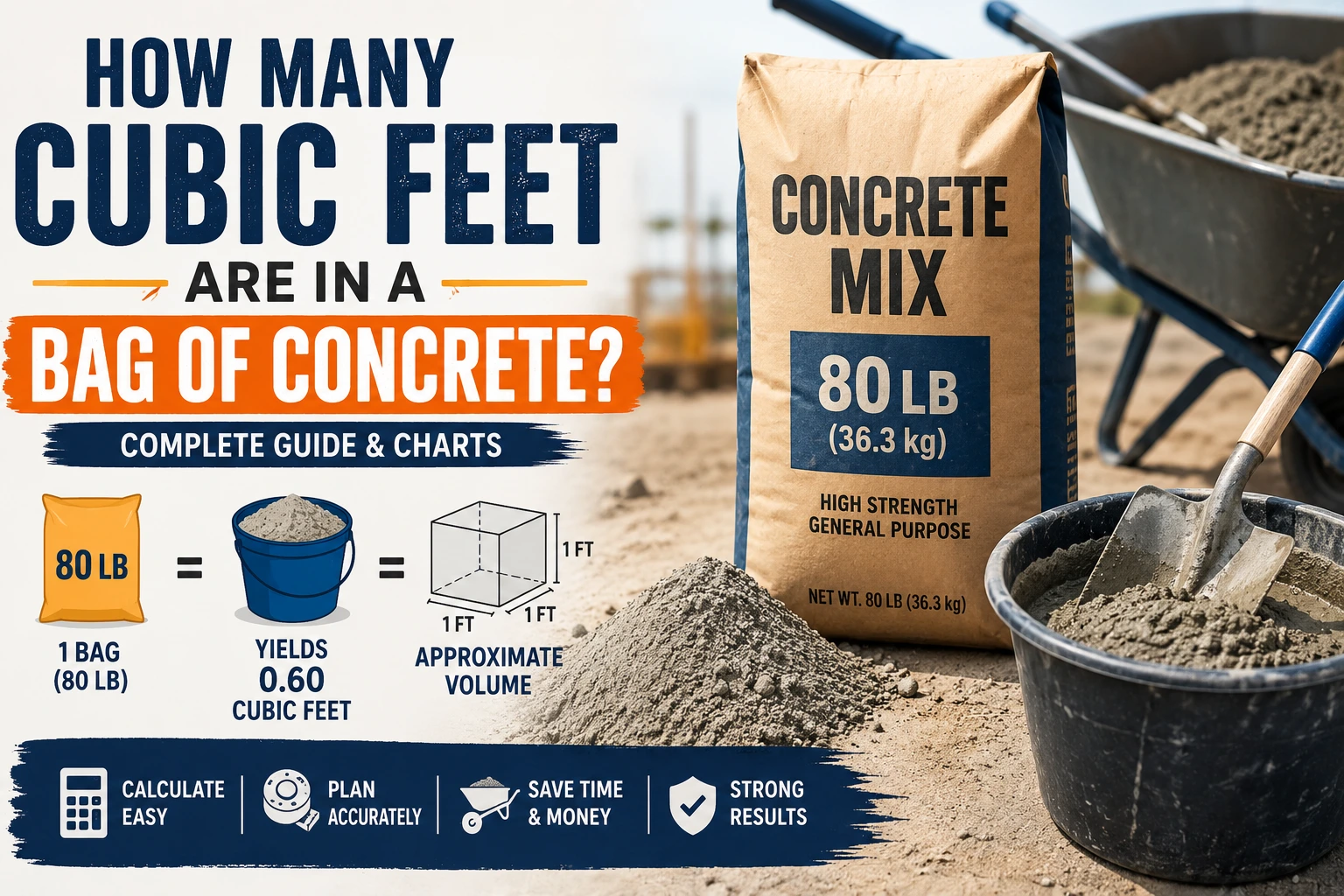
- After adding water, it produces approximately 0.60 cubic feet of concrete.
- The weight changes, but the finished volume is what matters for construction projects.
Knowing the yield makes estimating materials much easier.
Standard Concrete Bag Sizes
Different projects require different bag sizes. Below are the most common options.
40 lb Bag
A 40-pound bag typically yields:
0.30 cubic feet
This size is ideal for:
- Small repairs
- Setting mailbox posts
- Minor patchwork
- Garden edging
50 lb Bag
A 50-pound bag generally produces:
0.375 cubic feet
Best for:
- Small landscaping projects
- Repairs
- Decorative concrete work
60 lb Bag
A 60-pound bag yields approximately:
0.45 cubic feet
Suitable for:
- Fence posts
- Deck supports
- Small slabs
80 lb Bag
The most commonly purchased size.
An 80-pound bag produces approximately 0.60 cubic feet of concrete.
This bag is ideal for:
- Sidewalks
- Patios
- Shed foundations
- Concrete steps
90 lb Bag
Some brands sell 90-pound bags that produce approximately:
0.675 cubic feet
These are commonly used for larger residential and commercial jobs.
Concrete Yield Chart
| Bag Size | Approximate Yield |
|---|---|
| 40 lb | 0.30 cubic feet |
| 50 lb | 0.375 cubic feet |
| 60 lb | 0.45 cubic feet |
| 80 lb | 0.60 cubic feet |
| 90 lb | 0.675 cubic feet |
This chart serves as a quick reference for estimating concrete requirements.
How to Calculate Concrete Volume
Before buying concrete, calculate the total volume of your project.
Use this formula:
Length × Width × Thickness = Cubic Feet
Example:
- Length = 10 feet
- Width = 4 feet
- Thickness = 4 inches
Convert thickness:
4 inches ÷ 12 = 0.333 feet
Now calculate:
10 × 4 × 0.333 = 13.32 cubic feet
Your project requires about 13.3 cubic feet of concrete.
How Many Bags Do You Need?
After determining the total cubic feet, divide by the yield of one bag.
Example:
Project volume:
13.3 cubic feet
Using 80-pound bags:
13.3 ÷ 0.60 = 22.2
Round up.
You’ll need 23 bags.
Example 1: Fence Post
Hole dimensions:
- Diameter: 12 inches
- Depth: 24 inches
Concrete required:
Approximately 2 cubic feet
Using 80-pound bags:
2 ÷ 0.60 = 3.3
You’ll need 4 bags.
Example 2: Small Patio
Dimensions:
- 8 feet
- 10 feet
- 4 inches thick
Volume:
8 × 10 × 0.333
= 26.64 cubic feet
Using 80-pound bags:
26.64 ÷ 0.60
= 44.4
You’ll need 45 bags.
Cubic Feet vs Cubic Yards
Many suppliers sell concrete by the cubic yard instead of individual bags.
Remember:
- 1 cubic yard = 27 cubic feet
Examples:
| Cubic Feet | Cubic Yards |
| 27 | 1 |
| 54 | 2 |
| 81 | 3 |
| 108 | 4 |
For larger projects, ordering ready-mix concrete is often more economical than buying dozens of bags.
Practical Concrete Coverage Examples
| Project | Approximate Concrete Needed |
| Mailbox post | 1–2 cubic feet |
| Fence post | 2 cubic feet |
| Basketball pole | 3–4 cubic feet |
| Sidewalk section | 15–30 cubic feet |
| Small patio | 25–40 cubic feet |
| Garden stepping stone | Less than 1 cubic foot |
These estimates help simplify planning before purchasing materials.
Common Mistakes When Estimating Concrete
Many DIYers underestimate or overestimate their concrete needs. Avoid these common errors:
- Forgetting to convert inches to feet.
- Not rounding up the number of bags.
- Ignoring uneven ground or excavation depth.
- Buying too little concrete, causing delays.
- Assuming every bag size produces the same yield.
Adding an extra 5–10% to your estimate helps account for spills, uneven surfaces, and waste.
Expert Tips for Better Concrete Projects
- Measure your project carefully before purchasing materials.
- Buy one or two extra bags for unexpected needs.
- Use a concrete calculator to double-check your estimates.
- Follow the manufacturer’s recommended water ratio.
- Mix concrete thoroughly for consistent strength.
- Pour and finish the concrete before it begins to set.
- Wear gloves, safety glasses, and protective clothing when handling concrete.
Benefits of Knowing Concrete Bag Yield
Understanding concrete yield offers several advantages:
- Prevents overspending on unnecessary materials.
- Reduces project delays caused by running out of concrete.
- Improves budgeting accuracy.
- Minimizes waste.
- Makes project planning easier.
- Ensures better quality results.
When Should You Buy Ready-Mix Instead?
Bagged concrete works well for:
- Small slabs
- Fence posts
- Repairs
- DIY landscaping
However, if your project requires more than 1 cubic yard (27 cubic feet), ready-mix concrete is often the better option because it saves time, labor, and mixing effort.
Frequently Asked Questions
How many cubic feet are in an 80 lb bag of concrete?
An 80-pound bag typically yields about 0.60 cubic feet of finished concrete after adding water.
How many cubic feet are in a 60 lb bag of concrete?
A 60-pound bag produces approximately 0.45 cubic feet of concrete.
How many 80 lb bags make one cubic yard?
Since one cubic yard equals 27 cubic feet and each 80-pound bag yields 0.60 cubic feet:
27 ÷ 0.60 = 45 bags.
Is concrete yield the same for every brand?
Most manufacturers provide similar yields for the same bag sizes, but slight variations can occur. Always check the product label for the exact yield.
Should I buy extra concrete?
Yes. Purchasing an additional 5–10% helps cover waste, spills, uneven ground, and small calculation errors.
Conclusion
Understanding how many cubic feet are in a bag of concrete is essential for planning any concrete project, whether you’re building a patio, setting fence posts, or repairing a sidewalk. The most common 80-pound bag yields about 0.60 cubic feet, while smaller and larger bags produce different amounts based on their weight.
By measuring your project accurately, using the yield chart, and allowing a small margin for waste, you can purchase the correct number of bags, save money, and complete your project with confidence. Whether you’re a first-time DIYer or an experienced contractor, accurate concrete calculations are the key to a successful pour.
Discover more