
If you’re planning a construction or DIY project, one of the first questions you’ll ask is: how many cubic feet is a bag of concrete? Whether you’re pouring a slab, setting fence posts, or building a patio, knowing this helps you avoid wasting money and materials.
The answer depends on the size of the bag. Different weights produce different volumes when mixed with water.
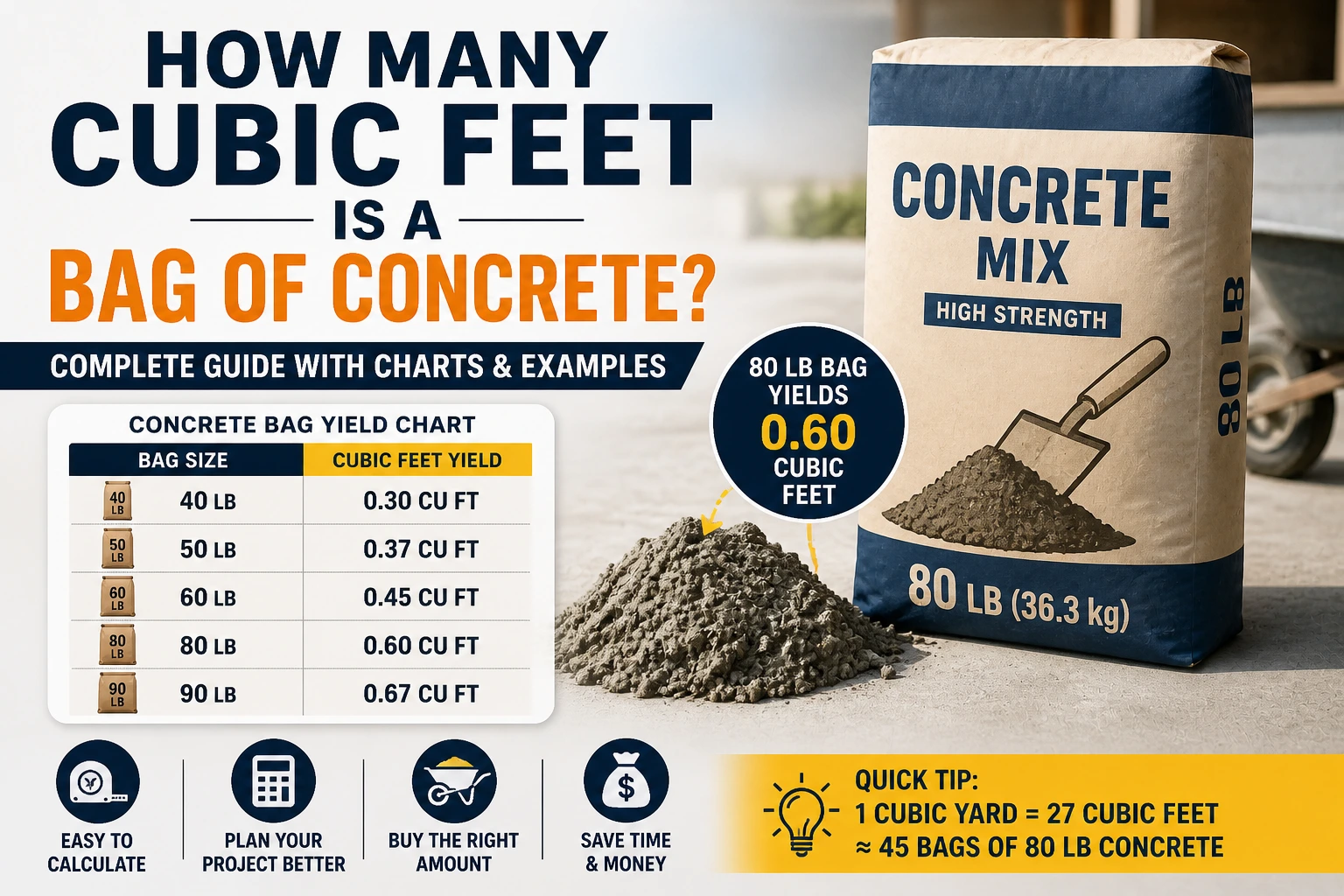
Here’s a quick overview:
- 40 lb bag ≈ 0.30 cubic feet
- 50 lb bag ≈ 0.37 cubic feet
- 60 lb bag ≈ 0.45 cubic feet
- 80 lb bag ≈ 0.60 cubic feet
- 90 lb bag ≈ 0.67 cubic feet
In this complete guide, you’ll learn how to calculate concrete volume, choose the right bag size, and estimate exactly how many bags you need.
What Does “Cubic Feet” Mean in Concrete
Before diving deeper, let’s understand the term.
A cubic foot is a unit of volume:
- 1 ft × 1 ft × 1 ft
- Used to measure how much space material fills
In concrete terms, cubic feet tell you how much mixed concrete a bag will produce—not the dry powder volume.
How Many Cubic Feet Is a Bag of Concrete (By Size)
The yield depends on the bag’s weight. Let’s break it down.
40 lb Bag
- Yield: 0.30 cubic feet
- Best for: small repairs, patches
50 lb Bag
- Yield: 0.37 cubic feet
- Good for: small DIY projects
60 lb Bag
- Yield: 0.45 cubic feet
- Common for: medium jobs like steps
80 lb Bag
- Yield: 0.60 cubic feet
- Most popular size for general construction
90 lb Bag
- Yield: 0.67 cubic feet
- Used for larger or heavier-duty work
Concrete Bag Yield Chart (Quick Reference)
| Bag Size | Cubic Feet Yield |
|---|---|
| 40 lb | 0.30 cu ft |
| 50 lb | 0.37 cu ft |
| 60 lb | 0.45 cu ft |
| 80 lb | 0.60 cu ft |
| 90 lb | 0.67 cu ft |
This chart is useful when estimating materials quickly.
How to Calculate Concrete Volume Step by Step
Follow this simple process:
Step 1: Measure Area
Length × Width
Step 2: Add Depth
Multiply by thickness
Step 3: Get Volume in Cubic Feet
Step 4: Divide by Bag Yield
Example
Project size:
- Length: 10 ft
- Width: 10 ft
- Depth: 0.5 ft
Volume = 10 × 10 × 0.5 = 50 cubic feet
Using 80 lb bags:
50 ÷ 0.60 = 83 bags (approx.)
Real-Life Examples of Concrete Calculations
Fence Post Installation
Hole size:
- 1 ft × 1 ft × 2 ft
Volume = 2 cubic feet
Using 60 lb bags:
2 ÷ 0.45 = 5 bags
Small Patio
- 8 ft × 8 ft × 0.5 ft
Volume = 32 cubic feet
Using 80 lb bags:
32 ÷ 0.60 = 54 bags
How Much Area Does One Bag of Concrete Cover
Coverage depends on thickness.
Example (80 lb bag):
| Thickness | Coverage |
|---|---|
| 1 inch | ~7 sq ft |
| 2 inches | ~3.5 sq ft |
| 4 inches | ~1.75 sq ft |
Thicker slabs require more bags.
Why Bag Size Matters in Concrete Projects
Choosing the right size affects:
- Cost efficiency
- Labor effort
- Mixing time
- Project speed
Larger bags reduce the number of bags needed but are heavier to handle.
Common Mistakes When Calculating Concrete Bags
Avoid these errors:
1. Ignoring Depth
Always include thickness in your calculation.
2. Not Adding Extra Material
Concrete spills and waste happen. Add 5–10% extra.
3. Using Wrong Bag Yield
Different brands may vary slightly.
4. Mixing Units
Stick to feet when calculating volume.
Expert Tips for Accurate Concrete Estimation
- ✔ Always round up
- ✔ Buy extra for safety
- ✔ Check manufacturer yield
- ✔ Measure twice before ordering
- ✔ Use consistent units
Bags vs Cubic Yards Comparison
| Measurement | Equivalent |
|---|---|
| 1 cubic yard | 27 cubic feet |
| 80 lb bags needed | ~45 bags |
This helps when comparing bulk vs bagged concrete.
When to Use Bagged Concrete vs Ready Mix
Use Bagged Concrete When:
- Small projects
- DIY jobs
- Limited access areas
Use Ready Mix When:
- Large slabs
- Driveways
- Commercial work
Benefits of Knowing Concrete Bag Yield
Understanding how many cubic feet is a bag of concrete helps you:
- ✔ Save money
- ✔ Avoid shortages
- ✔ Plan accurately
- ✔ Reduce waste
FAQs
1. How many cubic feet is an 80 lb bag of concrete?
It yields about 0.60 cubic feet.
2. How many bags make 1 cubic yard?
About 45 bags (80 lb each).
3. Does water affect cubic feet yield?
Yes, but only slightly. Follow instructions for accurate results.
4. How much concrete do I need for a slab?
Multiply length × width × depth, then divide by bag yield.
5. Should I buy extra concrete bags?
Yes, always add 5–10% extra.
Conclusion
So, how many cubic feet is a bag of concrete? The answer depends on the bag size, but the most common 80 lb bag yields about 0.60 cubic feet.
Understanding this simple concept can make a huge difference in your project. It helps you calculate accurately, avoid waste, and complete your work efficiently.
Whether you’re building a patio, fixing a driveway, or setting posts, always measure carefully, choose the right bag size, and plan ahead. With the right approach, your concrete project will be smooth, cost-effective, and successful.
Discover More:
How Many Feet Is 400 Square Feet