
If you’ve ever watched basketball or played the game, you’ve probably wondered: how many feet is the free throw line? It’s one of the most important markings on the court, and understanding its distance helps players improve accuracy and follow official rules.
The simple answer is:
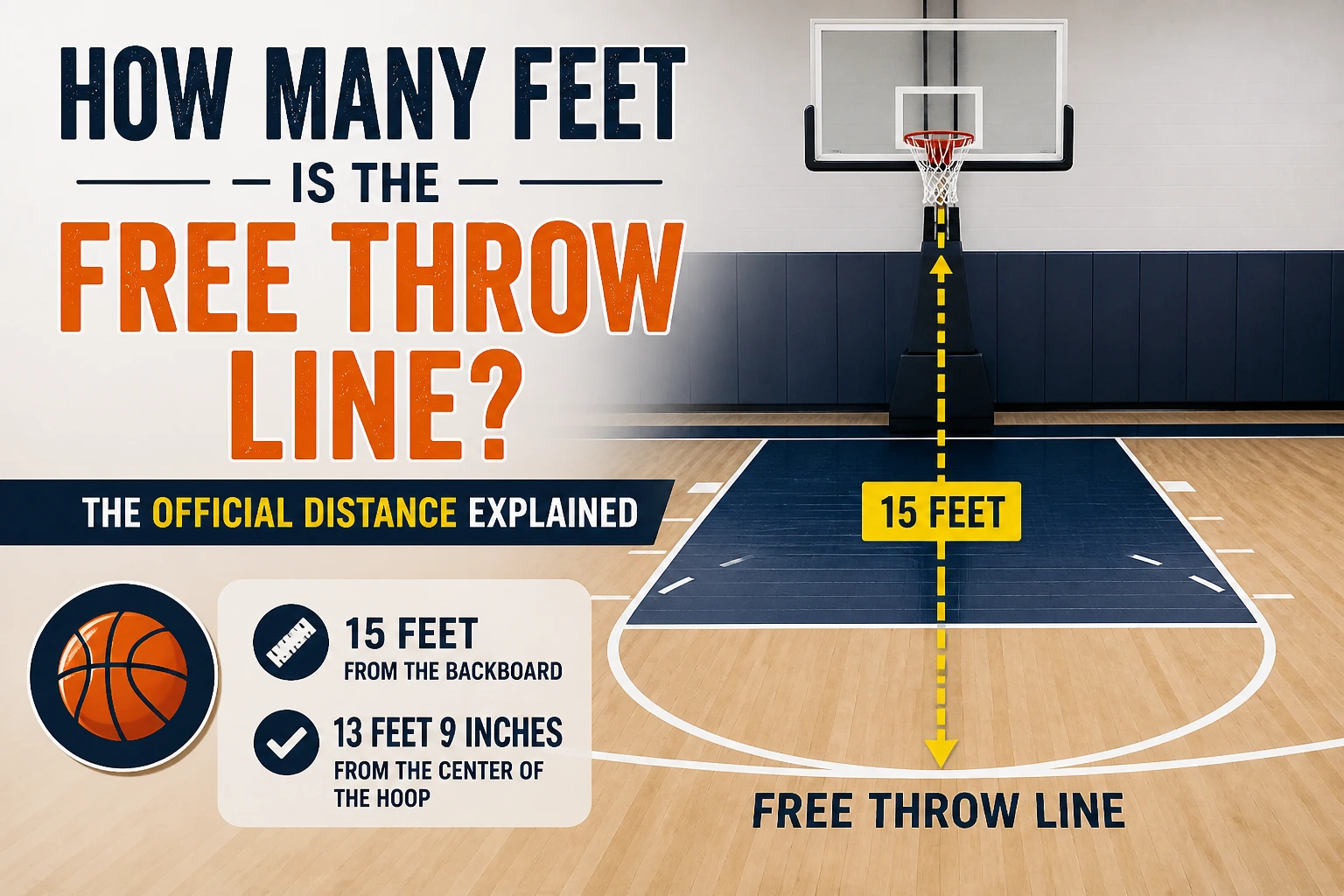
👉 The free throw line is 15 feet from the backboard (or 13 feet 9 inches from the hoop center).
But there’s much more to know. In this complete guide, we’ll explain the exact measurement, why it matters, how it varies across levels, and how you can use this knowledge to improve your game.
What Is the Free Throw Line in Basketball
Definition
The free throw line, also called the foul line, is the line where players stand to take free shots after certain fouls.
It is located inside the “key” or “paint” area on the basketball court.
Purpose in the Game
The free throw line plays a key role in basketball:
- It gives players a chance to score without defense
- It acts as a penalty for fouls
- It tests shooting skill and focus
Free throws often decide close games, making this line extremely important.
How Many Feet Is the Free Throw Line (Exact Distance)
Let’s clearly answer the main question:
👉 The free throw line is exactly 15 feet from the backboard
👉 It is about 13 feet 9 inches from the center of the hoop
This measurement is standard in:
- Professional basketball
- College basketball
- High school basketball
No matter where you play, the distance remains consistent for official courts.
Why Is the Free Throw Line 15 Feet?
History Behind the Distance
The 15-foot distance has been used since early basketball rules were established by James Naismith.
It was designed to create a fair challenge—neither too easy nor too difficult.
Balance Between Skill and Fairness
At 15 feet:
- Beginners can still score with practice
- Professionals must use precision and technique
- The shot rewards consistency and mental focus
This balance is why the distance hasn’t changed over time.
Free Throw Line Distance in Different Leagues
One interesting fact is that the free throw line distance stays the same across most levels.
NBA
In the National Basketball Association:
- Distance = 15 feet from the backboard
College (NCAA)
In NCAA:
- Distance = 15 feet
High School
In NFHS:
- Distance = 15 feet
Youth Basketball
Younger players may use shorter distances, such as:
- 12 feet
- 10 feet
This helps them develop proper shooting form.
Full Basketball Court Measurement Breakdown
To better understand the free throw line, it helps to see how it fits into the full court.
| Court Element | Distance |
|---|---|
| Hoop height | 10 feet |
| Free throw line | 15 feet |
| Three-point line (NBA) | 23.75 feet |
| Key width | 16 feet |
These measurements work together to create a balanced game.
How to Measure a Free Throw Line Step by Step
If you’re building a court or practicing at home, here’s how to measure it correctly.
Step 1: Locate the Backboard
Start from the flat surface behind the hoop.
Step 2: Measure 15 Feet Forward
Use a measuring tape to mark exactly 15 feet from the backboard.
Step 3: Draw the Line
Mark a straight line across the court at that point.
Step 4: Align with the Hoop
Make sure the line is centered with the basketball rim.
Step 5: Check Accuracy
Double-check measurements to avoid errors.
Real-Life Examples of Free Throw Distance
Let’s make it easier to understand.
- 15 feet is about the length of a small room
- It’s roughly equal to the height of a one-story building
- About 5 average adult steps
This helps you visualize the distance better.
Why Free Throw Distance Matters
Understanding how many feet is the free throw line is not just about rules—it affects performance.
Key Benefits
- Improves shooting accuracy
- Builds muscle memory
- Helps players practice correctly
- Ensures fair gameplay
Even a small change in distance can impact shooting success.
Common Mistakes About Free Throw Line Distance
Many beginners misunderstand this measurement.
1. Thinking It’s Measured from the Rim
It’s actually measured from the backboard, not the front of the rim.
2. Ignoring Alignment
The line must be centered with the hoop.
3. Using Incorrect Units
Mixing feet and meters can lead to mistakes.
4. Practicing at the Wrong Distance
Training at incorrect distances affects performance in real games.
Expert Tips to Improve Free Throw Shooting
Knowing the distance is just the start. Here’s how to improve your free throws:
- ✔ Keep your feet shoulder-width apart
- ✔ Bend your knees slightly
- ✔ Focus on the rim
- ✔ Use consistent shooting motion
- ✔ Practice regularly from 15 feet
Consistency is more important than power.
Free Throw Line vs Other Court Distances
Here’s a helpful comparison:
| Measurement | Distance |
|---|---|
| Free throw line | 15 feet |
| Layup distance | 3–5 feet |
| Mid-range shot | 10–20 feet |
| Three-point line | 22–23.75 feet |
This shows where free throws sit in the overall shooting range.
Practical Use for Players and Builders
Understanding this measurement helps:
For Players
- Practice correctly
- Improve accuracy
- Build confidence
For Builders
- Design courts properly
- Follow official standards
- Avoid costly mistakes
FAQs
1. How many feet is the free throw line from the hoop?
It is about 13 feet 9 inches from the center of the hoop.
2. Is the free throw line always 15 feet?
Yes, in professional, college, and high school basketball.
3. Why is the free throw line important?
It allows players to score without defense and tests shooting skill.
4. Can kids use a shorter free throw distance?
Yes, youth leagues often reduce the distance to match skill level.
5. How can I practice free throws at home?
Measure 15 feet from a wall or hoop and practice consistently.
Conclusion
So, how many feet is the free throw line? The answer is clear:
👉 15 feet from the backboard
This distance has remained unchanged because it creates the perfect balance between challenge and fairness. Whether you’re a beginner, a coach, or building your own court, understanding this measurement is essential.
By practicing at the correct distance and following proper techniques, you can improve your accuracy and confidence. Remember, free throws may look simple, but they often decide the outcome of the game—so mastering them starts with knowing the exact distance.
Discover More:
How Many Feet Is 400 Square Feet