

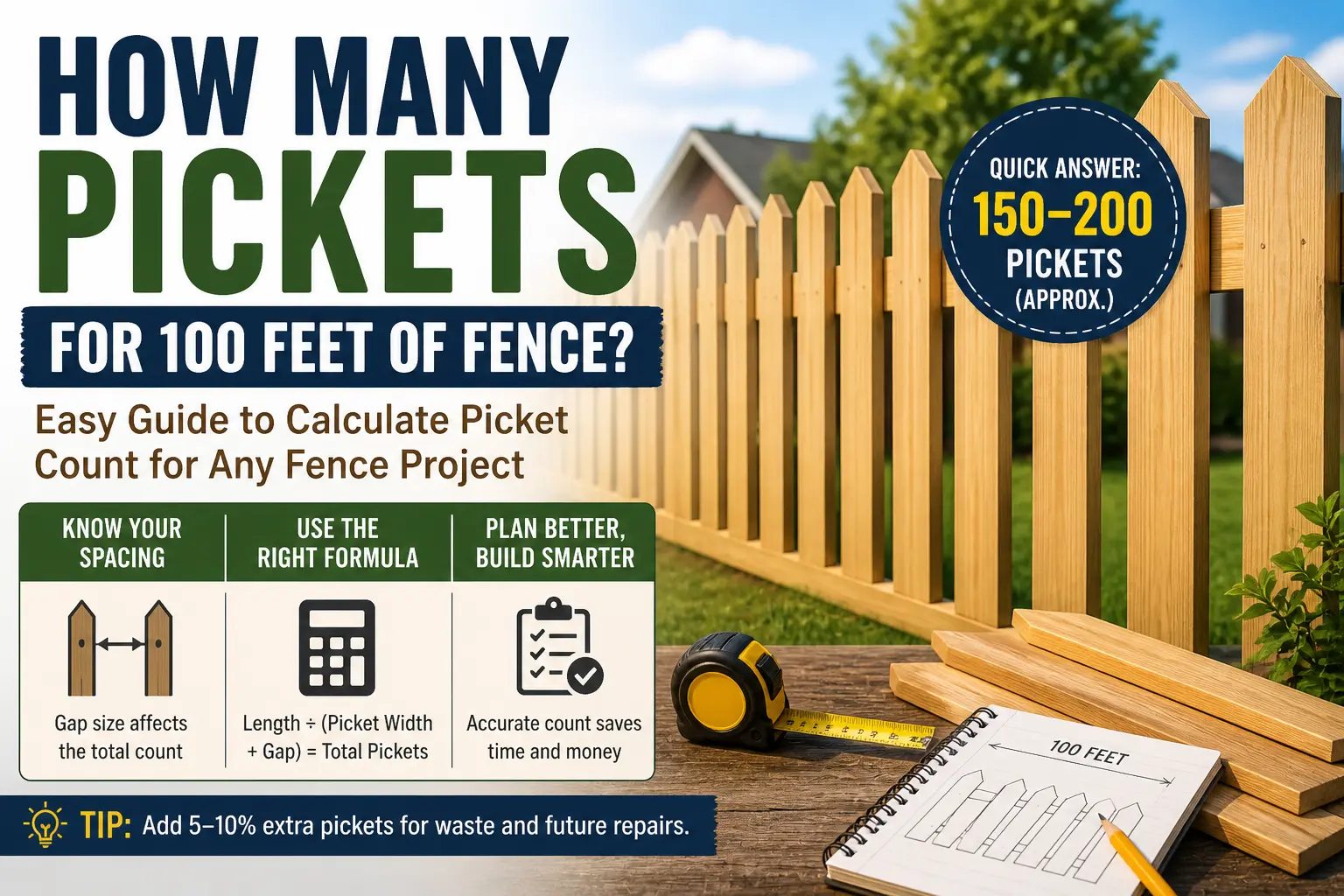
If you’re planning a fencing project, one of the most common questions is: how many pickets for 100 feet of fence do you actually need? Getting this number right is important because buying too few pickets can delay your project, while buying too many wastes money.
The answer depends on a few key factors such as picket width, spacing between pickets, and the type of fence you’re building. In this complete guide, you’ll learn exact formulas, real-world examples, and expert tips to calculate the perfect number of pickets for your fence.
Quick Answer: Pickets Needed for 100 Feet
For a standard wooden fence, the number of pickets for 100 feet typically ranges between:
- 150 to 200 pickets for most fences
- 160 pickets (most common estimate for privacy fences)
This assumes:
- Each picket is 5.5 inches wide
- Minimal or no gap between pickets
Standard Spacing Estimate
Here’s a quick rule of thumb:
- No gap: about 160 pickets per 100 feet
- Small gap (½ inch): about 145–150 pickets
- Larger gap (1–2 inches): about 120–140 pickets
Quick Formula
You can use this simple formula:
Total Pickets = Fence Length (in inches) ÷ (Picket Width + Gap)
This gives you a precise count based on your design.
What Is a Fence Picket?
A fence picket is a vertical board attached to horizontal rails to form the visible part of a fence.
Definition
Pickets are usually made of:
- Wood (most common)
- Vinyl
- Composite materials
They determine the fence’s appearance, privacy level, and strength.
Common Sizes
Standard picket sizes include:
- Width: 3.5 inches, 5.5 inches, or 6 inches
- Height: 4 feet, 6 feet, or 8 feet
The width plays a major role in how many pickets you’ll need.
Standard Picket Spacing Explained
Spacing is one of the biggest factors in determining how many pickets for 100 feet of fence you need.
Privacy Fence (No Gap)
- Pickets are installed edge-to-edge
- Maximum privacy
- Highest picket count
Typical requirement: 160–180 pickets per 100 feet
Semi-Privacy Fence
- Small gaps (¼–½ inch)
- Allows airflow
- Slightly fewer pickets
Typical requirement: 140–160 pickets
Decorative Fence
- Larger gaps (1–2 inches or more)
- Used for style, not privacy
- Lowest picket count
Typical requirement: 100–140 pickets
Picket Calculation Table for 100 Feet
| Picket Width | Gap Size | Estimated Pickets |
|---|---|---|
| 5.5 inches | 0 inch | 160–165 |
| 5.5 inches | 0.5 inch | 145–150 |
| 5.5 inches | 1 inch | 130–135 |
| 3.5 inches | 0 inch | 250–270 |
| 6 inches | 0 inch | 150–155 |
This table gives you a quick reference for planning your fence.
How to Calculate Exactly How Many Pickets You Need
Step-by-Step Formula
Follow these steps:
- Convert fence length to inches
- 100 feet × 12 = 1,200 inches
- Add picket width and gap
- Example: 5.5 + 0.25 = 5.75 inches
- Divide total length by spacing
- 1,200 ÷ 5.75 ≈ 209 pickets
- Round up to ensure full coverage
Example Calculations
Example 1: Privacy Fence (No Gap)
- Width: 5.5 inches
- Gap: 0
- Result: ~218 pickets (tight installation)
Example 2: Semi-Privacy Fence
- Width: 5.5 inches
- Gap: ½ inch
- Result: ~150 pickets
These examples show how spacing changes the total significantly.
Factors That Affect Picket Count
Picket Width
Wider pickets = fewer boards needed
Narrow pickets = more boards required
Gap Size
Even a small gap can reduce total pickets by 10–20%.
Fence Design
Different fence styles require different layouts, which impacts picket count.
Types of Fences and Their Picket Requirements
Privacy Fence
- No gaps
- Maximum pickets
- Best for security and privacy
Shadowbox Fence
- Alternating pickets on both sides
- Requires nearly double pickets
- Ideal for shared boundaries
Spaced Picket Fence
- Even gaps
- Fewer pickets
- Good for decorative purposes
Real-World Examples
Let’s look at real scenarios:
Backyard Fence (100 ft, Privacy Style)
- 5.5-inch pickets
- No gap
- Total: ~160–180 pickets
Garden Fence (100 ft, Decorative)
- 1-inch gap
- Total: ~130 pickets
Shared Fence (Shadowbox)
- Double-sided
- Total: ~300+ pickets
These examples show how design choices affect material needs.
Benefits and Drawbacks of Different Spacing
Tight Spacing (No Gap)
Pros:
- Maximum privacy
- Better security
- Strong structure
Cons:
- Higher cost
- More materials
Wider Spacing
Pros:
- Lower cost
- Better airflow
- Decorative look
Cons:
- Less privacy
- Reduced security
Expert Tips for Accurate Estimation
- Always measure your fence line twice
- Add 5–10% extra pickets for waste
- Consider future repairs
- Use consistent spacing for a clean look
- Check local building codes
Common Mistakes to Avoid
- Forgetting to include gaps in calculations
- Not converting feet to inches
- Buying exact quantity without extra
- Ignoring fence style differences
- Choosing wrong picket size
Avoiding these mistakes ensures a smooth installation process.
FAQs
1. How many pickets for 100 feet of fence with no gaps?
You typically need around 160–180 pickets using standard 5.5-inch boards.
2. How many pickets do I need with a 1-inch gap?
Around 130–135 pickets for a 100-foot fence.
3. Does picket width affect the total count?
Yes, wider pickets reduce the number needed.
4. Should I buy extra pickets?
Yes, always buy 5–10% extra to cover waste and mistakes.
5. How do I calculate pickets per foot?
Divide 12 inches by (picket width + gap) to get pickets per foot.
Conclusion
So, how many pickets for 100 feet of fence do you need? The answer usually falls between 150 and 200 pickets, depending on spacing, picket width, and fence style. A standard privacy fence often requires around 160 pickets, making it a reliable estimate for most projects.
To get the most accurate number, always use the calculation formula and consider your specific design. With proper planning, you can avoid costly mistakes, complete your project smoothly, and build a fence that looks great and lasts for years.
Discover more