
Wrapping your car is one of the easiest ways to change its appearance without committing to a permanent paint job. Whether you want a glossy finish, a matte black look, carbon fiber accents, or a custom color, buying the right amount of vinyl is one of the first and most important decisions.
Many people ask how many feet of wrap for a car because purchasing too little can delay the installation, while buying too much increases the overall project cost. The correct amount depends on your vehicle’s size, body style, the width of the vinyl roll, and whether you are wrapping the entire vehicle or only selected panels.
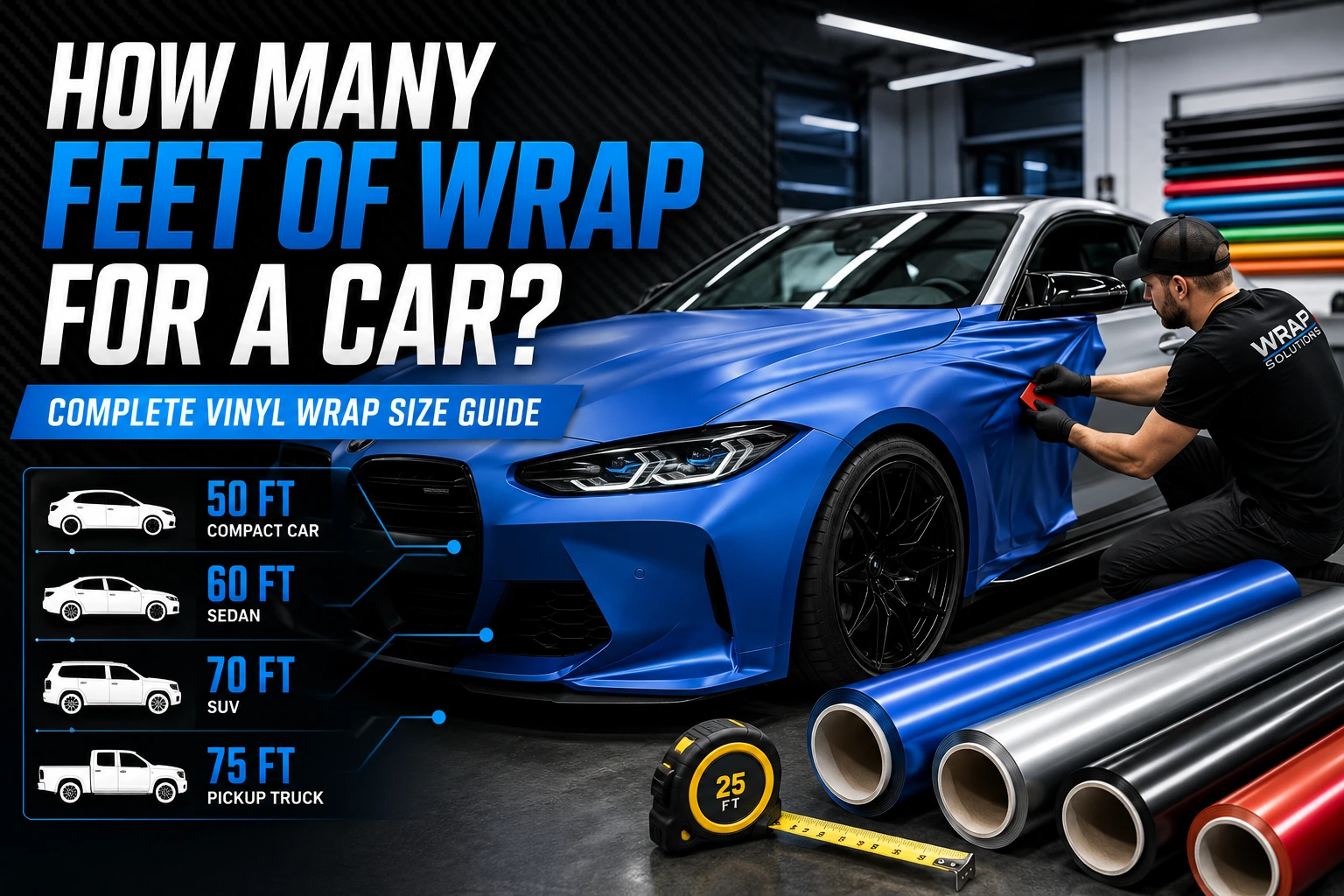
Most passenger vehicles require between 50 and 75 feet of vinyl from a standard 5 foot wide roll. Smaller cars need less material, while larger SUVs, pickup trucks, and vans need significantly more. Professional installers also purchase additional material to account for trimming, stretching, and unexpected installation errors.
This guide explains exactly how much wrap different vehicles need, how to calculate the correct amount, and practical tips that help you avoid wasting money.
Why Choosing the Correct Wrap Size Matters
Selecting the proper amount of vinyl wrap affects much more than your budget.
If you purchase too little material, you may encounter several problems.
- The installer may not be able to complete the wrap.
- Different production batches may have slight color variations.
- Shipping delays can extend your project.
- Matching finishes becomes difficult.
Buying slightly more material provides several benefits.
- Extra vinyl for installation mistakes
- Material for future repairs
- Better coverage around curves
- Consistent color across the vehicle
- Less stress during installation
Most professional installers recommend ordering about 10 to 15 percent extra material for complete vehicle wraps.
How Many Feet of Wrap for a Car Based on Vehicle Type
The exact amount depends on the size and shape of your vehicle.
Below are common recommendations using a standard 5 foot wide vinyl roll.
Compact Cars
Examples include:
- Honda Fit
- Mini Cooper
- Toyota Yaris
- Fiat 500
Typical requirement:
50 to 55 feet
Compact cars have smaller body panels and shorter wheelbases, making them the easiest vehicles to wrap.
DIY installers should consider buying around 55 feet to allow room for practice and trimming.
Sedans
Examples include:
- Toyota Camry
- Honda Accord
- Hyundai Sonata
- Nissan Altima
Typical requirement:
55 to 60 feet
Sedans have four doors, a larger roof, and longer side panels than compact vehicles.
Professional shops commonly purchase around 60 feet for full coverage.
Hatchbacks
Examples include:
- Volkswagen Golf
- Ford Focus
- Mazda 3 Hatchback
Typical requirement:
55 to 60 feet
Although hatchbacks are shorter than sedans, the rear hatch introduces additional curves that require extra vinyl.
Complex rear sections may increase material usage.
SUVs
Examples include:
- Toyota RAV4
- Honda CR V
- Ford Explorer
- Jeep Grand Cherokee
Typical requirement:
60 to 70 feet
SUVs have:
- Taller roofs
- Larger doors
- Bigger rear panels
- Longer side sections
These larger surfaces increase vinyl consumption considerably.
Many professional wrappers order 65 to 70 feet for midsize SUVs.
Pickup Trucks
Examples include:
- Ford F 150
- Chevrolet Silverado
- RAM 1500
- Toyota Tacoma
Typical requirement:
65 to 75 feet
Pickup trucks require more wrap because of:
- Cargo bed sides
- Tailgate
- Larger hood
- Bigger bumpers
Crew cab trucks may need even more material.
Vans
Examples include:
- Mercedes Sprinter
- Ford Transit
- RAM ProMaster
Typical requirement:
75 feet or more
Commercial vans have the largest body panels among passenger vehicles.
Businesses wrapping fleet vehicles often purchase additional material for branding graphics and future repairs.
Sports Cars
Examples include:
- Chevrolet Corvette
- Nissan GT R
- Porsche 911
- Toyota Supra
Typical requirement:
50 to 60 feet
Although sports cars are lower, they feature aggressive curves that increase installation complexity.
Extra vinyl is often needed for:
- Deep bumpers
- Large air vents
- Wide fenders
- Rear diffusers
Vinyl Wrap Size Chart
| Vehicle Type | Average Wrap Length | Estimated Coverage |
|---|---|---|
| Compact Car | 50 to 55 feet | Full vehicle |
| Sedan | 55 to 60 feet | Full vehicle |
| Hatchback | 55 to 60 feet | Full vehicle |
| Small SUV | 60 to 65 feet | Full vehicle |
| Large SUV | 65 to 70 feet | Full vehicle |
| Pickup Truck | 65 to 75 feet | Full vehicle |
| Cargo Van | 75 feet or more | Full vehicle |
These measurements assume a standard 5 foot wide vinyl roll, which is the most common size used by installers.
Typical Vinyl Wrap Roll Sizes
Vinyl wrap manufacturers produce rolls in several standard sizes.
The most popular width is 5 feet, as it covers most vehicle panels without requiring seams.
Common roll lengths include:
| Roll Width | Roll Length | Best For |
|---|---|---|
| 5 feet | 25 feet | Hood, roof, or partial wrap |
| 5 feet | 50 feet | Small cars or partial wraps |
| 5 feet | 60 feet | Sedans and hatchbacks |
| 5 feet | 75 feet | SUVs and trucks |
Choosing the correct roll size reduces waste and simplifies installation.
Professional installers often buy larger rolls because leftover vinyl can be used for future repairs or matching replacement panels.
How to Measure Your Car for Vinyl Wrap
If your vehicle has custom body panels or aftermarket accessories, measuring it yourself provides a more accurate estimate.
Measure Vehicle Length
Measure from the front bumper to the rear bumper.
Include:
- Front bumper
- Hood
- Roof
- Trunk
- Rear bumper
Record the total length in feet.
Measure Vehicle Height
Next, measure from the bottom of the rocker panel to the highest point of the roof.
This helps estimate the material required for both sides of the vehicle.
Count Curved Panels
Vehicles with aggressive styling often require extra vinyl because curves consume more material during stretching.
Pay close attention to:
- Front bumpers
- Rear bumpers
- Wheel arches
- Side mirrors
- Roof spoilers
These areas often account for more waste than flat panels.
Square Feet Needed for Different Vehicles
While many people buy vinyl by the foot, it also helps to understand the approximate surface area of different vehicle types. This gives you a better idea of how much material is actually covering the vehicle.
| Vehicle Type | Approximate Surface Area |
|---|---|
| Compact Car | 220 to 240 square feet |
| Sedan | 240 to 260 square feet |
| Hatchback | 240 to 265 square feet |
| Small SUV | 260 to 290 square feet |
| Large SUV | 290 to 330 square feet |
| Pickup Truck | 300 to 350 square feet |
| Cargo Van | 340 to 420 square feet |
Remember that vinyl wraps are sold in rolls, not by square foot. These numbers simply help explain why larger vehicles require longer rolls.
Factors That Affect How Many Feet of Wrap for a Car
There is no single answer to how many feet of wrap for a car because every vehicle is different. Several factors determine the final amount of vinyl needed.
Vehicle Size
Larger vehicles naturally require more material.
For example, a compact hatchback may only need around 50 feet, while a long wheelbase cargo van may require more than 75 feet.
Body Shape
Vehicles with smooth, flat panels are easier to wrap.
Cars with aggressive curves, sharp body lines, and large fenders require extra material because installers must stretch and trim the vinyl carefully.
Examples include:
- Sports cars
- Luxury SUVs
- Performance sedans
Mirrors
Side mirrors are small but surprisingly difficult to wrap.
Many installers use separate pieces instead of trying to stretch one large sheet.
This increases material usage.
Front and Rear Bumpers
Bumpers are among the most complex parts of any vehicle.
Air vents, curves, sensors, and grills often require additional vinyl.
Beginners usually waste more material in these areas.
Roof
Some vehicle roofs include:
- Sunroofs
- Shark fin antennas
- Roof rails
Each obstacle requires extra trimming and careful installation.
Door Handles
Many professionals remove the handles before wrapping.
Others wrap around them.
Both methods require additional vinyl for clean results.
Spoilers and Accessories
Aftermarket accessories increase material requirements.
These may include:
- Rear spoilers
- Fender flares
- Body kits
- Splitters
- Diffusers
Always allow extra vinyl if your vehicle has modifications.
DIY vs Professional Material Requirements
DIY installers usually need more vinyl than professionals.
Professionals have years of experience and can reduce waste while cutting and stretching the material.
| Installation Type | Recommended Wrap Length |
|---|---|
| Professional Installation | Standard recommended length |
| DIY Beginner | Add 10 to 15 feet |
| First Time Wrapper | Add 15 to 20 feet |
For example:
A sedan normally requires 60 feet.
A beginner should consider purchasing around 70 feet.
The additional material provides room for mistakes and practice pieces.
Partial Wraps Require Less Material
Not every project involves wrapping the entire vehicle.
Here are approximate material requirements for common partial wraps.
| Vehicle Part | Average Vinyl Needed |
|---|---|
| Hood | 6 to 8 feet |
| Roof | 7 to 9 feet |
| Trunk | 4 to 6 feet |
| Front Bumper | 6 to 8 feet |
| Rear Bumper | 6 to 8 feet |
| Side Mirrors | 2 to 3 feet |
| Racing Stripes | 12 to 18 feet |
Partial wraps are more affordable and are a great option for drivers who want to customize their vehicle without covering every panel.
Real World Examples
Here are a few examples to make estimating easier.
Example 1
Vehicle: Honda Civic Sedan
Recommended wrap length:
Approximately 60 feet
Reason:
The Civic has four doors, moderate body curves, and average sized bumpers.
Example 2
Vehicle: Toyota RAV4
Recommended wrap length:
Around 65 feet
Reason:
Its taller roof and larger doors require more material than a sedan.
Example 3
Vehicle: Ford F 150 Crew Cab
Recommended wrap length:
About 75 feet
Reason:
The long cargo bed, large hood, and tailgate significantly increase vinyl usage.
Example 4
Vehicle: Porsche 911
Recommended wrap length:
Approximately 55 feet
Reason:
Although compact, the complex curves and wide fenders require careful installation.
Average Cost Based on Wrap Size
The amount of vinyl directly affects the total project cost.
Below are general estimates for vinyl material only.
| Wrap Length | Estimated Material Cost |
|---|---|
| 50 feet | Moderate |
| 60 feet | Moderate to High |
| 70 feet | High |
| 75 feet | Higher |
| 80 feet or more | Premium |
Professional installation adds labor costs, which usually exceed the price of the vinyl itself.
Premium finishes such as:
- Satin
- Chrome
- Color shift
- Brushed metal
- Carbon fiber
often cost more than standard gloss or matte films.
Benefits of Buying Slightly More Vinyl
Many people try to purchase the exact amount needed.
However, buying a little extra has several advantages.
Benefits include:
- Better margin for installation mistakes
- Easier repairs later
- Matching color if a panel becomes damaged
- Less stress during installation
- Enough material for difficult curves
Extra vinyl is especially valuable for beginners.
Common Mistakes When Buying Vinyl Wrap
Avoid these common errors.
Measuring Only the Vehicle Length
Many beginners ignore the vehicle height and body shape.
Always consider both dimensions.
Forgetting Complex Panels
Bumpers consume far more vinyl than flat panels.
Never underestimate them.
Buying Narrow Rolls
Using multiple narrow sheets creates unnecessary seams.
A 5 foot wide roll is usually the best option for full vehicle wraps.
Ignoring Installation Waste
Stretching, trimming, and repositioning all consume additional material.
Ordering exactly the calculated amount often leads to shortages.
Choosing Cheap Vinyl
Low quality films are harder to install and may tear more easily.
Quality vinyl usually saves both time and money.
Expert Tips Before Ordering Wrap Material
Professional installers follow a few simple practices that help achieve better results.
- Measure your vehicle twice before ordering.
- Purchase from a reputable vinyl manufacturer.
- Keep leftover material for future repairs.
- Wrap in a clean and dust free environment.
- Remove trim pieces whenever possible.
- Use quality tools for smoother installation.
- Watch installation tutorials if attempting a DIY wrap.
- Buy extra material if it is your first project.
- Store unused vinyl in a cool, dry place.
- Practice on smaller panels before wrapping the entire vehicle.
Frequently Asked Questions
How many feet of wrap for a car is enough?
Most passenger cars need between 50 and 75 feet of vinyl from a standard 5 foot wide roll. Compact cars require less, while SUVs, trucks, and vans need more.
Can I wrap a car with a 50 foot roll?
Yes. A 50 foot roll is usually enough for many compact cars and some sports cars. Larger sedans, SUVs, and trucks typically require longer rolls.
Should beginners buy extra vinyl?
Yes. Beginners should purchase an additional 10 to 20 feet to allow for mistakes, trimming, and practice.
What width of vinyl wrap is best?
A 5 foot wide roll is the industry standard because it covers most vehicle panels without creating unnecessary seams.
Is it better to buy more wrap than needed?
Yes. Extra material is useful for installation errors, future repairs, and replacing damaged panels while maintaining the same color and finish.
Conclusion
Knowing how many feet of wrap for a car helps you avoid unnecessary expenses and ensures your wrapping project goes smoothly from start to finish. While most compact cars require around 50 to 55 feet of vinyl, sedans generally need 55 to 60 feet, SUVs often require 60 to 70 feet, and trucks or cargo vans may need 75 feet or more.
The exact amount depends on your vehicle’s dimensions, body style, and whether you plan to wrap the entire vehicle or only selected panels. Measuring carefully, choosing a standard 5 foot wide roll, and purchasing a little extra material are smart steps that can save time and money.
Whether you are wrapping your vehicle yourself or hiring a professional installer, planning ahead ensures better results, fewer delays, and a cleaner finish. By following the recommendations in this guide, you can confidently choose the right amount of vinyl and complete your car wrap project with less waste and greater success.
how many square feet can a 3 ton ac unit cool