

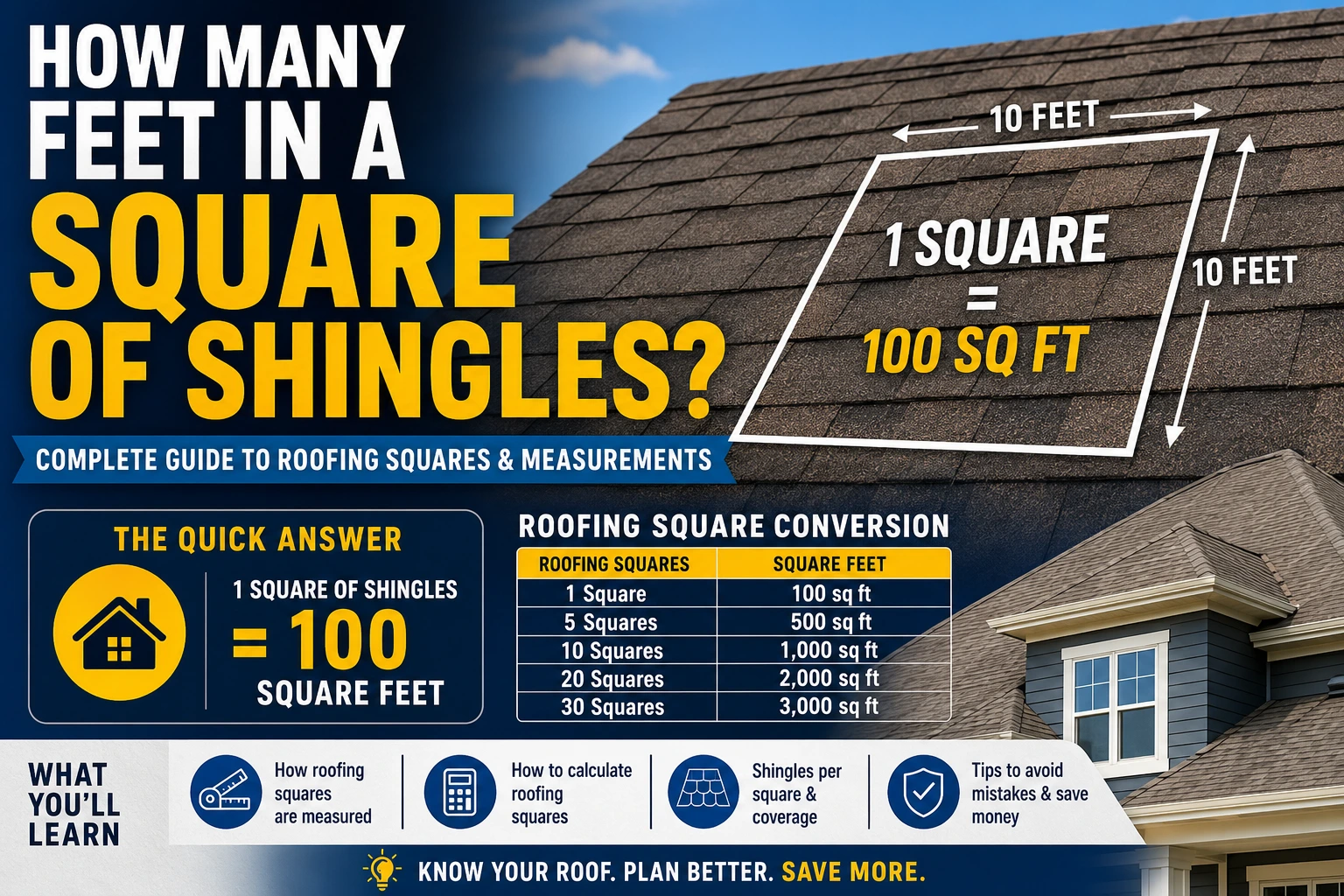
If you’ve searched how many feet in a square of shingles, you’re probably planning a roofing project, estimating material costs, or trying to understand roofing terminology. One of the most confusing terms for homeowners is the word “square.” Unlike everyday square feet measurements, a roofing square has a specific meaning used throughout the roofing industry.
Whether you’re replacing an old roof, installing new asphalt shingles, or simply calculating roofing materials, knowing exactly how many square feet are covered by one square of shingles helps you estimate costs more accurately and avoid ordering too much or too little material.
In this guide, you’ll learn what a roofing square is, how many square feet it covers, how roofers calculate roofing squares, and practical examples that make roofing measurements much easier to understand.
The Quick Answer
The answer is simple.
One square of shingles covers exactly 100 square feet of roof area.
| Roofing Measurement | Value |
|---|---|
| 1 Roofing Square | 100 square feet |
| 2 Roofing Squares | 200 square feet |
| 5 Roofing Squares | 500 square feet |
| 10 Roofing Squares | 1,000 square feet |
| 20 Roofing Squares | 2,000 square feet |
When roofers say a house requires 20 squares, they mean the roof has approximately 2,000 square feet of surface area before accounting for waste.
What Is a Square of Shingles?
A roofing square is the standard unit contractors use to measure roof size.
Instead of discussing thousands of square feet, roofers simplify estimates by measuring roofs in squares.
One roofing square always equals:
- 100 square feet
- 9.29 square meters (approximately)
- The amount of roofing material needed to cover 100 square feet of roof surface
The roofing square has been the industry standard for decades because it makes estimating materials much easier.
Why Roofers Use Roofing Squares
Imagine telling a supplier you need 2,850 square feet of shingles.
Instead, roofers simply order:
28.5 roofing squares
Using roofing squares makes estimating:
- Materials
- Labor
- Costs
- Delivery
- Waste
much faster and easier.
Most roofing manufacturers package shingles according to roofing squares.
How Many Feet in a Square of Shingles?
The answer never changes.
One roofing square equals exactly 100 square feet.
Regardless of the type of roofing material, the measurement remains the same.
This applies to:
- Asphalt shingles
- Architectural shingles
- Wood shingles
- Slate roofing
- Metal roofing
- Composite shingles
The roofing material changes, but the square measurement does not.
Standard Roofing Measurement
Roofers calculate roof size using area rather than length.
Remember:
A roofing square measures square feet, not linear feet.
That means:
100 square feet could be:
- 10 feet × 10 feet
- 20 feet × 5 feet
- 25 feet × 4 feet
Each example covers exactly 100 square feet, making it one roofing square.
Simple Roofing Calculation
Suppose your roof measures:
40 feet long
25 feet wide
Multiply:
40 × 25 = 1,000 square feet
Now divide by 100:
1,000 ÷ 100 = 10 roofing squares
Your roof requires approximately 10 squares of shingles, before adding waste.
Roofing Square Conversion Table
The following table provides quick roofing conversions.
| Roof Area | Roofing Squares |
|---|---|
| 100 sq ft | 1 |
| 200 sq ft | 2 |
| 300 sq ft | 3 |
| 500 sq ft | 5 |
| 750 sq ft | 7.5 |
| 1,000 sq ft | 10 |
| 1,500 sq ft | 15 |
| 2,000 sq ft | 20 |
| 2,500 sq ft | 25 |
| 3,000 sq ft | 30 |
This chart makes estimating roofing materials much easier.
How Roofing Squares Compare to Other Measurements
Roofing projects often involve multiple measurement units.
Here’s how one roofing square compares.
| Unit | Equivalent |
|---|---|
| Roofing Square | 100 sq ft |
| Square Meters | 9.29 |
| Acres | 0.0023 |
| Square Inches | 14,400 |
Although homeowners usually think in square feet, roofing contractors almost always use roofing squares.
Understanding Roof Dimensions
Roof area is not always the same as house floor area.
For example:
A home with:
2,000 square feet of living space
may have:
2,300 to 2,600 square feet of roofing
because roofs include:
- Roof pitch
- Dormers
- Valleys
- Overhangs
- Multiple roof sections
This is why roof measurements should never rely solely on home size.
How Roofers Calculate Roofing Squares
Professional roofers follow a simple process.
Measure Roof Length
Each roof section is measured separately.
For example:
30 feet
40 feet
18 feet
Each section is recorded individually.
Measure Roof Width
Next, roofers measure the width of every roof section.
Each roof plane is measured independently.
Calculate Each Roof Plane
Multiply:
Length × Width
Example:
30 × 20 = 600 square feet
40 × 12 = 480 square feet
18 × 15 = 270 square feet
Total roof area:
600 + 480 + 270 = 1,350 square feet
Convert to Roofing Squares
Divide total square footage by 100.
1,350 ÷ 100 = 13.5 roofing squares
Professional contractors then add extra material for waste, roof cuts, ridges, valleys, and installation errors.
Typically, they order 14 to 15 roofing squares for this project.
Common Types of Roofing Shingles
Although roofing squares remain the same, different shingles cover roofs differently based on packaging.
Common roofing materials include:
Asphalt Shingles
The most common residential roofing material.
Typically:
- Three bundles equal one roofing square.
Architectural Shingles
These thicker shingles improve durability and curb appeal.
Many brands still require approximately three bundles per roofing square, although some premium products may vary.
Wood Shingles
Wood shingles are measured using roofing squares but may require different installation methods and overlap, depending on the product.
Metal Roofing
Metal roofing panels are often sold by square footage, but contractors still estimate the project using roofing squares before ordering materials.
Estimating How Many Squares of Shingles You Need
Knowing that one roofing square equals 100 square feet makes estimating roofing materials much easier. However, most roofing projects require more than a simple calculation because roofs often have multiple slopes, valleys, dormers, and overhangs.
A basic estimation process looks like this:
- Measure the length and width of each roof section.
- Multiply the length by the width to calculate the square footage.
- Add the square footage of all roof sections together.
- Divide the total square footage by 100 to determine the number of roofing squares.
- Add extra material for waste and cutting.
For simple roofs, contractors often add 5% to 10% extra material. For complex roofs with many valleys and angles, they may add 10% to 15% or more.
Roofing Squares for Common House Sizes
The table below shows approximate roofing squares needed for different roof areas before adding waste.
| Roof Area | Roofing Squares |
|---|---|
| 800 sq ft | 8 |
| 1,000 sq ft | 10 |
| 1,200 sq ft | 12 |
| 1,500 sq ft | 15 |
| 1,800 sq ft | 18 |
| 2,000 sq ft | 20 |
| 2,500 sq ft | 25 |
| 3,000 sq ft | 30 |
| 3,500 sq ft | 35 |
| 4,000 sq ft | 40 |
Remember that actual material requirements may increase depending on roof complexity.
Real-World Roofing Examples
Understanding roofing squares becomes easier with practical examples.
Example 1: Small Garage Roof
A detached garage measures:
- Length: 20 feet
- Width: 25 feet
Calculation:
20 × 25 = 500 square feet
500 ÷ 100 = 5 roofing squares
With 10% waste:
Approximately 5.5 squares of shingles would be required.
Example 2: Medium-Sized House
A home’s roof measures approximately 2,200 square feet.
Calculation:
2,200 ÷ 100 = 22 roofing squares
Adding 10% waste:
22 × 1.10 = 24.2 squares
The contractor would typically order 25 roofing squares.
Example 3: Large Residential Roof
A large home has 3,600 square feet of roof surface.
Calculation:
3,600 ÷ 100 = 36 roofing squares
With a complex roof design requiring 15% extra material:
36 × 1.15 = 41.4 squares
The contractor would likely purchase 42 roofing squares.
Why Understanding Roofing Squares Matters
Learning how roofing squares work offers several important advantages.
More Accurate Material Estimates
Knowing the correct number of roofing squares helps prevent ordering too many or too few shingles.
Better Budget Planning
Roofing materials are commonly priced by the square.
Understanding roofing squares makes it easier to compare contractor estimates and calculate project costs.
Easier Communication
Roofing professionals almost always discuss projects using roofing squares instead of square feet.
Knowing this terminology helps homeowners communicate more effectively with contractors.
Reduced Material Waste
Accurate calculations reduce excess materials, helping save money and minimize construction waste.
Factors That Affect Shingle Requirements
Even if two roofs have the same square footage, they may require different amounts of shingles.
Roof Pitch
Steeper roofs have more surface area than flat roofs covering the same building footprint.
This means a steep roof may require additional roofing squares.
Roof Complexity
Features such as:
- Dormers
- Valleys
- Hips
- Skylights
- Chimneys
increase cutting and waste, requiring extra shingles.
Shingle Type
Some premium shingles require additional bundles because of their design or installation method.
Always check the manufacturer’s coverage recommendations.
Installation Method
Different installation patterns can affect material usage, especially for decorative or specialty shingles.
Common Mistakes When Calculating Roofing Squares
Many homeowners make simple errors when estimating roofing materials.
Measuring the House Instead of the Roof
The home’s floor area is not the same as the roof area.
Roof pitch, overhangs, and multiple roof sections increase the actual roofing surface.
Forgetting Waste
Ordering exactly the calculated number of roofing squares often results in shortages.
Always include additional material for cuts and installation waste.
Ignoring Roof Pitch
A steep roof contains more surface area than it appears when viewed from above.
Professional measurements account for roof slope.
Confusing Linear Feet with Square Feet
Roofing squares measure area, not length.
Linear feet cannot be converted directly into roofing squares without knowing the roof’s width.
Assuming Every Bundle Covers the Same Area
Although many asphalt shingles require three bundles per roofing square, some premium products may require more or fewer bundles.
Always verify the manufacturer’s specifications.
Expert Roofing Tips
Professional roofers recommend following these best practices before purchasing shingles.
- Measure every roof section individually.
- Include roof pitch in your calculations.
- Add at least 5% to 15% for waste.
- Confirm bundle coverage with the manufacturer.
- Measure roof surface rather than house floor area.
- Purchase a few extra shingles for future repairs.
- Hire a professional inspection if the roof has a complex design.
Following these recommendations helps improve accuracy and reduces unexpected costs during installation.
FAQs
How many feet in a square of shingles?
One roofing square covers 100 square feet of roof surface. This is the standard measurement used throughout the roofing industry.
How many bundles of shingles are in one roofing square?
Most standard asphalt shingles require three bundles to cover one roofing square, although this may vary depending on the manufacturer and shingle type.
Does roof pitch affect the number of roofing squares?
Yes. Steeper roofs have more surface area than flat roofs with the same footprint, so they generally require more roofing material.
How do I calculate roofing squares?
Measure the total roof area in square feet and divide the result by 100.
Formula:
Roofing Squares = Total Square Feet ÷ 100
Should I buy extra shingles?
Yes. Most roofing professionals recommend purchasing an additional 5% to 15% of material to account for cuts, waste, future repairs, and installation adjustments.
Conclusion
If you’re wondering how many feet in a square of shingles, the answer is simple: one roofing square covers exactly 100 square feet of roof area. This standard measurement is used throughout the roofing industry because it simplifies material estimates, pricing, and project planning. Whether you’re replacing a roof, comparing contractor quotes, or calculating roofing materials for a DIY project, understanding roofing squares is an essential first step.
By learning how to calculate roof area, convert square footage into roofing squares, and account for roof pitch and waste, you can estimate material requirements more accurately and avoid costly mistakes. Using the examples, conversion tables, and expert tips in this guide will help you plan your roofing project with greater confidence and ensure you order the right amount of shingles for a successful installation.
Discover more