

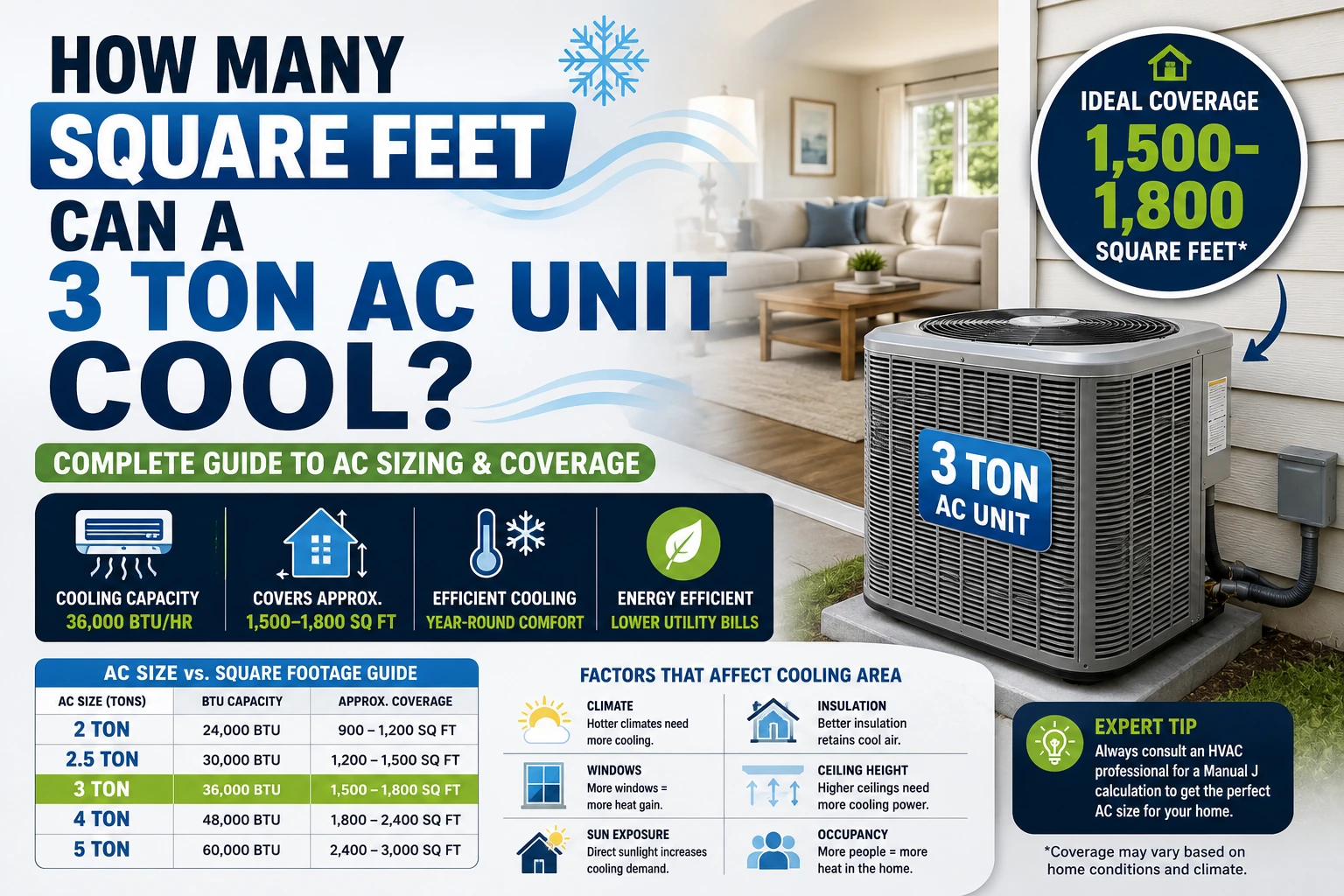
If you’re wondering how many square feet can a 3 ton AC unit cool, you’re asking one of the most important questions before purchasing a new air conditioner. Choosing the right AC size affects your home’s comfort, monthly energy bills, and the lifespan of your HVAC system.
A unit that is too small may struggle to keep your home cool during hot weather, while an oversized system may cool the space too quickly without removing enough humidity. That’s why understanding the cooling capacity of a 3-ton air conditioner is essential before making an investment.
In this guide, you’ll learn the average square footage a 3-ton AC can cool, how HVAC professionals determine cooling requirements, and the key factors that influence AC performance.
The Quick Answer
Under average conditions, a 3-ton air conditioner can cool approximately 1,500 to 1,800 square feet.
However, the exact coverage depends on factors such as:
- Climate
- Insulation quality
- Ceiling height
- Number of windows
- Home layout
- Sun exposure
- Occupancy
Here is a quick reference.
| AC Size | Approximate Cooling Area |
|---|---|
| 1.5 Ton | 600–900 sq ft |
| 2 Ton | 900–1,200 sq ft |
| 2.5 Ton | 1,200–1,500 sq ft |
| 3 Ton | 1,500–1,800 sq ft |
| 3.5 Ton | 1,800–2,100 sq ft |
| 4 Ton | 2,000–2,400 sq ft |
| 5 Ton | 2,400–3,000 sq ft |
This chart provides general estimates. A professional HVAC load calculation offers the most accurate recommendation.
What Is a 3 Ton AC Unit?
Many homeowners assume the word “ton” refers to the weight of an air conditioner.
In reality, tonnage measures cooling capacity, not physical weight.
One ton of air conditioning equals the amount of heat required to melt one ton of ice over 24 hours.
Today, HVAC systems use this historical measurement to describe cooling output.
Meaning of AC Tonnage
Every ton of cooling equals:
12,000 BTUs per hour
Therefore:
| AC Size | BTU Capacity |
|---|---|
| 1 Ton | 12,000 BTU/hr |
| 2 Ton | 24,000 BTU/hr |
| 3 Ton | 36,000 BTU/hr |
| 4 Ton | 48,000 BTU/hr |
| 5 Ton | 60,000 BTU/hr |
A 3-ton air conditioner produces approximately 36,000 BTUs of cooling every hour.
BTU Capacity Explained
BTU stands for British Thermal Unit.
It measures how much heat an air conditioner can remove from your home in one hour.
The higher the BTU rating, the larger the area the unit can generally cool.
However, bigger isn’t always better.
An oversized AC can:
- Short cycle frequently
- Waste electricity
- Wear out faster
- Leave excess humidity indoors
Proper sizing is far more important than simply choosing the largest unit available.
How Many Square Feet Can a 3 Ton AC Unit Cool?
The general HVAC rule suggests:
One ton of cooling covers approximately 500 to 600 square feet.
Applying this rule:
3 × 500 = 1,500 square feet
3 × 600 = 1,800 square feet
Therefore:
A 3-ton AC is generally recommended for homes between 1,500 and 1,800 square feet.
This estimate assumes:
- Average insulation
- Standard 8-foot ceilings
- Moderate climate
- Normal window area
Homes with unusual conditions may require a different AC size.
Recommended Coverage
The following table shows recommended cooling capacity.
| Home Size | Recommended AC Size |
|---|---|
| 800 sq ft | 1.5 Ton |
| 1,000 sq ft | 2 Ton |
| 1,300 sq ft | 2.5 Ton |
| 1,500 sq ft | 3 Ton |
| 1,700 sq ft | 3 Ton |
| 2,000 sq ft | 4 Ton |
| 2,500 sq ft | 5 Ton |
This sizing guide provides a useful starting point before consulting an HVAC professional.
Cooling Capacity Chart
Below is another helpful comparison.
| BTUs | AC Size | Approximate Coverage |
|---|---|---|
| 18,000 | 1.5 Ton | 600–900 sq ft |
| 24,000 | 2 Ton | 900–1,200 sq ft |
| 30,000 | 2.5 Ton | 1,200–1,500 sq ft |
| 36,000 | 3 Ton | 1,500–1,800 sq ft |
| 42,000 | 3.5 Ton | 1,800–2,100 sq ft |
| 48,000 | 4 Ton | 2,000–2,400 sq ft |
These values represent average recommendations rather than strict rules.
Factors That Affect Cooling Area
Several variables determine whether a 3-ton AC will perform efficiently in your home.
Climate
Climate has one of the biggest impacts on AC sizing.
Homes located in:
- Southern states
- Desert regions
- Tropical climates
often require larger AC systems than homes of the same size located in cooler regions.
Insulation
Well-insulated homes retain cool air much better.
High-quality insulation reduces:
- Heat gain
- Energy bills
- Cooling demand
Poor insulation may require a larger air conditioner even if the home’s square footage remains the same.
Ceiling Height
Most AC sizing charts assume 8-foot ceilings.
Homes with:
- Vaulted ceilings
- Cathedral ceilings
- Two-story living rooms
contain much more air volume.
These homes may need additional cooling capacity despite having the same floor area.
Windows
Large windows increase solar heat gain.
Factors include:
- Window size
- Window orientation
- Glass quality
- Window tint
- Shading
Homes with many south-facing windows often require more cooling.
Sun Exposure
A shaded home surrounded by mature trees usually stays cooler than a home exposed to direct sunlight throughout the day.
Roof color also influences cooling demand.
Dark roofs absorb more heat than lighter-colored roofing materials.
Real-World Examples of 3 Ton AC Coverage
Here are a few examples of how a 3-ton air conditioner performs in different homes.
Example 1: Well-Insulated Home
A modern home measuring 1,700 square feet with:
- Energy-efficient windows
- Excellent insulation
- Shade trees
- Moderate climate
is an ideal candidate for a 3-ton AC system.
Example 2: Older Home
An older home measuring 1,600 square feet with:
- Poor insulation
- Single-pane windows
- Dark roofing
- Significant afternoon sun exposure
may require additional cooling capacity or insulation upgrades to achieve the same comfort level.
Example 3: Open Floor Plan
A newly built 1,500-square-foot home with an open layout allows air to circulate more efficiently, making a 3-ton AC an excellent choice in many climates.
Choosing the Right AC Size
Although a 3-ton AC unit is suitable for many homes between 1,500 and 1,800 square feet, square footage alone should never determine the size of your air conditioner.
HVAC professionals consider several additional factors before recommending a system.
Home Layout
An open floor plan allows cool air to circulate more freely than a home with many small rooms and hallways.
Homes with enclosed layouts may require different airflow designs or zoning systems to maintain even temperatures.
Number of Occupants
People generate heat.
A home occupied by six people will generally require more cooling than a home of the same size occupied by only two people.
Appliances, electronics, and lighting also contribute to indoor heat gain.
Ductwork Condition
Even a properly sized air conditioner cannot perform efficiently if the ductwork leaks or is poorly designed.
Leaky ducts reduce airflow, increase energy consumption, and make rooms difficult to cool evenly.
Manual J Load Calculation
Professional HVAC contractors use a Manual J load calculation rather than relying only on square footage.
This calculation considers:
- Home size
- Climate zone
- Ceiling height
- Insulation
- Window placement
- Air leakage
- Occupancy
- Building orientation
It provides the most accurate recommendation for AC sizing.
3-Ton AC vs. Other AC Sizes
Choosing between different AC sizes becomes easier with a side-by-side comparison.
| AC Size | BTU Capacity | Typical Coverage |
|---|---|---|
| 1.5 Ton | 18,000 BTU | 600–900 sq ft |
| 2 Ton | 24,000 BTU | 900–1,200 sq ft |
| 2.5 Ton | 30,000 BTU | 1,200–1,500 sq ft |
| 3 Ton | 36,000 BTU | 1,500–1,800 sq ft |
| 3.5 Ton | 42,000 BTU | 1,800–2,100 sq ft |
| 4 Ton | 48,000 BTU | 2,000–2,400 sq ft |
| 5 Ton | 60,000 BTU | 2,400–3,000 sq ft |
This chart serves as a general guideline. Actual cooling needs vary depending on your home’s characteristics.
Climate Zones and Cooling Requirements
Climate has a major impact on how much area a 3-ton AC unit can cool.
Cooler Climates
Homes in northern regions with mild summers may comfortably cool up to 1,800 square feet with a 3-ton unit.
Moderate Climates
In areas with average summer temperatures, a 3-ton AC is typically ideal for homes between 1,500 and 1,700 square feet.
Hot Climates
Homes in regions with long, hot summers may need a larger unit or better insulation, even if the home measures only 1,500 square feet.
Humidity also increases cooling demand because the AC must remove both heat and moisture from the air.
Benefits of Choosing a Properly Sized 3-Ton AC
Selecting the correct AC size provides several important advantages.
Improved Comfort
A properly sized system maintains a consistent indoor temperature and reduces hot or cold spots throughout the home.
Better Energy Efficiency
Correct sizing helps the unit run efficiently, reducing electricity consumption and lowering monthly utility bills.
Longer Equipment Life
An appropriately sized AC experiences less wear and tear because it runs in normal operating cycles instead of constantly starting and stopping.
Better Humidity Control
A correctly sized unit runs long enough to remove excess moisture from indoor air, creating a more comfortable living environment.
Lower Maintenance Costs
Efficient operation places less stress on system components, which can reduce repair costs over time.
Drawbacks of an Incorrect AC Size
Choosing the wrong AC size can create ongoing problems.
AC Unit Too Small
An undersized system may:
- Run continuously
- Struggle to cool the home
- Increase energy bills
- Wear out faster
- Leave some rooms too warm
AC Unit Too Large
An oversized system may:
- Short cycle frequently
- Fail to remove humidity properly
- Create uneven temperatures
- Consume unnecessary electricity
- Experience increased compressor wear
For these reasons, proper sizing is more important than purchasing the largest available unit.
Common AC Sizing Mistakes
Homeowners often make avoidable mistakes when selecting an air conditioner.
Choosing Based Only on Square Footage
Square footage is only one part of the sizing process.
Ignoring insulation, windows, ceiling height, and climate can result in an incorrectly sized system.
Ignoring Home Improvements
New insulation, upgraded windows, or energy-efficient roofing may reduce cooling requirements.
An older sizing estimate may no longer be accurate after renovations.
Replacing an Old Unit With the Same Size
Many homeowners assume their existing AC size is correct.
However, previous installations may have been oversized or undersized from the beginning.
Always perform a new load calculation before replacing equipment.
Overlooking Air Leaks
Poorly sealed windows, doors, and ductwork increase cooling demand and reduce system efficiency.
Improving air sealing can sometimes eliminate the need for a larger AC.
Expert HVAC Tips
HVAC professionals recommend following these best practices before purchasing a new air conditioner.
- Schedule a Manual J load calculation for accurate sizing.
- Improve insulation before upgrading your AC.
- Seal duct leaks to maximize cooling efficiency.
- Replace dirty air filters regularly to maintain proper airflow.
- Choose a high-SEER or ENERGY STAR® rated unit to reduce energy costs.
- Install a programmable or smart thermostat for better temperature control.
- Have your HVAC system professionally serviced each year to maintain peak performance.
These steps help improve comfort, increase efficiency, and extend the lifespan of your cooling system.
FAQs
How many square feet can a 3 ton AC unit cool?
A 3-ton air conditioner typically cools 1,500 to 1,800 square feet under average conditions with standard ceiling heights and good insulation.
How many BTUs does a 3 ton AC produce?
A 3-ton AC provides approximately 36,000 BTUs of cooling per hour, since each ton of air conditioning equals 12,000 BTUs.
Can a 3 ton AC cool a 2,000-square-foot house?
It depends on factors such as insulation, climate, ceiling height, and window area. In many cases, a 4-ton AC may be more appropriate for a 2,000-square-foot home, but a professional load calculation is recommended.
What happens if my AC is too large?
An oversized AC may cool the home too quickly without running long enough to remove humidity. This can result in short cycling, uneven temperatures, and reduced efficiency.
How do HVAC professionals determine the correct AC size?
They perform a Manual J load calculation, which evaluates the home’s size, insulation, windows, orientation, occupancy, climate, and other factors to determine the proper cooling capacity.
Conclusion
If you’re asking how many square feet can a 3 ton AC unit cool, the general answer is 1,500 to 1,800 square feet under average conditions. A 3-ton air conditioner delivers 36,000 BTUs of cooling per hour, making it a popular choice for many medium-sized homes. However, the ideal coverage depends on more than just square footage. Climate, insulation, ceiling height, window placement, ductwork, and overall home design all influence how effectively the system cools your space.
Before purchasing a new air conditioner, it’s best to go beyond standard sizing charts and have a qualified HVAC professional perform a Manual J load calculation. Choosing the right size ensures better comfort, lower energy bills, improved humidity control, and a longer-lasting HVAC system. By understanding how a 3-ton AC unit performs and considering the factors discussed in this guide, you can make a confident and informed decision for your home’s cooling needs.
Discover more