
If you are planning a roof repair or replacement, one of the first questions you may ask is: how many square feet will a bundle of shingles cover?
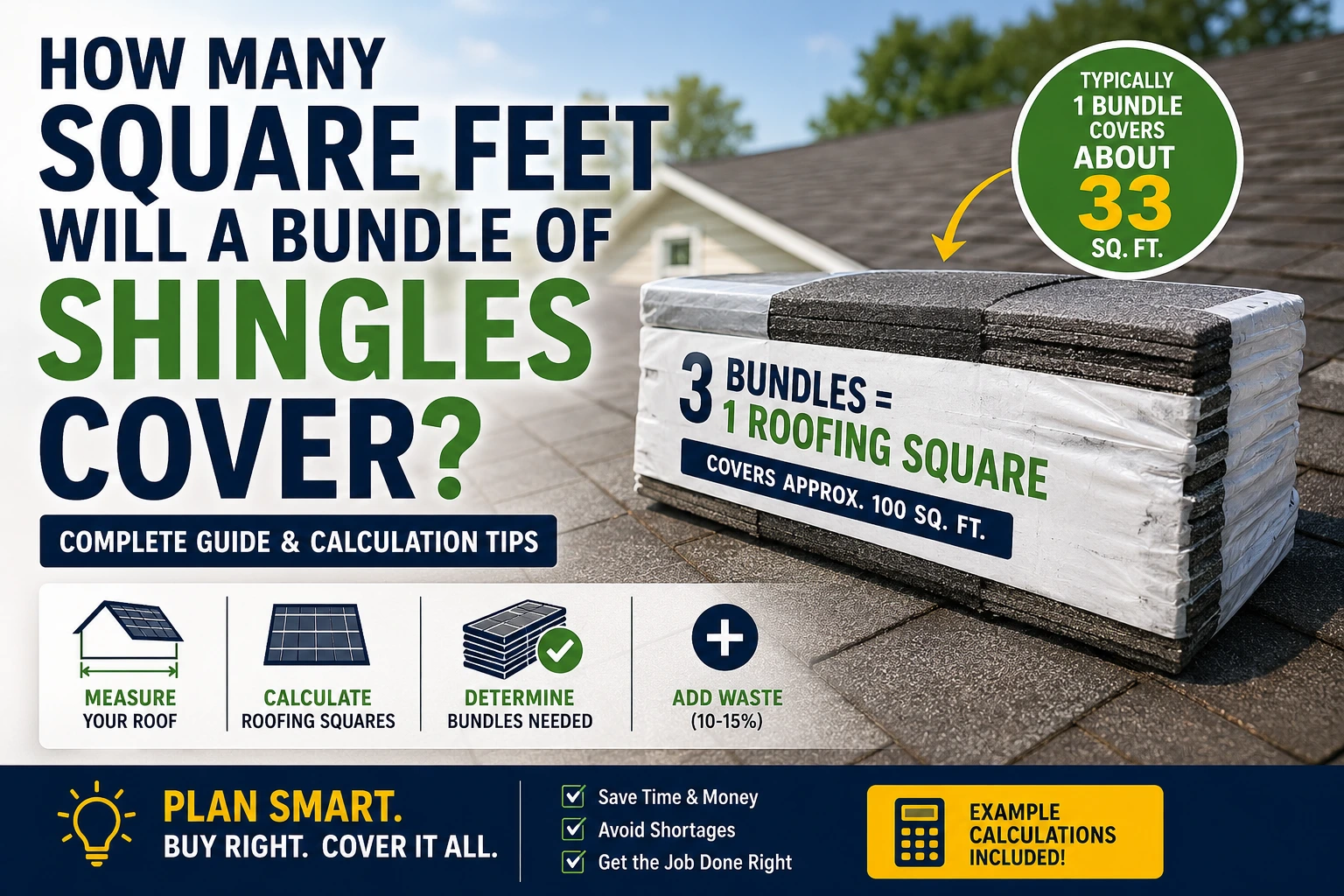
For many standard asphalt shingles, one bundle covers about 33 square feet. This is because three bundles usually cover one roofing square, and one roofing square equals 100 square feet.
However, this is not a rule that applies to every shingle product. Some thicker architectural shingles, premium shingles, and designer shingles may need four, five, or even six bundles to cover 100 square feet.
That is why checking the product label before ordering is important. The bundle count, coverage area, exposure, and shingle style can all affect how much roofing material you need.
This guide explains bundle coverage in simple terms, shows how to calculate the number of bundles for your roof, and helps you avoid ordering too little material.
Quick Answer: How Many Square Feet Will a Bundle of Shingles Cover?
The short answer is:
One bundle of standard asphalt shingles usually covers around 33 square feet.
Most common architectural and 3-tab shingles are packed in three bundles per roofing square. Since one roofing square equals 100 square feet, each bundle covers about one-third of that area.
| Shingle Packaging | Typical Coverage Per Bundle | Bundles Per Roofing Square |
|---|---|---|
| Standard architectural shingles | About 33 sq. ft. | 3 bundles |
| Standard 3-tab shingles | About 33 sq. ft. | 3 bundles |
| Heavier architectural shingles | About 25 sq. ft. | 4 bundles |
| Premium or designer shingles | About 16–25 sq. ft. | 4–6 bundles |
| Ridge cap shingles | Varies by product | Sold separately |
A roofing square is equal to 100 square feet of roof surface, not 100 square feet of house floor space. Roofers use this unit because it makes material estimates easier.
Typical Coverage for Standard Asphalt Shingles
For standard asphalt shingles, the most common estimate is:
- 3 bundles = 1 roofing square
- 1 roofing square = 100 square feet
- 1 bundle = about 33.3 square feet
For example, if your roof area is 900 square feet, you may need about nine roofing squares of shingles. At three bundles per square, that would be around 27 bundles before adding waste.
Many common architectural shingles are packaged this way, but exact coverage can vary slightly by manufacturer and product line.
Why Bundle Coverage Is Not Always the Same
It is easy to assume every bundle covers 33 square feet. That can lead to a shortage if you buy a thicker or specialty shingle.
Bundle coverage changes because of:
- Shingle weight
- Shingle size
- Exposed area after installation
- Layered or laminated design
- Packaging method
- Manufacturer instructions
For example, some products use three bundles per square, while others use four or six bundles per square. Owens Corning lists certain premium shingle lines with six bundles per square, while some standard products use three.
What Is a Roofing Square?
A roofing square is a unit used by roofers and material suppliers.
One roofing square equals:
[
100 \text{ square feet}
]
It does not mean a roof is shaped like a square. It simply means 100 square feet of roof surface.
Roofing Square vs. Square Foot
A square foot measures a small area. A roofing square measures a larger area.
| Measurement | Equals |
| 1 square foot | 12 inches × 12 inches |
| 100 square feet | 1 roofing square |
| 3 bundles of standard shingles | About 1 roofing square |
| 30 bundles of standard shingles | About 10 roofing squares |
For example, a roof measuring 2,000 square feet has 20 roofing squares.
[
2,000 ÷ 100 = 20
]
If the shingles need three bundles per square:
[
20 × 3 = 60 \text{ bundles}
]
Why Roofers Use Squares
Roofers use squares because roofing materials are commonly sold and estimated in 100-square-foot units.
This makes it easier to calculate:
- Shingle bundles
- Underlayment
- Ice and water barrier
- Starter shingles
- Ridge cap shingles
- Labor costs
- Waste allowance
It also makes contractor estimates easier to compare. If one quote says 25 squares and another says 32 squares, you can ask why the measurements differ.
How Many Square Feet Will a Bundle of Shingles Cover by Type?
The answer depends on the exact product.
Architectural Shingles
Architectural shingles are also called dimensional or laminate shingles. They are thicker than basic 3-tab shingles and create a layered appearance.
Many architectural shingles use three bundles per square. In that case, one bundle covers around 33 square feet.
However, heavier architectural products may require four bundles per square. That means one bundle may cover only 25 square feet.
Always read the manufacturer’s wrapper or technical sheet. Some products list coverage as 98.4 square feet per square instead of exactly 100 square feet, which is normal because installation exposure and product design vary.
3-Tab Shingles
3-tab shingles are flatter, lighter, and usually more affordable than architectural shingles.
Most 3-tab shingles are commonly sold in three bundles per square. One bundle generally covers about 33 square feet.
They can be easier to estimate, but you should still confirm the package coverage before placing an order.
Premium and Designer Shingles
Premium, luxury, and designer shingles often have a thicker profile or larger layered design. They may imitate slate, cedar shake, or high-end architectural materials.
These shingles often require more bundles per roofing square.
For example:
- 4 bundles per square = about 25 square feet per bundle
- 5 bundles per square = about 20 square feet per bundle
- 6 bundles per square = about 16.7 square feet per bundle
Do not use the standard 33-square-foot estimate for specialty shingles unless the manufacturer confirms it.
Hip and Ridge Shingles
Hip and ridge shingles are separate products used on roof peaks, ridges, and hips. They are not usually included in your field-shingle bundle calculation.
Their coverage is normally measured in linear feet, not square feet.
For example, you may need to measure the length of every ridge and hip, then use the manufacturer’s stated linear-foot coverage per bundle.
Shingle Bundle Coverage Chart
Use this quick chart as a starting point.
| Bundles Per Square | Coverage Per Bundle | Best Used For |
| 3 bundles | About 33.3 sq. ft. | Many standard architectural and 3-tab shingles |
| 4 bundles | About 25 sq. ft. | Heavier laminate shingles |
| 5 bundles | About 20 sq. ft. | Some premium shingles |
| 6 bundles | About 16.7 sq. ft. | Thick designer or luxury shingles |
Remember: this chart is an estimate. The package label is the final answer.
How to Calculate How Many Bundles of Shingles You Need
You can estimate shingle bundles with a few simple steps.
Step 1: Measure Every Roof Plane
A roof plane is one flat section of the roof.
Measure the length and width of each plane. Include:
- Main roof sections
- Dormers
- Garages
- Porches
- Extensions
- Small roof sections over bays or entrances
Do not measure only the footprint of the house. The roof area is often larger because of overhangs and roof pitch.
Step 2: Calculate Roof Area
Multiply the length by the width of each roof plane.
[
\text{Length} × \text{Width} = \text{Square Footage}
]
For example:
[
40 \text{ ft.} × 25 \text{ ft.} = 1,000 \text{ sq. ft.}
]
If your roof has more than one plane, calculate each section and add the totals.
Step 3: Convert Square Feet Into Roofing Squares
Divide the total roof area by 100.
[
\text{Roof Area} ÷ 100 = \text{Roofing Squares}
]
For a 1,500-square-foot roof:
[
1,500 ÷ 100 = 15 \text{ squares}
]
Step 4: Multiply by Bundles Per Square
If your shingles need three bundles per square:
[
15 × 3 = 45 \text{ bundles}
]
If your shingles need four bundles per square:
[
15 × 4 = 60 \text{ bundles}
]
Step 5: Add a Waste Factor
Add extra shingles for cuts, valleys, ridges, starter rows, damaged pieces, and installation errors.
A common waste allowance is:
- 10% for a simple gable roof
- 15% for roofs with valleys, hips, or dormers
- 15% to 20% for complex roofs
A 10% to 15% waste factor is often recommended for roofing projects, with more complex roofs needing more allowance.
Example: How Many Bundles for a 1,500-Square-Foot Roof?
Here is a simple example using standard shingles that cover about 33 square feet per bundle.
Simple Gable Roof Example
Roof area: 1,500 square feet
First, convert the area into roofing squares:
[
1,500 ÷ 100 = 15 \text{ squares}
]
Next, multiply by three bundles:
[
15 × 3 = 45 \text{ bundles}
]
Now add 10% waste:
[
45 × 0.10 = 4.5
]
Round up to five extra bundles.
Estimated total: 50 bundles
Complex Roof Example
Now imagine the same 1,500-square-foot roof has several valleys, a chimney, and two dormers.
Base estimate:
[
15 × 3 = 45 \text{ bundles}
]
Add 15% waste:
[
45 × 0.15 = 6.75
]
Round up to seven extra bundles.
Estimated total: 52 bundles
This estimate covers field shingles only. You may also need starter shingles, ridge cap shingles, underlayment, flashing, nails, and other roofing materials.
Factors That Change Shingle Coverage
Shingle Style and Exposure
The visible part of a shingle after installation is called its exposure. Larger exposure can affect how much material covers a roof area.
Thicker shingles may also be packaged in smaller coverage amounts because each bundle is heavier.
Manufacturer Packaging
Different manufacturers package shingles differently. Even two architectural shingles can have different bundle coverage.
Check for these details on the wrapper:
- Bundles per square
- Coverage per bundle
- Coverage per square
- Number of shingles per bundle
- Installation instructions
Roof Pitch and Complexity
A steep roof has more surface area than a flat roof with the same house footprint.
Complex features also create more waste:
- Valleys
- Hips
- Dormers
- Skylights
- Chimneys
- Curved sections
- Multiple roof levels
Starter, Ridge, and Hip Materials
Field shingles cover the main roof surface. Starter shingles and ridge cap shingles are separate materials.
Do not assume leftover field shingles will cover every ridge or starter requirement. Some roofing systems need matching accessories to meet installation instructions or warranty conditions.
How Much Extra Shingle Material Should You Buy?
Buying extra shingles may feel unnecessary, but it is usually better than running short during installation.
Recommended Roofing Waste Percentages
| Roof Type | Suggested Waste Allowance |
| Simple gable roof | 10% |
| Hip roof | 10%–15% |
| Roof with valleys or dormers | 15% |
| Complex roof with many cuts | 15%–20% |
A roofing professional may adjust this percentage after inspecting the roof.
Why Leftover Shingles Can Be Useful
A few leftover bundles can help later if your roof is damaged by wind, falling branches, or repairs around vents and chimneys.
They can also be useful if the original color is discontinued or fades over time.
Store unopened bundles in a dry place, off the ground, and away from direct moisture.
Common Mistakes When Estimating Shingle Bundles
Measuring the House Instead of the Roof
The house footprint is not always the roof area. Overhangs, roof slope, garages, and porches can add significant square footage.
Forgetting Roof Pitch
A steeper roof has more surface area. If you measure only the horizontal footprint, your estimate may be too low.
Assuming Every Bundle Covers 33 Square Feet
This is one of the most common errors. Standard shingles may cover around 33 square feet per bundle, but premium products may cover much less.
Ignoring Starter and Ridge Cap Shingles
Field shingles are only part of the material list. Ridge caps, starter strips, underlayment, flashing, nails, and ventilation components may all be needed.
Expert Tips Before Ordering Roofing Shingles
Use these practical tips before you buy:
- Check the exact shingle product label.
- Measure every roof plane separately.
- Round bundle quantities up, not down.
- Add a realistic waste factor.
- Buy all visible shingles from the same production batch when possible.
- Order matching ridge cap and starter shingles.
- Confirm local building-code requirements.
- Ask a roofing professional to verify measurements for steep, damaged, or complex roofs.
If you are replacing an entire roof, a professional measurement report can reduce ordering mistakes and help you compare contractor quotes more accurately.
Frequently Asked Questions
How many square feet will a bundle of shingles cover?
A standard bundle of asphalt shingles usually covers about 33 square feet. This is based on three bundles covering one 100-square-foot roofing square.
How many bundles of shingles are in one roofing square?
Most standard shingles use three bundles per roofing square. However, heavier or premium shingles may require four, five, or six bundles per square.
How many bundles of shingles do I need for 1,000 square feet?
For standard three-bundle shingles, 1,000 square feet equals 10 roofing squares.
[
10 × 3 = 30 \text{ bundles}
]
Add 10% waste, and you should plan for about 33 bundles.
Does one bundle of shingles cover 33 square feet?
Often, yes. One bundle of standard shingles typically covers about 33 square feet. But always check the packaging because coverage varies by shingle type and manufacturer.
Should I buy extra bundles of shingles?
Yes. Add at least 10% for a simple roof and 15% or more for roofs with valleys, dormers, hips, or many cuts.
Conclusion: How Many Square Feet Will a Bundle of Shingles Cover?
So, how many square feet will a bundle of shingles cover? For many standard asphalt shingles, one bundle covers about 33 square feet, because three bundles usually cover one 100-square-foot roofing square.
Still, do not rely on this estimate alone. Bundle coverage can change based on the shingle style, thickness, exposure, and manufacturer packaging. Premium shingles may require four to six bundles per square, meaning each bundle covers less area.
Measure every roof plane, convert the total into roofing squares, check the package coverage, and add a waste factor before ordering. This approach helps you buy enough shingles, avoid costly delays, and keep your roofing project moving smoothly.
Discover more