

If you are planning to refresh a room, paint a ceiling, or update the outside of your home, you may be asking: how many sq feet does 1 gallon of paint cover?
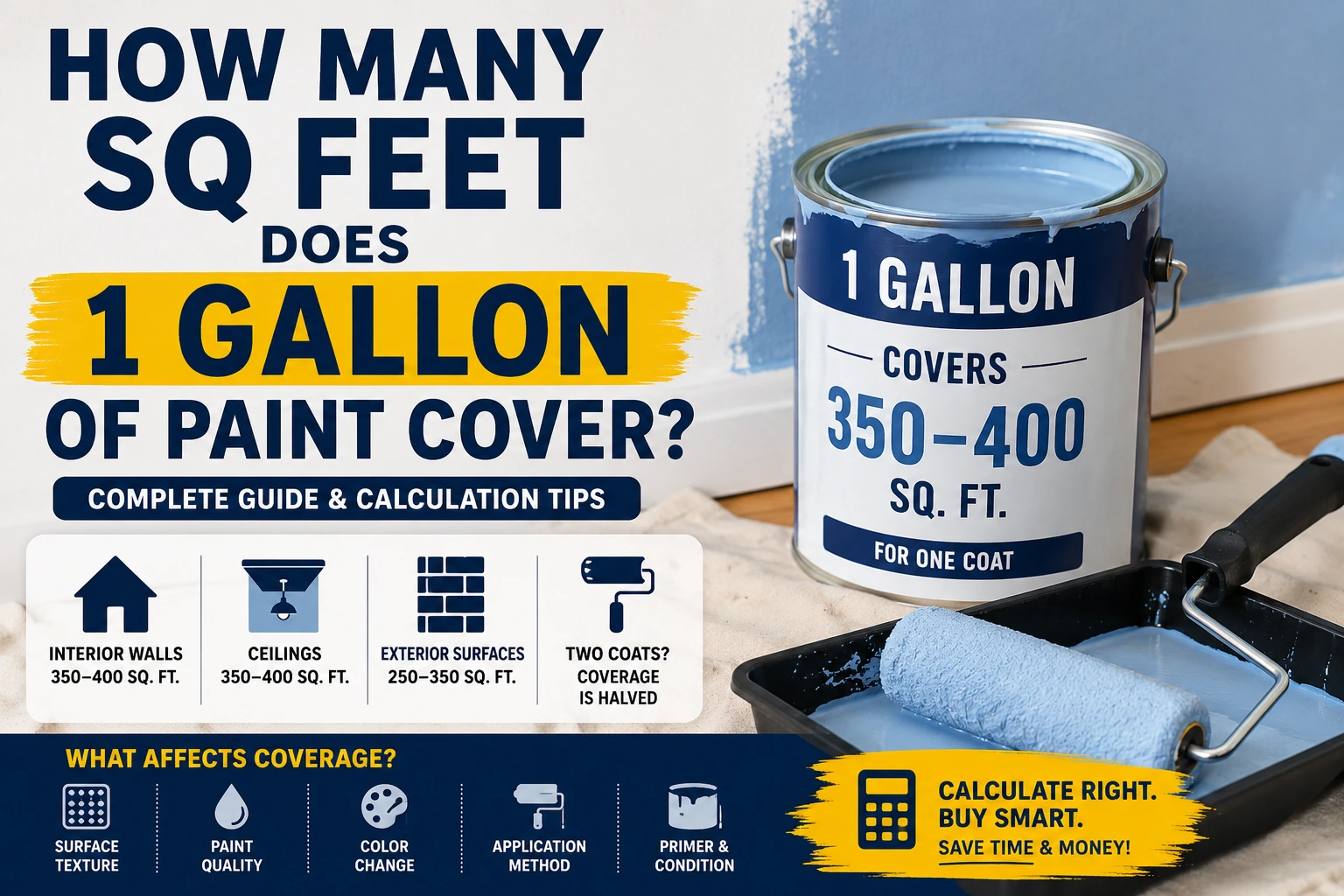
In most cases, one gallon of paint covers around 350 to 400 square feet for one coat. However, the exact coverage depends on the paint type, wall condition, surface texture, color change, and how you apply the paint.
A smooth, previously painted interior wall may allow one gallon to cover close to 400 square feet. On the other hand, rough brick, new drywall, bare wood, dark walls, or heavily textured surfaces may reduce coverage to 250 to 300 square feet per gallon.
Knowing the real coverage rate helps you buy enough paint without overspending. This guide explains how to estimate paint coverage, calculate gallons for your project, and avoid common measuring mistakes.
Quick Answer: How Many Sq Feet Does 1 Gallon of Paint Cover?
The average answer is:
One gallon of paint usually covers 350 to 400 square feet with one coat.
This is the typical coverage range listed for many interior wall paints. Still, it is best to check the label on the exact paint product because each formula has its own coverage rate.
| Surface or Situation | Typical Coverage From 1 Gallon |
|---|---|
| Smooth interior walls | 350–400 sq. ft. |
| Ceilings | 350–400 sq. ft. |
| Previously painted walls | 350–400 sq. ft. |
| New drywall with primer | 300–350 sq. ft. |
| Textured walls | 250–350 sq. ft. |
| Exterior siding | 250–350 sq. ft. |
| Brick, stucco, or rough masonry | 200–300 sq. ft. |
Paint brands commonly state coverage ranges on the can or product information. For example, Sherwin-Williams notes that coverage can vary depending on the product and surface condition.
Average Coverage Per Gallon
For a simple estimate, use 350 square feet per gallon. This gives you a safer number than assuming the full 400 square feet.
For example:
- 350 square feet of wall area = about 1 gallon
- 700 square feet of wall area = about 2 gallons
- 1,050 square feet of wall area = about 3 gallons
- 1,400 square feet of wall area = about 4 gallons
If you are applying two coats, double the amount of paint needed.
Why Paint Coverage Can Change
Paint does not spread the same way on every surface. Coverage can change because of:
- Wall texture
- Porous or unpainted material
- Paint thickness
- Roller nap size
- Brush versus roller application
- Number of coats
- Dark-to-light color changes
- Primer use
- Paint quality and formula
For example, painting a light color over a similar light color may need only one strong coat. Painting white over deep red, navy, black, or bright blue may require primer plus two finish coats.
How Many Sq Feet Does 1 Gallon of Paint Cover for One Coat?
For one coat, most interior paints cover between 350 and 400 square feet per gallon.
Interior Wall Coverage
Smooth interior walls are usually the easiest surfaces to paint. If the wall is already painted and in good condition, one gallon can often cover 350 to 400 square feet.
Interior walls may use more paint if they have:
- Heavy texture
- Patch repairs
- Stains
- Unprimed drywall
- Dark paint underneath
- Glossy old paint
- Large color changes
For planning, use 350 square feet per gallon unless the paint label gives a different number.
Ceiling Coverage
Ceilings often use a flat paint designed to hide small marks and uneven areas. One gallon of ceiling paint may cover about 350 to 400 square feet.
However, ceilings can absorb more paint if they are new, stained, textured, or not primed.
A standard 12-by-12-foot ceiling has:
[
12 × 12 = 144 \text{ square feet}
]
One gallon is usually enough for two coats on a ceiling of this size, depending on the product and surface condition.
Exterior Surface Coverage
Exterior paint often covers less area than interior paint because outdoor surfaces are rougher and more exposed.
Wood siding, stucco, brick, concrete, and weathered trim can absorb more paint. One gallon of exterior paint may cover around 250 to 350 square feet.
Exterior projects may also need extra paint for:
- Fascia boards
- Soffits
- Trim
- Window frames
- Doors
- Railings
- Shutters
Always measure these separately instead of assuming they are included in wall coverage.
How Many Sq Feet Does 1 Gallon of Paint Cover for Two Coats?
If you need two coats, one gallon covers about half the area.
For two coats, one gallon of paint usually covers around 175 to 200 square feet.
This is a simple rule because you are applying the paint twice.
| Number of Coats | Approximate Coverage Per Gallon |
| One coat | 350–400 sq. ft. |
| Two coats | 175–200 sq. ft. |
| Three coats | 115–133 sq. ft. |
Why Two Coats Usually Need More Paint
Two coats improve color depth, durability, and evenness. They are often needed when:
- Changing from dark paint to light paint
- Painting a new wall
- Covering stains
- Painting over patchwork
- Using a bold or bright color
- Painting exterior surfaces
- Using low-quality paint with weaker coverage
The first coat may soak into the wall or show uneven areas. The second coat creates a more consistent finish.
When One Coat May Be Enough
One coat may be enough when:
- You are using a high-quality paint-and-primer product
- The new color is close to the old color
- The wall is smooth and clean
- The existing paint is in good condition
- You are touching up a small area
Still, test a small section first. Paint may look different after it dries.
Paint Coverage Per Gallon Chart
Use this chart as a starting point when estimating your project.
| Project Size | One Coat at 350 Sq. Ft. Per Gallon | Two Coats |
| 175 sq. ft. | 1 gallon | 1 gallon |
| 350 sq. ft. | 1 gallon | 2 gallons |
| 400 sq. ft. | 1–2 gallons | 2 gallons |
| 700 sq. ft. | 2 gallons | 4 gallons |
| 1,000 sq. ft. | 3 gallons | 6 gallons |
| 1,400 sq. ft. | 4 gallons | 8 gallons |
Always round up when your estimate falls between gallon sizes. It is easier to store a small amount of leftover paint than to stop halfway through a project because you ran out.
How to Calculate How Much Paint You Need
You do not need a complicated paint calculator to make a basic estimate. Follow these steps.
Step 1: Measure Each Wall
Measure the width and height of every wall.
For example, if one wall is 12 feet wide and 8 feet high:
[
12 × 8 = 96 \text{ square feet}
]
Repeat this for each wall in the room.
Step 2: Find Total Wall Square Footage
Add the square footage of all walls.
For a 12-by-12-foot room with 8-foot ceilings:
[
12 × 8 = 96
]
There are four walls:
[
96 × 4 = 384 \text{ square feet}
]
The total wall area is 384 square feet.
Step 3: Subtract Doors and Windows
You can subtract large doors and windows if you want a more accurate estimate.
Typical sizes include:
| Item | Approximate Area |
| Standard door | 20 sq. ft. |
| Small window | 12–15 sq. ft. |
| Large window | 20–30 sq. ft. |
For a simple estimate, many painters do not subtract small windows because extra paint is useful for touch-ups.
Step 4: Divide by Paint Coverage
Divide the paintable area by the coverage rate.
For example:
[
384 ÷ 350 = 1.1
]
For one coat, you would need about 1.1 gallons. Since paint is usually sold by the gallon, buy 2 gallons if you need full coverage, touch-ups, or a second coat.
Step 5: Multiply for Extra Coats
If you need two coats:
[
1.1 × 2 = 2.2 \text{ gallons}
]
You would likely need 3 gallons for the room.
Example: How Much Paint for a 12×12 Room?
A 12-by-12-foot room with 8-foot ceilings has four walls.
Wall Paint Calculation
Each wall measures:
[
12 × 8 = 96 \text{ square feet}
]
Four walls equal:
[
96 × 4 = 384 \text{ square feet}
]
Subtract one door, around 20 square feet:
[
384 – 20 = 364 \text{ square feet}
]
For one coat, one gallon may be close to enough. For a safer estimate, buy 2 gallons.
Ceiling Paint Calculation
The ceiling is:
[
12 × 12 = 144 \text{ square feet}
]
One gallon is normally enough for one or two coats on a ceiling this size.
Two-Coat Example
For two coats on the walls:
[
364 × 2 = 728 \text{ square feet of paint coverage}
]
At 350 square feet per gallon:
[
728 ÷ 350 = 2.08
]
You should buy 3 gallons for two wall coats.
Factors That Affect How Much Area One Gallon Covers
Surface Texture and Porosity
Rough surfaces need more paint because they have more tiny gaps and uneven areas.
These surfaces often reduce coverage:
- Stucco
- Brick
- Popcorn ceilings
- Rough wood
- Textured drywall
- Concrete blocks
A smooth wall uses less paint than a heavily textured wall.
Paint Type and Quality
Higher-quality paints often contain more solids and pigments. This can improve coverage and reduce the number of coats needed.
Lower-cost paint may look cheaper at first, but it can require more coats. Compare coverage, durability, washability, and finish before choosing.
Paint Color Changes
Changing from a dark shade to a light shade can use more paint. Deep colors may also need more than one coat for an even result.
Using a tinted primer can help when switching from dark navy, black, red, or green to a lighter color.
Application Method
Rollers, brushes, and sprayers apply paint differently.
- Rollers: Good for large walls and even coverage
- Brushes: Best for edges, trim, and small areas
- Sprayers: Fast for large surfaces but can create overspray and waste
Using a roller with the correct nap length can improve coverage. Smooth walls need a shorter nap, while textured walls need a thicker roller cover.
Primer and Previous Wall Condition
Primer helps paint stick better and can reduce uneven absorption. It is especially useful for:
- New drywall
- Bare wood
- Stained walls
- Repairs and patches
- Major color changes
- Glossy surfaces
Primer is not always necessary, but it can improve the final result and make the topcoat look more even.
Interior vs. Exterior Paint Coverage
Interior and exterior paints are made for different conditions.
Why Exterior Paint Often Covers Less
Exterior surfaces are often rough, weathered, and more porous. Paint may sink into cracks, grain, or masonry.
Exterior paint also needs to handle sun, rain, temperature changes, and moisture. This can affect how it spreads and dries.
Common Exterior Surfaces
| Exterior Surface | Typical Coverage Per Gallon |
| Smooth siding | 300–350 sq. ft. |
| Wood siding | 250–350 sq. ft. |
| Stucco | 200–300 sq. ft. |
| Brick | 200–300 sq. ft. |
| Concrete | 200–300 sq. ft. |
For exterior projects, use the lower end of the coverage range unless the surface is very smooth and already painted.
Common Mistakes When Estimating Paint Coverage
Forgetting the Second Coat
Many people calculate only one coat, then discover the color looks uneven. If you expect two coats, double the paint estimate from the start.
Ignoring Ceilings and Trim
Walls are not the only painted surfaces. You may also need paint for ceilings, doors, trim, baseboards, and window frames.
Measure them separately because trim paint may use a different finish or color.
Not Accounting for Surface Texture
A textured wall can use much more paint than a smooth wall. Use a lower coverage rate for rough surfaces.
Buying Too Little Paint
Running out of paint can delay your project. It can also make color matching harder if a new batch looks slightly different.
Buy a little extra, especially for large rooms or custom colors.
Expert Tips to Reduce Paint Waste
Use these tips to make your paint go further:
- Clean walls before painting.
- Repair holes and cracks first.
- Use primer where needed.
- Stir paint thoroughly before use.
- Use the correct roller nap.
- Avoid applying paint too thickly.
- Keep a wet edge while rolling.
- Pour only what you need into a tray.
- Seal leftover paint tightly for touch-ups.
- Label leftover cans with the room name and date.
A careful setup gives you better coverage and a smoother finish.
Frequently Asked Questions
How many sq feet does 1 gallon of paint cover?
One gallon of paint usually covers about 350 to 400 square feet for one coat. Rough, porous, or textured surfaces may reduce coverage.
Is one gallon of paint enough for one room?
It can be enough for one small room with one coat. For a standard 12-by-12-foot room, you may need 2 to 3 gallons if you are painting all walls with two coats.
How much paint do I need for a 12×12 room?
For a 12-by-12-foot room with 8-foot ceilings, the walls are about 384 square feet before subtracting doors and windows. Plan for 2 gallons for one coat or 3 gallons for two coats.
How many gallons do I need for 1,000 square feet?
For one coat at 350 square feet per gallon, you need about 3 gallons. For two coats, plan for about 6 gallons.
Does primer count as a coat of paint?
Primer is a separate base coat. It prepares the surface and improves adhesion, but it does not usually replace the finish coat. Most projects still need one or two coats of paint after primer.
Conclusion: How Many Sq Feet Does 1 Gallon of Paint Cover?
So, how many sq feet does 1 gallon of paint cover? In most cases, one gallon covers around 350 to 400 square feet for one coat. For two coats, expect one gallon to cover about 175 to 200 square feet.
Your final coverage depends on the paint product, wall texture, surface condition, paint color, primer use, and application method. Smooth interior walls usually need less paint, while rough exterior surfaces, new drywall, brick, and dark-to-light color changes often need more.
Measure your walls carefully, use 350 square feet per gallon as a safe estimate, and round up when needed. This will help you avoid running out of paint and give your project a clean, even finish.
Discover more