

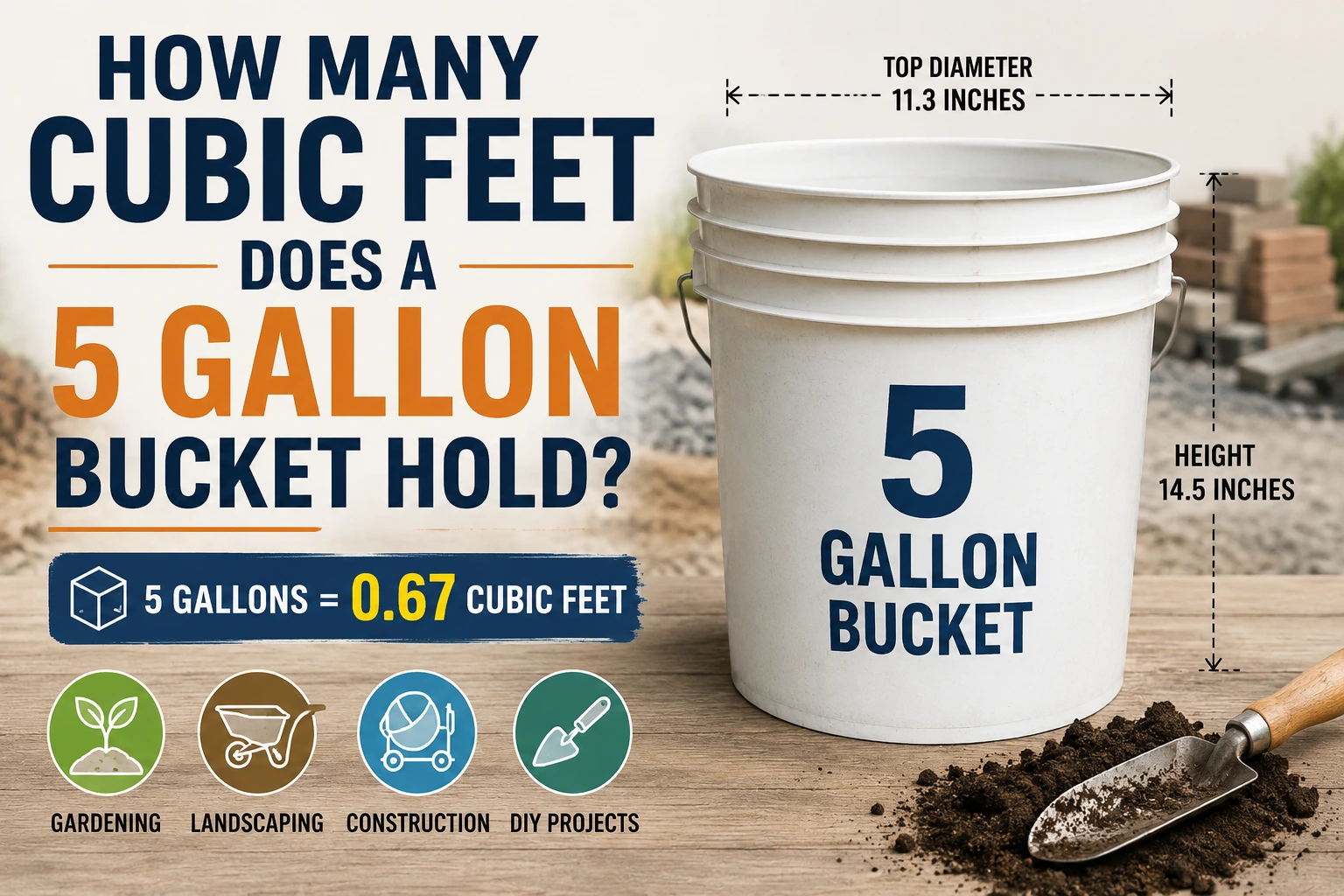
If you’ve ever asked how many cubic feet does a 5 gallon bucket hold, you’re not alone. This simple conversion is useful in gardening, landscaping, construction, farming, home improvement, and many DIY projects. Whether you’re calculating soil, mulch, gravel, concrete, water, or other materials, knowing the cubic-foot capacity of a standard 5-gallon bucket makes estimating quantities much easier.
A standard 5-gallon bucket holds approximately 0.67 cubic feet (about two-thirds of a cubic foot). While this number seems small, it becomes incredibly useful when measuring larger amounts of material or converting between different units.
In this guide, you’ll learn exactly how the conversion works, why it matters, practical examples, comparison charts, and expert tips to help you measure materials accurately.
Understanding Volume Measurements
Before converting gallons into cubic feet, it’s important to understand what each measurement represents.
A gallon measures volume in the U.S. customary system and is commonly used for liquids like water, paint, fuel, and chemicals.
A cubic foot measures three-dimensional space. It’s commonly used when estimating:
- Soil
- Sand
- Gravel
- Mulch
- Concrete
- Compost
- Firewood
- Storage space
Although both measure volume, cubic feet are often preferred when dealing with construction or landscaping materials because suppliers typically sell products by the cubic yard or cubic foot.
How Many Cubic Feet Does a 5 Gallon Bucket Hold?
The answer is straightforward:
A standard 5-gallon bucket holds approximately 0.67 cubic feet.
More precisely:
- 1 U.S. gallon = 0.133681 cubic feet
- 5 gallons × 0.133681
- = 0.6684 cubic feet
Rounded for everyday use:
| Gallons | Cubic Feet |
|---|---|
| 1 gallon | 0.1337 cu ft |
| 2 gallons | 0.267 cu ft |
| 3 gallons | 0.401 cu ft |
| 4 gallons | 0.535 cu ft |
| 5 gallons | 0.668 cubic feet |
| 6 gallons | 0.802 cu ft |
| 7 gallons | 0.936 cu ft |
| 10 gallons | 1.337 cubic feet |
For most DIY projects, people round this to:
5 gallons ≈ 0.67 cubic feet
Why This Conversion Matters
Knowing the cubic-foot capacity of a bucket helps you estimate materials more accurately.
Instead of guessing, you can calculate exactly how much material you’ll need.
This is especially useful for:
- Filling raised garden beds
- Mixing concrete
- Measuring compost
- Estimating gravel
- Purchasing mulch
- Calculating soil
- Moving sand
- Filling planters
Many landscaping suppliers list products in cubic feet or cubic yards rather than gallons, making this conversion essential.
How to Convert Gallons to Cubic Feet
Fortunately, the conversion formula is very simple.
Formula
Cubic Feet = Gallons × 0.133681
Example using a 5-gallon bucket:
5 × 0.133681 = 0.668405 cubic feet
Rounded:
0.67 cubic feet
Quick Conversion Table
| Gallons | Cubic Feet |
|---|---|
| 1 | 0.134 |
| 5 | 0.668 |
| 10 | 1.337 |
| 20 | 2.674 |
| 30 | 4.010 |
| 50 | 6.684 |
| 100 | 13.368 |
Keeping this chart handy can save time on future projects.
Common Uses for a 5-Gallon Bucket
The humble 5-gallon bucket is one of the most versatile containers available.
It is commonly used for:
Gardening
Gardeners use buckets to transport:
- Potting soil
- Compost
- Mulch
- Fertilizer
- Plant waste
Knowing that one bucket equals roughly 0.67 cubic feet helps estimate how many trips are needed.
Landscaping
Professional landscapers often measure:
- Decorative stone
- Gravel
- Sand
- Topsoil
- Bark mulch
Instead of using expensive measuring tools, they simply count bucket loads.
Construction
Builders frequently use 5-gallon buckets for:
- Concrete mix
- Mortar
- Cement
- Gravel
- Dry sand
Consistent bucket measurements improve mixing accuracy.
Farming
Farmers rely on buckets for transporting:
- Animal feed
- Grain
- Seed
- Fertilizer
- Water
Understanding bucket volume simplifies storage planning.
Liquid Volume vs. Dry Material Volume
One common misunderstanding is assuming every material behaves exactly like water.
While a 5-gallon bucket always holds the same volume, different materials have different weights.
For example:
| Material | Approximate Weight in a 5-Gallon Bucket |
|---|---|
| Water | 41–42 pounds |
| Dry sand | 65–75 pounds |
| Wet sand | 80–90 pounds |
| Gravel | 65–75 pounds |
| Compost | 18–30 pounds |
| Potting soil | 20–40 pounds |
| Mulch | 10–20 pounds |
The volume remains approximately 0.67 cubic feet, but the weight changes significantly depending on density and moisture content.
How Many 5-Gallon Buckets Make One Cubic Foot?
Since one bucket equals approximately 0.668 cubic feet, calculating the number of buckets in one cubic foot is easy.
1 ÷ 0.668 = 1.5 buckets
So:
- 1 cubic foot ≈ 1½ five-gallon buckets
This estimate is useful when buying bagged soil or planning landscaping projects.
How Many Buckets Are in One Cubic Yard?
Many landscaping materials are sold by the cubic yard.
Since:
- 1 cubic yard = 27 cubic feet
And one bucket holds:
- 0.668 cubic feet
Calculation:
27 ÷ 0.668 = 40.4 buckets
Rounded:
About 40 to 41 standard 5-gallon buckets equal one cubic yard.
This estimate is especially useful when transporting bulk materials without a trailer or wheelbarrow.
Practical Examples
Understanding the conversion becomes much easier when applied to real-world situations.
Example 1: Filling a Raised Garden Bed
Suppose your raised garden bed requires 8 cubic feet of soil.
Each bucket holds approximately 0.67 cubic feet.
Calculation:
8 ÷ 0.67 = approximately 12 buckets
You’ll need about 12 full 5-gallon buckets to fill the bed.
Example 2: Buying Mulch
A bag of mulch contains 2 cubic feet.
How many bucket loads is that?
2 ÷ 0.67 = about 3 buckets
One 2-cubic-foot bag fills roughly three 5-gallon buckets.
Example 3: Mixing Concrete
Imagine a project requires 4 cubic feet of mixed concrete.
Calculation:
4 ÷ 0.67 = 6 bucket loads
Preparing materials by bucket helps maintain consistent concrete ratios.
Factors That Can Affect Actual Bucket Capacity
Although a bucket is marketed as “5 gallons,” its usable capacity may differ slightly.
Some reasons include:
Bucket Design
Different manufacturers use different dimensions.
Some buckets hold slightly more than 5 gallons when filled to the rim.
Others reach exactly 5 gallons at the marked fill line.
Fill Level
A completely overflowing bucket holds more than five gallons.
For accurate measurements, always fill to the manufacturer’s capacity line rather than the top edge.
Material Shape
Solid materials such as rocks or firewood create air pockets between pieces.
These gaps reduce the amount of actual material contained within the bucket, even though the bucket’s overall volume remains the same.
Expert Tips for Accurate Volume Measurements
Whether you’re working on a landscaping project, pouring concrete, or filling garden beds, small measurement errors can add up. These practical tips will help you get more accurate results when using a 5-gallon bucket.
Fill Buckets Consistently
Always fill the bucket to the same level. If one bucket is heaping and another is only three-quarters full, your volume calculations will be inaccurate.
Level Off Dry Materials
For materials like sand, soil, compost, or gravel, use a straight board or shovel to level the top before measuring. This ensures each bucket contains approximately the same volume.
Account for Settling
Loose materials often settle during transport or after watering. Potting soil, mulch, and compost may compress over time, reducing their volume.
Buy a Little Extra
If you’re purchasing landscaping materials, it’s wise to buy 5–10% more than your calculations suggest. This helps cover spillage, settling, and unexpected needs.
Use the Same Bucket
Not every bucket labeled “5 gallons” has identical dimensions. Using the same bucket throughout a project keeps measurements consistent.
Common Conversion Chart for Landscaping Materials
The following chart helps estimate bucket requirements for common project sizes.
| Project Volume | Approximate 5-Gallon Buckets Needed |
|---|---|
| 1 cubic foot | 1.5 buckets |
| 2 cubic feet | 3 buckets |
| 5 cubic feet | 7.5 buckets |
| 10 cubic feet | 15 buckets |
| 20 cubic feet | 30 buckets |
| 27 cubic feet (1 cubic yard) | 40–41 buckets |
These estimates are useful when moving materials without heavy equipment.
Comparing Gallons, Cubic Feet, and Cubic Yards
Understanding how these units relate to one another makes estimating larger jobs much easier.
| Measurement | Equivalent Volume |
|---|---|
| 1 gallon | 0.1337 cubic feet |
| 5 gallons | 0.668 cubic feet |
| 7.48 gallons | 1 cubic foot |
| 27 cubic feet | 1 cubic yard |
| 201.97 gallons | 1 cubic yard |
Remember these two conversions:
- 7.48 gallons = 1 cubic foot
- 27 cubic feet = 1 cubic yard
They are among the most commonly used conversions in construction and landscaping.
When Is a 5-Gallon Bucket the Best Measuring Tool?
Although professional measuring equipment is available, a 5-gallon bucket remains a favorite because it is:
- Affordable
- Easy to carry
- Durable
- Widely available
- Suitable for liquids and dry materials
- Simple to clean and reuse
Many contractors and gardeners use bucket counts instead of complex calculations for small and medium-sized projects.
Common Mistakes to Avoid
Even a simple volume conversion can lead to errors if you’re not careful.
Confusing Weight With Volume
A bucket always holds about 0.67 cubic feet of volume, but the weight depends on the material inside.
For example:
- Water is much lighter than gravel.
- Wet sand weighs more than dry sand.
- Compost weighs less than topsoil.
Never assume equal volume means equal weight.
Mixing U.S. and Imperial Gallons
The standard 5-gallon bucket sold in the United States is based on U.S. gallons.
Imperial gallons, used in some countries, are larger. Using the wrong gallon measurement can produce inaccurate calculations.
Ignoring Air Spaces
Materials such as rocks, wood chips, and firewood leave empty spaces between pieces. While the bucket’s total volume stays the same, the amount of solid material inside is less than it appears.
Forgetting Material Compression
Fresh mulch, compost, and soil can settle after installation. Plan for slight volume loss, especially in garden and landscaping projects.
Real-World Applications
Knowing how many cubic feet does a 5 gallon bucket hold is useful in many everyday situations.
Home Gardening
Measure potting soil for:
- Raised beds
- Vegetable gardens
- Flower pots
- Tree planting
Landscaping
Estimate:
- Gravel for walkways
- Decorative stone
- Mulch around plants
- Topsoil for lawns
Concrete Projects
Small concrete jobs often require measured amounts of:
- Cement
- Sand
- Gravel
- Water
Using bucket measurements helps maintain consistent mixing ratios.
Farming and Homesteading
Farmers use buckets for:
- Livestock feed
- Grain
- Compost
- Fertilizer
- Water storage
Knowing the bucket’s cubic-foot capacity improves storage and transportation planning.
DIY Home Improvement
Buckets are useful when moving:
- Dirt
- Debris
- Firewood
- Salt
- Ice melt
- Construction waste
The standard volume makes estimating quantities much easier.
Quick Reference Summary
Here are the most important numbers to remember:
| Measurement | Value |
|---|---|
| 1 gallon | 0.1337 cubic feet |
| 5 gallons | 0.668 cubic feet |
| Rounded value | 0.67 cubic feet |
| Buckets per cubic foot | 1.5 buckets |
| Buckets per cubic yard | 40–41 buckets |
| Gallons per cubic foot | 7.48 gallons |
Saving these conversions can make future projects faster and more accurate.
FAQs
How many cubic feet does a standard 5 gallon bucket hold?
A standard U.S. 5-gallon bucket holds approximately 0.668 cubic feet, which is commonly rounded to 0.67 cubic feet for everyday calculations.
How many 5 gallon buckets equal one cubic foot?
It takes about 1.5 standard 5-gallon buckets to equal one cubic foot of volume.
How many 5 gallon buckets are in one cubic yard?
Since one cubic yard equals 27 cubic feet, you’ll need approximately 40 to 41 five-gallon buckets to equal one cubic yard.
Does a 5 gallon bucket always hold exactly 5 gallons?
Most standard buckets are designed to hold 5 U.S. gallons, but some manufacturers include additional space above the fill line. Always check the bucket’s specifications if precise measurements are required.
Why is cubic feet used instead of gallons for landscaping?
Landscaping materials such as soil, mulch, gravel, and compost are typically sold in cubic feet or cubic yards. Converting a 5-gallon bucket to cubic feet makes it easier to estimate how much material you need for a project.
Conclusion
Understanding how many cubic feet does a 5 gallon bucket hold is a simple yet valuable skill for homeowners, gardeners, contractors, and DIY enthusiasts. A standard 5-gallon bucket holds approximately 0.668 cubic feet, or about 0.67 cubic feet when rounded for everyday use.
This conversion makes it much easier to estimate soil, mulch, gravel, concrete, compost, and other materials without relying on specialized measuring equipment. It also helps you determine how many bucket loads are needed for a project, compare supplier quantities, and avoid buying too much or too little material.
By remembering a few key conversions—such as 1 gallon = 0.1337 cubic feet, 7.48 gallons = 1 cubic foot, and 27 cubic feet = 1 cubic yard—you can confidently plan projects of any size. Whether you’re filling a raised garden bed, mixing concrete, or transporting landscaping materials, using a standard 5-gallon bucket as a measuring tool is both practical and accurate.
Discover more
how many cubic feet is a large capacity washer