

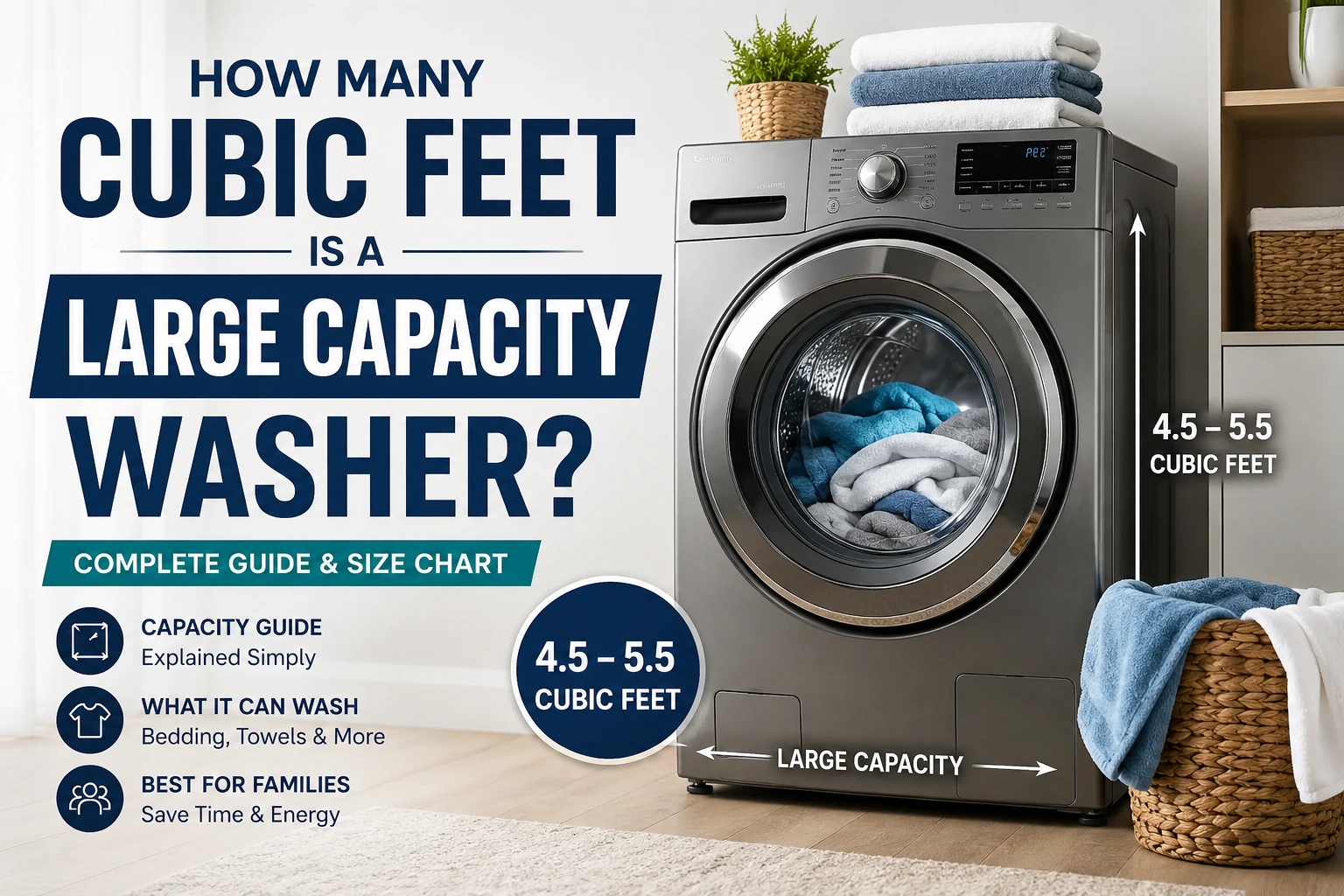
If you’re shopping for a new washing machine, one question you’ll probably ask is how many cubic feet is a large capacity washer. Washer capacity plays a major role in how much laundry you can wash at one time, how efficiently your machine performs, and whether it can handle bulky items like comforters and blankets.
In general, a large capacity washer ranges from 4.5 to 5.5 cubic feet, although some premium models offer up to 6.0 cubic feet or more. This size is ideal for larger families, frequent laundry days, and oversized loads.
In this guide, you’ll learn exactly what washer capacity means, how manufacturers classify washing machines, what different capacities can hold, and how to choose the best washer for your needs.
Understanding Washer Capacity
Buying a washing machine isn’t only about dimensions or price. Capacity determines how much clothing fits inside the drum without reducing cleaning performance.
A washer that’s too small means more loads each week, while one that’s too large may waste water and energy if you rarely fill it.
What Does Cubic Feet Mean?
The capacity of a washing machine is measured in cubic feet, which represents the amount of space available inside the drum.
Unlike the outside dimensions, cubic feet tells you the usable interior volume where laundry is placed.
For example:
- A washer with 3.5 cubic feet has less room than one with 5.0 cubic feet.
- Larger drums allow clothes to tumble more freely.
- Better movement often results in improved cleaning and rinsing.
Think of cubic feet as the storage space inside the washer rather than the size of the appliance itself.
Why Washer Capacity Matters
Choosing the right capacity provides several benefits:
- Wash more clothes in one cycle.
- Save time on weekly laundry.
- Reduce electricity usage by running fewer loads.
- Lower water consumption.
- Wash bulky bedding without visiting a laundromat.
- Minimize wear on clothing by avoiding overloaded drums.
For busy households, washer capacity directly affects convenience.
How Many Cubic Feet Is a Large Capacity Washer?
Most appliance manufacturers classify washing machine capacities into several categories.
| Washer Size | Capacity (Cubic Feet) | Best For |
|---|---|---|
| Compact | 2.0–2.9 | Singles, apartments |
| Small | 3.0–3.9 | One or two people |
| Medium | 4.0–4.4 | Small families |
| Large | 4.5–5.5 | Families of 4–6 |
| Extra Large | 5.6–6.5+ | Large households |
Generally speaking:
- 4.5 cubic feet is considered the starting point of a large-capacity washer.
- 5.0 cubic feet is one of the most popular sizes sold today.
- 5.5 cubic feet can comfortably wash oversized bedding.
- Premium washers exceeding 6 cubic feet offer commercial-level capacity.
If you’re wondering how many cubic feet is a large capacity washer, the answer for most modern residential models is between 4.5 and 5.5 cubic feet.
Washer Capacity Comparison Chart
Here’s a simple comparison showing what each washer size can typically handle.
| Capacity | Approximate Clothing Load |
|---|---|
| 3.0 cu ft | 9–11 pounds |
| 3.5 cu ft | 12–14 pounds |
| 4.0 cu ft | 15–17 pounds |
| 4.5 cu ft | 18–20 pounds |
| 5.0 cu ft | 20–25 pounds |
| 5.5 cu ft | 25–30 pounds |
| 6.0 cu ft | 30+ pounds |
Keep in mind that clothing weight varies depending on material, moisture, and item type.
Front Load vs Top Load Capacity
Not all washers with similar exterior dimensions offer the same drum capacity.
Which Holds More Clothes?
Front-load washers generally provide:
- Larger drum volume
- Better tumbling action
- Higher efficiency
- Larger usable interior
Top-load washers have improved significantly in recent years, especially high-efficiency (HE) models without center agitators.
Agitator models typically have slightly less usable space because the agitator occupies room inside the drum.
Which Cleans Better?
Large-capacity front-load washers generally:
- Use less water
- Spin faster
- Remove more moisture
- Clean heavily soiled clothes efficiently
- Handle delicate fabrics gently
Modern high-efficiency top-load machines, however, offer faster loading and easier access without bending down.
What Can You Wash in a Large Capacity Washer?
One of the biggest advantages of a large washer is the ability to clean oversized household items at home.
Bedding
A washer between 4.8 and 5.5 cubic feet can usually wash:
- King comforters
- Queen comforters
- Thick blankets
- Mattress covers
- Duvets
- Sleeping bags
Always check the manufacturer’s recommendations since fabric thickness varies.
Towels
A 5 cubic foot washer can often wash:
- 12–15 bath towels
- Multiple hand towels
- Washcloths
- Bath mats
This makes it ideal for larger families or households with children.
Family Laundry
Large-capacity washers are perfect for:
- School uniforms
- Jeans
- Hoodies
- Jackets
- Workout clothing
- Weekly laundry for four or more people
Instead of running several small loads, you can combine clothing into fewer cycles, saving both time and utilities.
Is a Large Capacity Washer Right for You?
A large-capacity washer is convenient, but it isn’t the best choice for everyone. Consider your household size, laundry habits, available space, and budget before deciding.
Best Households for Large Capacity Washers
A washer with 4.5–5.5 cubic feet is an excellent option if you:
- Have a family of four or more
- Wash laundry several times a week
- Frequently clean bulky bedding
- Own large towels or heavy winter clothing
- Want to reduce the number of laundry loads
- Need a machine that can keep up with busy schedules
For larger families, fewer loads mean less time spent doing laundry and lower utility costs over time.
When a Smaller Washer Makes More Sense
A compact or medium-capacity washer may be a better fit if you:
- Live alone
- Have limited laundry each week
- Live in an apartment with limited space
- Have a smaller budget
- Rarely wash comforters or bulky items
Buying the biggest washer isn’t always the smartest choice. Selecting a machine that matches your actual laundry needs is usually more efficient.
How to Measure Washer Capacity Yourself
If you’re comparing older washing machines or models without listed specifications, you can estimate the drum capacity.
Simple Formula
To estimate washer drum capacity:
- Measure the inside diameter of the drum.
- Measure the drum depth.
- Use the cylinder volume formula.
- Convert cubic inches into cubic feet.
Although most manufacturers already provide the capacity, understanding the calculation can help when comparing models.
Example Calculation
Suppose your washer drum measures:
- Diameter: 27 inches
- Depth: 15 inches
The calculated volume is approximately 5.0 cubic feet, placing it firmly in the large-capacity category.
For most shoppers, however, checking the product specifications is much easier than measuring the drum manually.
Benefits of a Large Capacity Washer
Choosing a larger washer offers several practical advantages.
Saves Time
Instead of washing three or four smaller loads, you can finish the same amount of laundry in just one or two cycles.
Handles Bulky Items
A larger drum easily accommodates:
- Comforters
- Blankets
- Pillows
- Pet beds
- Large rugs (if approved by the manufacturer)
Better Cleaning Performance
Clothes need room to tumble freely. A spacious drum allows detergent and water to circulate more effectively, leading to better cleaning results.
More Energy Efficient Over Time
While larger washers may use more water per cycle, running fewer loads often reduces your overall water and electricity usage.
Less Wear on Clothing
Overloaded small washers can stretch fabrics and reduce cleaning quality. A larger drum provides more room for garments to move naturally.
Potential Drawbacks of Large Capacity Washers
Although they offer many advantages, large-capacity washers also have a few downsides.
| Advantage | Possible Drawback |
|---|---|
| Washes more clothes | Higher purchase price |
| Fewer laundry loads | Larger installation space needed |
| Handles bulky bedding | May use more water for small loads |
| Saves time | Heavier appliance |
| Better for families | Not ideal for single-person households |
Fortunately, many modern high-efficiency washers automatically adjust water levels based on the size of the load.
Large Capacity Washer vs Medium Capacity Washer
Choosing between medium and large capacity depends on your household needs.
| Feature | Medium Washer (4.0–4.4 cu ft) | Large Washer (4.5–5.5 cu ft) |
|---|---|---|
| Household Size | 2–3 people | 4–6 people |
| Weekly Laundry | Moderate | Heavy |
| Comforters | Queen only (sometimes) | Queen and King |
| Towels per Load | 8–10 | 12–15 |
| Clothing Load | Medium | Large |
| Number of Loads | More | Fewer |
If your family is growing or you regularly wash large items, investing in a large-capacity washer is often worth the extra cost.
Tips for Using a Large Capacity Washer Efficiently
Owning a large washer doesn’t mean every load should be packed to the top. Follow these expert tips for the best results.
- Leave some space at the top of the drum so clothes can move freely.
- Sort laundry by fabric type and color.
- Use the recommended amount of detergent.
- Wash bulky items separately when possible.
- Choose the correct cycle for the fabric.
- Clean the washer drum regularly to prevent odor and buildup.
- Avoid overloading, even in a large-capacity machine.
Proper loading improves washing performance and extends the life of your appliance.
Common Mistakes When Choosing Washer Capacity
Many shoppers make simple mistakes that lead to disappointment later.
Buying Only Based on Price
A cheaper washer may save money upfront but require more laundry loads every week.
Ignoring Household Size
A single person usually doesn’t need a 5.5 cubic-foot washer, while a family of six may quickly outgrow a smaller machine.
Confusing Exterior Size with Capacity
A washing machine may look large from the outside but still have a smaller drum than another model with similar dimensions.
Overloading the Washer
Even the largest residential washers have weight limits. Stuffing too many clothes inside reduces cleaning performance and may damage the appliance.
Forgetting Future Needs
If you expect your family or laundry demands to grow, purchasing a slightly larger washer now may save money in the long run.
Expert Tips Before Buying a Large Capacity Washer
Before making your purchase, keep these recommendations in mind:
- Compare drum capacity rather than exterior dimensions.
- Look for Energy Star or high-efficiency (HE) models to reduce utility costs.
- Measure your laundry room to ensure the washer fits comfortably.
- Consider matching the washer with a dryer of similar capacity.
- Read customer reviews for reliability, noise level, and maintenance.
- Check warranty coverage and available service in your area.
- Choose features you’ll actually use, such as steam cleaning or smart controls, rather than paying extra for unnecessary extras.
FAQs
1. What is considered a large-capacity washer?
A large-capacity washer typically has a drum size between 4.5 and 5.5 cubic feet. This range is suitable for families, bulky bedding, and larger weekly laundry loads.
2. Can a 5.0 cubic-foot washer wash a king-size comforter?
Yes. Most 5.0 cubic-foot washers can handle a standard king-size comforter, provided the comforter fits comfortably in the drum and follows the manufacturer’s guidelines.
3. Is a larger washer more energy efficient?
It can be. While a large washer may use more water during a single cycle, washing fewer loads often reduces overall water and electricity consumption, especially with high-efficiency models.
4. How many clothes fit in a 4.5 cubic-foot washer?
A 4.5 cubic-foot washer can typically wash 18–20 pounds of laundry, including several outfits, towels, and bedding in a single load.
5. Should I buy a large-capacity washer if I live alone?
Not necessarily. If you have minimal laundry each week and limited space, a smaller washer may be more practical. However, a large-capacity model can still be worthwhile if you frequently wash blankets, comforters, or other bulky items.
Conclusion
If you’ve been asking how many cubic feet is a large capacity washer, the simple answer is that most large-capacity residential washing machines range from 4.5 to 5.5 cubic feet, with some premium models exceeding 6.0 cubic feet. This capacity is ideal for families, frequent laundry days, and washing oversized items like king-size comforters and heavy blankets.
When choosing a washer, don’t focus solely on price or exterior dimensions. Instead, consider your household size, laundry habits, available space, and the types of items you wash most often. A well-sized washer can save time, reduce energy use, and make laundry day much more convenient.
By understanding washer capacities and comparing your options carefully, you’ll be able to choose a machine that meets your current needs while providing reliable performance for years to come.
Discover more