

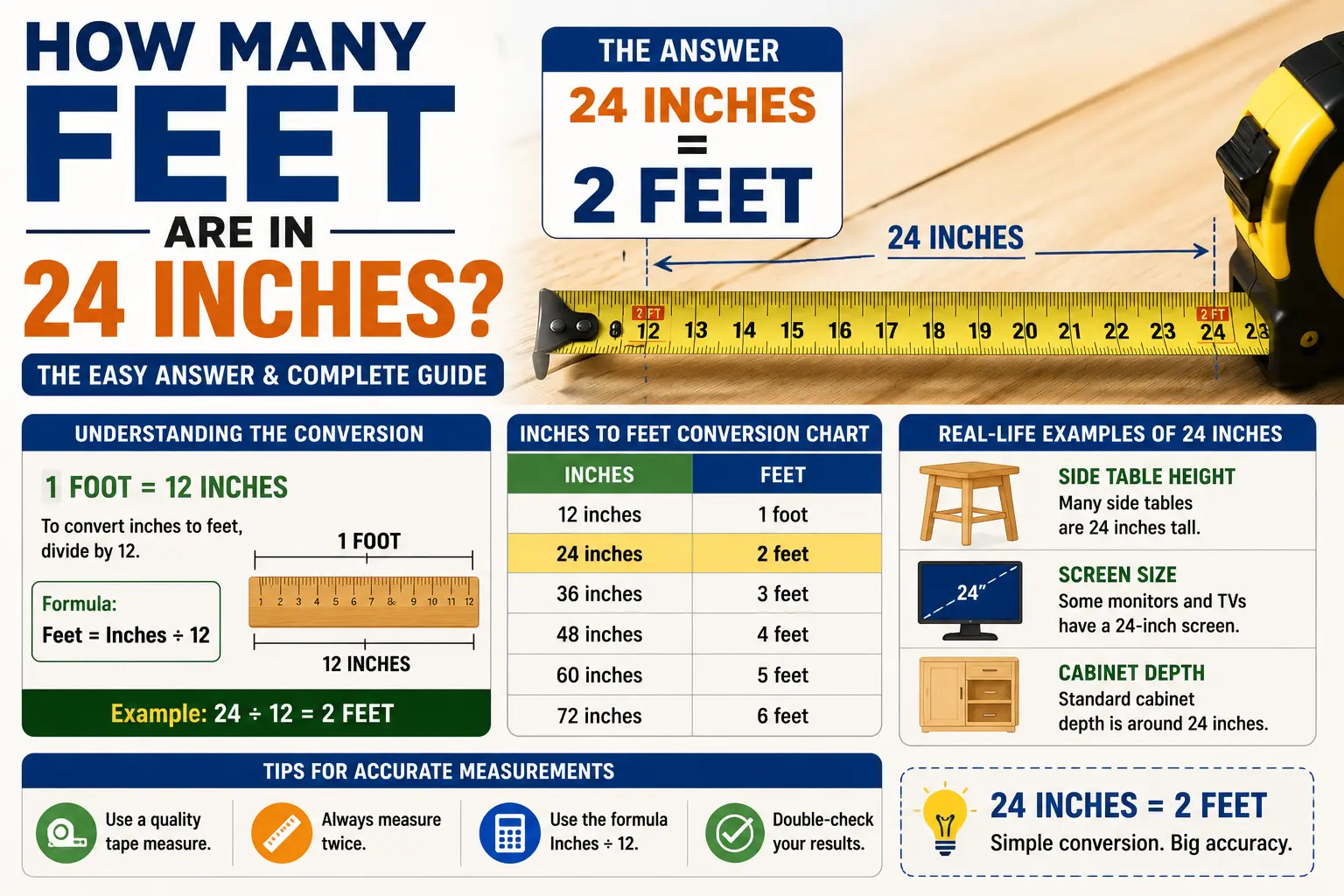
If you are wondering how many feet are in 24 inches, the simple answer is:
24 inches=2 feet
This conversion is one of the most common measurements used in daily life, construction, furniture sizing, school math, and home improvement projects.
Understanding how inches convert into feet helps with:
- Measuring furniture
- Reading tape measures
- Planning DIY projects
- Understanding room dimensions
- Construction calculations
- Shopping for appliances and TVs
In this guide, you will learn exactly how to convert inches into feet, why the formula works, and how to apply these measurements in real-life situations.
Understanding Inches and Feet
Before converting measurements, it helps to understand the difference between inches and feet.
Both are units of length used in the imperial measurement system.
What Is an Inch?
An inch is a small unit of measurement commonly used in:
- Rulers
- Tape measures
- Furniture dimensions
- Electronics sizing
One inch is equal to:
- 2.54 centimeters
Inches are often used for smaller objects and precise measurements.
What Is a Foot?
A foot is a larger unit of measurement.
One foot contains:
1 foot=12 inches
Feet are commonly used for:
- Room dimensions
- Ceiling height
- Building materials
- Human height
- Construction projects
How Many Feet Are in 24 Inches?
To convert 24 inches into feet, divide by 12 because there are 12 inches in one foot.
The formula looks like this:
1224=2
Result:
- 24 inches equals 2 feet
Quick Answer
| Inches | Feet |
|---|---|
| 24 inches | 2 feet |
This is an exact conversion with no decimals.
Simple Formula
Use this formula for any inch-to-feet conversion:
Feet=12Inches
This works because each foot contains 12 inches.
Inches to Feet Conversion Formula
Learning the formula makes conversions much easier.
Step-by-Step Method
Follow these steps:
- Take the number of inches
- Divide by 12
- The result equals feet
For 24 inches:
24÷12=2 feet
Why Divide by 12?
The imperial system defines:
- 12 inches = 1 foot
So dividing inches by 12 converts the smaller unit into the larger one.
Conversion Chart for Inches to Feet
This quick chart helps with common conversions.
| Inches | Feet |
|---|---|
| 12 inches | 1 foot |
| 18 inches | 1.5 feet |
| 24 inches | 2 feet |
| 30 inches | 2.5 feet |
| 36 inches | 3 feet |
| 48 inches | 4 feet |
| 60 inches | 5 feet |
Charts like this are useful for:
- DIY projects
- Construction work
- School assignments
- Shopping measurements
Real-Life Examples of 24 Inches
A 24-inch measurement appears in many everyday situations.
Furniture Measurements
Many furniture pieces are around 24 inches tall or wide.
Examples include:
- Coffee tables
- Counter stools
- End tables
- Small cabinets
Since 24 inches equals 2 feet, visualizing measurements becomes easier.
TV Sizes
Some smaller computer monitors and TVs measure around:
- 24 inches diagonally
However, TV measurements use diagonal screen size rather than height or width.
Construction Uses
Construction workers frequently convert inches into feet when:
- Reading blueprints
- Measuring lumber
- Installing cabinets
- Framing walls
Understanding conversions improves accuracy.
How to Convert Inches to Feet
There are several easy ways to convert measurements.
Manual Calculation
The manual method uses division.
Example:
48÷12=4 feet
This means:
- 48 inches = 4 feet
Calculator Method
You can also:
- Use a phone calculator
- Search online converters
- Use construction apps
However, basic mental math is often faster for simple numbers.
Common Inches to Feet Conversions
Here are additional helpful examples.
| Inches | Feet |
|---|---|
| 6 inches | 0.5 feet |
| 12 inches | 1 foot |
| 24 inches | 2 feet |
| 72 inches | 6 feet |
| 84 inches | 7 feet |
| 96 inches | 8 feet |
Knowing common conversions saves time during measurements.
Inches vs Feet Comparison
| Measurement Type | Best Used For |
|---|---|
| Inches | Small precise measurements |
| Feet | Larger spaces and distances |
For example:
- Furniture width may use inches
- Room size usually uses feet
Both units work together frequently.
Why Measurement Conversions Matter
Measurement conversions are important in many industries and everyday activities.
Home Improvement
DIY projects often require:
- Accurate cutting
- Material sizing
- Space planning
Mistakes in measurement conversions can waste materials and money.
Shopping
Furniture and appliances are commonly measured in inches.
Knowing equivalent feet helps visualize size better.
Construction
Builders constantly switch between:
- Inches
- Feet
- Yards
Understanding conversions improves project accuracy.
Common Mistakes When Converting Inches to Feet
Many people make simple conversion errors.
Forgetting to Divide by 12
Some beginners accidentally multiply instead of divide.
Always remember:
- Inches → feet = divide by 12
Mixing Units
Do not combine:
- Inches
- Feet
- Centimeters
without converting units properly first.
Incorrect Decimal Interpretation
For example:
- 18 inches = 1.5 feet
- Not 1 foot 8 inches
Decimals represent fractions of a foot.
Tips for Accurate Measurements
Use these tips for better measurement accuracy.
Use a Reliable Tape Measure
Quality measuring tools improve precision.
Double-Check Measurements
Measure twice before:
- Cutting wood
- Buying furniture
- Installing fixtures
Learn Common Conversions
Memorizing simple conversions speeds up projects significantly.
Examples:
- 12 inches = 1 foot
- 24 inches = 2 feet
- 36 inches = 3 feet
Feet and Inches in Construction and DIY Projects
Construction professionals constantly use feet and inches together.
Examples include:
- Wall framing
- Flooring installation
- Cabinet spacing
- Roofing measurements
A tape measure often shows:
- Feet
- Inches
- Fractional inches
Learning these units improves DIY confidence.
Fun Facts About Feet and Inches
Measurement systems have interesting history.
Origin of the Foot
The “foot” measurement originally came from the approximate length of a human foot.
Standardization
Modern measurements are now standardized internationally for consistency.
The Imperial System
The United States still commonly uses:
- Feet
- Inches
- Yards
while many countries primarily use the metric system.
Practical Uses for 24 Inches
Two feet is a very common dimension.
Examples include:
- Standard countertop depth
- Small table width
- Desk height variations
- Decorative shelf spacing
Knowing that 24 inches equals 2 feet helps visualize objects more quickly.
9. FAQs
How many feet are in 24 inches?
24 inches equals exactly 2 feet.
What formula converts inches to feet?
Divide the number of inches by 12.
Why are there 12 inches in a foot?
The imperial measurement system defines one foot as 12 inches.
Is 24 inches the same as 2 feet?
Yes. Both measurements represent the exact same length.
How do I convert inches into feet quickly?
Use this formula:
Inches ÷ 12 = Feet.
10. Conclusion
Understanding how many feet are in 24 inches is simple once you know the basic conversion formula. Since one foot equals 12 inches, dividing 24 by 12 shows that 24 inches equals exactly 2 feet.
This conversion is useful in everyday life, construction, DIY projects, shopping, and education. Whether you are measuring furniture, reading a tape measure, or planning a renovation project, knowing how to convert inches into feet helps improve accuracy and confidence. By learning common conversions and practicing simple formulas, measurement tasks become much faster and easier.
Discover more