

How Many Square Feet Are in a Cubic Foot?
Many people ask, “how many square feet are in a cubic foot?” especially when working on landscaping, flooring, concrete, or home improvement projects. The answer can seem confusing because square feet and cubic feet measure two completely different things.
A square foot measures area, while a cubic foot measures volume. Because of this, there is no single direct conversion between cubic feet and square feet unless you also know the depth or thickness.
For example:
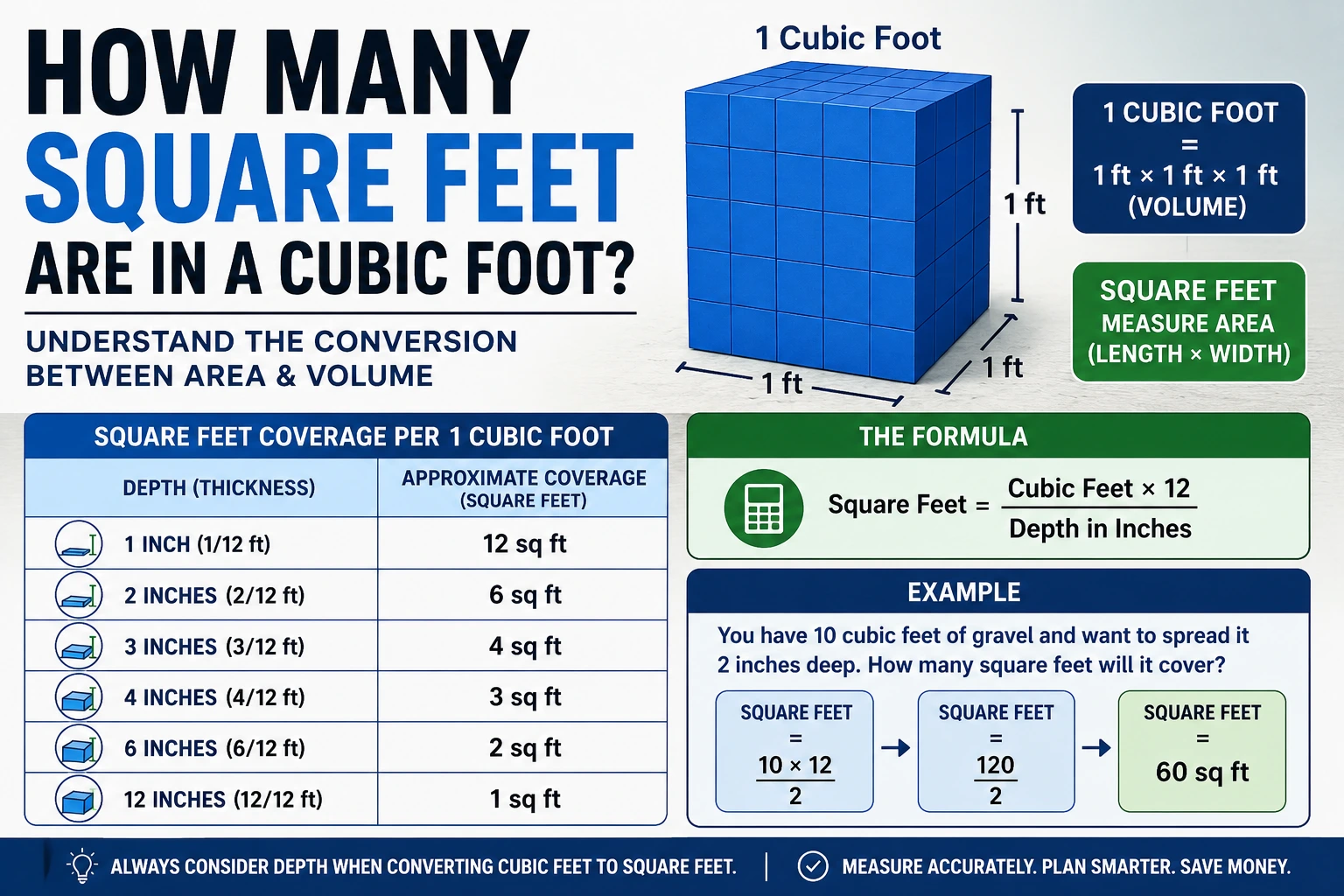
- 1 cubic foot covers 12 square feet at 1-inch depth
- 1 cubic foot covers 6 square feet at 2-inch depth
- 1 cubic foot covers 4 square feet at 3-inch depth
Understanding this relationship helps you calculate materials accurately and avoid costly mistakes during projects.
Understanding Cubic Feet and Square Feet
Before learning how many square feet are in a cubic foot, it is important to understand these measurement units.
What Is a Cubic Foot?
A cubic foot is a measurement of volume. It describes the amount of space inside a three-dimensional object.
A cubic foot equals:
1 cubic foot=1 ft×1 ft×1 ft
This means a cube measuring:
- 1 foot wide
- 1 foot long
- 1 foot high
contains exactly 1 cubic foot.
Cubic feet are commonly used for:
- Soil
- Gravel
- Concrete
- Mulch
- Storage boxes
- Refrigerators
What Is a Square Foot?
A square foot measures area instead of volume.
A square foot equals:
1 square foot=1 ft×1 ft
It measures flat surfaces such as:
- Floors
- Walls
- Rooms
- Patios
- Lawns
Key Difference Between Area and Volume
This is the most important concept to understand.
| Measurement | What It Measures |
|---|---|
| Square feet | Area (2D) |
| Cubic feet | Volume (3D) |
Square feet only include:
- Length
- Width
Cubic feet include:
- Length
- Width
- Height or depth
That extra dimension changes everything.
How Many Square Feet Are in a Cubic Foot?
The answer depends entirely on depth.
Why There Is No Single Answer
You cannot directly convert cubic feet into square feet without knowing how thick or deep the material will be spread.
For example:
- A thin layer covers more area
- A thick layer covers less area
The Importance of Depth
Imagine spreading 1 cubic foot of soil:
- Spread thinly, it covers a large area
- Spread deeply, it covers a smaller area
This is why depth matters in every conversion.
Basic Formula
The standard formula is:
Square Feet=Depth in FeetCubic Feet
This formula helps estimate material coverage accurately.
Cubic Foot to Square Feet Conversion Chart
Here is a simple chart showing how much area 1 cubic foot covers at different depths.
| Depth | Approximate Coverage |
|---|---|
| 1 inch | 12 square feet |
| 2 inches | 6 square feet |
| 3 inches | 4 square feet |
| 4 inches | 3 square feet |
| 6 inches | 2 square feet |
| 12 inches | 1 square foot |
This chart is useful for:
- Mulch calculations
- Gravel projects
- Soil spreading
- Concrete work
Coverage at 1 Inch Depth
At a depth of 1 inch:
1 cubic foot≈12 square feet at 1 inch depth
This is common for:
- Decorative mulch
- Thin gravel layers
- Light landscaping
Coverage at 2 Inches Depth
At 2 inches thick:
1 cubic foot≈6 square feet at 2 inch depth
This depth works well for:
- Garden beds
- Pathways
- Topsoil applications
Coverage at Different Thicknesses
As thickness increases:
- Coverage decreases
- More material is required
This is especially important in construction and landscaping.
Formula to Convert Cubic Feet to Square Feet
You can easily calculate coverage using a few simple steps.
Step-by-Step Formula
The formula is:
Square Feet=Depth in InchesCubic Feet×12
Example Calculation
Suppose you have:
- 10 cubic feet of mulch
- Depth = 2 inches
Calculation:
210×12=60 square feet
So 10 cubic feet covers about 60 square feet at 2-inch depth.
Common Measurement Scenarios
| Material | Common Depth |
|---|---|
| Mulch | 2–3 inches |
| Gravel | 2–4 inches |
| Topsoil | 4–6 inches |
| Concrete | 4 inches |
Always use the correct depth for accurate estimates.
Real-Life Examples of Cubic Foot Coverage
Understanding practical applications makes conversions easier.
Soil and Mulch
Mulch is usually spread 2–3 inches deep.
If you buy:
- 5 cubic feet of mulch
- Spread at 2 inches
Coverage becomes approximately:
25×12=30 square feet
Concrete Projects
Concrete slabs require volume calculations.
For example:
- Patio = 100 square feet
- Depth = 4 inches
You first convert depth into feet and calculate total cubic feet needed.
Flooring Materials
Some flooring underlayment materials use cubic measurements for packaging and square feet for coverage.
Understanding conversions helps prevent shortages.
Storage Spaces
Storage units and shipping containers often use cubic feet because they measure three-dimensional space.
Common Mistakes When Converting Cubic Feet to Square Feet
Many people make avoidable errors during calculations.
Ignoring Depth
This is the biggest mistake.
Without depth, cubic feet cannot convert into square feet properly.
Mixing Units
Some people mix:
- Inches
- Feet
- Yards
Always use consistent units.
Wrong Area Calculations
Incorrect room measurements lead to poor material estimates.
Double-check:
- Length
- Width
- Depth
before ordering materials.
Expert Tips for Accurate Measurements
Professional contractors follow several best practices.
Measure Depth Carefully
Even a small depth difference changes coverage significantly.
For example:
- 1 inch doubles the coverage compared to 2 inches
Use Consistent Units
Convert everything into:
- Feet
or - Inches
before calculating.
Add Extra Material
Most experts recommend ordering:
- 5–10% extra material
This covers:
- Waste
- Spillage
- Uneven surfaces
Cubic Feet vs Square Feet Comparison
Here is a simple comparison table.
| Feature | Square Feet | Cubic Feet |
|---|---|---|
| Measures | Area | Volume |
| Dimensions Used | Length + Width | Length + Width + Height |
| Used For | Floors, walls | Soil, gravel, storage |
| Unit Type | 2D | 3D |
Understanding the difference prevents confusion.
Why These Measurements Matter
These calculations are important for:
- Landscaping
- Home renovations
- Construction
- Gardening
- Interior design
Incorrect estimates can:
- Waste money
- Delay projects
- Cause material shortages
Accurate conversions save both time and effort.
Practical Material Coverage Examples
| Material | 1 Cubic Foot Coverage |
|---|---|
| Mulch at 2 inches | 6 sq ft |
| Gravel at 3 inches | 4 sq ft |
| Soil at 1 inch | 12 sq ft |
| Sand at 4 inches | 3 sq ft |
These estimates help homeowners plan projects more efficiently.
Benefits of Understanding Cubic Foot Conversions
Learning these measurements provides several advantages.
Better Budget Planning
You can buy the correct amount of material.
Less Waste
Accurate estimates reduce leftover materials.
Faster Projects
Proper planning avoids extra supply trips.
Improved Accuracy
Correct calculations create more professional results.
FAQs
1. How many square feet are in 1 cubic foot?
It depends on the depth. At 1-inch depth, 1 cubic foot covers about 12 square feet.
2. Can cubic feet be directly converted to square feet?
No. You must know the depth or thickness before converting cubic feet into square feet.
3. How many square feet does 2 cubic feet cover?
At 2-inch depth:
22×12=12 square feet
So 2 cubic feet covers about 12 square feet.
4. Why are cubic feet and square feet different?
Square feet measure area, while cubic feet measure volume using length, width, and height.
5. What industries use cubic feet calculations?
Construction, landscaping, gardening, shipping, storage, and interior design commonly use cubic feet measurements.
Conclusion
Understanding how many square feet are in a cubic foot becomes much easier once you know the difference between area and volume. Since cubic feet measure three-dimensional space and square feet measure flat surfaces, the conversion always depends on depth.
For example:
- 1 cubic foot covers about 12 square feet at 1-inch depth
- 6 square feet at 2-inch depth
- 4 square feet at 3-inch depth
These calculations are extremely useful for landscaping, concrete work, gardening, flooring, and construction projects. By measuring carefully, using the correct formulas, and accounting for depth, you can estimate materials accurately and avoid costly mistakes.
Whether you are spreading mulch, pouring concrete, or planning a home improvement project, understanding cubic feet and square feet conversions helps you work smarter and more efficiently.
Discover More:
1How Many Feet Between Telephone Poles?