

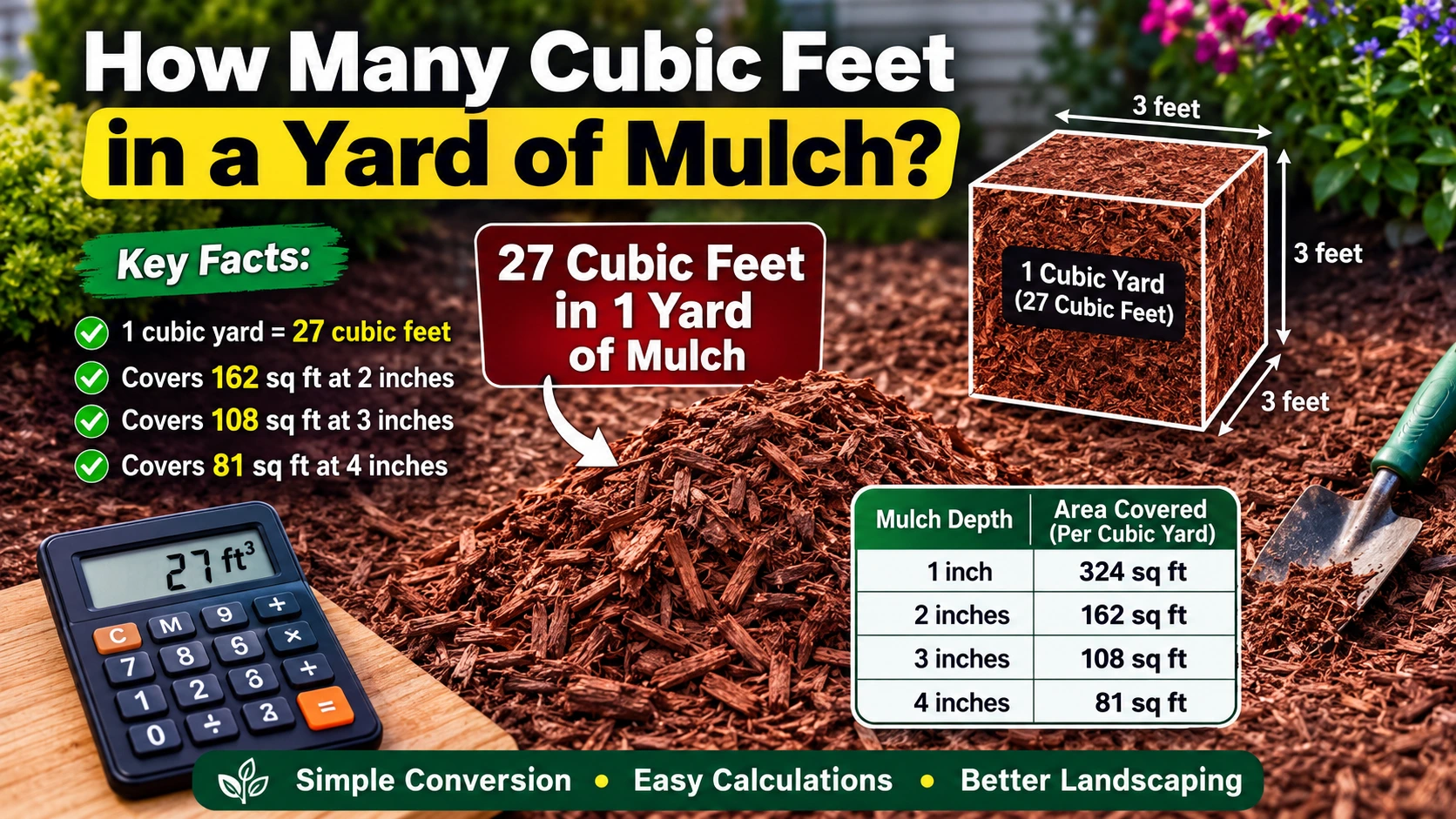
If you are planning a landscaping project, one of the first questions you may have is how many cubic feet in yard of mulch. The answer is simple: one cubic yard of mulch contains 27 cubic feet.
This conversion is important because mulch is commonly sold by the cubic yard when purchased in bulk, while bagged mulch is usually sold by the cubic foot. Knowing the relationship between cubic yards and cubic feet makes it much easier to estimate how much material you need.
For example, if one bag contains 2 cubic feet of mulch, you would need 13.5 bags to equal one cubic yard. Since you cannot normally buy half a bag, you would purchase 14 bags to slightly exceed one cubic yard.
However, knowing the conversion is only the beginning. You also need to consider the size of your garden area and the depth of mulch you want to apply. This guide explains how to calculate your mulch requirements accurately.
How Many Cubic Feet in Yard of Mulch?
There are exactly 27 cubic feet in one cubic yard of mulch.
The calculation comes from the dimensions of a cubic yard:
1 yard × 1 yard × 1 yard = 1 cubic yard
Since one yard equals 3 feet:
3 feet × 3 feet × 3 feet = 27 cubic feet
Therefore:
| Cubic Yards | Cubic Feet |
| 1 | 27 |
| 2 | 54 |
| 3 | 81 |
| 4 | 108 |
| 5 | 135 |
| 6 | 162 |
| 10 | 270 |
This conversion applies to mulch as well as other materials measured by volume.
The weight of mulch can vary considerably depending on the type of mulch and its moisture content. However, the volume remains the same. One cubic yard always represents 27 cubic feet.
What Is a Cubic Yard of Mulch?
A cubic yard is a measurement of volume.
Imagine a box that is 3 feet long, 3 feet wide, and 3 feet high. The total space inside that box is one cubic yard.
For landscaping, suppliers use cubic yards because bulk materials such as mulch, soil, compost, and gravel are often purchased in large quantities.
A cubic yard does not tell you the weight of the mulch. Different mulch materials can have different weights.
For example, dry wood mulch may weigh considerably less than wet mulch. Fresh mulch can also contain more moisture, which increases its weight.
Therefore, when ordering mulch, volume is usually more useful than weight for determining how much area the material will cover.
How to Calculate Cubic Feet of Mulch
Calculating the amount of mulch you need becomes easy when you know three measurements:
• Length of the area
• Width of the area
• Desired mulch depth
For a rectangular garden bed, the basic calculation is:
Length × Width × Depth = Cubic feet
The important part is making sure all measurements use the same unit.
If your length and width are measured in feet, your depth should also be converted into feet.
Measure the Length
Start by measuring the longest side of your garden bed.
For example, suppose your garden bed is 20 feet long.
Measure the Width
Next, measure the width.
Suppose the garden bed is 10 feet wide.
You now have an area of:
20 × 10 = 200 square feet
Choose the Mulch Depth
Now decide how deep you want the mulch to be.
Suppose you want 3 inches of mulch.
Convert inches to feet:
3 ÷ 12 = 0.25 feet
Convert the Measurements
Multiply the area by the depth:
200 × 0.25 = 50 cubic feet
You need approximately 50 cubic feet of mulch.
Since one cubic yard contains 27 cubic feet:
50 ÷ 27 = 1.85 cubic yards
You would therefore need approximately 1.9 cubic yards of mulch. When ordering bulk mulch, you may choose 2 cubic yards to allow for minor measurement differences and settling.
How Much Area Does One Cubic Yard of Mulch Cover?
The coverage of one cubic yard depends on the depth at which you spread the mulch.
One cubic yard contains 27 cubic feet, but that volume can cover different amounts of surface area.
| Mulch Depth | Approximate Coverage From 1 Cubic Yard |
| 1 inch | 324 square feet |
| 2 inches | 162 square feet |
| 3 inches | 108 square feet |
| 4 inches | 81 square feet |
| 5 inches | 65 square feet |
| 6 inches | 54 square feet |
These figures assume the mulch is spread evenly.
The deeper you spread the mulch, the smaller the surface area one cubic yard can cover.
For example, one cubic yard spread at 2 inches covers about 162 square feet. The same amount spread at 4 inches covers only about 81 square feet.
One Inch of Mulch
At a depth of 1 inch, one cubic yard can cover approximately 324 square feet.
This depth may be useful for a very light decorative layer, but it may not provide the same weed suppression and moisture protection as a deeper application.
Two Inches of Mulch
At 2 inches, one cubic yard covers approximately 162 square feet.
This can be suitable for areas that already have mulch and only need a lighter refresh.
Three Inches of Mulch
At 3 inches, one cubic yard covers approximately 108 square feet.
This is a common depth for many landscaping applications because it provides a useful layer without requiring excessive material.
Four Inches of Mulch
At 4 inches, one cubic yard covers approximately 81 square feet.
A deeper layer may be appropriate in some situations, but placing too much mulch around plants and tree trunks can create problems.
How Many Bags of Mulch Are in a Cubic Yard?
The answer depends on the size of the bags.
Common bag sizes include 1 cubic foot, 1.5 cubic feet, and 2 cubic feet.
Since one cubic yard equals 27 cubic feet, you can divide 27 by the size of the bag.
| Bag Size | Bags Needed for 1 Cubic Yard |
| 1 cubic foot | 27 bags |
| 1.5 cubic feet | 18 bags |
| 2 cubic feet | 13.5 bags |
| 2.5 cubic feet | 10.8 bags |
| 3 cubic feet | 9 bags |
If you use 2 cubic foot bags, you need 13.5 bags to equal exactly one cubic yard.
In practical terms, you would purchase 14 bags.
Always check the volume printed on the bag because bag sizes can differ between products.
Mulch Coverage Chart
A coverage chart can make planning easier.
| Mulch Amount | At 2 Inches | At 3 Inches | At 4 Inches |
| 1 cubic yard | 162 sq ft | 108 sq ft | 81 sq ft |
| 2 cubic yards | 324 sq ft | 216 sq ft | 162 sq ft |
| 3 cubic yards | 486 sq ft | 324 sq ft | 243 sq ft |
| 4 cubic yards | 648 sq ft | 432 sq ft | 324 sq ft |
| 5 cubic yards | 810 sq ft | 540 sq ft | 405 sq ft |
These are useful planning estimates. Actual coverage can vary slightly because mulch particles differ in size and shape, and the material may settle after installation.
Real World Mulch Calculation Examples
Small Flower Bed
Imagine a flower bed measuring 10 feet by 8 feet.
The surface area is:
10 × 8 = 80 square feet
You want to apply 3 inches of mulch.
Three inches equals 0.25 feet.
Now calculate:
80 × 0.25 = 20 cubic feet
Convert cubic feet into cubic yards:
20 ÷ 27 = 0.74 cubic yards
You need approximately 0.75 cubic yards.
If buying 2 cubic foot bags:
20 ÷ 2 = 10 bags
So, approximately 10 bags would provide the required volume.
Medium Garden Bed
Suppose your garden bed is 20 feet by 12 feet.
The area is:
20 × 12 = 240 square feet
At a depth of 3 inches:
240 × 0.25 = 60 cubic feet
Convert to cubic yards:
60 ÷ 27 = 2.22 cubic yards
You would typically order around 2.25 to 2.5 cubic yards of bulk mulch.
Large Landscaping Area
Suppose you have an area measuring 50 feet by 30 feet.
The total area is:
50 × 30 = 1,500 square feet
At 3 inches deep:
1,500 × 0.25 = 375 cubic feet
Now divide by 27:
375 ÷ 27 = 13.89 cubic yards
You would need approximately 14 cubic yards of mulch.
For a project this size, bulk mulch is usually much more practical than buying individual bags.
How Deep Should Mulch Be?
The ideal mulch depth depends on the purpose of the mulch and the landscape area.
A depth of around 2 to 4 inches is commonly used for garden beds.
Consider the following:
• Around 2 inches can work well for refreshing an existing mulch layer.
• Around 3 inches provides a substantial layer for many garden beds.
• Around 4 inches may be suitable for some larger landscape areas.
Avoid creating very thick piles around plant stems and tree trunks. Excessive mulch can hold too much moisture against plant tissue and may contribute to pest or disease problems.
When adding new mulch, check the existing layer first. You may need less material than expected if there is already sufficient mulch on the ground.
Bulk Mulch vs Bagged Mulch
Both purchasing methods have advantages.
| Feature | Bulk Mulch | Bagged Mulch |
| Cost per Volume | Often lower for large projects | Often higher |
| Convenience | Good for large areas | Good for small areas |
| Transportation | Usually delivered | Easy to carry individually |
| Storage | Requires open space | Easier to store |
| Large Projects | Excellent choice | Labor intensive |
| Small Projects | May be excessive | Convenient |
Bulk mulch is generally practical when you need several cubic yards.
Bagged mulch can be easier when you only need a small amount or want a specific product that is not available in bulk.
Common Mulch Calculation Mistakes
One of the most common mistakes is confusing square feet with cubic feet.
Square feet measure surface area. Cubic feet measure volume.
Another mistake is forgetting to convert mulch depth from inches into feet.
For example, 3 inches is not 3 feet. You must divide 3 by 12 to get 0.25 feet.
Other common mistakes include:
• Measuring an irregular area as a perfect rectangle
• Forgetting existing mulch
• Ordering based only on bag count
• Ignoring the desired mulch depth
• Assuming every mulch product has the same bag size
• Forgetting that mulch can settle after installation
• Ordering too little material for large projects
For irregular garden beds, divide the space into smaller rectangles or other simple shapes and calculate each section separately.
Expert Tips for Buying Mulch
Measure the area before visiting the supplier.
Determine the depth you want before calculating the quantity.
Check whether the supplier sells mulch by cubic yard or cubic foot.
If buying bags, confirm the exact volume printed on each bag.
For large landscaping projects, compare the total cost of bulk delivery with the cost of individual bags.
It is also smart to order a small amount more than the exact mathematical calculation when practical. Minor differences in measurement, uneven ground, settling, and spillage can affect the final coverage.
However, avoid ordering a large excess because unused mulch can take up considerable storage space.
Frequently Asked Questions
How many cubic feet are in a yard of mulch?
There are exactly 27 cubic feet in one cubic yard of mulch. This is because one yard equals 3 feet, and a cubic yard measures 3 feet by 3 feet by 3 feet.
How many bags of mulch make a cubic yard?
The number depends on the bag size. If each bag contains 2 cubic feet, you need 13.5 bags to equal one cubic yard. In practice, you would purchase 14 bags.
How much area does one cubic yard of mulch cover?
One cubic yard can cover approximately 162 square feet at 2 inches deep, 108 square feet at 3 inches deep, or 81 square feet at 4 inches deep.
How deep should mulch be in a garden bed?
A mulch depth of about 2 to 4 inches is commonly suitable for many garden beds. The best depth depends on the type of mulch, plants, soil conditions, and purpose of the mulch.
How do I calculate how many cubic yards of mulch I need?
Measure the length and width of the area in feet. Multiply them to find square feet. Convert your desired mulch depth from inches to feet, multiply the area by the depth, and divide the resulting cubic feet by 27.
Conclusion
Knowing how many cubic feet in yard of mulch makes it much easier to plan a landscaping project and avoid buying too much or too little material. The key conversion is simple: one cubic yard contains 27 cubic feet.
From there, you can calculate how much mulch your garden or landscape area needs based on its square footage and desired depth.
For example, one cubic yard covers about 108 square feet when spread 3 inches deep. At 2 inches deep, it covers about 162 square feet, while at 4 inches deep, it covers about 81 square feet.
For small projects, bagged mulch can be convenient. For larger areas, buying mulch by the cubic yard is often more practical and economical.
Before ordering, measure your space carefully, choose the right depth, check the bag size if purchasing packaged mulch, and allow for small differences caused by settling and uneven ground. With these calculations, you can estimate your mulch needs confidently and plan your landscaping project more efficiently.
Discover more