

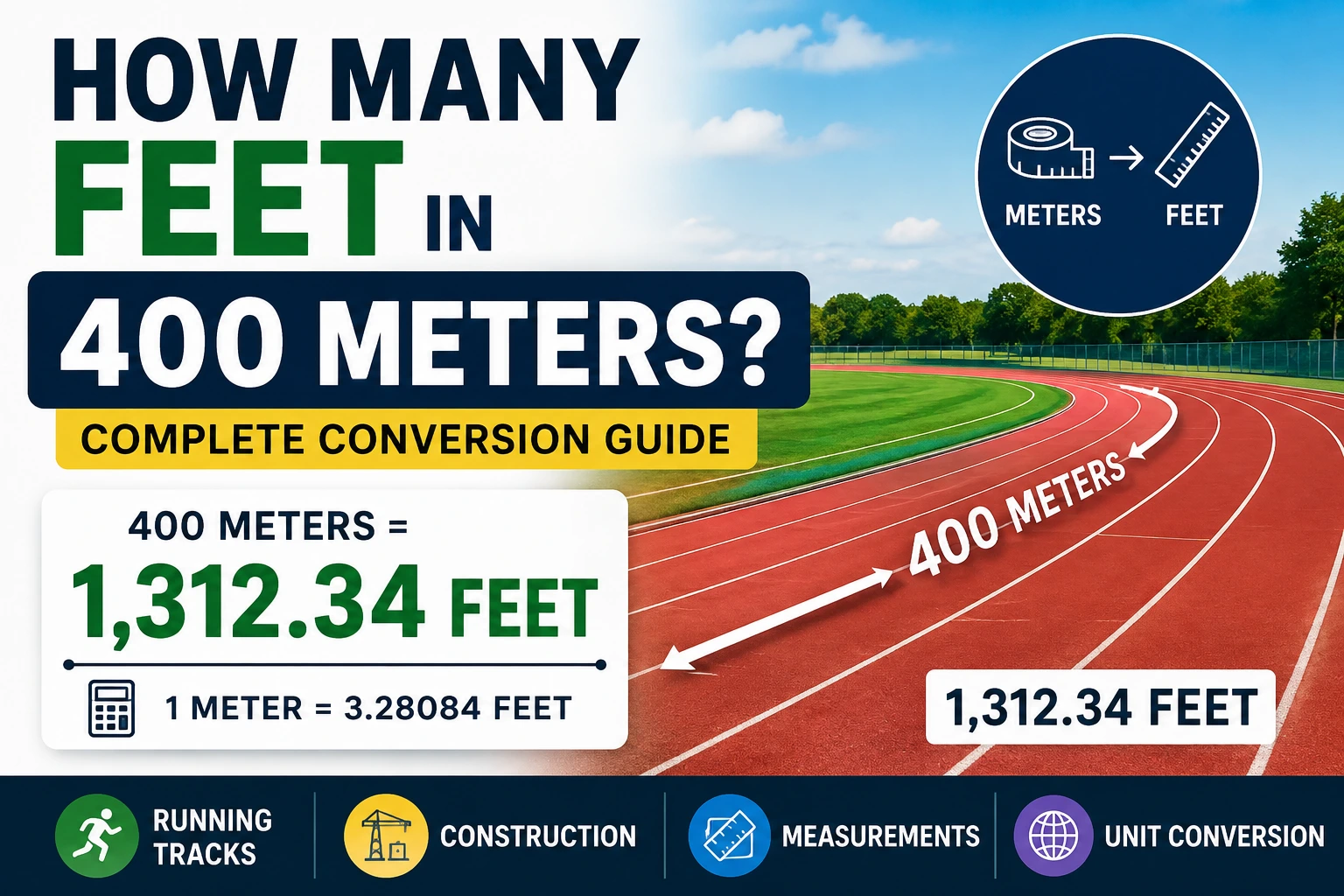
If you are wondering how many feet in 400 meters, the simple answer is 1,312.34 feet. Whether you are measuring a running track, planning a construction project, studying for school, or converting units for everyday use, knowing this conversion can save time and improve accuracy.
The metric system and the imperial system are both widely used around the world. Since many countries use meters while others commonly use feet, converting between these two units is a practical skill. This guide explains the exact conversion, shows the formula, provides useful examples, and helps you understand why the conversion matters in real life.
How Many Feet in 400 Meters
The exact conversion is:
| Meters | Feet |
|---|---|
| 400 meters | 1,312.34 feet |
This value comes from the standard conversion factor:
1 meter = 3.28084 feet
To calculate the answer:
400 × 3.28084 = 1,312.336 feet
Rounded to two decimal places:
400 meters = 1,312.34 feet
For most everyday situations, rounding to 1,312 feet is acceptable. However, professional work such as engineering, surveying, and architecture often requires the more precise figure of 1,312.34 feet.
Understanding Meters and Feet
Before learning the conversion process, it helps to understand what each unit measures.
What Is a Meter
A meter is the standard unit of length in the International System of Units. Most countries use meters for measuring distance, height, road lengths, buildings, and sporting events.
You will commonly see meters used for:
- Running races
- Road signs
- Building dimensions
- Swimming pools
- Scientific measurements
Because the metric system is based on multiples of ten, calculations are usually straightforward.
What Is a Foot
A foot is a unit of length used mainly in the United States and a few other countries that follow the imperial measurement system.
One foot contains:
- 12 inches
- Approximately 30.48 centimeters
Feet are commonly used when measuring:
- Human height
- Room dimensions
- Property sizes
- Construction materials
- Sports fields
Since the metric and imperial systems use different units, conversion is often necessary when working with international measurements.
How to Convert 400 Meters to Feet
Learning the conversion formula makes it easy to convert any number of meters into feet.
The Conversion Formula
Use this formula:
Feet = Meters × 3.28084
This works because every meter contains approximately 3.28084 feet.
Once you remember this number, converting becomes quick and simple.
Step by Step Calculation
Let’s convert 400 meters.
Step 1
Write the formula.
Feet = Meters × 3.28084
Step 2
Insert the value.
Feet = 400 × 3.28084
Step 3
Multiply.
Feet = 1,312.336
Step 4
Round the result if needed.
400 meters = 1,312.34 feet
This same method works for any measurement in meters.
Conversion Table for Common Meter Values
Instead of calculating every time, you can use this quick reference table.
| Meters | Feet |
|---|---|
| 10 | 32.81 |
| 20 | 65.62 |
| 50 | 164.04 |
| 100 | 328.08 |
| 150 | 492.13 |
| 200 | 656.17 |
| 250 | 820.21 |
| 300 | 984.25 |
| 350 | 1,148.29 |
| 400 | 1,312.34 |
| 450 | 1,476.38 |
| 500 | 1,640.42 |
This chart is especially useful for students, athletes, engineers, and anyone who frequently converts measurements between metric and imperial systems.
Real Life Examples of 400 Meters in Feet
Knowing how many feet in 400 meters is useful in many everyday situations. Although the exact answer is 1,312.34 feet, understanding what this distance looks like in real life makes it easier to visualize and use correctly.
Here are some common examples where this conversion is helpful.
Running Tracks
The most familiar example of a 400 meter distance is a standard outdoor running track. One complete lap around the inside lane measures 400 meters, which equals 1,312.34 feet.
Athletes, coaches, and fitness enthusiasts often convert this distance when using training plans created in countries that use the imperial system.
For example:
- One lap around a standard track is 400 meters
- One lap is also 1,312.34 feet
- Two laps equal 800 meters or 2,624.67 feet
- Four laps equal 1,600 meters or 5,249.34 feet
Understanding both measurements helps runners compare workouts across different countries and training programs.
Construction Projects
Construction professionals frequently work with measurements from both metric and imperial systems.
For example, if a construction drawing specifies a wall, pipeline, or fence length of 400 meters, contractors working with feet will need to know that the distance is 1,312.34 feet.
Accurate conversions help with:
- Material estimation
- Property planning
- Road construction
- Utility installation
- Site surveying
Even a small conversion error can become expensive on large projects.
Sports Fields
Many sports venues use different measurement systems depending on the country.
Knowing that 400 meters equals 1,312.34 feet helps when comparing:
- Training grounds
- Athletic facilities
- Stadium dimensions
- Practice courses
- Outdoor fitness tracks
Sports coaches often convert distances to create consistent training sessions for international athletes.
Why Accurate Measurement Conversion Matters
Measurement conversions may seem simple, but precision is important in many professions and everyday activities.
Here are some reasons why accurate conversion matters.
Education
Students studying mathematics, science, or physics often solve questions involving metric and imperial units. Learning the correct conversion formula improves accuracy during exams and assignments.
Engineering
Engineers regularly work with international specifications. Converting measurements correctly ensures equipment fits together and projects remain safe.
Architecture
Architects often receive building plans prepared in different unit systems. Accurate conversions prevent costly design mistakes.
Travel
Travelers may encounter road signs measured in meters while using maps or navigation systems that display distances in feet or miles.
Sports and Fitness
Running distances, cycling routes, and training programs are often published using different measurement systems. Understanding conversions helps athletes follow their plans correctly.
How to Convert Other Meter Values into Feet
Once you know the conversion factor, converting other distances becomes very easy.
Simply multiply the number of meters by 3.28084.
Here are a few examples.
| Meters | Calculation | Feet |
|---|---|---|
| 1 | 1 × 3.28084 | 3.28 |
| 5 | 5 × 3.28084 | 16.40 |
| 25 | 25 × 3.28084 | 82.02 |
| 75 | 75 × 3.28084 | 246.06 |
| 100 | 100 × 3.28084 | 328.08 |
| 250 | 250 × 3.28084 | 820.21 |
| 400 | 400 × 3.28084 | 1,312.34 |
After practicing a few examples, you can estimate conversions quickly without always using a calculator.
Metric System Versus Imperial System
Many people wonder why two different measurement systems still exist.
The metric system is used by most countries because it is based on powers of ten, making calculations straightforward.
The imperial system, which includes feet and inches, remains common in the United States and is still used in some industries worldwide.
Here is a quick comparison.
| Metric System | Imperial System |
|---|---|
| Meter | Foot |
| Kilometer | Mile |
| Centimeter | Inch |
| Gram | Ounce |
| Kilogram | Pound |
Understanding both systems makes it easier to communicate measurements internationally.
Common Mistakes When Converting Meters to Feet
Although converting meters into feet is simple, mistakes still happen. Being aware of these common errors can help you avoid inaccurate results.
Using the Wrong Conversion Factor
Some people round 1 meter to 3.3 feet for convenience. While this works for rough estimates, it can create noticeable errors over longer distances like 400 meters.
Always use 3.28084 when precision matters.
Forgetting to Round Correctly
The exact answer is:
400 meters = 1,312.336 feet
Rounded correctly, this becomes:
1,312.34 feet
Rounding too early in the calculation can reduce accuracy.
Confusing Feet with Yards
Feet and yards are different units.
- 1 yard = 3 feet
- 400 meters is 1,312.34 feet
- 400 meters is approximately 437.45 yards
Mixing these units can lead to incorrect measurements.
Multiplying Instead of Dividing in Reverse Conversions
When converting meters to feet, multiply by 3.28084.
When converting feet back to meters, divide by 3.28084.
Remembering this simple rule helps prevent calculation errors.
Quick Tips for Remembering the Conversion
You do not always need to memorize long formulas. These simple tips can help.
- Remember that 1 meter is a little more than 3 feet
- Use 3.28084 for accurate calculations
- Think of a standard running track when you hear 400 meters
- Remember that one lap around the track equals 1,312.34 feet
- Save a conversion chart on your phone for quick reference
These shortcuts make everyday conversions much faster without sacrificing accuracy.
Practical Uses of Knowing How Many Feet in 400 Meters
Understanding how many feet in 400 meters is more useful than many people realize. Whether you are studying, working, or exercising, this conversion can help you make better decisions and avoid mistakes.
Here are some practical situations where this knowledge is valuable.
Planning Outdoor Activities
If you are organizing a charity walk, fitness challenge, or school sports event, converting distances ensures everyone understands the course regardless of the measurement system they use.
Measuring Property
Land surveyors, real estate professionals, and homeowners often convert measurements when reviewing property maps or construction plans prepared in different countries.
DIY Home Projects
If you are building a fence, laying a pathway, or measuring a large backyard, converting 400 meters to 1,312.34 feet helps when your measuring tools use feet instead of meters.
Academic Learning
Students frequently encounter unit conversion questions in mathematics, physics, geography, and engineering courses. Knowing the correct formula improves both speed and accuracy during exams.
International Communication
Businesses that work with international clients often exchange drawings and specifications in different measurement systems. Understanding conversions reduces confusion and helps projects stay on schedule.
Quick Conversion Summary
The table below provides a quick overview of the most important information.
| Measurement | Value |
|---|---|
| 1 meter | 3.28084 feet |
| 100 meters | 328.08 feet |
| 200 meters | 656.17 feet |
| 300 meters | 984.25 feet |
| 400 meters | 1,312.34 feet |
| 500 meters | 1,640.42 feet |
Keep this table handy whenever you need a fast and reliable conversion.
Final Answer
If someone asks, how many feet in 400 meters, the precise answer is:
400 meters = 1,312.34 feet
For everyday use, you can round this to 1,312 feet, but for engineering, surveying, architecture, and scientific work, it is best to use the exact value of 1,312.34 feet.
1: How many feet are exactly in 400 meters?
There are 1,312.34 feet in 400 meters. This result is calculated by multiplying 400 by the standard conversion factor of 3.28084 feet per meter.
2: Is 400 meters equal to a quarter mile?
No. A quarter mile is approximately 402.34 meters, making it slightly longer than 400 meters. The difference is about 2.34 meters, or roughly 7.68 feet.
3: Why do some people round 400 meters to 1,312 feet?
The exact conversion is 1,312.34 feet, but many people round it to 1,312 feet because the difference is very small and acceptable for everyday measurements. Professional applications should use the precise value.
4: What formula converts meters into feet?
The formula is:
Feet = Meters × 3.28084
This formula can be used for any meter measurement, whether it is 5 meters, 100 meters, or 400 meters.
5: Where is the 400 meter distance commonly used?
A distance of 400 meters is commonly used on athletic running tracks, in school sports, road planning, construction projects, engineering, surveying, and scientific measurements.
Conclusion
Knowing how many feet in 400 meters is useful for students, athletes, engineers, construction professionals, and anyone working with different measurement systems. The exact conversion is 1,312.34 feet, calculated using the standard formula of meters × 3.28084.
Understanding this conversion helps you interpret maps, complete school assignments, plan construction projects, and compare measurements used around the world. While rounding to 1,312 feet is sufficient for most everyday situations, using the exact value ensures accuracy in technical and professional work.
By remembering the simple conversion factor and practicing with a few examples, you can confidently convert meters to feet whenever the need arises. Whether you are measuring a running track, reviewing architectural plans, or solving a math problem, this knowledge makes distance conversions quick, accurate, and reliable.
Discover more