

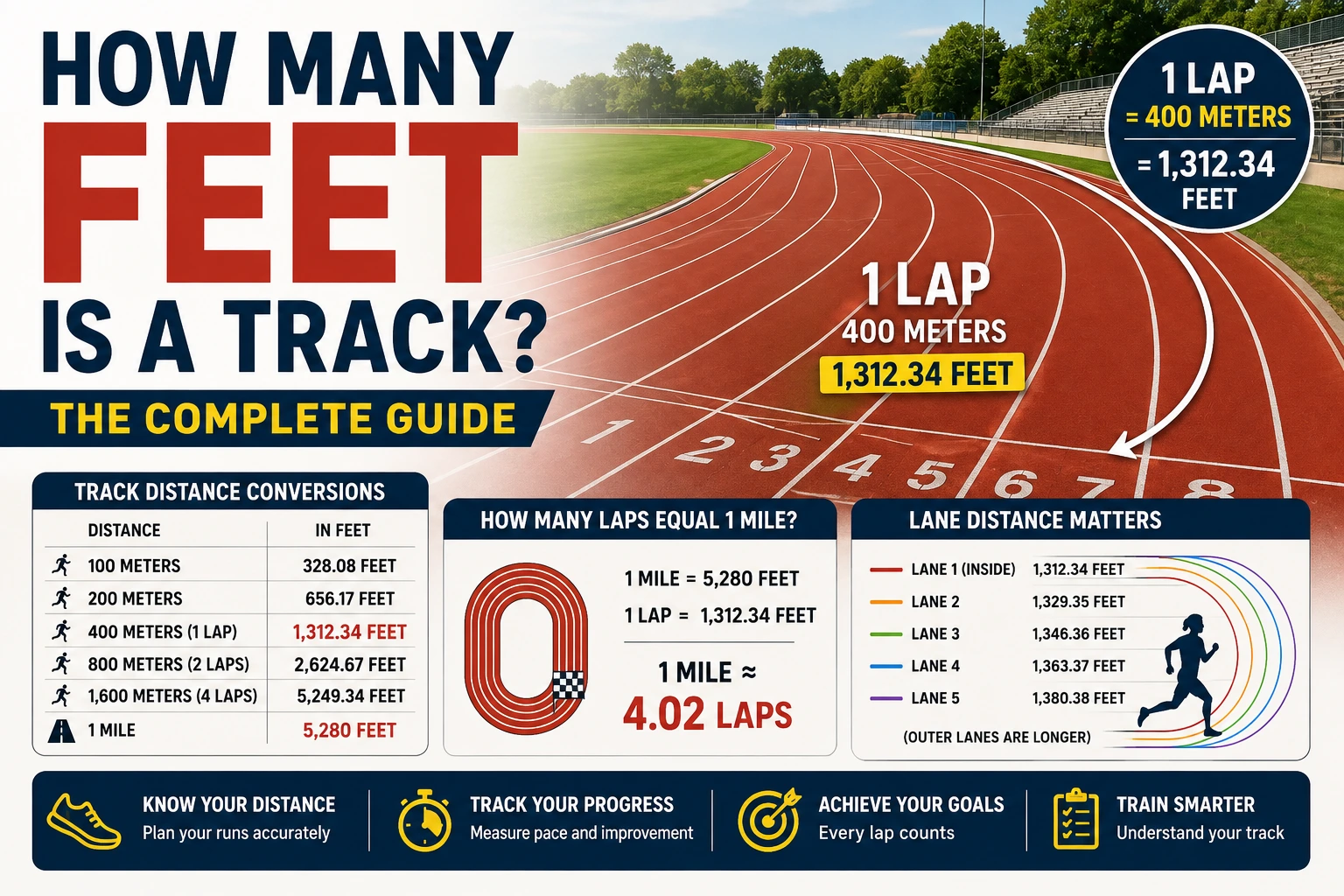
If you have ever wondered how many feet is a track, the answer depends on the type of track you mean. For a standard outdoor running track, one complete lap in the inside lane is 400 meters, which equals approximately 1,312.34 feet.
This means that running one full lap around a standard 400 meter track takes you about 1,312 feet. Four complete laps equal 1,600 meters, which is slightly shorter than a mile.
However, track distance can become more complicated when you move from the inside lane to the outside lanes. Outside lanes have a larger circumference, so runners cover more distance during a full lap.
Understanding track measurements is useful for runners, walkers, students, coaches, and anyone using a track for exercise. This guide explains the standard track length in feet, how many feet are in each common race distance, how lanes affect distance, and how track laps compare with a mile.
How Many Feet Is a Track?
A standard outdoor running track is generally 400 meters around the inside lane.
To convert meters to feet, multiply the distance in meters by 3.28084.
Therefore:
400 × 3.28084 = 1,312.336 feet
Rounded to two decimal places, one lap is approximately 1,312.34 feet.
For everyday running, you can simply remember:
One standard track lap = 400 meters = about 1,312 feet
This measurement refers to the standard distance around lane one. The distance becomes longer in the outside lanes.
How Long Is a Standard Running Track?
A standard outdoor track used for athletics is designed around a 400 meter lap.
The track usually has two straight sections and two curved sections. Together, these sections create the oval shape that runners recognize.
A typical track includes:
• Two straightaways
• Two semicircular curves
• Multiple running lanes
• Clearly marked start and finish points
• Lane markings
The exact dimensions can vary slightly depending on the facility and governing standards, but the intended race distance in the inside lane is 400 meters.
Why Standard Tracks Measure 400 Meters
The 400 meter distance is useful because it provides a convenient standard for track and field competitions.
Many common races are based directly on this distance.
For example:
• 100 meters is one quarter of a standard lap
• 200 meters is half a lap
• 400 meters is one full lap
• 800 meters is two laps
• 1,500 meters is three and three quarter laps
• 1,600 meters is four laps
The 400 meter lap therefore provides a simple foundation for many track events.
Converting 400 Meters to Feet
The exact conversion is:
400 meters = 1,312.34 feet
This means a runner completing one lap in lane one travels approximately 1,312 feet.
For quick mental calculations, 1,300 feet is a useful approximation.
How Many Feet Is One Lap Around a Track?
One lap around a standard track is approximately 1,312 feet in the inside lane.
The exact distance is about 1,312.34 feet.
Here are several useful conversions:
| Track Distance | Approximate Feet |
| 100 meters | 328.08 feet |
| 200 meters | 656.17 feet |
| 400 meters | 1,312.34 feet |
| 800 meters | 2,624.67 feet |
| 1,000 meters | 3,280.84 feet |
| 1,500 meters | 4,921.26 feet |
| 1,600 meters | 5,249.34 feet |
| 5,000 meters | 16,404.20 feet |
| 10,000 meters | 32,808.40 feet |
These conversions make it easier to understand how far you are running when your workout is measured in meters.
How Many Feet Is Each Track Lane?
One important detail is that not every lane has the same lap distance.
The inside lane has the shortest path around the track. Each lane farther from the center has a larger radius on the curves.
Because of this, a complete lap in an outside lane is longer.
For example, on a standard track with typical lane widths, lane two may require a little more distance than lane one. The difference continues as you move outward.
This is why competitive races that use staggered starting positions begin runners at different points.
Why Outside Lanes Are Longer
Imagine walking around a small circle and then walking around a much larger circle.
The larger circle requires more distance to complete one full revolution.
The same principle applies to a running track.
The inside lane follows a smaller oval. The outside lane follows a larger oval. Therefore, runners in outside lanes must travel farther during a complete lap.
Track designers account for these differences when marking race starting positions.
How Many Feet Is a Mile on a Track?
One mile equals 5,280 feet.
Since a standard track lap is 400 meters, four laps equal 1,600 meters.
Converting 1,600 meters into feet gives:
1,600 × 3.28084 = 5,249.34 feet
Therefore, four laps on a standard 400 meter track equal approximately 5,249 feet, which is about 30.66 feet shorter than one mile.
This is why people sometimes describe four laps as a mile even though the exact distance is slightly different.
A true mile is:
5,280 feet
Four standard 400 meter laps are:
5,249.34 feet
The difference is approximately 30.66 feet.
How Many Laps Equal One Mile?
A standard track has a 400 meter lap.
A mile is approximately 1,609.34 meters.
To calculate the exact number of laps:
1,609.34 ÷ 400 = 4.02335 laps
Therefore, one mile is approximately 4.02 laps on a standard 400 meter track.
In practical training, runners often use four laps as a convenient approximation for a mile.
| Distance | Standard Track Laps |
| 100 meters | 0.25 lap |
| 200 meters | 0.5 lap |
| 400 meters | 1 lap |
| 800 meters | 2 laps |
| 1,200 meters | 3 laps |
| 1,600 meters | 4 laps |
| 3,200 meters | 8 laps |
| 5,000 meters | 12.5 laps |
| 10,000 meters | 25 laps |
Track Distance Conversion Chart
If you prefer working in feet, the following chart can help.
| Distance | Feet | Approximate Track Laps |
| 100 meters | 328.08 | 0.25 |
| 200 meters | 656.17 | 0.5 |
| 400 meters | 1,312.34 | 1 |
| 800 meters | 2,624.67 | 2 |
| 1,600 meters | 5,249.34 | 4 |
| 3,200 meters | 10,498.69 | 8 |
| 5,000 meters | 16,404.20 | 12.5 |
| 10,000 meters | 32,808.40 | 25 |
This chart is especially useful when a workout plan uses meters but you are more familiar with feet.
How Track Measurements Work
A running track is not simply a large oval with random dimensions. Its shape is designed to produce specific race distances.
The measurement typically follows a designated running line within the inside lane.
This is important because measuring along the very inside edge or along the center of a lane can produce slightly different results.
Straightaways
The straight sections are the parts of the track where runners travel in a straight line.
A standard outdoor track generally has two straight sections.
These sections are connected by curves to create the complete lap.
Curves
The curves make up the remaining portion of the 400 meter lap.
The exact radius of the curves affects the overall track dimensions.
Because the outer lanes have larger curve radii, their total lap distances are longer.
Lane Width
Running tracks are divided into lanes of specific widths.
The wider the lane position from the center, the farther the runner travels around the curved sections.
This is why staggered starting lines are used for races that require runners to remain in their lanes.
Is Every Running Track the Same Length?
No.
Although the standard outdoor athletics track is designed around a 400 meter lap, not every track is exactly the same.
You may find:
• Standard outdoor 400 meter tracks
• Smaller school tracks
• Indoor tracks
• Recreational tracks
• Tracks designed for local facilities
Indoor tracks can be especially different because building space limits their size.
Some school or recreational facilities may also have unusual dimensions.
If exact distance matters, check the facility markings or official measurements rather than assuming every oval is 400 meters.
High School Track vs Standard Track
Many high school outdoor tracks use the standard 400 meter distance.
However, not every school track should automatically be assumed to be identical.
Older facilities, smaller facilities, and recreational tracks may have different measurements.
If you are training for a race, ask the facility manager or coach whether the track has been officially measured.
This is especially important when you are using track laps to calculate pace.
A small difference in lap length can affect your recorded time and distance.
How Far Do You Run During Different Track Workouts?
Track workouts often use simple distances because they are easy to measure.
100 Meter Workout
A 100 meter run is approximately 328 feet.
On a standard track, this represents one quarter of the 400 meter lap.
200 Meter Workout
A 200 meter run equals approximately 656 feet.
This is half of a standard lap.
400 Meter Workout
A 400 meter run equals approximately 1,312 feet.
This is one complete lap in lane one.
800 Meter Workout
An 800 meter run equals approximately 2,625 feet.
This represents two complete laps.
1600 Meter Workout
A 1,600 meter run equals approximately 5,249 feet.
This is four laps on a standard 400 meter track.
Because a true mile is 5,280 feet, the 1,600 meter distance is slightly shorter than a mile.
How to Calculate Track Distance in Feet
If you know the distance in meters, converting it to feet is straightforward.
Use this formula:
Meters × 3.28084 = Feet
For example, suppose you run 2,000 meters.
Multiply:
2,000 × 3.28084 = 6,561.68 feet
Therefore, 2,000 meters is approximately 6,562 feet.
You can also work backward.
To convert feet into meters, divide the number of feet by 3.28084.
For example:
6,000 ÷ 3.28084 = 1,828.8 meters
This is useful when comparing fitness distances that use different measurement systems.
Common Track Distance Mistakes
One common mistake is assuming that every track is exactly 400 meters.
Many outdoor competition tracks are 400 meters, but other tracks can have different dimensions.
Another mistake is assuming every lane has the same lap distance.
The inside lane is shorter than the outside lanes.
Other mistakes include:
• Confusing 1,600 meters with an exact mile
• Forgetting that four laps are slightly less than a mile
• Measuring from the wrong starting line
• Comparing times from tracks with different dimensions
• Assuming an indoor track has the same length as an outdoor track
• Ignoring lane differences during training
Understanding these details can make your workout calculations much more accurate.
Expert Tips for Measuring Track Distance
If you want reliable distance measurements, use the marked distances on the track whenever possible.
For a standard 400 meter track, lane one is generally the easiest reference point for basic lap calculations.
If you are training for a specific event:
• Use the correct starting mark
• Stay in the assigned lane when required
• Check whether the track is officially measured
• Use a consistent track for pace comparisons
• Remember that outside lanes cover more distance
• Use a GPS watch as an additional reference rather than the only measurement
For casual fitness, these differences may not matter much. For competitive training, even small distance differences can affect pace calculations.
Frequently Asked Questions
How many feet is a track?
A standard outdoor running track is 400 meters around lane one. That equals approximately 1,312.34 feet for one complete lap.
How many feet is one lap around a track?
One lap around a standard 400 meter track is approximately 1,312 feet in the inside lane. Outside lanes have longer lap distances because they follow larger curves.
How many feet is a 400 meter track?
A 400 meter track is approximately 1,312.34 feet around the inside lane. The conversion is based on 400 multiplied by 3.28084.
How many laps around a track is one mile?
One mile is approximately 4.02 laps on a standard 400 meter track. Four laps equal 1,600 meters, or about 5,249 feet, which is slightly shorter than a true mile of 5,280 feet.
Are all running tracks 400 meters?
No. Many standard outdoor athletics tracks are 400 meters, but indoor, recreational, school, and older tracks can have different dimensions. Check the facility measurements if exact distance matters.
Conclusion
So, how many feet is a track? For a standard outdoor running track, one complete lap in the inside lane is 400 meters, or approximately 1,312.34 feet.
This makes 100 meters about 328 feet, 200 meters about 656 feet, and 800 meters about 2,625 feet. Four laps equal 1,600 meters, which is approximately 5,249 feet and slightly shorter than a true mile of 5,280 feet.
The most important thing to remember is that track distance can vary by lane and facility. Outside lanes are longer because they travel around larger curves, while indoor and recreational tracks may have different dimensions.
For casual walking and running, the standard 400 meter track provides a convenient way to measure distance. For serious training, always use the official markings and confirm the track length so your pace and workout calculations remain accurate.
Discover more