

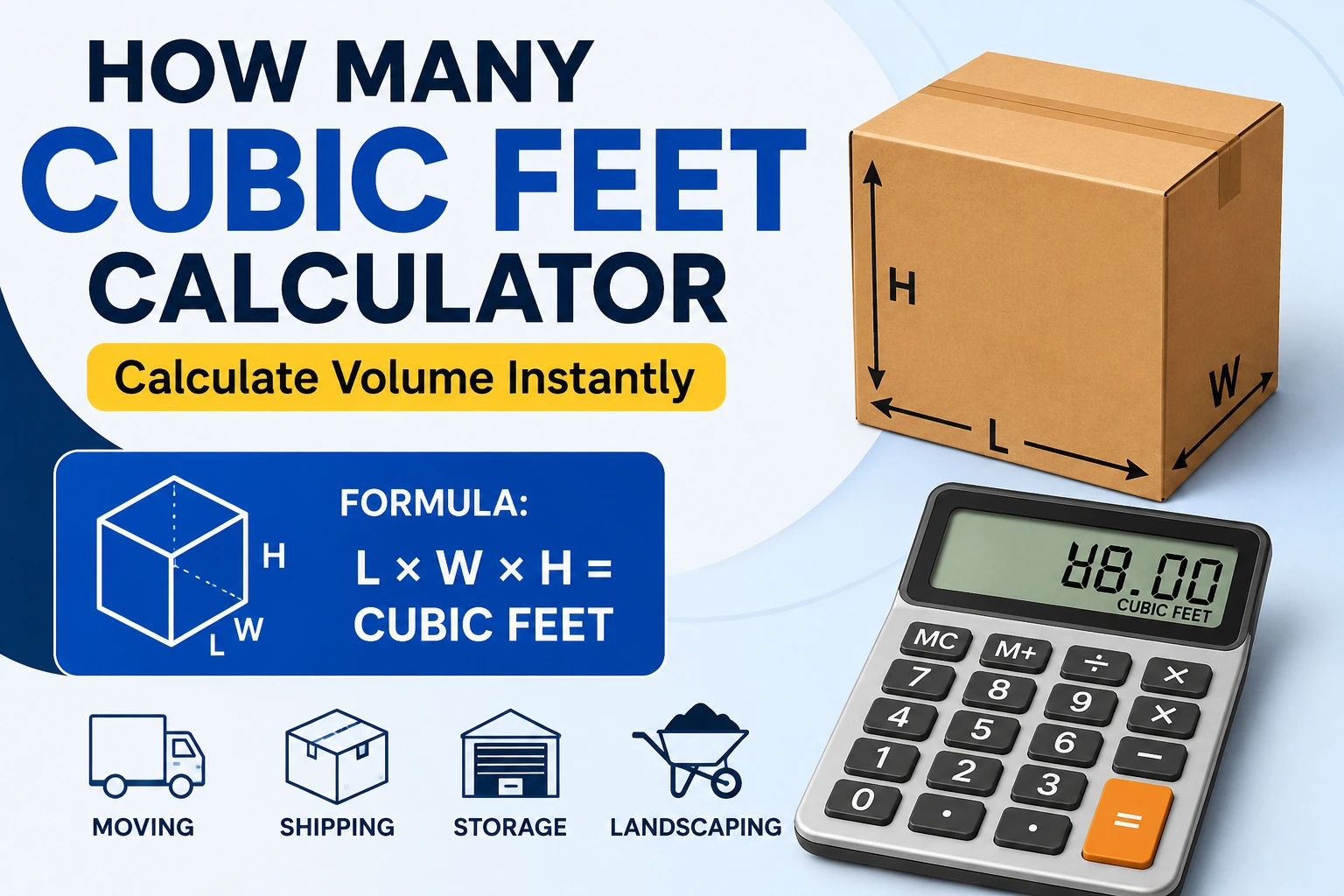
Whether you’re planning a move, buying a refrigerator, ordering mulch, or estimating storage space, knowing how to measure volume is essential. A how many cubic feet calculator helps you quickly determine the total space inside a box, room, container, or appliance using simple measurements.
Instead of guessing, you can calculate cubic feet accurately using length, width, and height. This guide explains the formulas, conversion methods, practical examples, and common mistakes so you can confidently calculate cubic feet for any project.
What Is a Cubic Foot?
A cubic foot is a unit of volume. It measures the amount of space inside a three-dimensional object.
One cubic foot equals:
- 12 inches × 12 inches × 12 inches
- 1,728 cubic inches
- Approximately 28.316 liters
Whenever you need to know how much space something occupies, cubic feet provide a standard measurement.
Examples include:
- Shipping boxes
- Storage units
- Refrigerators
- Freezers
- Washing machines
- Rooms
- Moving trucks
- Garden soil
- Gravel
- Concrete
How Many Cubic Feet Calculator Formula
The easiest way to calculate cubic feet is by multiplying three dimensions together.
Formula Using Feet
Cubic Feet = Length × Width × Height
Example:
Length = 6 ft
Width = 3 ft
Height = 2 ft
Calculation:
6 × 3 × 2 = 36 cubic feet
Formula Using Inches
If measurements are in inches:
Cubic Feet = Length × Width × Height ÷ 1,728
Example:
Length = 36 in
Width = 24 in
Height = 18 in
36 × 24 × 18 = 15,552
15,552 ÷ 1,728 = 9 cubic feet
Formula Using Centimeters
If measurements are in centimeters:
Cubic Feet = Length × Width × Height ÷ 28,316.85
Example:
120 × 80 × 60
= 576,000
576,000 ÷ 28,316.85
≈ 20.34 cubic feet
How to Calculate Cubic Feet Step by Step
A how many cubic feet calculator follows these simple steps.
Step 1
Measure the length.
Step 2
Measure the width.
Step 3
Measure the height.
Step 4
Ensure all measurements use the same unit.
Step 5
Multiply all three dimensions.
Step 6
Convert to cubic feet if needed.
That’s it!
Cubic Feet Conversion Charts
Inches to Cubic Feet
| Cubic Inches | Cubic Feet |
|---|---|
| 1,728 | 1 cu ft |
| 3,456 | 2 cu ft |
| 5,184 | 3 cu ft |
| 8,640 | 5 cu ft |
| 17,280 | 10 cu ft |
| 34,560 | 20 cu ft |
Cubic Feet to Cubic Yards
| Cubic Feet | Cubic Yards |
|---|---|
| 27 | 1 |
| 54 | 2 |
| 81 | 3 |
| 108 | 4 |
| 135 | 5 |
Cubic Feet to Liters
| Cubic Feet | Liters |
|---|---|
| 1 | 28.32 |
| 5 | 141.6 |
| 10 | 283.2 |
| 20 | 566.3 |
| 30 | 849.5 |
Common Cubic Feet Calculation Examples
Learning through examples makes calculations much easier.
Box Example
Dimensions:
- Length = 4 ft
- Width = 2 ft
- Height = 3 ft
Calculation:
4 × 2 × 3
= 24 cubic feet
Room Example
Room dimensions:
- Length = 15 ft
- Width = 12 ft
- Height = 8 ft
Calculation:
15 × 12 × 8
= 1,440 cubic feet
This number helps determine:
- HVAC sizing
- Air circulation
- Heating needs
- Cooling capacity
Moving Truck Example
Truck dimensions:
- Length = 12 ft
- Width = 6 ft
- Height = 6 ft
Calculation:
12 × 6 × 6
= 432 cubic feet
Moving companies often advertise truck sizes in cubic feet because it helps estimate how much furniture the truck can hold.
Landscaping Example
Suppose a garden bed measures:
- 10 ft long
- 5 ft wide
- 0.5 ft deep
Calculation:
10 × 5 × 0.5
= 25 cubic feet
You would need approximately 25 cubic feet of mulch or soil.
Where Is a Cubic Feet Calculator Used?
A how many cubic feet calculator has many practical uses.
Moving
Estimate furniture space before renting a truck.
Examples:
- Sofas
- Beds
- Chairs
- Tables
- Cabinets
Shipping
Shipping companies often calculate freight charges using volume.
Knowing cubic feet helps estimate:
- Shipping costs
- Container space
- Package dimensions
Home Appliances
Manufacturers describe appliance capacity in cubic feet.
Examples include:
- Refrigerators
- Freezers
- Washing machines
- Dryers
A larger cubic-foot rating means more storage or washing capacity.
Construction
Builders use cubic feet when calculating:
- Concrete
- Gravel
- Sand
- Excavation
- Foundation fill
Gardening
Landscape suppliers sell materials by cubic feet or cubic yards.
Common materials include:
- Compost
- Mulch
- Topsoil
- Decorative stones
Self Storage
Storage facilities classify units based on cubic footage.
Calculating your belongings helps you rent the correct unit and avoid paying for unnecessary space.
Cubic Feet vs Cubic Yards
Many landscaping projects use cubic yards instead of cubic feet.
| Cubic Feet | Cubic Yards |
|---|---|
| 27 | 1 |
| 54 | 2 |
| 81 | 3 |
| 108 | 4 |
Remember:
27 cubic feet = 1 cubic yard
Cubic Feet vs Square Feet
People often confuse these measurements.
| Square Feet | Cubic Feet |
|---|---|
| Measures area | Measures volume |
| Two dimensions | Three dimensions |
| Length × Width | Length × Width × Height |
| Flooring | Boxes and storage |
If height matters, you need cubic feet.
Common Mistakes When Calculating Cubic Feet
Even simple calculations can go wrong.
Avoid these mistakes:
Mixing Units
Don’t combine:
- Inches
- Feet
- Centimeters
Convert everything into the same unit first.
Forgetting Height
Many people calculate only:
Length × Width
Volume always requires:
Length × Width × Height
Incorrect Conversion
Remember:
- 1 foot = 12 inches
- 1 cubic foot = 1,728 cubic inches
Using the wrong conversion creates large errors.
Rounding Too Early
Keep decimal values until the final calculation.
This improves accuracy, especially for shipping and construction.
Expert Tips for Accurate Cubic Feet Measurements
Professionals use several best practices to improve accuracy.
- Measure twice before calculating.
- Record dimensions carefully.
- Use a tape measure instead of estimating.
- Keep all measurements in the same unit.
- Round only the final answer.
- Use decimal values when necessary.
- Measure the inside dimensions of containers rather than the outside.
- Double-check calculations for expensive material orders.
These simple habits reduce waste, save money, and improve planning.
Benefits of Using a How Many Cubic Feet Calculator
Instead of calculating everything manually, a calculator offers several advantages.
- Faster calculations
- Fewer math errors
- Accurate project estimates
- Better storage planning
- Easier moving preparation
- Improved shipping estimates
- Less material waste
- Suitable for home and professional use
Whether you’re ordering soil or packing a moving truck, a cubic feet calculator makes the process more efficient.
Real-World Applications
Here are a few everyday situations where cubic feet matter:
| Task | Why Cubic Feet Matter |
|---|---|
| Buying a refrigerator | Compare storage capacity |
| Renting a storage unit | Estimate required space |
| Ordering mulch | Calculate material volume |
| Packing a moving truck | Maximize available space |
| Shipping freight | Determine shipping charges |
| Filling a raised garden bed | Estimate soil needed |
| Planning HVAC | Measure room air volume |
These examples show why understanding cubic feet is useful in both personal and professional settings.
FAQ 1: How do I calculate cubic feet manually?
Measure the length, width, and height of the object using the same unit. Multiply the three numbers together. If the measurements are in inches, divide the result by 1,728 to convert to cubic feet.
FAQ 2: Can I calculate cubic feet using centimeters?
Yes. Multiply the length, width, and height in centimeters, then divide the result by 28,316.85 to convert cubic centimeters into cubic feet.
FAQ 3: Why is cubic feet important when moving?
Moving companies estimate truck capacity using cubic feet. Calculating the volume of your belongings helps you choose the right truck size and avoid unnecessary costs.
FAQ 4: What is the difference between cubic feet and square feet?
Square feet measure a flat surface using length and width. Cubic feet measure volume by including height, making them suitable for boxes, rooms, appliances, and containers.
FAQ 5: Is an online how many cubic feet calculator more accurate than manual calculations?
An online calculator uses the same formulas but reduces the chance of arithmetic errors. As long as your measurements are accurate, both methods provide reliable results.
Conclusion
A how many cubic feet calculator is one of the simplest and most useful tools for measuring volume. Whether you’re moving to a new home, ordering landscaping materials, selecting an appliance, or estimating storage space, understanding cubic feet helps you make better decisions.
By using the correct formulas, keeping measurements consistent, and applying the practical tips in this guide, you can calculate volume quickly and accurately. Save this reference whenever you need to determine cubic footage, compare capacities, or estimate materials for your next project.