

If you’ve ever purchased mulch, soil, compost, or gravel, you’ve probably asked how many 2 cubic feet bags in a yard. This is one of the most common landscaping questions because garden centers often sell materials by the bag, while bulk suppliers sell by the cubic yard.
The good news is that the math is simple once you understand the relationship between cubic feet and cubic yards. Whether you’re planning a flower bed, filling raised garden beds, or installing fresh mulch, knowing the correct conversion helps you buy the right amount, save money, and avoid unnecessary trips to the store.
This guide explains the conversion, provides practical examples, and includes easy-to-use charts to simplify your next landscaping project.
Quick Answer
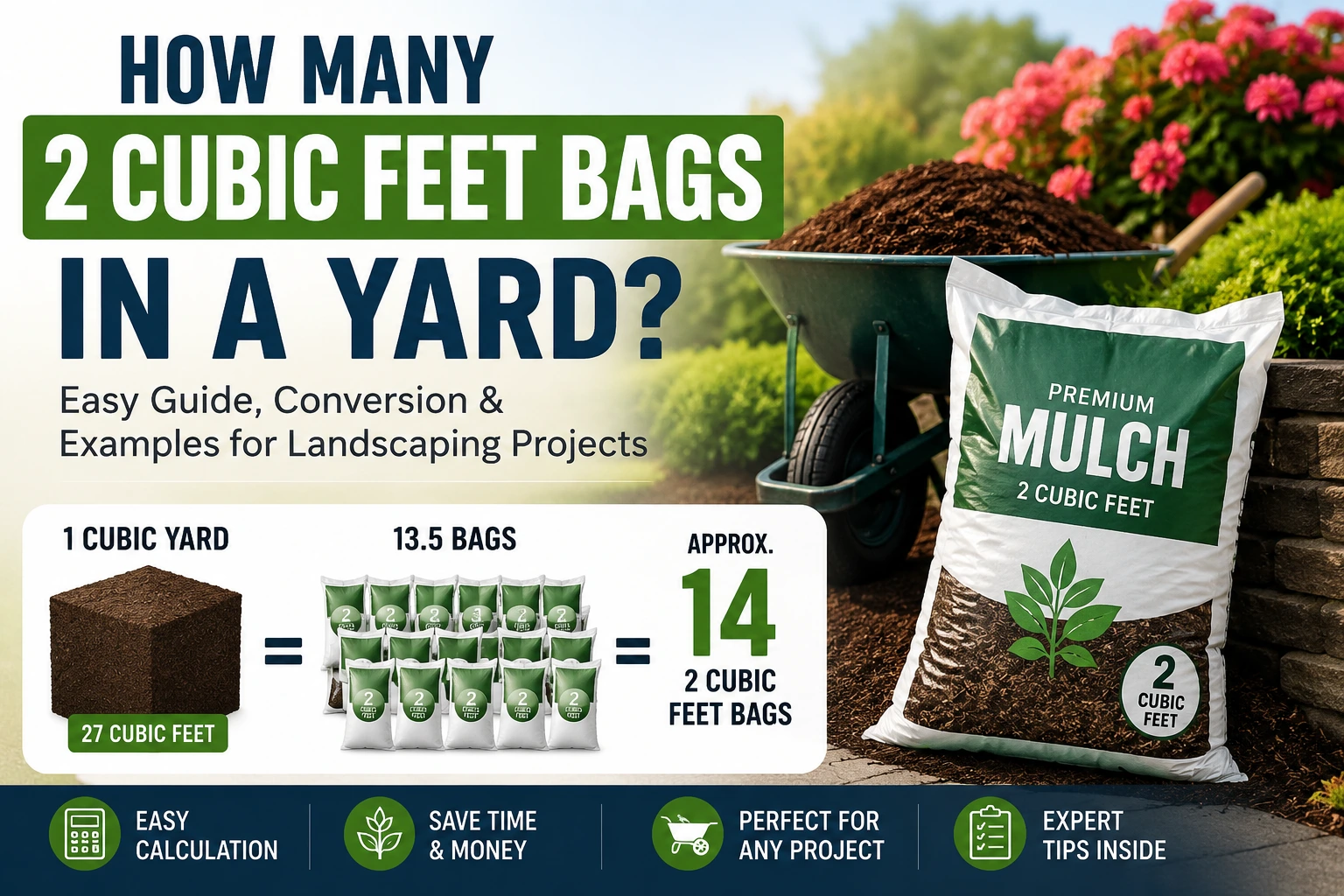
A cubic yard contains 27 cubic feet.
Since each bag contains 2 cubic feet, divide:
27 ÷ 2 = 13.5 bags
Answer:
You need approximately 14 bags of 2 cubic feet material to equal one cubic yard.
Because you can’t purchase half a bag in most cases, it’s best to round up.
| Cubic Yard | Cubic Feet | 2 Cubic Foot Bags |
|---|---|---|
| 1 Yard | 27 cu ft | 13.5 (14 bags) |
| 2 Yards | 54 cu ft | 27 bags |
| 3 Yards | 81 cu ft | 40.5 (41 bags) |
| 4 Yards | 108 cu ft | 54 bags |
Understanding Cubic Feet and Cubic Yards
Before calculating how many 2 cubic feet bags in a yard, it’s helpful to understand these measurements.
A cubic foot measures volume. Imagine a box that is:
- 1 foot long
- 1 foot wide
- 1 foot high
That box contains one cubic foot.
A cubic yard is much larger.
A cube measuring:
- 3 feet long
- 3 feet wide
- 3 feet high
contains:
3 × 3 × 3 = 27 cubic feet
That’s why one cubic yard always equals 27 cubic feet.
Why One Cubic Yard Equals 27 Cubic Feet
Volume calculations are based on three dimensions.
The formula is:
Length × Width × Height
Since one yard equals three feet:
3 × 3 × 3 = 27 cubic feet
This conversion never changes regardless of the material.
Whether you’re buying:
- Mulch
- Compost
- Topsoil
- Sand
- Decorative rock
- Gravel
one cubic yard is always 27 cubic feet.
How Many 2 Cubic Feet Bags in a Yard?
Here’s the simple formula.
Number of bags = Cubic yards × 27 ÷ Bag size
For 2 cubic foot bags:
1 × 27 ÷ 2 = 13.5
Since stores don’t usually sell half bags, purchase 14 bags.
Formula
Bags Needed = Cubic Yards × 13.5
Or simply multiply your number of cubic yards by 13.5.
Conversion Chart
This chart makes planning much easier.
| Cubic Yards | Cubic Feet | 2 Cubic Foot Bags |
|---|---|---|
| 0.25 | 6.75 | 4 |
| 0.50 | 13.5 | 7 |
| 0.75 | 20.25 | 11 |
| 1 | 27 | 14 |
| 1.5 | 40.5 | 21 |
| 2 | 54 | 27 |
| 2.5 | 67.5 | 34 |
| 3 | 81 | 41 |
| 4 | 108 | 54 |
| 5 | 135 | 68 |
Always round up when your calculation includes a fraction.
Examples for Common Landscaping Projects
Real-world examples make the calculation much easier to understand.
Example 1: Mulching a Flower Bed
Suppose your landscape design requires one cubic yard of mulch.
Each bag contains two cubic feet.
Calculation:
27 ÷ 2 = 13.5
Purchase:
14 bags
This ensures complete coverage with a small amount left over for touch-ups.
Example 2: Filling Raised Garden Beds
Your raised garden beds require two cubic yards of garden soil.
Calculation:
2 × 27 = 54 cubic feet
54 ÷ 2 = 27 bags
You’ll need:
27 bags
Example 3: Topsoil for Lawn Repair
A lawn renovation project requires 1.5 cubic yards of topsoil.
Calculation:
1.5 × 27 = 40.5 cubic feet
40.5 ÷ 2 = 20.25
Round up.
Purchase:
21 bags
Bagged Material vs Bulk Delivery
Many homeowners wonder whether buying bags or ordering bulk material is the better option.
| Bagged Material | Bulk Material |
|---|---|
| Easy to transport | Delivered directly |
| Cleaner storage | Lower cost per cubic yard |
| Great for small jobs | Best for large landscaping projects |
| Less waste for tiny areas | Requires delivery space |
| Easy to calculate | Usually sold by the yard |
Choose Bagged Material If:
- You’re covering a small flower bed.
- You have limited storage.
- You only need a few bags.
- You don’t own a truck.
Choose Bulk Material If:
- You need several cubic yards.
- You’re landscaping a large property.
- You want lower cost per cubic yard.
- You have space for delivery.
For projects requiring more than two cubic yards, bulk delivery is often the more economical option.
How to Calculate Bags for Your Project
Follow these four simple steps.
Step 1: Measure Length
Measure the area in feet.
Example:
20 feet
Step 2: Measure Width
Example:
10 feet
Step 3: Measure Depth
Convert depth into feet.
Examples:
- 2 inches = 0.17 ft
- 3 inches = 0.25 ft
- 4 inches = 0.33 ft
Step 4: Calculate Volume
Formula:
Length × Width × Depth
Example:
20 × 10 × 0.25
= 50 cubic feet
Now divide by two.
50 ÷ 2
= 25 bags
You’ll need 25 bags of 2 cubic feet material.
Common Materials Sold in 2 Cubic Foot Bags
Many landscaping products are available in this convenient size.
These include:
- Hardwood mulch
- Pine bark mulch
- Compost
- Garden soil
- Raised bed soil
- Topsoil
- Potting mix
- Decorative bark
- Wood chips
Some decorative stones and gravel may also come in 2 cubic foot bags, although weight varies depending on the material.
Common Mistakes to Avoid
Even experienced DIY landscapers can make simple calculation errors.
Forgetting to Round Up
If your answer is 13.5 bags, buy 14.
Running short is far more inconvenient than having a small amount left over.
Confusing Weight with Volume
A two cubic foot bag refers to volume, not weight.
Two bags of equal size can weigh very differently depending on whether they contain mulch, soil, sand, or gravel.
Ignoring Compaction
Some materials settle over time.
Mulch and compost can compress after rain, so buying one extra bag is often a smart idea.
Estimating Instead of Measuring
Guessing dimensions often leads to buying too much or too little.
Always measure your project carefully before shopping.
Expert Tips Before Buying
Professional landscapers recommend a few simple practices to reduce waste and save money.
- Measure your project twice before calculating.
- Round up to the nearest whole bag.
- Compare bag prices with bulk delivery.
- Purchase an extra bag for future touch-ups.
- Check product labels because some brands package slightly different volumes.
- Use online volume calculators for complex landscape shapes.
- Keep unopened bags in a dry place for future projects.
Planning ahead helps avoid delays and unnecessary expenses.
Practical Bag Calculator
Use this quick formula whenever you’re shopping.
Required Bags = (Length × Width × Depth) ÷ 2
Or if you already know cubic yards:
Required Bags = Cubic Yards × 13.5
This simple equation works for nearly every landscaping material sold in two cubic foot bags.
Why Accurate Calculations Matter
Buying the correct amount of material has several benefits.
It helps you:
- Save money
- Reduce waste
- Finish projects in one trip
- Avoid over-ordering
- Improve project planning
- Estimate landscaping costs more accurately
Whether you’re refreshing mulch around trees or filling new garden beds, accurate calculations make every project easier.
### Frequently Asked Questions
How many 2 cubic feet bags are in one cubic yard?
One cubic yard equals 27 cubic feet, so you’ll need 13.5 bags of 2 cubic feet each. Since half bags aren’t usually available, purchase 14 bags.
Is 13.5 bags exactly one cubic yard?
Yes. Mathematically, 13.5 bags × 2 cubic feet = 27 cubic feet, which equals one cubic yard. In practice, round up to 14 bags.
Can I use this calculation for mulch, compost, and soil?
Yes. The conversion is based on volume, so it works for mulch, compost, garden soil, topsoil, bark, and similar landscaping materials.
Is buying bulk cheaper than buying bags?
For larger projects, bulk material is usually more cost-effective. Bagged products are ideal for smaller jobs, while bulk delivery often offers a lower price per cubic yard.
How do I calculate bags for my own project?
Measure the length, width, and depth of the area in feet to find the total cubic feet. Then divide that number by 2 if you’re using 2 cubic foot bags. If you’re working with cubic yards, multiply the number of yards by 13.5.
Conclusion
Knowing how many 2 cubic feet bags in a yard makes landscaping projects much easier to plan. Since one cubic yard contains 27 cubic feet, you’ll need 13.5 bags, or 14 bags when rounded up, to equal one cubic yard.
Whether you’re spreading mulch, adding topsoil, filling raised beds, or applying compost, using the correct conversion helps you purchase the right amount of material, reduce waste, and stay within budget. Measure your project carefully, use the simple formulas provided in this guide, and you’ll be well prepared for a successful gardening or landscaping project.
Discover more