
If you’re planning a landscaping or gardening project, one of the most common questions is how many .5 cubic feet bags in a yard. Whether you’re buying mulch, compost, garden soil, or decorative stone, knowing this conversion helps you purchase the right amount without overspending or making extra trips to the store.
The good news is that the math is simple. One cubic yard contains 27 cubic feet, so converting from cubic yards to 0.5 cubic foot bags only takes a quick calculation.
In this guide, you’ll learn the exact answer, see helpful conversion tables, understand why the conversion works, and discover practical examples that make estimating landscaping materials much easier.
The Quick Answer
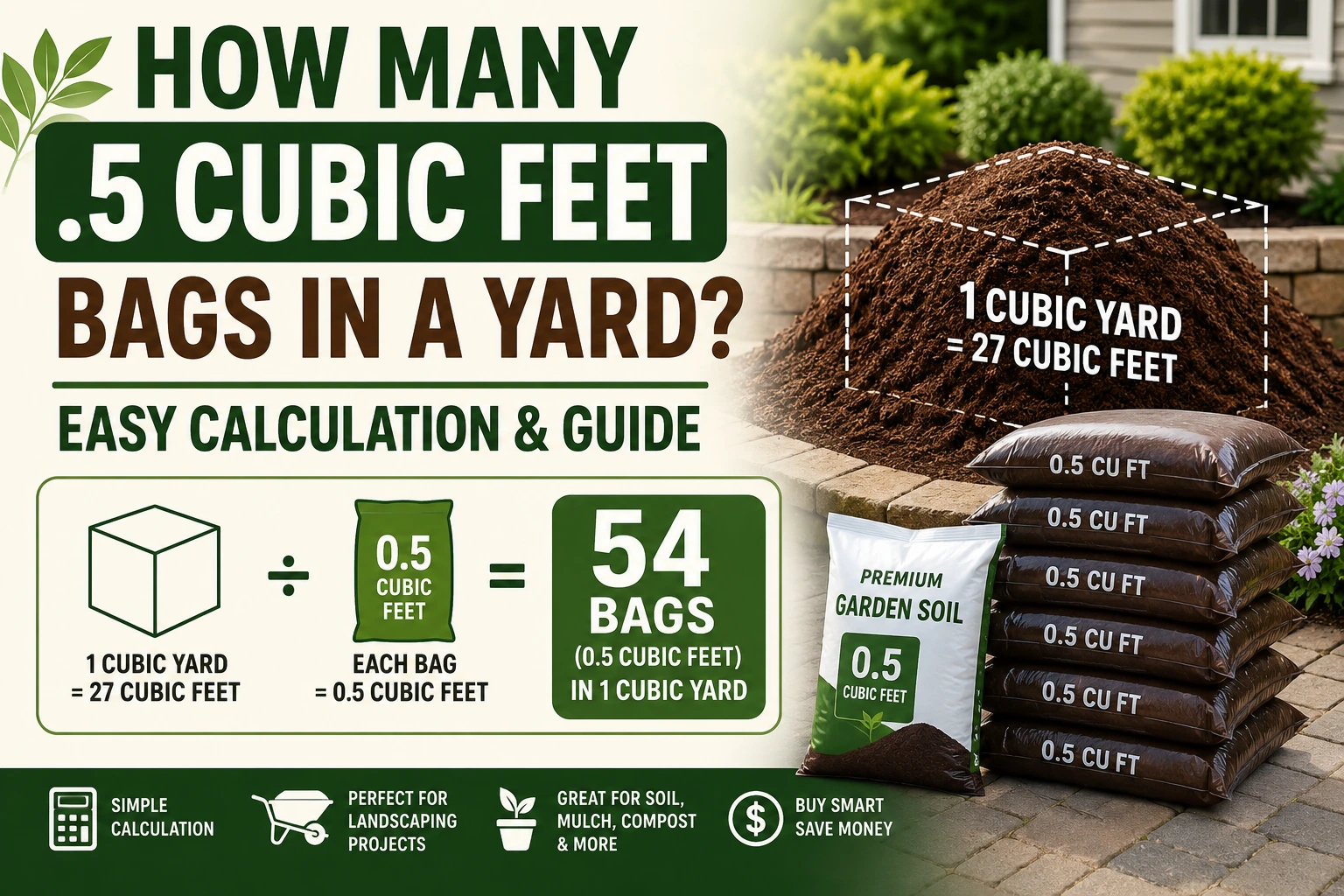
There are 54 bags of 0.5 cubic feet in one cubic yard.
Here’s the calculation:
- 1 cubic yard = 27 cubic feet
- Each bag = 0.5 cubic feet
27 ÷ 0.5 = 54 bags
Quick Reference
| Measurement | Value |
|---|---|
| 1 Cubic Yard | 27 Cubic Feet |
| Bag Size | 0.5 Cubic Feet |
| Bags Needed | 54 Bags |
This conversion works for soil, mulch, compost, sand, gravel, and most landscaping materials sold by volume.
Understanding Cubic Feet and Cubic Yards
Before making calculations, it’s important to understand these two units of measurement.
What Is a Cubic Foot?
A cubic foot measures volume. Imagine a box that is:
- 1 foot wide
- 1 foot long
- 1 foot high
That box contains one cubic foot.
Most bagged landscaping products are labeled in cubic feet.
Examples include:
- Potting soil
- Garden soil
- Compost
- Mulch
- Decorative bark
What Is a Cubic Yard?
A cubic yard is a much larger volume measurement.
One cubic yard measures:
- 3 feet long
- 3 feet wide
- 3 feet high
Since:
3 × 3 × 3 = 27 cubic feet
One cubic yard always equals 27 cubic feet.
How Many .5 Cubic Feet Bags in a Yard?
The answer is straightforward.
The Formula
Use this formula whenever you need to convert bag sizes into cubic yards:
Number of Bags = 27 ÷ Bag Size
For a 0.5 cubic foot bag:
27 ÷ 0.5 = 54 bags
So you’ll need 54 half-cubic-foot bags to equal one cubic yard.
Simple Calculation
Let’s break it down:
- One bag = 0.5 cubic feet
- Two bags = 1 cubic foot
- Fifty-four bags = 27 cubic feet
- 27 cubic feet = 1 cubic yard
This is why 54 bags is always the correct answer.
Conversion Table for Common Bag Sizes
Different landscaping products come in different bag sizes.
| Bag Size | Bags Per Cubic Yard |
|---|---|
| 0.25 cu ft | 108 bags |
| 0.5 cu ft | 54 bags |
| 0.75 cu ft | 36 bags |
| 1 cu ft | 27 bags |
| 1.5 cu ft | 18 bags |
| 2 cu ft | 13.5 bags (round to 14) |
| 3 cu ft | 9 bags |
This table makes shopping much easier when comparing products.
Examples for Different Landscaping Projects
Knowing how many .5 cubic feet bags in a yard becomes especially useful when planning real projects.
Flower Beds
Suppose your flower bed requires one cubic yard of mulch.
Instead of ordering bulk mulch, you decide to purchase bags.
You’ll need:
- 54 bags
- Each bag holds 0.5 cubic feet
This ensures complete coverage.
Raised Garden Beds
Imagine you’re filling several raised beds.
Your total soil requirement equals:
- 2 cubic yards
Calculation:
54 × 2 = 108 bags
Buying in bulk might save money, but bagged soil is easier to transport.
Tree Planting
Adding compost around newly planted trees often requires smaller quantities.
If you only need:
- Half a cubic yard
Calculation:
54 ÷ 2 = 27 bags
Mulching Around the House
Suppose your landscaping design requires:
- 3 cubic yards
Calculation:
54 × 3 = 162 bags
For projects this large, bulk delivery usually becomes the better option.
Why Buying by the Yard Can Save Money
Large landscaping projects often cost less when purchasing bulk materials.
Benefits include:
- Lower price per cubic foot
- Fewer plastic bags
- Less waste
- Faster installation
- Delivery directly to your home
If your project requires more than one cubic yard, comparing bulk pricing is worth considering.
When Bagged Materials Make More Sense
Although bulk purchases are economical, bagged products have several advantages.
Bagged materials are ideal because they:
- Are easy to carry
- Stay clean during storage
- Can be purchased gradually
- Work well for small gardens
- Reduce leftover material
Many homeowners prefer bags for weekend landscaping projects because they’re convenient and easy to handle.
Common Mistakes to Avoid
Many people underestimate or overestimate the amount of material needed.
Avoid these common mistakes.
Forgetting Depth
Always calculate the desired depth before purchasing materials.
For example:
- 2 inches of mulch
- 3 inches of compost
- 6 inches of topsoil
Depth changes the total volume required.
Mixing Weight and Volume
Bag labels often show weight and volume.
Remember:
- Pounds measure weight.
- Cubic feet measure volume.
Always use cubic feet when converting to cubic yards.
Ignoring Waste
Some material is always lost due to:
- Spreading
- Settling
- Uneven ground
Buying an extra 5–10% helps avoid shortages.
Rounding Down
If your calculation equals:
13.2 bags
Buy 14 bags, not 13.
It’s better to have a little extra than to stop your project halfway.
Expert Tips for Accurate Material Estimates
Professionals use a few simple tricks to improve accuracy.
Measure Carefully
Use a tape measure rather than estimating.
Record:
- Length
- Width
- Desired depth
Accurate measurements produce accurate calculations.
Convert Depth to Feet
Remember these conversions.
| Inches | Feet |
|---|---|
| 1 inch | 0.083 ft |
| 2 inches | 0.167 ft |
| 3 inches | 0.25 ft |
| 4 inches | 0.333 ft |
| 6 inches | 0.5 ft |
Buy Slightly More
Most experts recommend purchasing about 10% extra.
Extra material can be stored for:
- Future repairs
- Seasonal touch-ups
- New planting projects
Compare Prices
Sometimes:
- 54 bags cost more than
- One bulk cubic yard delivered
Always compare total costs before purchasing.
How to Calculate Bags for Any Project
You can estimate any project using four easy steps.
Step 1
Measure:
- Length
- Width
- Depth
Step 2
Convert depth into feet.
Example:
3 inches = 0.25 feet
Step 3
Multiply:
Length × Width × Depth
This gives cubic feet.
Step 4
Divide by the bag size.
Example:
Needed:
20 cubic feet
Bag size:
0.5 cubic feet
Calculation:
20 ÷ 0.5 = 40 bags
This same method works for mulch, compost, topsoil, bark, decorative rock, and many other landscaping products.
Frequently Asked Questions
How many .5 cubic feet bags are in one cubic yard?
There are 54 bags of 0.5 cubic feet in one cubic yard because one cubic yard equals 27 cubic feet.
How much area does one .5 cubic foot bag cover?
Coverage depends on depth. At a depth of about 2 inches, one 0.5 cubic foot bag covers roughly 3 square feet.
Should I buy bags or bulk material?
Bagged products are best for small landscaping projects, while bulk materials usually offer better value for larger jobs requiring one cubic yard or more.
Can I mix different bag sizes?
Yes. Simply add the total cubic feet from each bag until you reach the required volume.
Should I buy extra material?
Yes. Purchasing 5–10% extra helps account for settling, uneven spreading, and unexpected needs during installation.
Conclusion
Knowing how many .5 cubic feet bags in a yard makes landscaping, gardening, and home improvement projects much easier to plan. Since one cubic yard equals 27 cubic feet, you’ll need 54 bags of 0.5 cubic feet to match one cubic yard.
Whether you’re spreading mulch, filling raised beds, adding compost, or installing new garden soil, using the correct conversion helps you avoid waste, stay within budget, and finish your project without running short on materials. Keep the simple formula—27 ÷ 0.5 = 54 bags—in mind whenever you’re estimating landscaping supplies, and you’ll be able to shop with confidence and accuracy.
Discover more
how many square feet in pallet of sod