
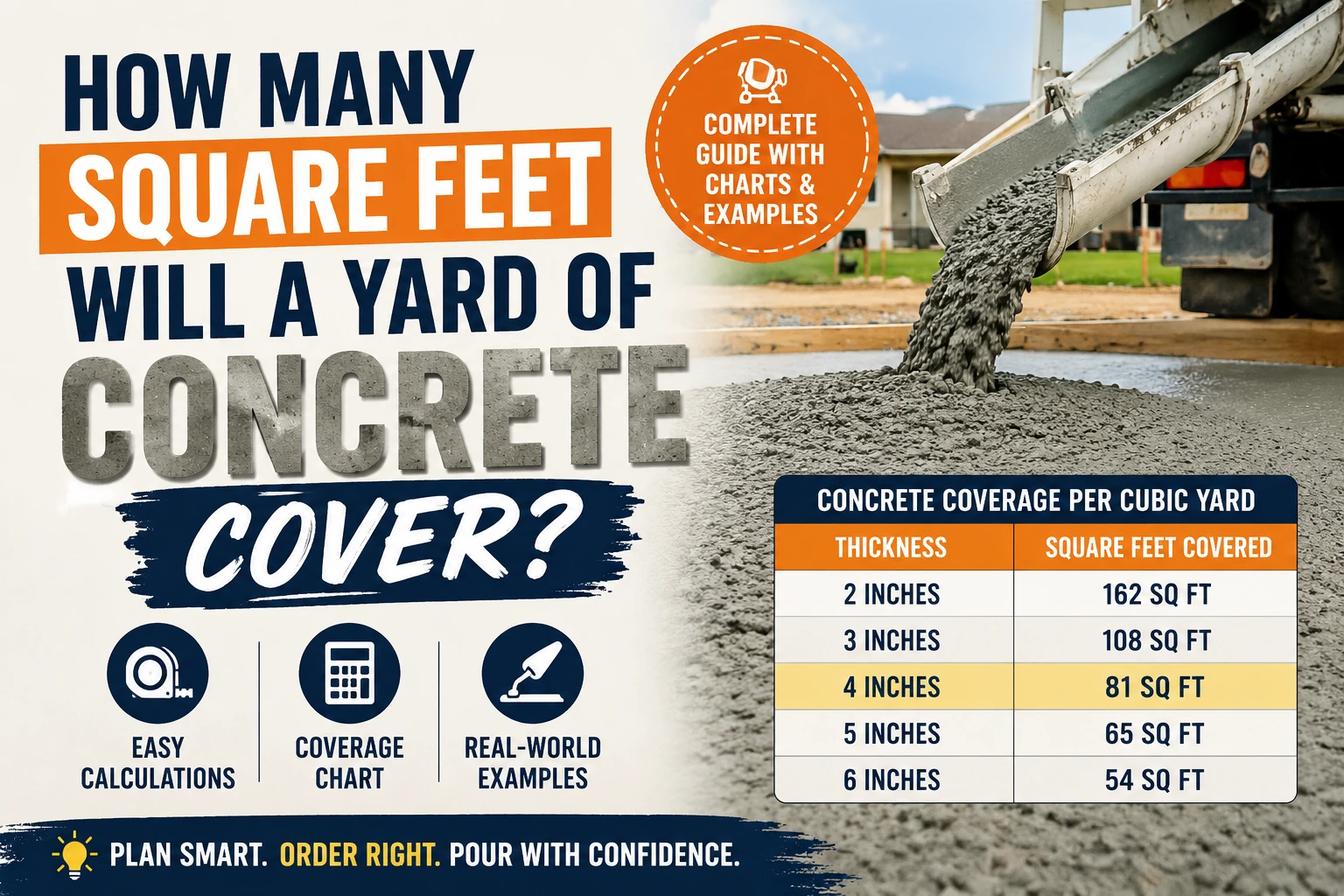
If you’re planning to pour a new driveway, patio, sidewalk, garage floor, or foundation, one of the first questions you’ll ask is how many square feet will a yard of concrete cover. Knowing the answer helps you estimate material costs, reduce waste, and order the right amount of ready-mix concrete.
A yard of concrete refers to one cubic yard, which equals 27 cubic feet of concrete. However, the number of square feet it covers depends entirely on the thickness of the slab. A thinner slab spreads over a larger area, while a thicker slab covers fewer square feet.
For example:
- A 4-inch slab covers about 81 square feet
- A 6-inch slab covers about 54 square feet
- A 2-inch slab covers approximately 162 square feet
In this guide, you’ll learn the exact calculation formula, easy-to-read coverage charts, practical examples, and expert tips to help you estimate concrete accurately for any project.
Understanding What a Yard of Concrete Means
Before calculating coverage, it’s important to understand what a “yard” of concrete actually measures.
Concrete is sold by volume, not by surface area. That means suppliers calculate concrete in cubic yards, while homeowners usually think in square feet.
To estimate correctly, you must convert between area and volume using the slab thickness.
What Is a Cubic Yard?
A cubic yard is a three-dimensional measurement.
One cubic yard equals:
| Measurement | Equivalent |
|---|---|
| Cubic Feet | 27 ft³ |
| Cubic Inches | 46,656 in³ |
| Cubic Yards | 1 yd³ |
Imagine a cube measuring:
- 3 feet long
- 3 feet wide
- 3 feet high
That cube contains exactly one cubic yard of concrete.
Why Thickness Changes Coverage
Many people assume one yard of concrete always covers the same amount of ground.
That’s incorrect.
Coverage depends on how thick the concrete must be.
For example:
| Thickness | Coverage |
|---|---|
| 2 inches | About 162 sq ft |
| 3 inches | About 108 sq ft |
| 4 inches | About 81 sq ft |
| 5 inches | About 65 sq ft |
| 6 inches | About 54 sq ft |
As the slab becomes thicker, each cubic yard is spread over a smaller surface area.
This is why contractors always ask for the planned slab thickness before providing an estimate.
How Many Square Feet Will a Yard of Concrete Cover?
The simplest answer is:
One cubic yard of concrete covers approximately 81 square feet at a thickness of 4 inches.
However, that’s only one scenario.
Here are the most common coverage amounts:
| Slab Thickness | Coverage Per Cubic Yard |
|---|---|
| 2 inches | 162 sq ft |
| 3 inches | 108 sq ft |
| 4 inches | 81 sq ft |
| 5 inches | 65 sq ft |
| 6 inches | 54 sq ft |
| 8 inches | 40.5 sq ft |
| 12 inches | 27 sq ft |
These figures are rounded and commonly used by contractors for quick estimates.
Concrete Coverage Formula
Instead of memorizing every number, you can calculate coverage using a simple formula.
Square Feet Covered = 324 ÷ Thickness (in inches)
Why 324?
One cubic yard contains 27 cubic feet, and each cubic foot contains 12 inches of depth.
So:
27 × 12 = 324
Using this formula:
- 324 ÷ 4 = 81 sq ft
- 324 ÷ 6 = 54 sq ft
- 324 ÷ 3 = 108 sq ft
This quick equation works for nearly every residential concrete project and makes estimating much easier.
Quick Concrete Coverage Chart
Use this chart whenever you’re estimating a project.
| Concrete Thickness | Square Feet Covered by 1 Yard |
|---|---|
| 2 inches | 162 |
| 2.5 inches | 130 |
| 3 inches | 108 |
| 3.5 inches | 93 |
| 4 inches | 81 |
| 4.5 inches | 72 |
| 5 inches | 65 |
| 5.5 inches | 59 |
| 6 inches | 54 |
Keep in mind that these values assume a perfectly level surface. If your site has uneven ground or requires extra concrete for footings, you’ll need to order additional material.
Coverage at 2 Inches
A 2-inch slab is generally used for decorative overlays, resurfacing projects, or light-duty applications.
One cubic yard covers approximately:
162 square feet
Typical uses include:
- Decorative concrete overlays
- Garden pathways
- Small landscaping features
- Surface repairs
Because a 2-inch slab is relatively thin, it is not recommended for driveways or areas that support vehicle traffic.
Coverage at 3 Inches
At 3 inches thick, one cubic yard covers approximately:
108 square feet
A 3-inch slab is commonly used for:
- Garden sheds
- Backyard patios
- Walkways
- Outdoor seating areas
It provides more strength than a 2-inch slab while still maximizing coverage.
Coverage at 4 Inches
A 4-inch concrete slab is the standard thickness for many residential projects. If you’re wondering how many square feet will a yard of concrete cover, this is the thickness most homeowners and contractors use as a reference.
One cubic yard of concrete covers approximately 81 square feet at a thickness of 4 inches.
A 4-inch slab provides an excellent balance between strength and material cost. It is suitable for areas that experience regular foot traffic and light vehicle use.
Common applications include:
- Residential patios
- Sidewalks
- Garage floors (for light vehicles)
- Concrete floors for sheds
- Small driveways
If you’re installing reinforcement such as welded wire mesh or rebar, a 4-inch slab becomes even more durable and resistant to cracking.
Coverage at 5 Inches
A 5-inch slab offers greater durability for heavier loads while reducing the total area covered by one cubic yard.
One cubic yard covers approximately 65 square feet at 5 inches thick.
This thickness is commonly recommended for:
- Heavy-duty patios
- RV parking pads
- Workshop floors
- Commercial sidewalks
- Driveways used by larger vehicles
Although you’ll need more concrete, the added thickness improves strength and extends the lifespan of the slab.
Coverage at 6 Inches
For projects requiring maximum strength, a 6-inch slab is often the preferred choice.
At this thickness:
One cubic yard covers approximately 54 square feet.
A 6-inch slab is commonly used for:
- Commercial floors
- Industrial buildings
- Warehouse slabs
- Heavy equipment storage
- Large driveways
While the coverage area is significantly smaller than thinner slabs, the increased structural integrity makes it ideal for demanding applications.
Concrete Coverage Chart by Thickness
The following chart provides a quick reference for estimating the coverage of one cubic yard of concrete at various slab thicknesses.
| Slab Thickness | Coverage (Square Feet) | Typical Use |
|---|---|---|
| 2 inches | 162 | Decorative overlay |
| 3 inches | 108 | Walkways, patios |
| 4 inches | 81 | Standard residential slabs |
| 5 inches | 65 | Heavy-duty patios |
| 6 inches | 54 | Driveways, commercial slabs |
| 8 inches | 40.5 | Industrial floors |
| 10 inches | 32 | Heavy foundations |
| 12 inches | 27 | Structural foundations |
Bookmarking or printing this table can save time whenever you estimate a future project.
Examples of Concrete Coverage Calculations
Learning the formula is helpful, but seeing it applied to real-world projects makes estimating much easier.
Patio Example
Suppose you’re building a backyard patio measuring:
- Length: 12 feet
- Width: 15 feet
- Thickness: 4 inches
Step 1: Calculate the area
12 × 15 = 180 square feet
Step 2: Determine coverage
At 4 inches, one yard covers approximately 81 square feet.
180 ÷ 81 = 2.22 cubic yards
Since concrete is typically ordered in quarter-yard or half-yard increments, you should order approximately 2.5 cubic yards. Many contractors also recommend adding an extra 5–10% to account for uneven ground, spillage, or slight variations in depth.
Driveway Example
Imagine a driveway measuring:
- Length: 20 feet
- Width: 18 feet
- Thickness: 6 inches
Area:
20 × 18 = 360 square feet
Coverage at 6 inches:
54 square feet per cubic yard
360 ÷ 54 = 6.67 cubic yards
A practical order would be 7 to 7.5 cubic yards, depending on site conditions and waste allowance.
Walkway Example
Let’s estimate a simple walkway.
Measurements:
- Length: 30 feet
- Width: 4 feet
- Thickness: 4 inches
Area:
30 × 4 = 120 square feet
Coverage:
81 square feet per yard
120 ÷ 81 = 1.48 cubic yards
Ordering 1.75 cubic yards provides enough concrete while allowing a small safety margin.
How to Calculate the Concrete You Need
Estimating concrete doesn’t have to be difficult. By following a simple four-step process, you can determine how many cubic yards to order for almost any slab.
Step 1: Measure the Length
Use a measuring tape to find the total length of the project in feet.
For example:
- Patio: 14 feet
- Driveway: 24 feet
- Sidewalk: 40 feet
Always measure the longest points to ensure accuracy.
Step 2: Measure the Width
Next, measure the width in feet.
Examples:
- Patio: 12 feet
- Walkway: 4 feet
- Garage floor: 20 feet
Multiply the length by the width to calculate the total square footage.
Area = Length × Width
Step 3: Determine the Thickness
Decide how thick your slab should be.
General recommendations include:
| Project | Recommended Thickness |
|---|---|
| Sidewalk | 4 inches |
| Patio | 4 inches |
| Shed base | 4 inches |
| Garage floor | 4–5 inches |
| Driveway | 5–6 inches |
| RV pad | 6 inches |
| Commercial slab | 6–8 inches |
Choosing the correct thickness is essential for both durability and accurate material estimates.
Step 4: Convert to Cubic Yards
Once you know the area and thickness, calculate the required concrete volume.
Formula:
Cubic Yards = (Length × Width × Thickness in Inches) ÷ 324
Example
Length: 15 feet
Width: 20 feet
Thickness: 4 inches
Calculation:
15 × 20 × 4 = 1,200
1,200 ÷ 324 = 3.7 cubic yards
You’ll typically round up and order 4 cubic yards to ensure you have enough concrete.
Why You Should Always Order Extra Concrete
One of the biggest mistakes homeowners make is ordering the exact calculated amount.
In reality, several factors can increase concrete usage:
- Uneven excavation
- Slightly deeper slab sections
- Form movement
- Concrete left inside the truck or wheelbarrow
- Small spills during pouring
Most experienced contractors recommend ordering 5–10% more concrete than the calculated requirement. The additional cost is usually far less than the expense and delay of ordering another delivery if you run short.
Quick Reference Formula Box
For fast estimates, remember these simple formulas:
Square Feet Covered by One Yard
324 ÷ Thickness (in inches)
Concrete Needed in Cubic Yards
(Length × Width × Thickness in Inches) ÷ 324
These two formulas cover the majority of residential concrete estimation needs and can help you plan projects with greater confidence.
Common Projects and Their Concrete Needs
Different projects require different slab thicknesses, reinforcement, and concrete volumes. Understanding these requirements helps you estimate materials more accurately and avoid costly mistakes.
Here’s a quick guide to common residential and commercial concrete projects.
| Project | Typical Thickness | Approximate Coverage Per Cubic Yard |
|---|---|---|
| Sidewalk | 4 inches | 81 sq ft |
| Patio | 4 inches | 81 sq ft |
| Garage Floor | 4–5 inches | 65–81 sq ft |
| Driveway | 5–6 inches | 54–65 sq ft |
| Shed Foundation | 4 inches | 81 sq ft |
| Basketball Court | 4 inches | 81 sq ft |
| RV Pad | 6 inches | 54 sq ft |
| Warehouse Floor | 6–8 inches | 40–54 sq ft |
Choosing the proper slab thickness ensures your concrete can handle the expected weight and traffic over many years.
Factors That Affect Concrete Coverage
Although coverage charts provide excellent estimates, several real-world factors can change the amount of concrete required.
1. Uneven Ground
Excavated areas are rarely perfectly level.
Low spots require additional concrete to achieve a consistent slab thickness.
Always inspect the site before ordering materials.
2. Compacted Base Material
Most concrete slabs are poured over compacted gravel or crushed stone.
If the base isn’t level, concrete thickness may vary, increasing the amount needed.
Proper site preparation improves both coverage accuracy and slab longevity.
3. Waste During Pouring
Even experienced contractors experience some material loss.
Concrete may remain in:
- Wheelbarrows
- Buckets
- Pump hoses
- Mixing equipment
- Truck chutes
A small percentage of waste is completely normal.
4. Reinforcement Requirements
Adding reinforcement such as rebar or wire mesh doesn’t change concrete coverage, but it often requires maintaining a minimum slab thickness throughout the project.
This can slightly increase the overall concrete volume if the original estimate assumed thinner areas.
5. Expansion Joints and Edges
Some slabs include thicker perimeter edges or footings for extra strength.
For example:
- Garage floors
- Foundations
- Structural slabs
These thicker sections require additional concrete beyond the standard surface calculation.
Concrete Coverage Comparison by Thickness
The relationship between slab thickness and coverage is simple.
As thickness increases, coverage decreases.
| Thickness | Coverage | Difference from Previous |
|---|---|---|
| 2 inches | 162 sq ft | — |
| 3 inches | 108 sq ft | -54 sq ft |
| 4 inches | 81 sq ft | -27 sq ft |
| 5 inches | 65 sq ft | -16 sq ft |
| 6 inches | 54 sq ft | -11 sq ft |
| 8 inches | 40.5 sq ft | -13.5 sq ft |
Notice that each additional inch of thickness reduces the area one cubic yard can cover.
This is why using the correct slab depth is essential when estimating concrete.
Common Mistakes When Estimating Concrete
Many homeowners underestimate how much concrete they’ll need. Avoid these common errors to save both time and money.
Forgetting to Convert Inches
One of the most common mistakes is using slab thickness in inches without applying the proper conversion formula.
Always use:
Cubic Yards = (Length × Width × Thickness in Inches) ÷ 324
This formula already accounts for the conversion from inches to cubic yards.
Measuring Incorrectly
Small measurement errors can significantly impact large projects.
Double-check:
- Length
- Width
- Thickness
Measure twice before ordering.
Ordering Exactly the Calculated Amount
Concrete cannot be returned once mixed.
Ordering the exact calculated volume leaves no room for:
- Uneven excavation
- Minor spills
- Slightly thicker sections
Adding 5–10% extra is considered best practice.
Ignoring Slab Thickness Recommendations
Some homeowners choose thinner slabs to save money.
Unfortunately, this often leads to:
- Early cracking
- Surface damage
- Shorter lifespan
- Costly repairs
Following the recommended thickness for your project is usually more economical in the long run.
Not Considering Future Loads
Think about how the slab will be used over time.
For example:
A driveway that currently supports only passenger cars may later need to support:
- Pickup trucks
- Moving vans
- RVs
Planning for future loads helps prevent premature concrete failure.
Expert Tips Before Ordering Ready-Mix Concrete
Professional contractors rely on a few simple practices to improve estimation accuracy.
Measure More Than Once
Even a one-foot measurement error can add or subtract several cubic yards on large slabs.
Take measurements from multiple locations.
Round Up Instead of Down
Concrete suppliers generally sell in quarter-yard or half-yard increments.
If your calculation is:
- 2.1 yards → order 2.5 yards
- 4.8 yards → order 5 yards
Running short during a pour can create visible joints and weaken the finished slab.
Account for Weather
Hot weather can speed up curing, while cold weather may delay finishing.
Although weather doesn’t change the amount of concrete needed, it affects how quickly the crew must work and may influence scheduling.
Prepare the Site Before Delivery
Concrete trucks charge waiting fees if crews aren’t ready.
Before the truck arrives:
- Complete excavation
- Install forms
- Compact the base
- Place reinforcement
- Gather finishing tools
Proper preparation ensures a smooth and efficient pour.
Use an Online Concrete Calculator
For complex shapes, combining manual calculations with an online concrete calculator can improve accuracy.
Many calculators allow you to enter:
- Length
- Width
- Thickness
- Multiple slab sections
This is especially useful for projects with irregular dimensions.
How Much Does One Yard of Concrete Weigh?
Although concrete is purchased by volume, many people also wonder about its weight.
On average:
| Concrete Type | Approximate Weight |
|---|---|
| Standard Concrete | 3,800–4,100 pounds per cubic yard |
| Lightweight Concrete | 2,800–3,000 pounds per cubic yard |
| Heavyweight Concrete | 4,500–5,000+ pounds per cubic yard |
The exact weight depends on the mix design, aggregate type, and moisture content.
Knowing the weight is helpful when planning transportation, crane lifts, or structural support.
Quick Estimation Cheat Sheet
Use this cheat sheet for fast planning.
| If Your Slab Is… | One Yard Covers |
|---|---|
| 2 inches thick | 162 sq ft |
| 3 inches thick | 108 sq ft |
| 4 inches thick | 81 sq ft |
| 5 inches thick | 65 sq ft |
| 6 inches thick | 54 sq ft |
For most residential projects, a 4-inch slab covering approximately 81 square feet per cubic yard remains the standard reference point.
FAQs
How many square feet will a yard of concrete cover at 4 inches thick?
One cubic yard of concrete covers approximately 81 square feet when poured at a thickness of 4 inches. This is the standard thickness for many residential patios, sidewalks, and garage floors.
How do I calculate how many yards of concrete I need?
Use this simple formula:
Cubic Yards = (Length × Width × Thickness in Inches) ÷ 324
For example, if your slab is 20 feet long, 10 feet wide, and 4 inches thick:
20 × 10 × 4 = 800
800 ÷ 324 = 2.47 cubic yards
Most contractors would recommend ordering 2.5 to 2.75 cubic yards to account for waste and uneven ground.
How many square feet does one yard of concrete cover at 6 inches?
A 6-inch-thick slab covers approximately 54 square feet per cubic yard.
This thickness is commonly used for:
- Driveways
- RV pads
- Commercial floors
- Heavy-duty concrete slabs
Should I order extra concrete?
Yes. It’s recommended to order 5% to 10% more concrete than your calculated amount.
Extra concrete helps cover:
- Uneven excavation
- Minor spills
- Variations in slab thickness
- Waste during transportation and pouring
Ordering slightly more is usually much less expensive than scheduling a second delivery because you ran short.
What is the easiest way to estimate concrete coverage?
The quickest method is to remember these two formulas:
Coverage Formula
324 ÷ Thickness (in inches) = Square Feet Covered by One Cubic Yard
Concrete Needed Formula
(Length × Width × Thickness in Inches) ÷ 324 = Cubic Yards Required
These formulas work for most residential and light commercial concrete projects and provide reliable estimates when measurements are accurate.
Conclusion
Understanding how many square feet will a yard of concrete cover is essential for planning any concrete project, whether you’re building a patio, driveway, sidewalk, garage floor, or foundation. Because concrete is sold by cubic yard but installed over square feet, knowing how slab thickness affects coverage helps you avoid ordering too much—or too little.
As a quick reference:
- 2-inch slab: about 162 square feet
- 3-inch slab: about 108 square feet
- 4-inch slab: about 81 square feet
- 5-inch slab: about 65 square feet
- 6-inch slab: about 54 square feet
By using the simple formula 324 ÷ thickness (in inches), you can quickly determine the coverage of one cubic yard of concrete for nearly any project. Then, calculate the total cubic yards needed using your slab’s length, width, and thickness.
For the most accurate estimate:
- Measure carefully.
- Use the correct slab thickness for your project.
- Round your order up rather than down.
- Add 5–10% extra concrete to account for waste, uneven surfaces, and minor variations during the pour.
With these calculations, coverage charts, and practical examples, you can confidently estimate your concrete needs, reduce material waste, and complete your project efficiently. Whether you’re a DIY homeowner or a professional contractor, knowing how many square feet will a yard of concrete cover will help you save time, money, and unnecessary trips to the concrete supplier.
Discover more