

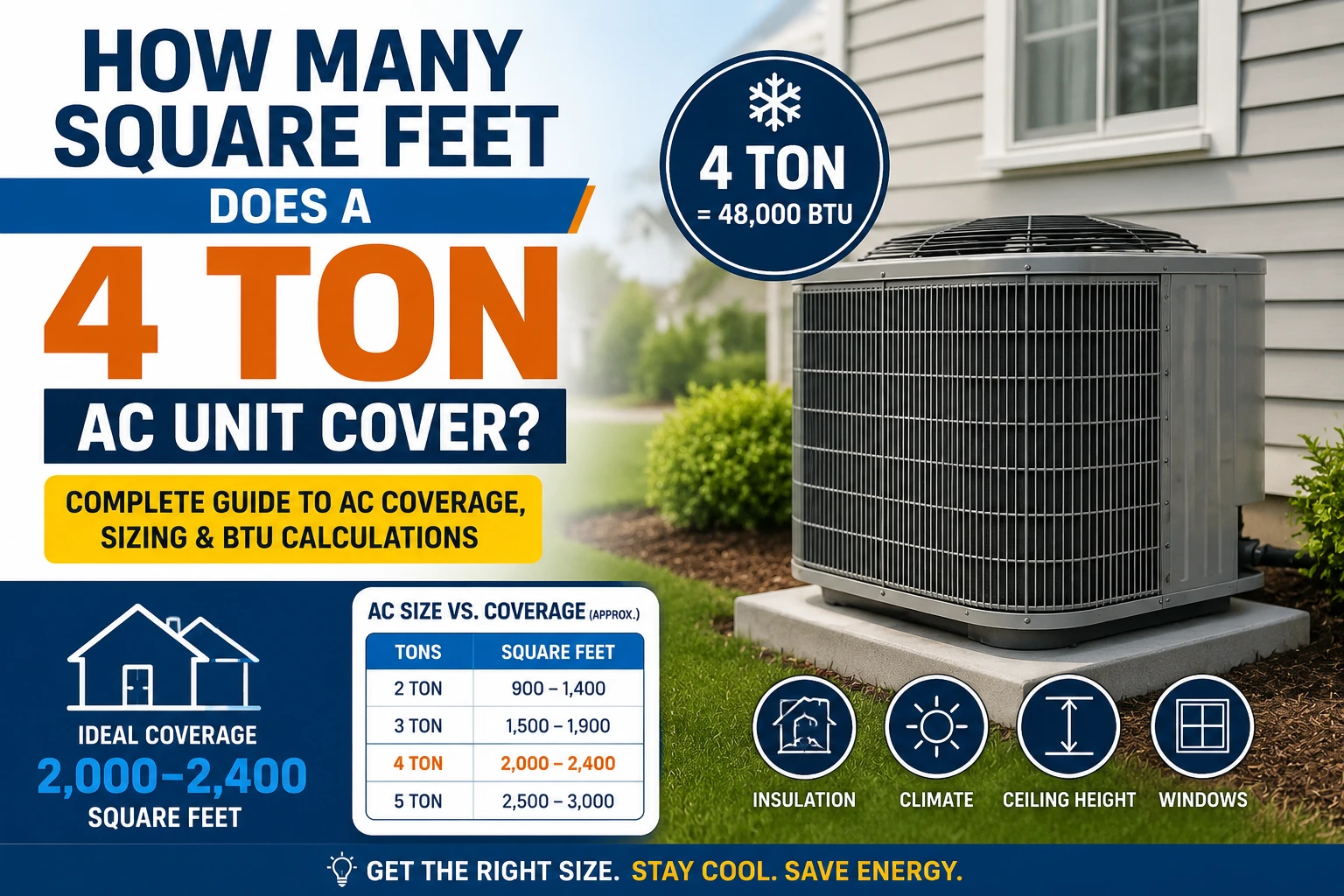
If you’re shopping for a new air conditioning system, one of the most common questions is how many square feet does a 4 ton AC unit cover. Choosing the right AC size is critical because an oversized or undersized system can lead to higher energy bills, uneven temperatures, and reduced comfort.
In general, a 4-ton air conditioner can cool approximately 2,000 to 2,400 square feet under average conditions. However, the actual coverage depends on factors such as climate, insulation, ceiling height, sun exposure, and the overall efficiency of the home.
This guide explains exactly how much area a 4-ton AC can handle, how HVAC sizing works, and how to determine whether a 4-ton unit is the right choice for your property.
Understanding AC Tonnage
Before answering how many square feet does a 4 ton AC unit cover, it helps to understand what “tonnage” means in air conditioning.
What Does a Ton Mean in Air Conditioning?
A ton in HVAC does not refer to the weight of the unit.
Instead, it refers to cooling capacity.
One ton of cooling equals the amount of heat required to melt one ton of ice over a 24-hour period.
In HVAC terms:
| AC Size | BTU Capacity |
|---|---|
| 1 Ton | 12,000 BTUs |
| 2 Ton | 24,000 BTUs |
| 3 Ton | 36,000 BTUs |
| 4 Ton | 48,000 BTUs |
| 5 Ton | 60,000 BTUs |
BTUs and Cooling Capacity
BTU stands for British Thermal Unit.
A 4-ton AC produces approximately:
4×12,000=48,000 BTUs per hour
This cooling capacity allows the unit to remove heat from a large living space efficiently.
How Many Square Feet Does a 4 Ton AC Unit Cover?
The standard industry estimate is that a 4-ton AC unit covers approximately 2,000 to 2,400 square feet.
This estimate assumes:
- Average insulation
- Standard 8-foot ceilings
- Moderate climate conditions
- Typical residential occupancy
- Proper ductwork
Standard Coverage Estimate
| AC Size | Approximate Coverage |
|---|---|
| 1 Ton | 500–700 sq ft |
| 2 Ton | 900–1,400 sq ft |
| 3 Ton | 1,500–1,900 sq ft |
| 4 Ton | 2,000–2,400 sq ft |
| 5 Ton | 2,500–3,000 sq ft |
Many HVAC contractors use a general rule of thumb of 20–25 BTUs per square foot when making initial estimates.
Quick Coverage Chart
| Home Size | Recommended AC Size |
|---|---|
| 1,200 sq ft | 2–2.5 Ton |
| 1,500 sq ft | 2.5–3 Ton |
| 1,800 sq ft | 3 Ton |
| 2,100 sq ft | 3.5–4 Ton |
| 2,400 sq ft | 4 Ton |
| 2,800 sq ft | 4.5–5 Ton |
Remember that these are estimates, not exact sizing recommendations.
Factors That Affect 4 Ton AC Coverage
Although a 4-ton system can cool around 2,000–2,400 square feet, several variables can change the actual coverage.
Climate
Climate is one of the biggest factors.
A 4-ton unit may cool:
- More space in cooler regions
- Less space in hot southern climates
For example:
| Climate | Coverage Estimate |
|---|---|
| Mild | 2,300–2,500 sq ft |
| Moderate | 2,000–2,400 sq ft |
| Hot | 1,800–2,200 sq ft |
Insulation
Well-insulated homes retain cooled air more effectively.
Good insulation can:
- Reduce energy use
- Improve comfort
- Increase effective cooling coverage
Poor insulation often requires larger equipment.
Ceiling Height
Most sizing charts assume 8-foot ceilings.
Higher ceilings increase room volume and cooling demands.
A home with 10-foot or 12-foot ceilings may require more cooling than its square footage alone suggests.
Sun Exposure
Homes with large windows and direct sunlight gain more heat throughout the day.
South-facing homes often need additional cooling capacity.
Occupancy
People generate heat.
A home occupied by multiple family members typically requires more cooling than one occupied by a single person.
4 Ton AC Coverage Chart by Home Size
The table below shows how a 4-ton AC unit may perform in various home sizes.
| Home Size | 4 Ton AC Suitability |
|---|---|
| 1,600 sq ft | Likely oversized |
| 1,800 sq ft | Slightly oversized |
| 2,000 sq ft | Good fit |
| 2,200 sq ft | Excellent fit |
| 2,400 sq ft | Good fit |
| 2,600 sq ft | May work with good insulation |
| 2,800 sq ft | Often undersized |
| 3,000 sq ft | Usually too small |
These estimates vary depending on local conditions.
Is a 4 Ton AC Right for Your Home?
Small Homes
For homes under 1,800 square feet, a 4-ton unit may be too large.
Oversized systems can:
- Cycle on and off frequently
- Waste energy
- Create humidity problems
- Reduce equipment lifespan
Medium Homes
A 4-ton AC is often ideal for homes between 2,000 and 2,400 square feet.
This range aligns closely with typical HVAC sizing recommendations.
Large Homes
For homes larger than 2,600 square feet, a 4-ton unit may struggle in hot climates.
Additional cooling capacity may be necessary.
Benefits of a Properly Sized 4 Ton AC
Selecting the correct size offers numerous advantages.
Better Comfort
A properly sized system maintains consistent temperatures throughout the home.
Improved Energy Efficiency
Efficient operation reduces monthly utility costs.
Longer Equipment Life
Systems that run correctly experience less wear and tear.
Better Humidity Control
Correct sizing helps remove excess moisture from indoor air.
Lower Maintenance Costs
Balanced operation often results in fewer repairs.
Problems With an Oversized or Undersized Unit
Many homeowners focus only on square footage and overlook other sizing factors.
Oversized AC Problems
An oversized unit may:
- Short cycle frequently
- Consume more electricity
- Wear out components faster
- Leave rooms humid
Undersized AC Problems
An undersized system may:
- Run continuously
- Increase energy bills
- Struggle during hot weather
- Fail to reach desired temperatures
Proper sizing avoids both issues.
How HVAC Professionals Calculate AC Size
Professional HVAC contractors use detailed methods rather than simple square footage estimates.
Manual J Load Calculation
The industry standard is called a Manual J calculation.
It evaluates:
- Square footage
- Ceiling height
- Window area
- Insulation levels
- Local climate
- Home orientation
- Air leakage
This process produces a precise cooling requirement.
BTU Formula
A simplified formula often used for rough estimates is:
Required BTUs=Square Feet×20 to 25
For a 2,200-square-foot home:
2200×22≈48,400 BTUs
This closely matches the output of a 4-ton AC unit.
Real-World Examples
Example 1: Modern 2,100-Square-Foot Home
Features:
- Energy-efficient windows
- Good insulation
- Moderate climate
Result:
A 4-ton AC is likely an excellent choice.
Example 2: Older 2,300-Square-Foot Home
Features:
- Older windows
- Limited insulation
- Hot climate
Result:
A 4-ton unit may be borderline and require professional evaluation.
Example 3: New 2,500-Square-Foot Home
Features:
- High-efficiency construction
- Advanced insulation
- Sealed ductwork
Result:
A 4-ton AC may still perform effectively despite the larger square footage.
Common Mistakes When Choosing AC Size
Avoid these common sizing errors.
Relying Only on Square Footage
Square footage is helpful but not sufficient.
Ignoring Climate Conditions
Regional weather significantly impacts cooling requirements.
Choosing the Largest Unit Available
Bigger is not always better.
Oversized units often create comfort problems.
Skipping Professional Evaluation
A Manual J calculation provides far greater accuracy than online estimates.
Expert Tips Before Buying a 4 Ton AC
Evaluate Insulation First
Improving insulation may reduce cooling requirements.
Check Ductwork Condition
Leaky ducts can reduce system performance dramatically.
Consider Energy Efficiency Ratings
Look for:
- High SEER ratings
- ENERGY STAR certifications
- Variable-speed systems
Get Multiple HVAC Quotes
Comparing recommendations can help ensure proper sizing.
Think Long-Term
Energy-efficient equipment may cost more upfront but save money over time.
Frequently Asked Questions
How many square feet does a 4 ton AC unit cover on average?
Most 4-ton AC systems effectively cool between 2,000 and 2,400 square feet under average residential conditions.
Is a 4 ton AC enough for a 2,500-square-foot house?
Possibly. If the home has excellent insulation and energy-efficient construction, a 4-ton system may be sufficient.
How many BTUs does a 4 ton AC produce?
A 4-ton air conditioner provides approximately 48,000 BTUs per hour of cooling capacity.
Can a 4 ton AC be too large for a house?
Yes. In homes under 1,800 square feet, a 4-ton system may be oversized and lead to short cycling and humidity issues.
What is the best way to determine AC size?
A professional Manual J load calculation is the most accurate method for selecting the proper AC size.
10. Conclusion
Understanding how many square feet does a 4 ton AC unit cover is essential when selecting a cooling system for your home. In most situations, a 4-ton air conditioner can effectively cool 2,000 to 2,400 square feet, making it a popular choice for medium-to-large homes.
However, square footage alone should never determine AC size. Climate, insulation quality, ceiling height, sun exposure, and occupancy all play important roles. While general sizing charts provide useful guidance, a professional load calculation remains the best way to ensure maximum comfort, energy efficiency, and long-term performance. By choosing the right-sized system, homeowners can enjoy lower utility bills, improved indoor comfort, and a longer-lasting HVAC investment.
Discover more